How to Rebuild Trust After Emotional Manipulation

How to Rebuild Trust After Emotional Manipulation
Rebuilding trust after emotional manipulation, especially gaslighting, is challenging but possible. Gaslighting can distort your reality, leaving you doubting yourself and others. Here's how you can take steps to heal:
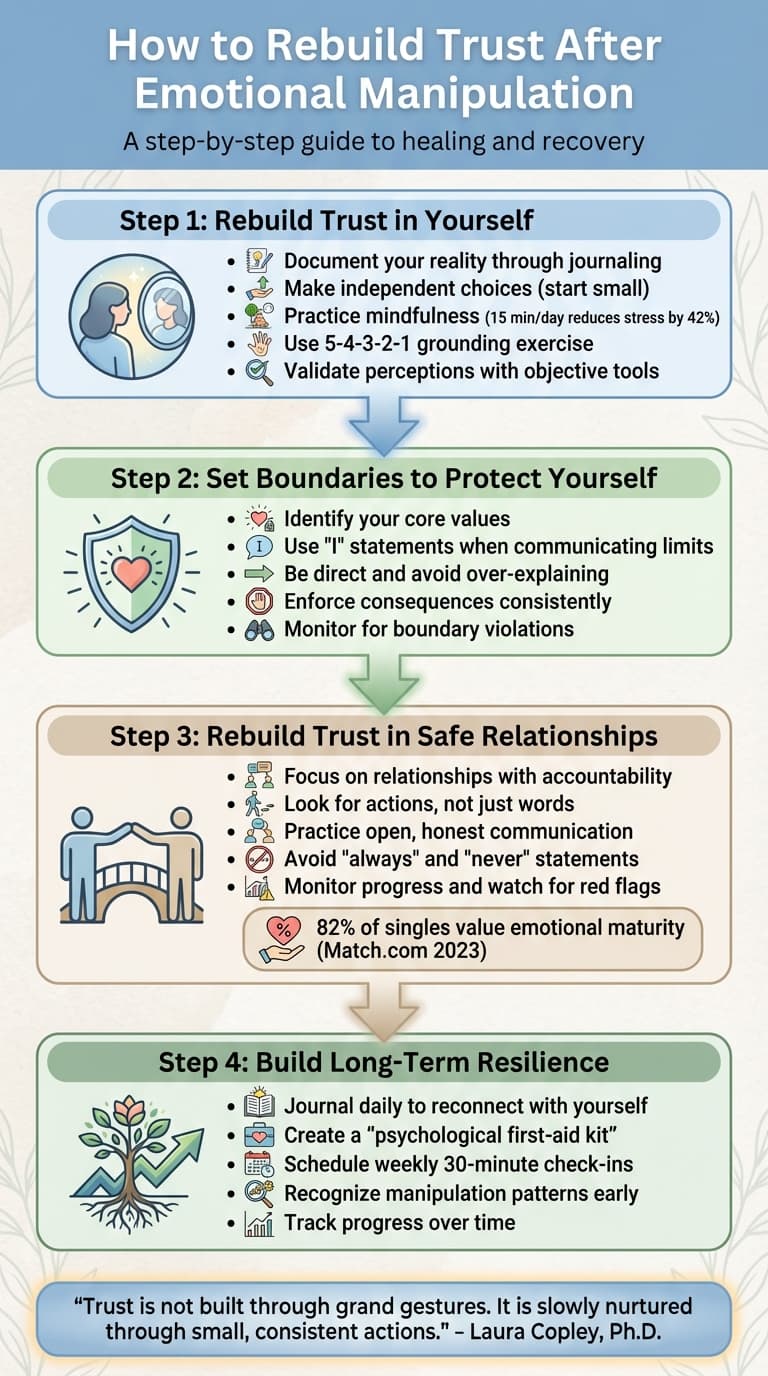
- Reconnect with Yourself: Document your experiences, make independent choices, and practice mindfulness to rebuild self-confidence. Use tools like Gaslighting Check to validate your perceptions.
- Set Boundaries: Clearly define and enforce limits to protect your emotional well-being. Use "I" statements and follow through with consequences when boundaries are crossed.
- Focus on Safe Relationships: Prioritize relationships with accountability and mutual respect. Honest communication and small, consistent actions help rebuild trust.
- Build Long-Term Resilience: Develop daily habits like journaling, mindfulness, and regular check-ins to strengthen your emotional health. Recognize and address manipulation patterns early.
Healing takes time, but with patience and consistent effort, you can restore trust in yourself and others.
::: @figure
Step 1: Rebuild Trust in Yourself
Methods to Restore Self-Trust
Rebuilding self-trust starts with reconnecting to your own judgment - reclaiming that inner compass that gaslighting may have disrupted.
A good first step is to document your reality. Write down key events, your feelings, and observations. Having a record can help you verify facts when self-doubt creeps in. When those negative thoughts arise, try to distance yourself from them mentally. Remind yourself that these critical voices often echo the manipulator, not your true self.
Start small by making independent choices - like deciding what to eat, wear, or which route to take during your day. Simple acts of autonomy can help rebuild confidence. Keep a list of activities that lift your spirits, so you’re prepared for emotional low points.
If you're feeling overwhelmed, try the 5-4-3-2-1 grounding exercise: name five things you see, four things you can touch, three sounds you hear, two things you can smell, and one thing you can taste. This method helps pull you back into the present moment. Interestingly, studies suggest that practicing mindfulness for just 15 minutes a day can reduce stress levels by as much as 42% [3].
Pair these techniques with tools that provide objective validation of your experiences.
Use Technology to Confirm Your Reality
Technology can be a powerful ally in validating your perceptions. For example, Gaslighting Check is a platform designed to analyze conversations and uncover subtle manipulation. It offers tools like text analysis for emails and messages, voice analysis to evaluate tone and speech patterns, and real-time audio recording to create an accurate record of interactions.
You can paste text conversations into Gaslighting Check to detect patterns like blame-shifting, deflection, or projection. This analysis not only helps confirm your instincts but also provides clarity. If something felt "off" during a conversation, the platform can either validate your concerns or reassure you that your worries were unfounded. Either way, it gives you peace of mind.
Your privacy is a top priority - the platform uses end-to-end encryption and automatically deletes analyzed data. By late 2025, Gaslighting Check plans to introduce a feature allowing users to export analysis reports as PDFs. These can be shared with therapists, offering professional validation of your experiences while keeping your data secure.
Step 2: Set Boundaries to Protect Yourself
Why Boundaries Matter in Recovery
Once you've started rebuilding trust in yourself, the next step is setting boundaries to safeguard your progress.
Experiencing emotional manipulation often leaves you feeling unsafe. Boundaries act as a protective shield, giving you the space to heal. Karen Salerno, MSSA, LISW-S from Cleveland Clinic, puts it like this:
Boundaries are the framework we set for ourselves on how we want to be treated by others and how we treat other people [5].
By establishing clear boundaries, you prevent others from taking advantage of you and draw a firm line between your needs and theirs. This process helps you reclaim your sense of self and break free from codependent tendencies [4]. Psychologist Ramone Ford, PhD, highlights the connection between boundaries and trust:
Trust is learned over time and it's based on your faith in the boundaries, limitations and expectations that you set up for each other [6].
How to Set Clear Boundaries
Start by identifying your core values and recognizing behaviors that make you uncomfortable - these will guide where boundaries are needed [5]. When communicating your limits, use "I" statements to focus on your feelings. For instance, say, "I feel overwhelmed when you call during work hours", instead of, "You always interrupt me" [4] [8].
Be direct and avoid over-explaining. A clear statement like, "Please do not call me during work hours", sets expectations without unnecessary detail [4]. If setting boundaries feels daunting, begin with small steps to build your confidence [5].
It's equally important to enforce consequences. For example, you could say, "If you raise your voice, I will end this conversation" [4]. As Salerno points out:
If you don't act on them, it may make it harder for other people to trust your boundary setting [5].
Remember, boundaries are about protecting yourself - not controlling others' behavior [7].
Here are a few examples of how to strengthen weak boundaries:
| Initial Boundary (Weak) | New Boundary (Protective) |
|---|---|
| Allowing a friend to vent daily regardless of your mental state | Limiting how often or how long you discuss stressful topics [4] |
| Helping family members pay bills even when it strains your finances | Setting stricter financial boundaries to prioritize your well-being [4] |
| Tolerating a partner's lies to avoid conflict | Letting them know you’ll step back if the lying continues [4] |
Once your boundaries are in place, you'll need tools to ensure they’re respected.
Use Gaslighting Check to Protect Your Boundaries

Just as you validated your experiences in Step 1, you can use Gaslighting Check to confirm whether others are honoring your boundaries.
Manipulators often use tactics like guilt-tripping, deflecting, or outright denial to undermine your limits. Gaslighting Check helps you identify these behaviors by analyzing conversations for patterns like blame-shifting, deflection, or DARVO (Deny, Attack, Reverse Victim and Offender).
With features like real-time voice analysis or text conversation reviews, you can spot subtle manipulation, such as passive-aggressive comments masked as humor [9]. This validation reinforces your instincts, making it easier to stand firm when someone tries to convince you, "That never happened", or, "You're overreacting." Detailed reports provide clear evidence of manipulation, giving you the confidence to maintain your boundaries.
For added support, the Premium Plan (USD $9.99/month) offers conversation history tracking. This feature helps you review patterns over time to see if someone repeatedly crosses your limits. Such documentation can strengthen your resolve and help you decide whether a relationship is worth continuing.
Step 3: Rebuild Trust in Safe Relationships
Focus on Trustworthy Relationships
Once you've strengthened your self-trust and established clear boundaries, it's time to focus on relationships where trust can genuinely be repaired. This means engaging only with people who show accountability and a willingness to change. As relationship coach Julie Nguyen puts it:
A toxic relationship can change if and only if both partners are equally committed to overcoming it with lots of open communication, honesty, self-reflection, and possibly professional help [12].
Accountability is key. Look for actions, not just words - like sincere apologies that include remorse, acknowledgment of your feelings, and noticeable behavior changes. Be cautious of manipulative tactics like hoovering, which might appear as an attempt to reconcile but often mask deeper issues. If you still feel like you're walking on eggshells or find yourself overly alert to potential conflict, it might be a sign that the relationship isn't ready for repair. A safe relationship allows you to express your fears and vulnerabilities without the fear of them being used against you.
Once you've identified a safe space for rebuilding trust, honest communication becomes the next step.
Practice Open and Honest Communication
When you're confident the relationship is on stable ground, clear and open communication is essential to rebuilding trust. Both parties need to discuss past issues, express their feelings, and outline what they need to move forward.
Steer clear of sweeping statements like "always" or "never", and instead focus on specific actions or events. Regular, open conversations can help strengthen the bond, address any lingering challenges, and show mutual appreciation. If direct discussions feel overwhelming, consider writing reflective letters to share your thoughts, even the difficult ones. Psychologist Ramone Ford, PhD, highlights the importance of authenticity in these moments:
If you're not being authentic or saying what you need in a relationship out of fear or mistrust, you could end up internalizing those feelings and worsen the situation [15].
Interestingly, emotional maturity is becoming a top priority in relationships. A 2023 study by Match.com found that 82% of singles value emotional maturity in a partner [14].
Keeping an eye on how your communication evolves can help solidify these efforts.
Monitor Progress and Watch for Red Flags
Positive, consistent interactions are a strong indicator of progress in rebuilding trust. Over time, these actions should reinforce the sense of safety and mutual respect within the relationship. Tools like Gaslighting Check can help you assess whether your conversations are staying on a healthy track. If discussions start slipping back into patterns of blame, criticism, or manipulation, it’s a warning sign that unhealthy dynamics may be resurfacing [12].
For those using the Premium Plan (USD $9.99/month), features like conversation history tracking can provide a detailed overview of how your interactions evolve over weeks or months. These insights, combined with professional guidance, can support your journey toward rebuilding trust and maintaining healthier relationships.
Detect Manipulation in Conversations
Use AI-powered tools to analyze text and audio for gaslighting and manipulation patterns. Gain clarity, actionable insights, and support to navigate challenging relationships.
Start Analyzing NowStep 4: Build Long-Term Resilience
Daily Habits to Build Resilience
Rebuilding trust isn’t something you can fix overnight - it’s a process that requires consistent effort and daily habits to strengthen your emotional foundation. If manipulation has shaken your sense of self, try journaling every day to reconnect with who you are [10]. Pair this with positive affirmations and mindfulness exercises to rebuild your confidence. Creating a personal "psychological first-aid kit" can also be a game-changer. Include activities that help you recharge when you feel triggered, like deep breathing, taking a short walk, meditating, or calling a trusted friend [2] [10]. Psychologist Ramone Ford, PhD, emphasizes the importance of self-care:
You have to develop some self-care regimen where you can pour into yourself because you can't pour from an empty cup or really give a whole lot if you're not taking care of yourself [2].
For relationships where trust is being rebuilt, consider scheduling weekly 30-minute check-ins. Use these sessions to express appreciation, coordinate household tasks, plan quality time, and address any issues [11]. Resilience grows through small, consistent actions - like honoring commitments, respecting boundaries, and showing up when it matters [13].
By incorporating these practices into your daily routine, you’ll be better prepared to recognize and respond to manipulation whenever it arises.
Spot and Avoid Manipulation Patterns
Recognizing manipulation early on can prevent you from falling into harmful cycles. Be on the lookout for tactics like love bombing, where someone uses excessive flattery or extravagant gestures to create emotional dependence [1] [16]. Other red flags include negging (masked insults disguised as jokes), intellectual bullying (using overly complex language to make you feel inadequate), and the "martyr" act (offering help but constantly complaining about the burden) [1] [16].
Pay attention to how you feel. If you’re always walking on eggshells, apologizing excessively, or questioning your memory and emotions, these could be signs of manipulation [1] [17]. Clinical psychologist Carla Marie Manly, PhD, advises:
Trust your gut when you feel manipulated, and then write about the experience in a journal. Journaling is a terrific way to gain objectivity [1].
After a week or two of journaling, you might start noticing patterns that expose manipulative behaviors.
Maintaining strong connections with friends, family, or a therapist can act as "reality anchors." These relationships validate your perceptions and help you avoid isolation [3] [17]. If you do encounter manipulation, address it head-on. Trauma-informed therapist Amelia Kelley, PhD, suggests:
The most effective way to stop gaslighting is with a clear and decisive response to it [3].
These reminders reinforce the importance of leaning on your resilience-building habits.
Use Gaslighting Check for Continued Growth
To keep strengthening your resilience, it’s helpful to track your progress over time. Tools like Gaslighting Check provide data-driven insights to help you monitor your interactions and spot subtle manipulation tactics that might otherwise slip by. For $9.99 a month, premium users can review conversation histories spanning weeks or months. This documented record offers a clearer perspective, helping you identify patterns and maintain a sense of reality during gaslighting attempts.
Detailed reports and actionable insights from tools like this can enhance your weekly check-ins, giving you concrete data to assess whether your communication is improving. When combined with professional support and your daily resilience habits, these resources can help you stay on track, fostering healthier communication and emotional well-being. By blending these practices with careful monitoring, you can continue rebuilding trust and protecting your emotional health.
How To Find Your Self-Trust After Being Gaslighted
Conclusion
Recovering from emotional manipulation is a journey that requires patience, persistence, and self-compassion. By following these steps, you can gradually rebuild trust and strengthen your emotional resilience. Start by reconnecting with yourself through practices like journaling and mindfulness. Establish firm boundaries and communicate honestly to rebuild intimacy and trust in your relationships.
As resilience develops, it's the small, consistent actions that make the difference. Laura Copley, Ph.D., emphasizes this beautifully:
Trust is not built through grand gestures. It is slowly nurtured through small, consistent actions demonstrating ability, integrity, and benevolence. [18]
Simple practices - like scheduling a 30-minute weekly check-in, repeating daily affirmations, or being present when it counts - can create a foundation for healing over time.
To support your progress, tools like Gaslighting Check can be incredibly helpful. This app allows you to document conversations, identify patterns of manipulation, and monitor your growth. For $9.99/month, the premium plan provides access to detailed reports and history tracking, which can complement therapy and self-care routines by reinforcing your confidence and sense of reality.
Healing is not a quick fix - it can take months or even years. But every small victory matters. Lean on your support system, celebrate progress, and give yourself grace. You're not just recovering; you're creating a stronger, more empowered version of yourself - step by step, day by day.
FAQs
How can I use Gaslighting Check to confirm if I’m experiencing emotional manipulation?
To determine if emotional manipulation is at play, start by recording or uploading the conversation in real time using Gaslighting Check. This tool provides a secure, timestamped log of your exchanges, ensuring your privacy with encrypted data that automatically deletes after a set period.
Then, take advantage of the text and voice analysis features to spot possible manipulation tactics, like denial or shifting blame. The platform creates a detailed report that highlights patterns and recurring themes, making it easier to separate distorted narratives from the truth.
Lastly, review the conversation history to observe behavior changes over time. Pairing these insights with personal reflection or guidance from someone you trust can help you rebuild confidence in your perceptions and work toward healthier relationships.
What are the early warning signs of emotional manipulation?
Emotional manipulation often starts with subtle tactics that might be easy to miss. For instance, it could look like constant criticism or backhanded compliments that leave you second-guessing yourself. Guilt-tripping phrases, like “If you really cared, you’d…”, or extreme shifts between overwhelming affection (love-bombing) and sudden withdrawal are other common signs. Manipulators might also deny or twist your words, dismiss your feelings (“You’re overreacting”), or invalidate your experiences (“You’re being too sensitive”).
You might also notice red flags like efforts to isolate you from friends and family, keeping an overly close watch on your actions, or always shifting blame onto you during disagreements. These patterns can chip away at your confidence and make you doubt your own judgment.
If pinpointing these behaviors feels challenging, tools like Gaslighting Check can analyze conversations to flag manipulation tactics. Spotting these signs early gives you the chance to set boundaries, reach out for support, and protect your emotional health.
How can I tell if it’s safe to rebuild trust in a relationship?
Rebuilding trust begins with creating a sense of safety within the relationship. A reliable partner demonstrates this by consistently keeping their promises, owning up to past mistakes, offering genuine apologies, and actively working to avoid repeating harmful actions. They honor your boundaries, encourage honest communication, and ensure you feel understood without fear of judgment or backlash.
Watch out for warning signs, such as denying past events, dismissing your emotions, or engaging in controlling behaviors like isolating you from others or demanding unquestioned compliance. These behaviors may indicate that the relationship isn’t ready for the hard work of rebuilding trust.
If you’re feeling uncertain, tools like Gaslighting Check can help. By analyzing conversations for manipulative patterns, it can highlight areas of concern. Recognizing consistent accountability and respect can give you the clarity and confidence to decide whether trust can be restored.