Real-Time Emotional Regulation: 7 Key Tools

Real-Time Emotional Regulation: 7 Key Tools
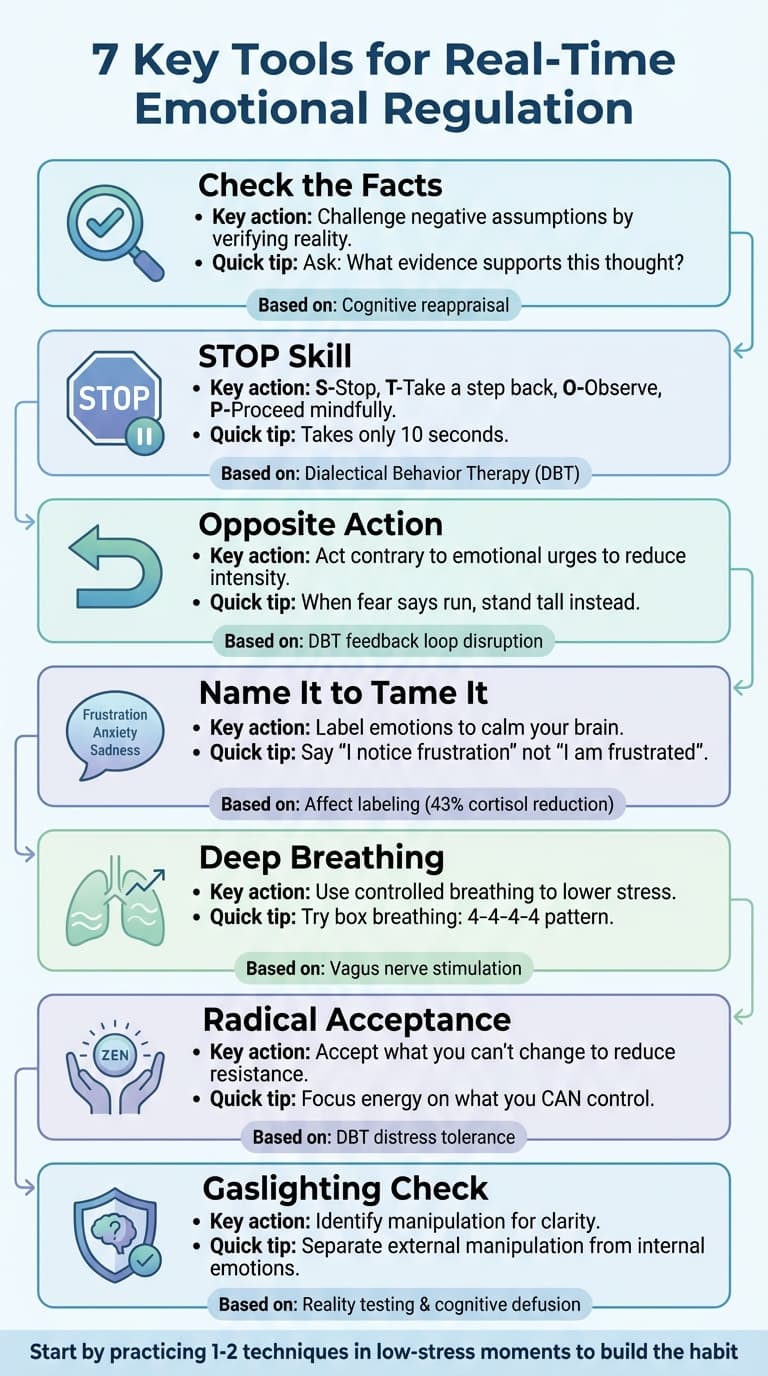
When emotions overwhelm you under pressure, it’s easy to lose control. But managing emotions in real-time is possible with practical tools. This article highlights seven techniques to help you pause, regain clarity, and respond wisely during stressful situations:
- Check the Facts: Challenge negative assumptions by verifying reality.
- STOP Skill: Pause, breathe, observe, and act mindfully.
- Opposite Action: Act contrary to emotional urges to reduce their intensity.
- Name It to Tame It: Label emotions to calm your brain and create distance.
- Deep Breathing: Use controlled breathing to lower stress and regain focus.
- Radical Acceptance: Accept what you can’t change to reduce emotional resistance.
- Gaslighting Check: Identify manipulation in conversations for clarity.
These tools disrupt emotional patterns, calm your nervous system, and improve decision-making. Start small by practicing one or two techniques in low-stress moments to make them second nature.
::: @figure
DBT Skills: Emotion Regulation and Calming Your Emotions
1. Check the Facts
Tool 1 is all about grounding yourself by verifying the facts. When emotions run high, your mind often fills in the blanks with negative assumptions, turning a small issue into a full-blown disaster. The "Check the Facts" approach steps in to challenge whether your thoughts actually reflect reality.
Scientific or psychological basis
This technique is rooted in cognitive reappraisal, which involves reinterpreting a situation to change its emotional impact [6][10]. Neuroscience backs this up - studies show that reappraisal reduces activity in the amygdala, the part of your brain responsible for processing emotions [10]. People who regularly use reappraisal strategies tend to report better overall well-being and fewer signs of depression compared to those who don't [10]. These brain-level changes explain why this technique works so well, especially in stressful situations.
Effectiveness in high-pressure scenarios
In moments of crisis, the mind often defaults to imagining the worst-case scenario. As UCSF Human Resources puts it:
"Be realistic and fact-based. It's easy to think about the worst outcomes, which are catastrophic, but that creates unnecessary stress arousal and suffering" [7].
By aiming for a realistic middle ground - balancing worst-case and best-case possibilities - you can avoid spiraling into panic [7]. This shift in perspective allows for a calmer, more practical response to challenges.
Ease of application in real-time
This tool is easy to use on the spot. Ask yourself straightforward questions like: "What evidence supports this thought?" or "Will this still matter in a week, a month, or a year?" [8]. Another helpful strategy is the "Just Like Me" approach: when you find yourself assigning negative motives to others, add "just like me" to the thought. It’s a reminder that everyone has flaws, helping you see things more objectively [9].
Instead of dwelling on emotionally charged thoughts like "I've failed", try shifting to action-oriented ones like "What can I do next?" [12]. This small adjustment moves you from feeling overwhelmed to focusing on solutions, giving you back a sense of control.
2. STOP Skill
The STOP Skill acts like an emotional emergency brake, giving you a moment to pause and recalibrate. It’s broken down into four steps: S – Stop (pause completely), T – Take a step back (breathe deeply), O – Observe (gather facts about the situation), and P – Proceed mindfully (take intentional action) [13]. The entire process takes about 10 seconds [15], but those few moments can make a world of difference by allowing you to reassess before reacting.
Effectiveness in High-Pressure Scenarios
This skill shines in situations where emotions might otherwise take over - like when you’re tempted to send an angry email, shout during an argument, or storm out of a meeting. Dr. Alicia Smart, Psy.D., from TheraHive, emphasizes its value:
"The STOP skill specifically addresses the need to pause and take control before acting on intense emotions, guiding us to prevent impulsive actions, gain clarity on the situation, and make wise and effective decisions." [16]
Its adaptability makes it a reliable tool for navigating a variety of high-stakes moments. As noted by the Bay Area DBT & Couples Counseling Center, "you know the skill is working if you survived the crisis without doing something (or not doing something) that made things worse." [14]
Scientific or Psychological Basis
The STOP Skill is rooted in Dialectical Behavior Therapy (DBT) and is particularly useful for managing crises that can’t be resolved immediately [14]. According to the Calm Editorial Team, its power lies in its ability to disrupt the stress cycle and provide your body with a chance to reset [15]. The "Take a step back" phase, which incorporates deep breathing, is especially effective for calming the nervous system and easing the fight-or-flight response. This creates a shift - from reacting emotionally to responding thoughtfully - helping you make decisions that align with your long-term goals rather than being driven by fleeting emotions.
Ease of Application in Real-Time
One of the most practical aspects of the STOP Skill is how easy it is to use, even under pressure. Physically freezing in the moment can help prevent impulsive actions [13]. If stepping away isn’t an option, mentally distance yourself to gain perspective. During the "Observe" phase, take note of any impulsive or negative thoughts and differentiate them from the actual facts of the situation. Before moving forward, ask yourself: "Will this reaction help me achieve what I want in the long run?"
To make the STOP Skill second nature, practice it in low-stress situations - like before opening an email or picking up the phone [15]. This habit strengthens your ability to pause and respond thoughtfully, making it a powerful addition to your emotional regulation toolkit.
3. Opposite Action
Opposite Action is a technique designed to disrupt the connection between emotions and the automatic behaviors they often trigger. For instance, when fear takes over, your first instinct might be to run, or when anger flares up, you may lash out. This method flips the script by encouraging you to act in a way that’s completely opposite to those urges - whether it’s adjusting your behavior, body language, facial expressions, or even your thoughts [17].
Scientific or Psychological Basis
This approach is grounded in Dialectical Behavior Therapy (DBT) and focuses on breaking the feedback loop between emotions and actions [1][9]. Typically, emotions drive actions that reinforce those same emotions. For example, hiding when you feel ashamed can deepen that shame. Opposite Action works by deliberately doing the opposite of what your emotion urges you to do, which weakens the emotion's grip over time [17]. By reversing the usual pattern, this technique reduces the intensity of the emotion, helping you regain control [9][19].
Effectiveness in High-Pressure Scenarios
In stressful situations, Opposite Action helps you step out of automatic, emotionally driven reactions and make more deliberate, constructive choices. Imagine being in a tense meeting where anger tempts you to lash out. Instead, you could choose to stay calm, speak kindly, or even step away to cool off. Similarly, if fear makes you want to avoid a tough conversation, you might choose to face it head-on and stay engaged [17]. This technique is particularly helpful when your emotional response doesn’t align with the facts of the situation - like isolating yourself when feeling depressed, even though connecting with others would be more beneficial. By interrupting these harmful patterns, Opposite Action can help you avoid choices you might later regret and steer you toward more thoughtful, value-based actions [9][19].
Ease of Application in Real-Time
To use Opposite Action effectively, start by identifying the specific emotional urge you’re experiencing. For instance, if shame makes you want to hide, stand tall, make eye contact, and square your shoulders. If depression urges you to withdraw, take small steps to get active or reach out to someone. When anger drives you to confront aggressively, consider showing empathy or taking a moment to step away [17]. A simple pause - like using the Stop-Breathe-Reflect-Choose method - can help interrupt the automatic reaction and give you space to act differently [11]. Unlike suppressing emotions, which only traps the discomfort inside, Opposite Action actively alters how you feel by changing what you do [9][18].
4. Name It to Tame It
"Name It to Tame It", a concept introduced by Dr. Dan Siegel, is a simple yet powerful way to manage emotions by putting them into words. By labeling your feelings - like saying, "I'm noticing a feeling of frustration" instead of "I'm frustrated" - you engage your prefrontal cortex, which helps calm the amygdala. This shift creates a healthy psychological distance, transforming "I am angry" into "I am a person experiencing anger." With this space, you're more likely to respond thoughtfully rather than react impulsively, making it easier to regain control [20].
The Science Behind It
Labeling emotions, also known as affect labeling, has a calming effect on both the mind and body. It slows your heart rate, relaxes tense muscles, and reduces stress hormones like cortisol. Research shows that emotional reactivity begins to settle within six seconds, so even a brief moment spent naming your emotion can give your brain the time it needs to think clearly [20]. In fact, a 2020 randomized controlled trial found that participants who verbalized their stress experienced a 43% drop in cortisol levels [21].
How It Works Under Pressure
Affect labeling has been shown to lower physiological arousal in stressful situations. For instance, people with spider phobias who named their fear were later able to approach the object of their fear more closely. Similarly, reframing "I'm anxious" as "I'm excited" has been proven to boost confidence and improve performance in high-pressure scenarios [20].
Putting It Into Practice
In the heat of the moment, pay attention to physical signs like a racing heart, a tight chest, or clenched jaw to pinpoint your emotion. Use specific labels - like "resentment" instead of a vague "upset" - and try phrasing it in a way that creates distance, such as "I am noticing a feeling of anger." This approach not only helps you identify the emotion but also gives you a sense of control [2] [9] [22]. You might even set a time limit for the emotion, such as, "I’ll allow myself to feel this grief for 10 minutes", before grounding yourself and moving forward [22].
Detect Manipulation in Conversations
Use AI-powered tools to analyze text and audio for gaslighting and manipulation patterns. Gain clarity, actionable insights, and support to navigate challenging relationships.
Start Analyzing Now5. Deep Breathing Techniques
Ease of Application in Real-Time
Deep breathing is one of those tools you can use anytime, anywhere, making it incredibly practical for managing emotions in the moment. Techniques like box breathing (4-4-4-4) can be done discreetly, even in stressful situations like a tense meeting or a crowded space [24][8]. Similarly, triangle breathing (3-3-3) offers a quick mental and physical reset [24]. These simple patterns help you pause, giving you the space to respond thoughtfully rather than reacting impulsively. That pause alone can trigger a noticeable shift in how your body feels.
Scientific or Psychological Basis
Deep breathing directly impacts the Autonomic Nervous System (ANS), helping to lower stress levels and slow down your heart rate. When you engage in paced breathing, you stimulate the vagus nerve, which helps your body transition from a "fight-or-flight" state to a more relaxed one. Studies show that this calming effect can begin within just two seconds of starting the practice, making it an excellent tool for quick emotional regulation [4]. A 2018 systematic review highlighted how deep breathing activates the parasympathetic nervous system, which promotes relaxation and restores balance [8].
Effectiveness in High-Pressure Scenarios
In high-stress situations, paced breathing becomes a go-to strategy for emotional relief. It’s even a core part of the TIPP skill used in Dialectical Behavior Therapy (DBT) to manage overwhelming emotions [3]. Annie Wright, LMFT, describes its benefits:
"These steps help to calm your nervous system, release emotional energy, and reduce physical and emotional tension" [3].
Therapy apps that incorporate guided breathing exercises have shown measurable success, with users experiencing reduced symptoms of anxiety and depression in just 2 to 4 weeks of regular practice [5]. Even dedicating just 15 minutes to focused breathing can significantly reduce negative emotions [23].
Relevance to Emotional Regulation
Deep breathing is a powerful distress tolerance tool, designed for moments when emotions are running too high for more complex strategies to work effectively [3]. By slowing your breath and establishing a steady rhythm, you send signals to your nervous system to calm down, which in turn lowers both your heart rate and cortisol levels [24]. It also gives you something tangible - your breath - to focus on, helping to ground you when your mind feels overwhelmed [23]. Whether you prefer 4-7-8 breathing (inhale for 4, hold for 7, exhale for 8) for deep relaxation or 5-5-5 breathing (inhale for 5, exhale for 5, pause for 5) for grounding, the key is to practice these techniques regularly. That way, they’ll feel natural and easy to use when you truly need them during high-pressure moments [24].
6. Radical Acceptance
Radical acceptance builds on cognitive and behavioral tools, offering a powerful way to manage emotions effectively.
Scientific or Psychological Basis
Developed by Dr. Marsha Linehan as part of Dialectical Behavior Therapy (DBT), radical acceptance emphasizes acknowledging reality without resistance. This skill is rooted in the idea that acceptance and change can coexist, making it an essential tool for distress tolerance. By practicing radical acceptance, you can help regulate your limbic system during moments of intense emotional arousal, allowing your rational mind to regain control. Research published in the Archives of General Psychiatry highlights the effectiveness of DBT, including radical acceptance, in significantly reducing suicidal behaviors and hospitalizations [21].
Relevance to Emotional Regulation
Radical acceptance is about seeing reality for what it is - without judgment or attempts to change it. This doesn’t mean you approve of the situation; rather, it’s about acknowledging it so you can respond more effectively. Fighting against reality often intensifies emotional pain, turning it into prolonged suffering. Dr. Katherine Compitus, DSW, LCSW, explains:
"When we relinquish the need to control a situation and understand that there is nothing we can do to change it, the pressure to fix things often subsides."
By focusing on what you can’t control, you free up mental energy to address what you can influence. This shift complements other emotional regulation strategies, helping you stay calm and grounded under pressure.
Effectiveness in High-Pressure Scenarios
Radical acceptance is especially useful in high-stakes or crisis situations. Whether it’s dealing with a sudden project cancellation or managing a tough negotiation, this approach helps prevent the amygdala from hijacking your decision-making. Instead of dwelling on uncontrollable factors, radical acceptance allows you to maintain focus on actionable steps. By staying within your "window of tolerance" - the mental space where you can think clearly while feeling your emotions - you can approach challenges with thoughtful responsiveness rather than impulsive reactions. This not only sharpens your decision-making but also makes the technique easy to apply in real time.
Ease of Application in Real-Time
One of the best things about radical acceptance is how practical it is during moments of acute stress. When overwhelmed, take a moment to identify what’s within your control and what isn’t. Then, consciously accept the aspects you cannot change. Simple reminders like "This is the situation" can help reduce resistance and shift your focus inward. Instead of trying to escape discomfort, the goal is to stay present with it and adjust your internal response. This approach allows you to move forward with clarity, even in the face of uncertainty.
7. Gaslighting Check

Relevance to Emotional Regulation
Ever find yourself questioning your reality during a tough conversation? Gaslighting Check helps you untangle manipulation from your own feelings. By analyzing both text and voice in real time, this tool identifies manipulative tactics and reframes them as external factors, rather than personal shortcomings. This separation empowers you to better manage your emotions and reactions, extending the principles of fact-based emotional regulation to your daily interactions.
Scientific or Psychological Basis
Gaslighting Check draws from techniques like reality testing and cognitive defusion, principles rooted in Acceptance and Commitment Therapy. By digitally documenting manipulative patterns, it helps re-engage the rational part of your brain - the prefrontal cortex - when emotions are running high. Essentially, it acts as a digital reality check, keeping you grounded and within your optimal "window of tolerance."
Effectiveness in High-Pressure Scenarios
Whether you're navigating tough family discussions, workplace disputes, or high-stakes negotiations, Gaslighting Check serves as a steadying force. It provides detailed reports and actionable insights, helping you spot manipulation in the moment and avoid second-guessing yourself. Plus, with its Premium Plan ($9.99/month), the platform stores conversation histories, giving you the chance to review and identify recurring patterns when you're in a calmer frame of mind.
Ease of Application in Real-Time
Gaslighting Check is designed to work seamlessly in the heat of the moment. Using real-time audio recording and instant text analysis, it captures conversations as they happen. This allows it to distinguish between valid concerns and manipulative behavior, offering immediate feedback to help you respond with clarity and confidence. It’s a practical, real-time tool that fits neatly into your emotional regulation arsenal.
Conclusion
Building emotional regulation takes time and consistent effort, but the payoff is worth it. The seven tools we've discussed work together to create that all-important pause between feeling triggered and reacting. As Dr. Pauline Peck, a licensed psychologist, puts it:
"Mindfulness has been shown to actually change matter in your brain. Our brains have neuroplasticity, which means that they can change and grow and adapt depending on how we use them" [25].
Every time you use tools like Check the Facts, the STOP skill, or deep breathing, you're actively training your brain to handle stress more efficiently. Over time, these small, repeated actions gradually reshape how your mind and body respond to challenges.
Daily practice makes a difference. It rewires your brain, helping you recover from stress more quickly [25][8]. Lisa Catanese from Harvard Health Publishing explains it well:
"Self-regulation starts with exploring and understanding your behaviors, emotional reactions, and impulses... You then consider the consequences of possible responses, and consciously choose those that can lead to a more positive outcome" [11].
This transition - from reacting on impulse to responding thoughtfully - doesn't happen overnight. It requires dedication and patience. While developing these internal skills is essential, it’s also important to stay alert to external factors that might undermine your progress.
Even the strongest internal regulation can falter in the face of external manipulation. If you're dealing with emotional manipulation on top of everyday stress, your toolkit may need extra reinforcement. Techniques like deep breathing and Radical Acceptance can help manage internal distress, but they won’t uncover whether someone is distorting your reality. That’s where Gaslighting Check becomes invaluable. It helps you recognize external manipulation while your other tools handle the emotional toll, ensuring you don’t dismiss valid feelings of mistreatment as something to "regulate away."
Start small - choose one or two tools and practice them in low-stress situations. The goal is to respond with intention, not let emotions take over. And for those navigating manipulative dynamics, Gaslighting Check offers real-time clarity to complement your internal regulation efforts.
FAQs
How can I start using emotional regulation tools in my daily life?
To make emotional regulation tools a part of your daily life, begin with small, easy-to-manage steps:
- Pick 2–3 techniques to try: Options like structured breathing, shifting your perspective, or spending time in nature are great starting points. Choose ones that feel straightforward and doable for you.
- Dedicate a few minutes each day: Set aside just 3–5 minutes, perhaps in the morning or before a potentially stressful event, to practice these tools. Regularity is key to making it a habit.
- Keep it simple at first: For instance, practice structured breathing by inhaling for 4 seconds, holding for 2 seconds, and exhaling for 6 seconds. Repeat a few cycles whenever you feel tense.
By linking these practices to everyday moments - like getting out of bed or preparing for a meeting - you'll gradually create a steady emotional regulation routine that can help you stay grounded, even in challenging situations.
How does deep breathing help manage stress in high-pressure situations?
Deep breathing works wonders in managing stress by engaging the parasympathetic nervous system, the part of your body that helps calm things down after a "fight or flight" response. Taking slow, purposeful breaths sends signals through the vagus nerve, which helps lower your heart rate, bring down blood pressure, and reduce cortisol levels. The result? A soothing, calming effect on both your mind and body.
One effective method is diaphragmatic breathing, also called "belly breathing." This technique encourages deeper, more steady breaths, improving oxygen flow and fostering a sense of balance. The best part? You can do it anywhere - whether you're sitting at your desk, standing in line, or lying down. It's a simple yet powerful way to regain emotional control and stay steady during stressful situations.
What is the Opposite Action technique, and how can it help manage strong emotions?
The Opposite Action technique, a powerful tool from Dialectical Behavior Therapy (DBT), is designed to help you handle intense emotions by deliberately acting in a way that goes against the instinctive urge your emotion triggers. For instance, if anger makes you want to yell, you might choose to lower your voice and speak calmly. Or, if fear tempts you to avoid a situation, you could decide to confront it directly.
This method is effective because emotions naturally drive specific urges. By acting in a way that contradicts those urges, you essentially send new signals to your brain, which can help dial down the intensity of the emotion. To apply this technique, start by identifying the emotion you're experiencing. Then, evaluate whether the action your emotion urges you to take is appropriate for the situation. Finally, commit to an opposite action that aligns better with your goals. With consistent practice, this strategy can help you shift overwhelming emotions like fear, anger, or sadness into more manageable and constructive experiences.