
Real-Time AI Tools for Emotional Manipulation
AI tools are now helping to detect emotional manipulation in digital communication. These tools analyze patterns in language, tone, and behavior to identify tactics like gaslighting, guilt-tripping, and scams. Here's a quick overview of four tools designed for this purpose:
- Gaslighting Check: Focuses on interpersonal manipulation by analyzing text and voice in real time. It detects tactics like blame-shifting and emotional invalidation while ensuring privacy with encryption and data deletion options.
- Norton's AI Scam Detection: Targets scams by spotting urgency, fear tactics, and phishing attempts. It works across texts, emails, and video content, offering instant alerts to protect users.
- Adaptive Security Platform: Designed for workplace communication monitoring, it tracks tone, rhythm, and sentiment to flag anomalies and manipulative behavior in real time.
- GPTZero: Specializes in identifying AI-generated text and fabricated narratives, offering tools like Chrome extensions and Google Docs integration for real-time analysis.
Each tool addresses specific challenges, from personal relationships to organizational needs. Privacy, accuracy, and real-time detection are key features, but their effectiveness varies based on the context. Below is a detailed comparison of their strengths and limitations.
1. Gaslighting Check

Detection Algorithms
Gaslighting Check uses a multi-layered system to identify manipulation. At its foundation, it leverages Natural Language Processing (NLP) to spot key indicators like reality distortion, blame-shifting, and emotional invalidation. To refine its detection, the platform integrates machine learning models, specifically a CNN-LSTM architecture paired with Word2Vec, which helps differentiate manipulative communication from typical conversational patterns.
For voice analysis, the tool employs deep learning with Recurrent Neural Networks (RNNs). It examines vocal cues such as pitch changes, tone variations, speech rhythm, and stress levels - factors that often signal emotional pressure. Additionally, it identifies behavioral patterns like silent treatment, triangulation, and love-bombing cycles, which are common in manipulative dynamics.
Accuracy and Performance
The platform measures its effectiveness using precision, recall, and F1-scores to evaluate its ability to detect reality distortion, emotional invalidation, and blame-shifting. It operates on a probability-based risk assessment model, where:
- Scores above 0.9 trigger high-risk alerts.
- Scores between 0.7 and 0.9 prompt caution.
- Scores above 0.5 generate subtle notifications.
This structured risk model ensures reliable detection and supports immediate response mechanisms.
Real-Time Capabilities
Gaslighting Check processes communication data in real-time, analyzing inputs in just milliseconds. Its live audio recording feature evaluates conversations as they occur, offering instant insights into emotional shifts or manipulative tactics. Both text and audio inputs are analyzed simultaneously, enabling users to receive alerts during live chats or phone calls. This real-time feedback empowers users to recognize harmful patterns before they escalate.
Privacy and Security
The platform prioritizes user privacy with end-to-end encryption for all communications. Depending on user preferences, data is automatically deleted within a timeframe of 24 hours to 90 days, reducing retention risks. It complies with major regulations like GDPR, CCPA, and CPRA, ensuring robust data protection. Security measures include two-factor authentication to prevent unauthorized access and semantic tokenization to anonymize user identities while still enabling behavioral analysis. These safeguards ensure both privacy and functionality.
2. Norton's AI Scam Detection
Detection Algorithms
Norton's AI Scam Detection leverages natural language processing (NLP) to identify scam tactics and emotional triggers like urgency or fear. Its machine learning models, trained on millions of past scam attempts, are designed to detect evolving threats, including phishing schemes, deepfakes, and fraudulent practices. The system also flags suspicious behaviors like unsolicited data requests.
What sets Norton apart is its use of heuristic analysis, which goes beyond basic URL filtering. This approach allows it to identify scams through linguistic patterns and behavioral signals, even when no malicious link is involved [3][4]. These advanced techniques are the backbone of its high detection accuracy.
Accuracy and Performance
Norton's Safe SMS feature, powered by Genie AI, boosts scam detection rates by up to 10x compared to non-AI systems [4]. This improvement addresses a growing problem, as 70% of consumers reportedly struggle to determine whether messages are legitimate [3]. With scammers attempting an average of 20 scams per week per consumer, Norton's AI continuously adapts by learning from user-reported cases, fine-tuning its ability to stay ahead of new threats [3].
Real-Time Capabilities
Norton’s system processes data instantly to protect users across various channels. The Safe SMS tool detects scam texts the moment they arrive, while Safe Email flags suspicious emails before they’re even opened. For video content, the Deepfake Protection feature uses neural processing unit (NPU) analysis to monitor live streams. Meanwhile, Safe Web blocks access to fraudulent websites during browsing. Users can also interact directly with the Norton Genie tool by uploading screenshots or pasting questionable content for immediate analysis and advice [3][4].
Privacy and Security
To enhance user privacy, Norton employs on-device NPU processing for detecting deepfakes locally, ensuring sensitive data doesn’t leave the device [4]. Scam detection features are bundled with other security tools, including a VPN and Privacy Monitor, to protect personal information. Additionally, Norton 360 plans offer Dark Web Monitoring and Identity Theft Protection, with premium plans providing up to $25,000 in stolen funds reimbursement for U.S. residents [4].
3. Adaptive Security Platform
Detection Algorithms
The Adaptive Security Platform uses advanced layers of behavioral detection to analyze tone, rhythm, and sentiment in messages. By leveraging natural language processing (NLP) and deep learning techniques like recurrent neural networks (RNNs), it examines word choices, sentence structure, and communication patterns. The system establishes a baseline of typical conversational behavior and uses anomaly detection to flag any deviations. This combination of emotion recognition models and behavioral baselines allows it to identify manipulative tactics, such as gaslighting or blame-shifting, in real time. These capabilities form the backbone of the platform's performance and reliability[1].
Accuracy and Performance
Designed for enterprise-level demands, the platform can scale to handle millions of interactions. It incorporates multi-factor verification and analyzes both speech and text, enabling early detection of deceptive behavior. Comparable systems have demonstrated 100% automated quality assurance coverage through real-time sentiment tracking, showcasing the effectiveness of this approach in similar use cases[1][5].
Real-Time Capabilities
The platform extends its detection features with real-time monitoring tools, including dashboards that track voice inflection, message rhythm, and textual sentiment. These tools intercept manipulative content as it occurs. Supervisors can receive instant alerts for escalating situations, allowing for quick human intervention when needed. With data processing speeds measured in milliseconds, the system can swiftly identify tactics like reality distortion and emotional manipulation during live, multi-channel conversations[1][5].
Privacy and Security
To protect sensitive emotional data, the Adaptive Security Platform employs end-to-end encryption (E2EE) and anonymization techniques. It also supports customizable automatic deletion policies, ensuring that conversation records are securely erased based on user-defined timelines. This approach minimizes the risk of retaining personal information unnecessarily[1].
4. GPTZero
Detection Algorithms
GPTZero is designed to spot AI-generated text, particularly in cases where automated emotional manipulation might be involved. It does this by analyzing linguistic patterns, such as perplexity, burstiness, and stylistic consistency. Using a proprietary model, GPTZero can differentiate content created by AI systems like ChatGPT, GPT-4, GPT-5, Claude, and Llama. The tool is also capable of identifying documents that mix human and AI writing. Its Chrome extension and Google Docs integration take things a step further by offering real-time monitoring. These features track typing patterns and copy-paste actions, creating a "video proof" of the writing process. This innovative approach highlights the platform's advanced detection methods [6].
Accuracy and Performance
GPTZero delivers impressive results in distinguishing AI-generated content. It boasts a 99% accuracy rate for identifying human-written versus AI-created text and detects 95.7% of AI-generated content with only a 1% false positive rate. Importantly, this accuracy holds steady even for ESL writers. In third-party RAID benchmark tests, it achieved a 96.5% accuracy rate for mixed documents. By January 2026, GPTZero had grown to serve over 10 million users, including 380,000 educators across more than 3,500 colleges.
Kyle Wiggins of TechCrunch remarked, "GPTZero was the only consistent performer, classifying AI-generated text correctly" [6].
Real-Time Capabilities
With its Chrome extension and Google Docs integration, GPTZero offers real-time analysis at the sentence level. Features like color-coded highlights and video replays of the writing process make it easier to understand and verify its findings [6].
Privacy and Security
GPTZero is enterprise-certified, earning the trust of over 100 organizations in sectors like education, hiring, publishing, and law. The platform takes steps to reduce bias by monitoring its training datasets and provides clear explanations for its classification decisions. While GPTZero leads in responsible AI practices, the company emphasizes that its results should be treated as advisory, as no detection tool is perfect [6].
Detect Manipulation in Conversations
Use AI-powered tools to analyze text and audio for gaslighting and manipulation patterns. Gain clarity, actionable insights, and support to navigate challenging relationships.
Start Analyzing NowHow AI is Manipulating Your Mind with Flattery
Strengths and Weaknesses
::: @figure
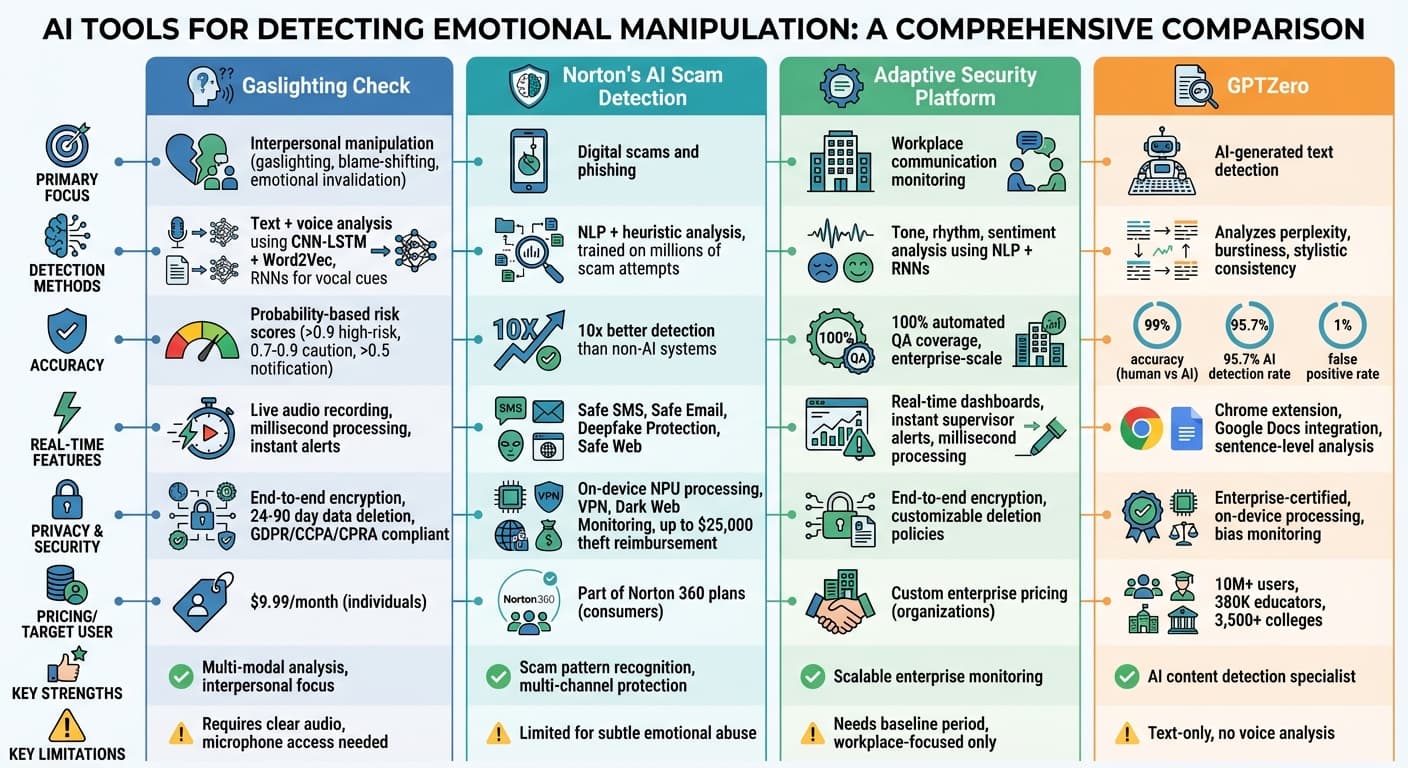
Each tool brings its own set of advantages and challenges when it comes to detecting emotional manipulation. The table below highlights their core features and limitations, focusing on detection methods, accuracy, real-time capabilities, and privacy.
| Tool | Strengths | Weaknesses |
|---|---|---|
| Gaslighting Check | Algorithms: Combines text and voice analysis using multi-modal AI to identify manipulation cues. Accuracy: Highly precise in spotting gaslighting and blame-shifting behaviors. Real-Time: Offers continuous audio recording and instant feedback based on analysis. Privacy: Ensures data protection with end-to-end encryption and automatic deletion policies. | Algorithms: Limited to interpersonal manipulation, not equipped for detecting AI-generated manipulative content. Accuracy: Relies on high-quality audio and may need additional context for complex relationship dynamics. Real-Time: Performance depends on clear audio conditions. Privacy: Requires microphone access, which might raise privacy concerns for some users. |
| Norton's AI Scam Detection | Algorithms: Uses behavioral analytics to detect urgency, tone shifts, and guilt-tripping tactics. Accuracy: Strong in assessing digital message credibility by identifying common scam patterns. Real-Time: Intercepts manipulative content in large-scale enterprise messaging systems. Privacy: Employs secure enterprise-grade protection protocols. | Algorithms: Primarily designed for financial scams, making it less effective for detecting subtle emotional abuse like gaslighting. Accuracy: Struggles with nuanced interpersonal manipulation. Real-Time: Tailored for enterprise use, limiting its utility in personal contexts. Privacy: Enterprise-focused design may reduce accessibility for individual users. |
| Adaptive Security Platform | Algorithms: Analyzes tone, rhythm, and sentiment to detect communication anomalies. Accuracy: Effective in organizational settings with multi-factor sentiment analysis. Real-Time: Features dashboards for ongoing communication monitoring. Privacy: Uses secure protocols specifically for workplace environments. | Algorithms: Geared toward organizational use, making it less suitable for personal scenarios. Accuracy: Requires a baseline period to establish normal communication patterns, which can delay initial detection. Real-Time: Dashboard reliance may not meet the needs of users seeking immediate alerts. Privacy: Continuous workplace monitoring could raise privacy concerns for employees. |
| GPTZero | Algorithms: Employs NLP to identify AI-generated content and fabricated narratives. Accuracy: Excels in distinguishing human-written text from AI-generated material. Real-Time: Provides quick text analysis through tools like a Chrome extension and Google Docs integration. Privacy: Supports on-device processing to protect user data during analysis. | Algorithms: Specializes in detecting AI-generated text, not designed for human emotional manipulation or voice analysis. Accuracy: Limited in addressing the complexities of human emotional manipulation. Real-Time: Restricted to text-based platforms, with no audio analysis capabilities. Privacy: Requires human verification for critical decisions, as its results are advisory. |
This breakdown highlights the trade-offs between tools designed for interpersonal emotional abuse detection and those focused on broader challenges like scams or AI-generated content. Gaslighting Check stands out for its focus on interpersonal manipulation, while the others cater to more general digital threats or organizational needs.
Conclusion
Each tool serves a specific purpose: Gaslighting Check tackles emotional manipulation in personal relationships, Norton's AI Scam Detection combats digital scams, Adaptive Security Platform focuses on workplace communication monitoring, and GPTZero identifies AI-generated content.
Gaslighting Check stands out with its multi-modal approach, using both text and voice analysis to detect gaslighting, blame-shifting, and other manipulative tactics. Its real-time audio analysis and instant feedback provide immediate support, making it especially useful for daily interactions.
For those navigating the risks of digital scams, Norton's AI Scam Detection uses advanced behavioral analytics to evaluate message credibility and flag urgency tactics - a common hallmark of scams. Meanwhile, organizations can turn to Adaptive Security Platform for large-scale monitoring, offering features like scalable dashboards and sentiment tracking across multiple communication channels.
A key consideration across these tools is the balance between individual privacy and enterprise-scale monitoring. Gaslighting Check prioritizes personal privacy with features like end-to-end encryption and automatic data deletion, available for $9.99/month. On the other hand, enterprise-grade tools like Adaptive Security Platform focus on broader monitoring capabilities, typically offered through custom pricing plans tailored for organizational needs.
The importance of these tools is further underscored by research showing that AI-driven manipulation can increase human error by nearly 25% when targeting decision-making vulnerabilities [2]. Tools like Gaslighting Check not only help detect manipulation in the moment but also generate detailed reports that document patterns over time - provided the audio input is clear - offering a crucial layer of protection in both personal and professional settings.
FAQs
How does Gaslighting Check protect user privacy while analyzing emotional manipulation?
Gaslighting Check prioritizes user privacy by employing encryption to safeguard data both during transmission and while stored. This ensures that sensitive details remain protected. Additionally, the platform provides an automatic data deletion feature, enabling users to erase conversation histories either after analysis or whenever they choose.
For real-time conversation analysis - whether via text or voice - Gaslighting Check utilizes cutting-edge tools like natural language processing, sentiment analysis, and voice pattern recognition. These technologies help identify tactics such as gaslighting and emotional invalidation, offering users meaningful insights while maintaining their trust and safety.
What features make Gaslighting Check effective at detecting emotional manipulation in real-time?
Gaslighting Check leverages cutting-edge AI tools like Natural Language Processing (NLP) and voice pattern analysis to spot emotional manipulation in real time.
By analyzing conversations, the platform identifies patterns of manipulative language, blame-shifting, and emotional invalidation. It even offers real-time alerts during interactions, empowering users to recognize and address gaslighting behaviors as they occur.
On top of that, Gaslighting Check takes user privacy seriously. With encrypted data storage and automatic deletion policies, your personal information stays protected while you gain deeper insights into communication dynamics.
Can I use Gaslighting Check to identify emotional manipulation in both personal and work-related conversations?
Gaslighting Check is built to evaluate communication patterns across different scenarios, making it useful for both personal interactions and workplace settings. By analyzing conversations in real time, the tool identifies behaviors like gaslighting, blame-shifting, and emotional invalidation.
Key features include real-time audio recording, text and voice analysis, and detailed reporting. These ensure precise identification of manipulative tactics while safeguarding user privacy through encrypted data storage and automatic deletion protocols.