Power Imbalance in Toxic Relationships: Solutions

Power Imbalance in Toxic Relationships: Solutions
Power imbalances in relationships can harm emotional well-being and lead to manipulation, like gaslighting. Recognizing these patterns early is key to restoring balance and building healthier connections. Here's what you need to know:
- Signs of imbalance: One partner controls decisions, finances, or social interactions, leaving the other feeling diminished. Emotional tactics like the silent treatment or making you question your reality are red flags.
- Causes: Past trauma, low self-esteem, or societal norms like traditional gender roles often contribute to unequal dynamics.
- Fixing the imbalance: Use open communication (e.g., "I" statements), share responsibilities fairly, and set boundaries. Tools like Gaslighting Check or therapy can provide clarity and support.
- When to seek help: If abuse is present, prioritize safety by contacting resources like the National Domestic Violence Hotline (800-799-SAFE).
Healthy relationships thrive on shared decision-making and mutual respect. Start by identifying issues, communicating openly, and seeking professional help if needed.
How to Recognize Power Imbalance in Your Relationship
Warning Signs of Power Imbalance
Spotting a power imbalance in a relationship often starts with observing who holds the decision-making reins. If one partner takes charge of finances, dictates how free time is spent, or sets household rules without mutual input, it’s a clear warning sign [3]. Other behaviors, like controlling what you wear or who you interact with, can slowly chip away at your independence [3].
Communication habits also offer clues. Patterns like withholding opinions, deploying the silent treatment, or creating an environment where you feel like you’re constantly second-guessing yourself can be telling. If you often feel like you’re "walking on eggshells", trust that instinct - it’s worth paying attention to [5].
"At the core of domestic violence, abusers have a sense of entitlement and a belief that they should be in control."
– Natacha Duke, Registered Psychotherapist, Cleveland Clinic [3]
Economic control is another significant red flag. This might include stopping you from working, controlling access to shared finances, or even restricting basic necessities like food or shelter [3]. Isolation tactics, such as limiting your contact with friends, family, or support networks, can further deepen your dependence on the controlling partner. It’s important to remember that leaving such a relationship often takes multiple attempts [3].
Understanding these signals can help set the stage for exploring the causes behind such imbalances.
What Causes Power Imbalance
Power imbalances frequently stem from personal history and vulnerabilities. Growing up in a household where one parent dominated the other or experiencing trauma can shape how you view relationships [1][4]. Factors like low self-esteem, fear of abandonment, or a strong need for approval can make it harder to advocate for yourself. A lack of assertiveness skills can further exacerbate these dynamics [1].
Broader societal influences, such as traditional gender roles, also play a role. These roles often frame one gender as more logical or deserving of authority, creating a fertile ground for imbalance to thrive [1][6]. For instance, in the United Kingdom, gaslighting was added to domestic violence law in 2015, with over 300 individuals charged since then. This highlights how societal structures can reinforce harmful patterns [6].
"Control can be confused with power. People who lack a sense of power in their lives try to manipulate and control others."
– Darlene Lancer, JD, LMFT [1]
How to Fix Power Imbalance in Your Relationship
Communication Methods That Work
Effective communication is a cornerstone of balanced relationships. To rebalance power and influence, focus on truly understanding your partner rather than trying to "win" a conversation. One way to achieve this is by using "I" statements to express your feelings without assigning blame. For example, instead of saying, "You never listen", try, "I feel unheard when our conversations are interrupted." This subtle shift helps reduce defensiveness and encourages open, honest dialogue.
"I think you are avoiding me. Can we try to fix a time to discuss this issue today so that both of us feel better?"
- Jourdan Travers, LCSW, TherapyTips.org
When dealing with manipulation, consider using the Reverse-DARVO technique. This strategy helps you assert boundaries by stepping back from emotional manipulation, clearly stating your needs, and validating your own feelings. It’s also a way to gauge whether your partner is genuinely open to addressing the issue at hand.
Assertiveness training can also play a crucial role. It helps prevent one-sided decision-making and builds trust, ensuring both partners feel heard and respected. These techniques not only counter manipulation but also create a stronger foundation for equitable sharing of responsibilities.
How to Share Responsibilities and Set Boundaries
A balanced relationship requires recognizing both the visible and invisible tasks that keep things running smoothly. This includes not only household chores but also emotional labor, like managing schedules or remembering important dates. Acknowledging these contributions is the first step toward addressing any imbalance.
To share responsibilities more effectively, start by dividing tasks based on mutual strengths and interests. For significant decisions - like where to live or how to handle major financial investments - ensure both partners have an equal say. For smaller, everyday choices, consider taking turns. Sharing decision-making, even in low-stakes situations, helps build confidence in a more balanced partnership.
"A healthy relationship involves a fluid exchange of power, where both partners feel empowered to express their needs, make decisions, and influence the direction of their shared life."
- Couples Rehabs
Financial transparency is another key factor in maintaining equality. Regularly reviewing your financial situation together ensures that both partners have access to information about income, savings, and debts. To preserve personal autonomy, you might set up individual allowances for discretionary spending while managing shared resources collaboratively.
Setting clear boundaries is equally important. Think of boundaries not as barriers but as guidelines for mutual respect. For instance, if interruptions are a recurring issue during conversations, agree to pause discussions until both parties are ready to engage respectfully. Regular check-ins can also help ensure that responsibilities remain fairly distributed, adapting to each partner’s abilities and schedules rather than sticking rigidly to a 50/50 split.
How to Take Back Your Power | Reclaiming Control in Relationships
Detect Manipulation in Conversations
Use AI-powered tools to analyze text and audio for gaslighting and manipulation patterns. Gain clarity, actionable insights, and support to navigate challenging relationships.
Start Analyzing NowTools and Professional Help for Power Imbalance
::: @figure
How Gaslighting Check Helps You Spot Manipulation

When toxic relationships lead to self-doubt, Gaslighting Check steps in with AI-powered analysis of text and voice conversations. This tool identifies manipulation patterns and provides detailed reports that help you recognize unhealthy behaviors and break free from the mental gymnastics often used to justify them.
The platform is particularly effective at spotting manipulation tactics often called the "Four Horsemen" - Contempt, Criticism, Stonewalling, and Defensiveness. These behaviors, identified by Dr. John Gottman, are linked to relationship failure with over 90% accuracy [7]. By keeping a record of interactions, Gaslighting Check helps counter the effects of gaslighting and rebuild trust in your own perceptions.
"Gaslighting is when a toxic person uses manipulation designed to make their target doubt their own perceptions, experiences, reality, or sanity."
- Charlene Quint, Author and Advocate [7]
The tool also offers practical support, such as guidance for creating safety plans or preparing for therapy. For $9.99/month, the Premium Plan includes features like conversation history tracking, allowing you to observe patterns over time. This tech-driven approach provides a fresh perspective, blending traditional self-help methods with modern solutions.
Self-Help vs. Tech-Assisted Solutions: A Comparison
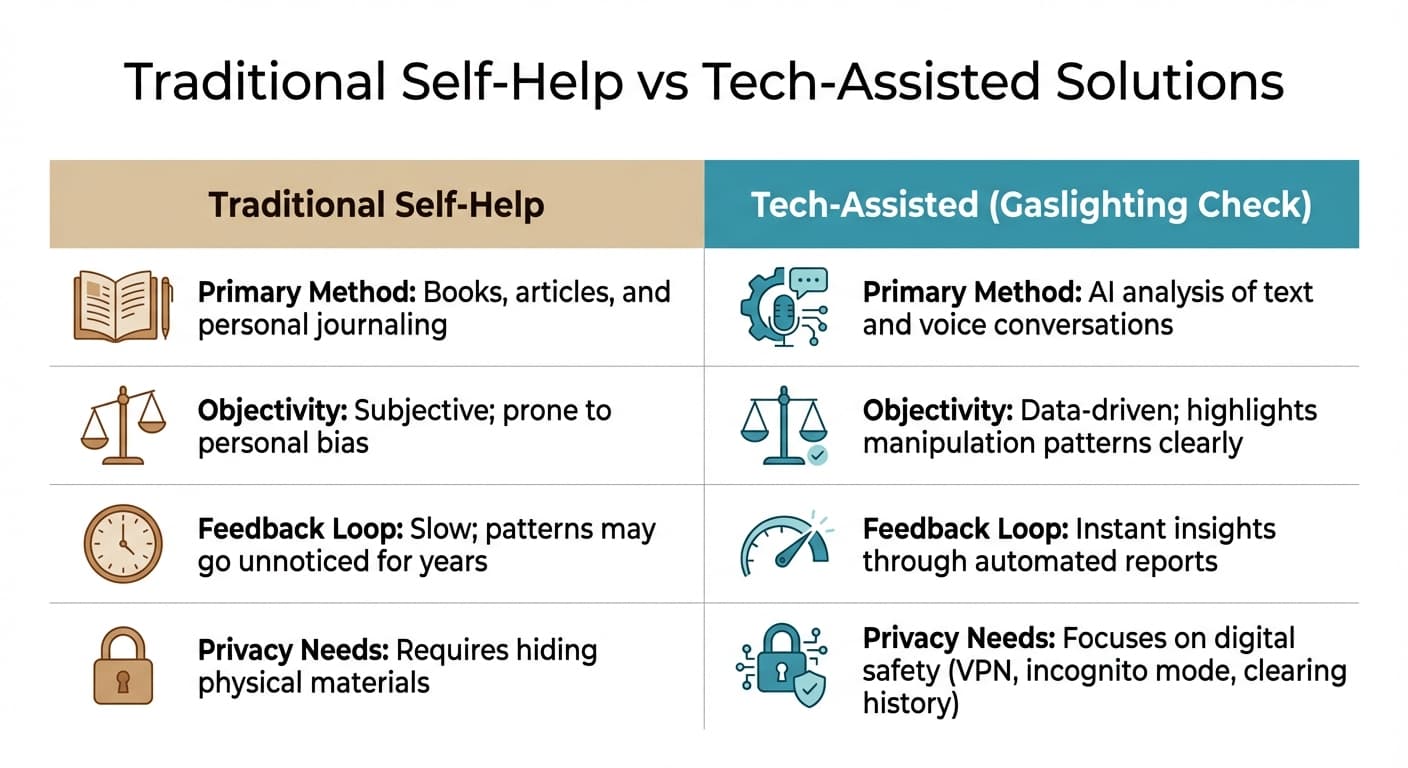
Gaslighting Check's objective analysis offers a stark contrast to traditional self-help methods, which often rely on personal reflection and can be clouded by self-doubt.
| Feature | Traditional Self-Help | Tech-Assisted (Gaslighting Check) |
|---|---|---|
| Primary Method | Books, articles, and personal journaling | AI analysis of text and voice conversations |
| Objectivity | Subjective; prone to personal bias | Data-driven; highlights manipulation patterns clearly |
| Feedback Loop | Slow; patterns may go unnoticed for years | Instant insights through automated reports |
| Privacy Needs | Requires hiding physical materials | Focuses on digital safety (e.g., VPN, incognito mode, clearing history) |
When to See a Therapist
Sometimes, rebalancing power in a relationship requires more than self-help or tech tools - this is where professional therapy becomes essential. If physical or emotional abuse has occurred, seek immediate professional support. Instances of physical or sexual violence, even if they happen just once, significantly increase the risk of future harm [3].
Therapists trained in Emotionally Focused Therapy (EFT) focus on building secure emotional connections, while the Gottman Method - grounded in decades of research - helps couples move from a "win-or-lose" mindset to one of collaboration.
"Conflict is the top reason couples seek help - but it's also an opportunity for greater intimacy, deeper connection, and lasting love."
- John and Julie Gottman, Founders of The Gottman Institute [8]
If you're in immediate danger, consider reaching out to resources like the National Domestic Violence Hotline or dialing 988 for crisis support [3]. Research shows that it often takes an average of seven attempts to leave an abusive relationship fully [3]. Professional assistance can also help you create a comprehensive safety plan, including emergency housing, legal guidance, and financial support.
Conclusion: Taking Back Control in Your Relationship
Addressing power imbalances in a relationship requires intentional effort. Start by honestly evaluating your dynamic: who makes the major decisions, manages the finances, or takes on the bulk of the invisible labor? Use open, non-blaming "I" statements to communicate concerns, share responsibilities, and balance the mental load of running a household. This honest self-assessment lays the groundwork for practical solutions and, if needed, professional support.
Tools like Gaslighting Check can provide clear, objective insights into manipulation patterns. These reports can validate your experiences, help you set firm boundaries, and prepare for therapy if necessary. Keep in mind that healthy power in a relationship is about balance - both partners should feel empowered to influence decisions, rather than one person consistently diminishing the other's autonomy [2].
"Love actually requires the exercise of power. To claim our power means learning to live consciously, taking responsibility for ourselves and choices, building self-esteem, and asking directly for our needs and wants."
- Darlene Lancer, JD, LMFT [1]
Instead of focusing on blame, shift your perspective inward. Believe in your ability to shape outcomes and manage your emotions. Building self-worth and autonomy allows you to express your needs confidently, without fear of rejection [1]. If you're facing physical or emotional abuse, prioritize your safety by reaching out to the National Domestic Violence Hotline at 800-799-SAFE or dialing 988 for crisis support.
The first step toward a healthier, more balanced relationship is recognizing the issue. From there, take action - whether it’s setting boundaries, seeking professional help, or using tools to gain clarity. A partnership built on mutual respect and shared power is not just possible - it’s what you deserve.
FAQs
How can I tell if there’s a power imbalance in my relationship?
A power imbalance in a relationship occurs when one partner consistently takes charge of crucial areas - like decision-making, finances, or emotional support - leaving the other feeling silenced or powerless. Signs to be aware of include frequent unresolved arguments, feeling dismissed or pressured to conform, and an increasing sense of emotional distance. You might also notice recurring behaviors, such as one partner avoiding difficult discussions or ignoring your needs entirely.
Other warning signs can include doubting your own perspective after disagreements (a classic indicator of gaslighting), becoming overly dependent on your partner for approval, or hesitating to share your opinions out of fear of rejection. If these scenarios resonate, tools like Gaslighting Check can help you evaluate conversations for manipulation tactics, offering clarity and helping you regain control. Spotting these patterns is a crucial step toward restoring balance in your relationship or seeking professional help.
How can I improve communication and create a healthier balance in my relationship?
Improving communication and finding equilibrium begins with recognizing the problem. Start by calmly voicing your feelings. For example, you might say, "I feel unheard when I’m left out of important decisions." This kind of honesty can create a foundation for mutual understanding and a shared commitment to address the imbalance.
Prioritize active listening and clear communication to strengthen your connection. Dedicate distraction-free time to talk openly, using "I" statements like, "I feel ___ when ___ happens", while the other person listens and repeats back what they heard. This method not only fosters understanding but also helps keep discussions from turning into arguments. If you suspect subtle manipulation, tools like Gaslighting Check can shed light on the situation and help you regain clarity.
Lastly, focus on equally sharing responsibilities and establishing boundaries. Divide tasks like household chores or decision-making fairly, and agree on how to handle significant decisions together. Revisit these arrangements regularly to ensure they remain effective for both of you. When communication, respect, and fairness are consistent, you can build a healthier, more balanced relationship.
How do I know when to seek professional help for power imbalances in my relationship?
If you often feel powerless, anxious, or unsure about making decisions in your relationship, it might be time to consider professional support. Warning signs include persistent feelings of shame, low self-esteem, or an overwhelming need for your partner’s approval. Other red flags could be frequent arguments, building resentment, or emotional distance that starts to weigh on your mental health. Additionally, controlling behaviors - like financial control, withdrawal during conflicts, or gaslighting that makes you question your reality - can signal a harmful dynamic. Seeking help early can prevent further emotional damage.
In situations where intimidation, threats, or any form of physical or sexual violence is present, immediate action is essential. These behaviors can escalate quickly and may require help from therapists, domestic violence counselors, or even law enforcement. If you feel unsafe or notice patterns of increasing control, reach out to resources like the National Domestic Violence Hotline at 1-800-799-7233 or a local crisis line for support.
Professional counseling can also help you identify and address more subtle forms of manipulation, such as gaslighting. Tools like Gaslighting Check may help you analyze conversations and recognize emotional manipulation, allowing you to work with a therapist to rebuild trust in your own perceptions. Acting early can safeguard your well-being and guide you in deciding whether the relationship can improve or if it’s time to walk away.