
Narcissistic Abuse Support Groups: What to Expect
If you're recovering from narcissistic abuse, support groups can be a helpful resource. They provide a safe space to share experiences, learn coping strategies, and connect with others who understand what you're going through. Here's what you can expect:
- Validation: Hearing others' stories affirms your feelings and helps rebuild trust in your perceptions.
- Education: Learn about narcissistic behavior patterns like gaslighting, love-bombing, and the abuse cycle.
- Practical Tools: Groups often teach boundary-setting, emotional management, and techniques like mindfulness or CBT.
- Formats: Both in-person and online groups are available, each offering unique benefits like face-to-face connection or greater anonymity.
Tools like Gaslighting Check can complement group support by analyzing interactions for manipulation patterns. Combining these insights with group sessions can help you make sense of your experiences and regain confidence.
Attending your first meeting may feel daunting, but preparation - like journaling or reflecting on your needs - can make it easier. Whether in-person or virtual, these groups aim to provide a supportive space for healing.
Why Join a Narcissistic Abuse Support Group
Validation and Emotional Support
Gaslighting often leaves you second-guessing your memories and judgment. Support groups create a safe space where others who’ve faced similar experiences can help you push through that cloud of doubt.
"When you share something painful and see heads nodding around the circle... that's when the isolation starts to crack." [3]
Hearing affirmations like, "That wasn’t your fault", or "I thought I was the only one", can be incredibly powerful. These shared experiences not only validate your feelings but also help you rebuild trust in your own perceptions. Over time, this mutual understanding naturally leads to discovering practical strategies for coping.
Learning Coping Strategies and Setting Boundaries
Support groups aren’t just about emotional connection - they’re also a source of practical advice. Members often share tips for managing difficult situations, such as dealing with "flying monkeys" (those who act as allies of the abuser), navigating tricky custody battles, or spotting red flags in future relationships. Groups led by licensed professionals may also introduce evidence-based techniques like grounding exercises, cognitive behavioral therapy (CBT) to reframe harmful thoughts, and mindfulness practices to find calm. Role-playing scenarios within the group provide a safe way to practice setting and strengthening boundaries.
Using Gaslighting Check Alongside Group Support

While support groups offer invaluable emotional and practical help, technology can add another layer of assistance. Tools like Gaslighting Check are available 24/7 to provide clarity between meetings. This tool analyzes texts, voice recordings, and live audio for signs of manipulation, offering detailed reports that highlight patterns of gaslighting or devaluation. Sharing these insights during group sessions can help make sense of confusing interactions and affirm your instincts.
For instance, Gaslighting Check’s Premium Plan, which costs $9.99 per month, includes features like conversation history tracking. This can be especially helpful for documenting recurring cycles of abuse and recognizing patterns over time. Combining these AI-driven insights with the empathy and validation from your support group allows you to untangle distorted memories and rebuild confidence in your own perceptions.
SPAN: A Free Online Support Group for Survivors of Narcissistic Abuse
What Happens in a Narcissistic Abuse Support Group
::: @figure
Common Group Activities
Support group meetings usually follow a structured flow to create a safe and welcoming space. Sessions often begin with the facilitator greeting members and setting clear ground rules like maintaining confidentiality and showing mutual respect. Afterward, a check-in allows participants to share how they're feeling. If you're not ready to speak, no pressure - the "pass rule" lets you simply listen and observe.
The core of the meeting is the open discussion, where members share personal stories and tackle topics like spotting red flags, understanding gaslighting, or managing interactions with "flying monkeys" (individuals manipulated by a narcissist to target others). To keep things fair, facilitators often limit each person to 1–2 minutes of speaking time. Many groups also include structured exercises like journaling prompts, guided breathing, or role-playing scenarios to help members develop coping skills. Sessions typically wrap up with a grounding activity, such as reciting a positive quote or expressing feelings in one word.
"The simple act of sharing your problems can be extremely cathartic. So, most people feel uplifted and encouraged after attending a support group." - Toni Hoy, Author, HelpGuide.org
Smaller groups, ideally with 10 or fewer members, tend to be more effective. This size ensures that everyone has the chance to participate and connect. These structured activities and discussions work well in both in-person and online formats, each offering its own benefits.
In-Person vs. Online Groups
Though all support groups follow a similar structure, the setting - whether in-person or online - can shape the experience in different ways.
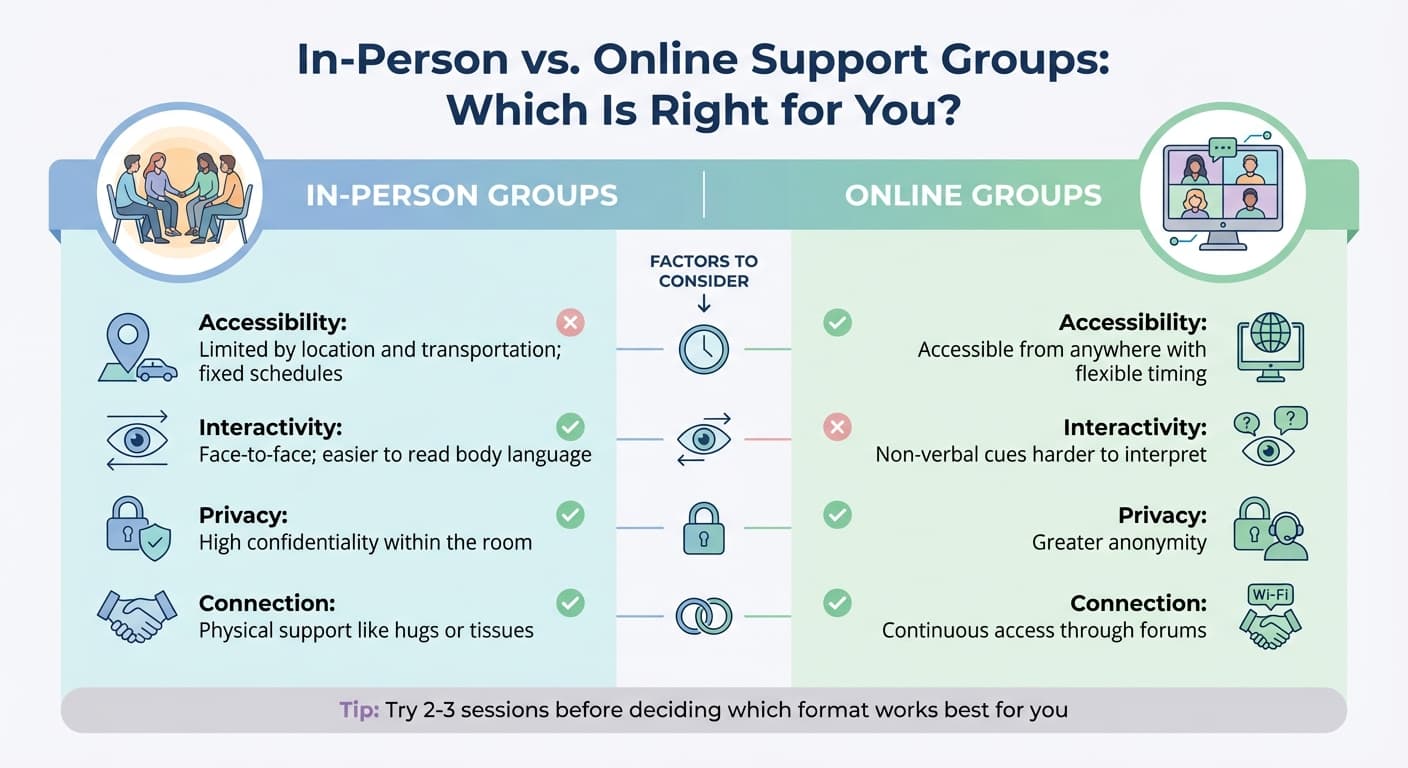
In-person groups provide a unique sense of connection through shared physical space. You can pick up on body language, feel the emotional energy in the room, and even offer or receive small gestures of support, like a tissue or a comforting hug. However, these groups are bound by location and fixed schedules, which can make attending difficult if transportation or distance is an issue.
Online groups, meanwhile, remove geographical barriers, offering access to support through video calls or forums at any time. They also allow for greater anonymity, which can be especially important if you're still in a vulnerable situation or not ready to show your face. The downside? It’s harder to interpret non-verbal cues, and you might miss the physical warmth that comes with face-to-face interactions.
| Factor | In-Person Groups | Online Groups |
|---|---|---|
| Accessibility | Limited by location and transportation; fixed schedules | Accessible from anywhere with flexible timing |
| Interactivity | Face-to-face; easier to read body language | Non-verbal cues harder to interpret |
| Privacy | High confidentiality within the room | Greater anonymity |
| Connection | Physical support like hugs or tissues | Continuous access through forums |
If you're exploring support groups, try attending at least two or three sessions before deciding if it’s the right fit. Look for groups led by skilled facilitators who enforce boundaries and confidentiality. Be cautious of groups that focus on selling products or skip grounding exercises at the end of meetings - these are red flags that the group may not be as supportive as it should be.
Detect Manipulation in Conversations
Use AI-powered tools to analyze text and audio for gaslighting and manipulation patterns. Gain clarity, actionable insights, and support to navigate challenging relationships.
Start Analyzing NowPreparing for Your First Meeting
Introductions and Ground Rules
Walking into your first group meeting can feel overwhelming. For some, it’s an emotional experience that takes time to process - even after the meeting ends. It’s not unusual for participants to sit in their cars afterward, reflecting on what they’ve just experienced [9][3].
Most groups begin by laying out ground rules that emphasize confidentiality and respect for everyone involved [3]. You might be asked to sign a confidentiality agreement before the session starts. Other common rules include limiting speaking time (usually 1–2 minutes per person) and the "pass rule", which means you’re never obligated to share your story if you’re not ready [9][3].
"Everyone in that room has sat where you're sitting. They remember their first meeting, too. You don't have to be eloquent or put-together or ready to heal. You just have to show up." - Kinder in the Keys [3]
When it’s time for introductions, you’ll be invited to share your name and as much of your story as you feel comfortable. Listening to others talk about experiences like gaslighting or love bombing can be a powerful reminder that you’re not alone [1]. If you’re joining a professionally facilitated group, you may need to complete an intake interview beforehand. These sessions typically cost around $50 per class, with some insurance options available [8].
Before stepping into your first meeting, taking some time to reflect on your needs and boundaries can help you feel more prepared.
Journaling and Reflection Before Attending
Group meetings often follow a structured format, and doing a little personal preparation beforehand can make the experience more meaningful. Journaling is a great way to start. Consider creating a validation journal where you document specific events, your feelings about them, and what you hope to gain from the group [7]. This practice can help you rebuild trust in yourself and serve as a helpful reference if you decide to share.
It’s also a good idea to reach out to the group facilitator ahead of time. Ask about the group’s dynamics, confidentiality practices, and what you can expect during the session [4]. If you have any concerns or questions, jot them down so you don’t forget to address them. You might also want to outline your personal boundaries - what you’re okay discussing and what you’d prefer to keep private for now. Bringing a notebook or a small grounding object can also help you stay centered if the conversation becomes emotionally intense.
Finally, plan some self-care for after the meeting. Whether it’s a quiet drive, a walk, or time spent on a favorite hobby, giving yourself space to decompress is important [4][3][5]. And remember, there’s no pressure to have it all figured out right away. The first few meetings are often about exploring whether the group’s approach feels like the right fit for your healing journey.
How to Find and Join a Support Group
Where to Search for Groups
Finding the right support group often begins with knowing where to look. A great starting point is your therapist or counselor, as they typically have access to curated lists of local groups and can recommend specialized recovery programs tailored to your needs. If you don’t currently have a therapist, online directories like Psychology Today can help you locate groups based on your location and specific focus areas.
National organizations also provide valuable resources. For example, the National Domestic Violence Hotline (1-800-799-7233) and NAMI (National Alliance on Mental Illness) offer tools, helplines, and directories to connect you with local chapters and support systems. Additionally, consider checking out grassroots groups at places like local libraries, community centers, or mental health clinics.
If you’re looking for virtual options, websites such as Help Within Reach and She Recovers host online meetings accessible from anywhere. Another resource, I Believe Your Abuse, provides a state-by-state directory of support groups. When searching online or using platforms like Meetup, try specific terms like “toxic relationship recovery,” “Cluster B awareness,” or “emotional abuse support.” These keywords can help you find groups that may not use traditional labels.
Technology can also play a key role in broadening your support network.
Gaslighting Check Community Features
For those seeking additional resources, Gaslighting Check offers unique community features designed to complement both in-person and virtual support groups. Through its Premium Plan ($9.99/month), members gain access to moderated community channels where survivors can share experiences and connect in a secure environment. These channels provide an outlet to discuss and process feelings between meetings with others who understand the complexities of gaslighting and emotional manipulation.
Gaslighting Check also uses AI tools to identify manipulation tactics such as gaslighting, love bombing, or DARVO. This feature helps you better articulate and understand your experiences. To protect your privacy, the platform employs end-to-end encryption and automatic data deletion policies, ensuring your information stays secure.
Conclusion
Joining a narcissistic abuse support group can be a powerful step in your recovery journey. These groups provide validation when self-doubt has taken root, help break the isolation often imposed by narcissistic relationships, and teach practical skills like setting boundaries and spotting manipulation. In fact, 70% of participants in therapist-led online group therapy sessions reported noticeable symptom relief within just 8 weeks [2]. This highlights how impactful peer support can be.
"Healing from the impacts of narcissistic abuse can be lonely, frustrating, and challenging, but healing is absolutely possible." - Verywell Mind [6]
Support groups are most effective when paired with individual trauma-informed therapy and self-care practices like journaling or meditation. Whether you choose to meet face-to-face at a local center or join virtual sessions from the comfort of home, finding a group led by trained facilitators who prioritize confidentiality and foster a safe, judgment-free space is essential. For ongoing support, digital tools can complement these efforts.
For example, apps like Gaslighting Check offer AI-driven insights and secure community spaces to help you stay connected and supported between meetings.
"You survived something that would have destroyed many people. Finding support isn't weakness - it's wisdom." - Kinder in the Keys [3]
Taking that first step to attend a meeting or reach out for help takes courage, but you don't have to go through this alone. With the right combination of support groups, therapy, and digital tools, you can begin to reclaim your sense of self and build the healthy, safe relationships you deserve. Recovery is a gradual process, but with the right resources and community, it becomes a shared journey.
FAQs
How can I emotionally prepare for my first narcissistic abuse support group meeting?
Feeling nervous or unsure before your first support group meeting? That’s completely normal. Here are a few ways to make things a little easier:
- Recognize your emotions: Feeling anxious or vulnerable is natural. Simply acknowledging these emotions can help you feel more grounded and in control.
- Remember the group’s purpose: This is a supportive, confidential space where people come together to share experiences and offer encouragement - free of judgment.
- Set a simple goal: Maybe you just want to listen, share a small story, or ask a question. Starting with a small, manageable goal can help ease any pressure.
- Take care of yourself beforehand: A few deep breaths, a short walk, or a calming cup of tea can help you feel more relaxed and focused.
By accepting your feelings, keeping the group’s supportive nature in mind, and preparing in small ways, you’ll step into your first meeting with a little more confidence.
How can Gaslighting Check enhance the support group experience for survivors of narcissistic abuse?
Using Gaslighting Check in tandem with a narcissistic abuse support group can be a powerful way to navigate the recovery process. The platform’s AI-driven tools are designed to spot manipulation tactics like gaslighting and love-bombing in real-time, giving survivors straightforward insights they can share with their group. This helps validate their experiences and fosters a deeper understanding of the patterns they’ve endured. Plus, its secure, encrypted recordings and text analysis enable users to document abusive behaviors, making it easier to articulate their experiences and feel supported by others who understand.
Gaslighting Check also offers tools to track emotional progress through detailed reports and conversation histories, allowing users to acknowledge their growth and celebrate milestones. For those seeking professional assistance, the premium plan - priced at $9.99 per month - provides the option to export reports for therapists or legal professionals, creating a bridge between peer support and expert care. By blending the compassion of support groups with the actionable insights from Gaslighting Check, survivors can gain confidence, strengthen their self-advocacy, and carve out a clearer path toward healing.
Should I join an in-person or online narcissistic abuse support group?
Deciding between an in-person or online narcissistic abuse support group comes down to what works best for your lifestyle and comfort level. If you enjoy face-to-face interaction and find value in connecting with others in a shared physical space, an in-person group might be the way to go. These groups often gather at local mental health clinics or community centers, making it easier to form connections with people in your area.
On the flip side, online support groups bring a level of flexibility and convenience that’s hard to beat. You can join from anywhere - whether you're at home, on the go, or even traveling. They also offer a layer of anonymity, which can feel reassuring if you're still navigating the emotions tied to your experiences. Plus, virtual meetings cut out travel time and costs, making them a practical choice for those with packed schedules or limited local resources.
When deciding, think about what matters most to you: Are you comfortable sharing in person? Do you need a group that fits into a tight schedule? Is privacy a top concern? If you’re on the fence, why not try both formats to see which feels like the best fit? And if you need extra support, tools like Gaslighting Check can help you recognize manipulation tactics, whether you're in a face-to-face meeting or an online session.