How Gaslighting Triggers Anxiety and Depression

How Gaslighting Triggers Anxiety and Depression
Gaslighting is a form of manipulation where someone distorts your reality, making you question your thoughts, memories, and perception. This tactic, often used to gain control, can lead to severe mental health issues like anxiety and depression. Victims face chronic self-doubt, hypervigilance, and emotional exhaustion, often feeling trapped in a cycle of confusion and dependence on the manipulator.
Key Points:
- Gaslighting disrupts your sense of reality, causing self-doubt and emotional instability.
- Common tactics include dismissing your feelings, twisting facts, and making you feel "too sensitive" or "crazy."
- Long-term effects include anxiety, depression, physical stress, and social withdrawal.
- Recovery involves therapies like CBT, trauma-informed approaches, and EMDR, along with rebuilding self-trust and setting boundaries.
- Tools like journaling, documenting interactions, and apps like Gaslighting Check can help validate your experiences and detect manipulation.
Gaslighting isn't just emotional abuse - it rewires your brain, leaving lasting scars. Recognizing the signs and seeking support is crucial for healing and reclaiming your reality.
::: @figure
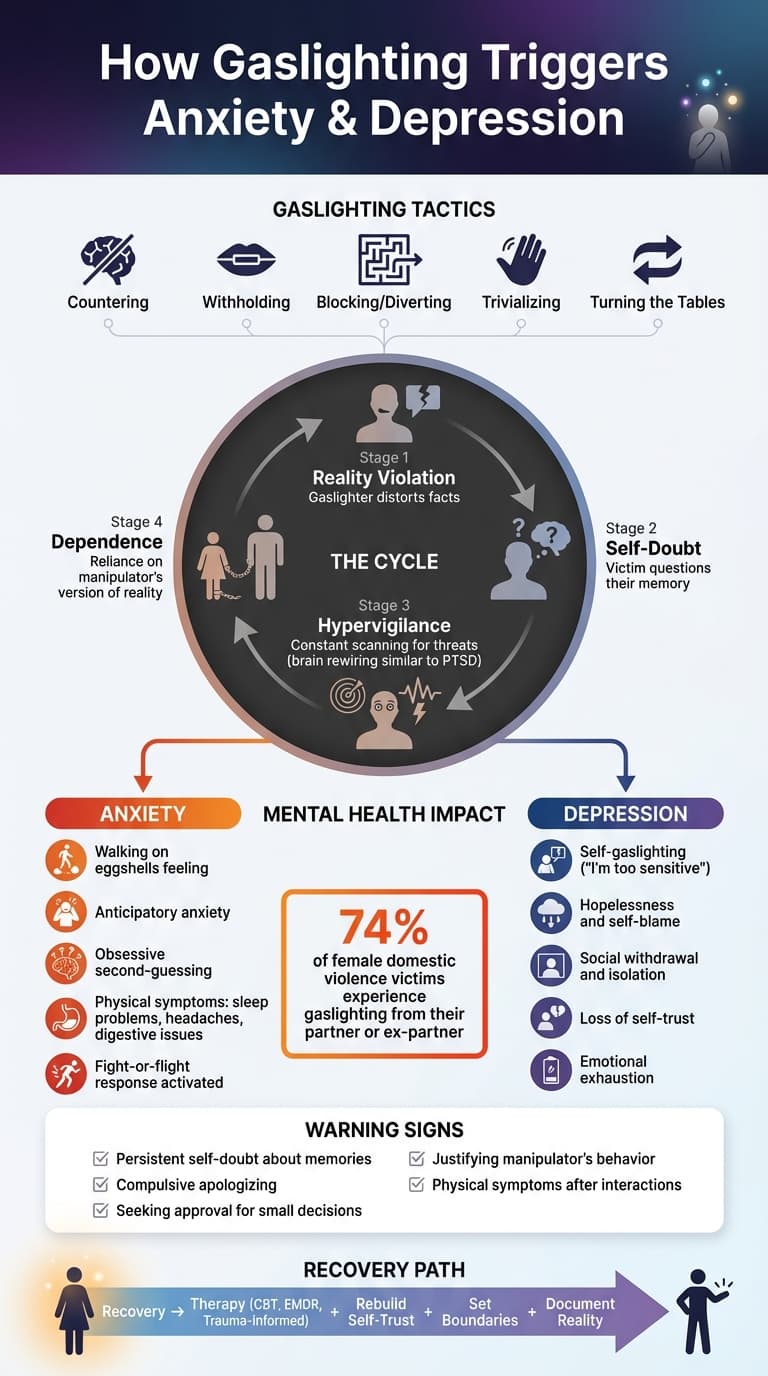
What Gaslighting Is and How It Works
Defining Gaslighting
Gaslighting is a calculated form of psychological manipulation where someone feeds false information to another person, making them question their own thoughts, memories, and sense of reality. This behavior is not random - it’s a deliberate tactic designed to destabilize the victim’s confidence in their perceptions. The ultimate aim? To gain control and make the victim emotionally dependent on the manipulator.
What makes gaslighting so harmful is how it exploits the brain’s natural tendency to resolve conflicts in perception. Victims are forced into a mental tug-of-war, where they either acknowledge they’re being deceived or start doubting their own reality. Over time, this mental strain chips away at their self-trust, leaving them confused, uncertain, and often questioning their own mental health. This erosion of confidence often leads to anxiety and depression, as discussed later in this context [3][6][2]. The following gaslighting examples in everyday conversations highlight the ways gaslighters distort reality and manipulate their victims.
Tactics Gaslighters Use
Gaslighters rely on specific strategies to distort their victim’s reality. These methods are meant to confuse, discredit, and destabilize. Some of the most common tactics include:
- Countering: Challenging the victim’s memory to make them doubt themselves.
- Withholding: Refusing to engage with or acknowledge the victim’s concerns.
- Blocking or diverting: Avoiding the issue by questioning the victim’s thoughts or motives.
- Trivializing: Dismissing the victim’s feelings as insignificant or exaggerated.
- Turning the tables: Twisting the victim’s actions or words to use them as a weapon against them [3].
Take, for instance, Chandra, a woman who endured 12 years of marriage to a man who repeatedly cheated on her. When she confronted him with evidence, he dismissed her as "crazy", "jealous", and "paranoid." He also manipulated their financial situation to make her feel incompetent and dependent, which further eroded her confidence [2]. In another case, a survivor shared how her legitimate concerns were not only dismissed but later twisted to undermine her credibility [2].
Psychotherapist Stephanie Sarkis, PhD, captures the essence of gaslighting, stating:
"Gaslighters are master manipulators. They lie or withhold information, pit people against each other, and always place blame elsewhere, all the while gaining control over those they are gaslighting." [1]
Recognizing these tactics is a critical first step in breaking free from manipulation and reclaiming one’s sense of reality.
The Connection Between Gaslighting and Anxiety
How Constant Uncertainty Creates Anxiety
Your brain is wired to reduce uncertainty by predicting and adjusting to reality. Gaslighters exploit this by creating "reality violations", where their lies make you question your perceptions. Over time, this leaves victims in a painful cycle of self-doubt, often choosing to distrust their own memories rather than reject the manipulator's version of events [3].
Even seemingly small interactions can feel like battlegrounds, blurring the line between truth and deceit. This persistent self-doubt evolves into anticipatory anxiety, leaving victims in a state often described as "walking on eggshells." It's a constant readiness for the next challenge to their sense of reality [5]. Alarmingly, 74% of women who have experienced domestic violence report being gaslit by their partner or ex-partner [7]. The mental toll of this manipulation doesn't just cloud thoughts - it triggers physical stress responses, too.
The Body's Stress Response to Gaslighting
Chronic uncertainty caused by gaslighting can rewire the brain's threat detection system. Studies of chronic victims reveal brain activity patterns similar to those seen in severe PTSD cases [3]. Clinical psychologist Joni E. Johnston, Psy.D., highlights the cruel irony of this process:
"Victims become simultaneously hypervigilant and unable to trust their hypervigilance" [3].
This rewiring creates a hyperactive state where the brain is constantly scanning for danger, despite its inability to assess threats accurately.
This hypervigilance sets off a feedback loop of anxiety. Victims may find themselves obsessively second-guessing their thoughts and behaviors, trying to avoid being labeled as "too sensitive", "crazy", or "wrong" by the manipulator. Jamie Cannon, MS, LPC, explains:
"Gaslighting over the long term creates disparities and power imbalances in relationships, an environment that is ripe for anxiety to develop" [5].
The physical toll is just as severe. Many victims report sleep problems, trouble concentrating, headaches, and digestive issues, as their bodies remain stuck in a prolonged fight-or-flight response. This relentless stress leaves both the mind and body in a state of exhaustion.
How Gaslighting Causes Depression
The Path from Self-Doubt to Hopelessness
Gaslighting has a way of turning self-doubt into a deep sense of hopelessness over time. Victims start to question their memories and, worse, begin to accept the abuser's negative narratives as truth. This leaves them feeling fundamentally flawed. Psychotherapist Carol A. Lambert, MSW, describes the process:
"By internalizing the false accusations of the gaslighter, you begin the painful process of doubting yourself - a process that negatively impacts your perception of the world, self-esteem, and personal identity" [8].
This self-doubt often escalates into self-gaslighting, where victims adopt beliefs like "I'm too sensitive", "I'm the problem", or "There's something wrong with me." These thoughts can spiral into clinical depression. Robin Stern, PhD, author of The Gaslight Effect, explains:
"Gaslighting may not be the only factor leading to mental illness, but the same factors that leave a person vulnerable to gaslighting may result in lower self-esteem, uncertainty about their own reality, anxiety, and ultimately depression" [9].
As gaslighters strip away alternative viewpoints, victims find themselves stuck in a cycle of self-blame, shame, and guilt. Over time, they become increasingly reliant on the gaslighter's warped version of reality, which chips away at their sense of self. This internal erosion often leads to social withdrawal, further fueling the cycle of depression.
Social Isolation and Emotional Withdrawal
The despair caused by gaslighting often leads victims to pull away from others. Social withdrawal becomes a hallmark of depression in this context. Abusers frequently play a role in this isolation by discrediting the victim - spreading rumors or labeling them as "unstable", "irrational", or "crazy" - to weaken their support systems [2]. Sociologist Paige L. Sweet highlights this tactic:
"Isolation... is the 'breeding ground' for gaslighting" [2].
This strategy traps victims in a cycle of doubt. They may begin to fear that speaking up will only confirm the gaslighter’s accusations of being "too emotional" or "paranoid." In a study involving 122 in-depth interviews, about 30% of participants identified their parents as their primary gaslighters, showing how this isolation can start within the family [2]. One domestic violence survivor, Selah (pseudonym), encapsulates the experience:
"They live in an alternate reality. And they want you to live there with them" [2].
As victims withdraw further, their depression worsens. They stop reaching out, lose trust in others, and eventually even lose trust in themselves, deepening their isolation and emotional pain.
Identifying Anxiety and Depression Caused by Gaslighting
Warning Signs to Look For
Gaslighting leaves a unique imprint on mental health, making it essential to recognize its specific warning signs. These symptoms go beyond general sadness or anxiety - they're deeply tied to interactions with the manipulator.
One major red flag is persistent self-doubt. You might find yourself constantly questioning your memories, perceptions, or even your sanity. The National Domestic Violence Hotline reports that 74% of female domestic violence victims experience gaslighting from a current or former partner [10].
Other indicators include hypervigilance and compulsive apologizing. You may catch yourself apologizing excessively or justifying the manipulator's actions to friends and family. Even small decisions might feel overwhelming without seeking their approval. On top of that, physical symptoms like headaches, stomach issues, or chronic fatigue - especially after engaging with the manipulator - can signal emotional strain caused by gaslighting.
Recognizing these signs is the first step in uncovering the specific manipulation tactics at play.
Learning to Recognize Manipulation Patterns
Gaslighters often rely on specific tactics to distort reality and maintain control. Understanding these patterns can help you identify manipulation as it happens. A 2023 study of 65 survivors highlighted a method called "turning the tables." This tactic involves shifting blame onto the victim by attacking their mental health or past trauma. The study found that this technique often leads to "prediction error corruption", training victims to doubt themselves instead of questioning the manipulator [3].
Some common manipulation tactics include:
- Countering: "You have a bad memory; that never happened."
- Trivializing: "You're too sensitive."
- Diverting: "You're just saying that because you're stressed."
Recognizing these behaviors can help rebuild trust in your own perceptions. It validates your experience and gives you the confidence to challenge the distortions.
To combat these tactics, consider documenting interactions. Use secure journals or legally recorded conversations to keep track of events and conversations. Tools like Gaslighting Check (https://gaslightingcheck.com) can also help by identifying manipulation in real time and providing detailed reports, giving you a clearer understanding of the situation.
Steps to Recovery and Healing
Therapy Options for Gaslighting Recovery
Therapy can be a powerful way to recover from the psychological effects of gaslighting. Cognitive Behavioral Therapy (CBT) focuses on identifying and challenging the negative beliefs that a gaslighter may have instilled in you. Through practical exercises, it helps rebuild self-esteem and restore confidence.
Trauma-Informed Therapy emphasizes your safety and autonomy, which gaslighting often undermines. This approach addresses how the abuse impacts both your mental and physical well-being, ensuring progress happens at a pace you're comfortable with. Another effective method, EMDR (Eye Movement Desensitization and Reprocessing), is designed to ease the emotional weight of traumatic memories.
Group therapy offers connection and combats the isolation gaslighting often causes. For instance, structured online therapy groups have shown promising results, with 70% of participants reporting significant improvements within just 8 weeks [11]. Some platforms even provide affordable options, like DBT skills groups starting at $25 [11]. Dialectical Behavior Therapy (DBT), in particular, equips individuals with tools for emotional regulation and mindfulness, helping them navigate the anxiety and confusion gaslighting creates.
Rebuilding Self-Trust and Confidence
Rebuilding trust in yourself is just as important as seeking professional help. Start with small, independent choices - like deciding what to eat or wear each day - to regain confidence in your judgment.
Documenting your reality can also be a game-changer. Keep a journal, save screenshots, or take photos to create a personal "fact base" that reinforces your memory and shields you from future manipulation. Incorporate daily affirmations such as "My feelings are valid" or "I trust my perception" to counteract the gaslighter's influence. When setting boundaries, using effective ways to respond to gaslighting, such as assertive language like "I know what I experienced" or "I won’t debate my memory of this event," can help protect your mental space.
In a 2023 study by Willis Klein at McGill University, researchers examined 65 gaslighting survivors and found that activities like yoga and journaling were instrumental in regaining a sense of self-awareness. The study also highlighted that spending time with supportive people - those who respect your interpretation of reality - was one of the most effective ways to heal [12][13].
Using Tools to Detect Manipulation
Technology can play a supportive role in your recovery by validating your experiences and helping you detect manipulation. Gaslighting Check (https://gaslightingcheck.com) is a tool that analyzes conversations to identify patterns of manipulation in real time. It offers text and voice analysis, providing detailed reports that help you make sense of interactions.
For $9.99/month, the platform’s conversation history tracking allows you to review past interactions and spot recurring tactics. With end-to-end encryption and automatic data deletion, your privacy is safeguarded while you gather evidence. These reports can provide the objective validation you need to trust your perceptions and confirm what you're experiencing.
The Gaslight Effect: Gaslighting, Anxiety, & Self-Trust with Dr. Robin Stern | Dealing With Feeling
Conclusion: Moving Beyond Gaslighting
Gaslighting can twist your sense of reality, disrupt your mental and emotional well-being, and leave lasting scars like anxiety and depression. The first step toward healing is recognizing these harmful patterns and understanding their impact on your life.
Recovery involves both internal growth and external support. Start with small acts of independence and document your experiences to create a clear, objective record. Seeking professional help, such as trauma-focused therapies like CBT or EMDR, can be incredibly effective in rebuilding your self-trust. As Dr. Chivonna Childs from Cleveland Clinic explains:
"A fire cannot burn if there's no fuel. They can't fight if there's no one to fight with." [4]
Surrounding yourself with supportive individuals who validate your experiences is just as crucial. Many survivors find that, over time, they develop stronger boundaries and become less reliant on others for validation. Tools like Gaslighting Check (https://gaslightingcheck.com) can also provide clarity by offering objective insights into your interactions, helping you rebuild confidence in your perceptions.
Moving forward means acknowledging the manipulation, standing firm in your truth, and refusing to engage in unproductive arguments. Grounding statements like "I am clear on what happened" can help you reaffirm your reality. Your feelings and memories are valid, and with intentional steps, you can reclaim your life and begin the journey toward healing.
FAQs
How can I tell if I’m being gaslit or just misremembering?
Gaslighting happens when someone intentionally tries to make you question your memory, perception, or understanding of reality. You might notice it if you often find yourself second-guessing events, feeling confused, or doubting your own judgment even when the facts are clear. Early signs can include questioning whether conversations happened the way you remember or feeling unsure about your own experiences. When someone repeatedly dismisses or denies your memories, it’s likely gaslighting rather than simple forgetfulness. Spotting these behaviors early is crucial for maintaining your mental well-being.
Can gaslighting cause PTSD-like symptoms?
Gaslighting can lead to symptoms that resemble PTSD, including anxiety, hypervigilance, emotional numbness, and chronic stress. These outcomes can create a trauma response similar to PTSD. Understanding these signs is essential for grasping the psychological toll of gaslighting and finding the right support.
What should I document if I think I’m being gaslit?
If you think you might be experiencing gaslighting, start by keeping track of specific actions or situations that make you question your perception of reality. Look for recurring patterns, such as someone denying events outright (e.g., "That never happened"), brushing off your emotions (e.g., "You’re overreacting"), or using manipulative strategies to confuse you. Write down details like dates, conversations, and descriptions of incidents. These records can help you recognize emotional manipulation and may serve as evidence if you ever need it.