Gaslighting Recovery Reports: What to Include

Gaslighting Recovery Reports: What to Include
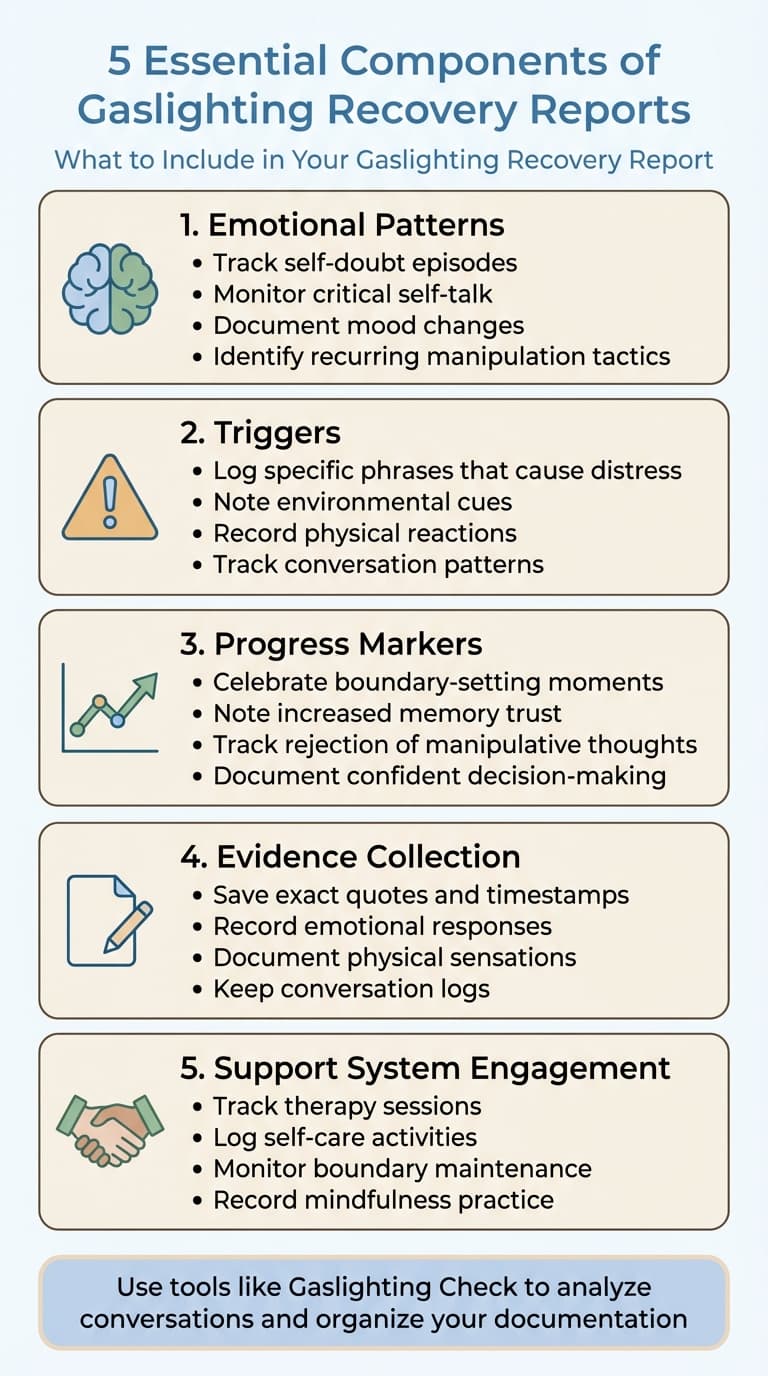
Gaslighting recovery reports help you document your emotional healing and regain clarity after manipulation. By tracking emotional patterns, triggers, and progress, these reports create a factual record of your experiences, countering confusion and self-doubt. They’re also useful for therapy or legal purposes. Here’s what to include:
- Emotional Patterns: Record self-doubt episodes, critical self-talk, and mood changes to identify recurring manipulation tactics.
- Triggers: Log specific phrases, environments, or physical reactions that evoke distress, helping you understand what sparks emotional turmoil.
- Progress Markers: Highlight moments of growth, such as setting boundaries, trusting your memory, or rejecting manipulative thoughts.
- Evidence Collection: Keep detailed records of conversations, emotional responses, and physical sensations to validate your reality.
- Support System Engagement: Track your use of therapy, self-care tools, and boundary-setting to measure recovery.
Use tools like Gaslighting Check to analyze conversations for manipulation and organize your documentation. A structured weekly report template can simplify tracking and provide a clear snapshot of your progress for personal reflection or professional guidance.
::: @figure
Healing from Gaslighting
Documenting Emotional Patterns
Emotional patterns reveal how gaslighting takes hold. When manipulation becomes a regular occurrence, it sets off predictable cycles of self-doubt, anxiety, and mood swings. Writing these patterns down turns vague feelings into tangible evidence, helping you recognize manipulation as a recurring process rather than isolated misunderstandings.
This kind of documentation breaks the cycle of second-guessing yourself - the "maybe I imagined it" loop that gaslighters rely on to keep control. By linking your emotional responses to specific incidents, you create an external record that validates your experiences. It also helps you identify when you've started to absorb the gaslighter's distorted version of reality. Start by paying attention to moments when doubt clouds your perception.
Self-Doubt Episodes
Keep track of every time you question your memory or perception of events. Write down what happened, what triggered the doubt, how often it occurs, and how it makes you feel. Capture the thoughts running through your mind, such as "maybe I imagined it", "am I losing it?" or "I must be unreliable."
Include specific details like triggers, quotes, or physical reactions to uncover repeated manipulation tactics. When you notice the same denials or dismissive behaviors showing up across your entries, the pattern becomes unmistakable. This kind of record is also invaluable for therapists or legal professionals, as it creates a clear timeline linking your psychological symptoms to specific interactions.
Critical Self-Talk
Pay attention to the inner voice that criticizes you. Write down thoughts like "I'm too sensitive", "I'm being dramatic", or "I'm unstable." Reflect on where these ideas come from - did the gaslighter use these exact words, or have you internalized their criticism over time?
Notice how this negative self-talk influences your everyday actions. Do you hesitate to make simple decisions? Do you hold back from speaking up because you've convinced yourself your perspective doesn't matter? By documenting these moments, you can separate the gaslighter's voice from your true self, an essential step in rebuilding self-trust. As you do this, also observe how these thought patterns align with changes in your overall mood.
Mood Changes
Track emotional highs and lows. Write down instances of sudden anxiety, panic attacks, irritability, or feeling emotionally "shut down." Include physical sensations like a racing heart, trembling hands, or stomach tension - your body's way of signaling that something is off.
Document changes in sleep patterns, social behavior, focus, and motivation to show the long-term effects of manipulation. These shifts often provide some of the clearest evidence of gaslighting's impact, helping you reconnect with your body's natural warning system. Over time, seeing these patterns laid out can bring clarity about which interactions consistently drain your emotional energy.
Identifying Triggers
Understanding your triggers - whether they stem from conversations, environments, or physical reactions - is a crucial step in creating a thorough gaslighting recovery plan. Triggers are those moments, words, or situations that bring back the emotional turmoil caused by gaslighting, often sparking feelings of anxiety, confusion, or dread. The goal isn’t to avoid discomfort forever but to recognize what sets off these reactions so you can take back control and respond intentionally.
To pinpoint triggers, focus on three main areas: the conversations that echo past manipulation, the environments that stir up distress, and the physical signals your body sends when something feels wrong. Together, these elements form a map of where the gaslighter’s influence might still linger.
As Robin Stern, Ph.D., Co-founder of the Yale Center for Emotional Intelligence, explains: "Gaslighting is an insidious and sometimes covert form of emotional abuse... where the abuser leads the target to question their judgments, reality, and, in extreme cases, their own sanity" [3].
Conversation Triggers
Certain phrases can feel like emotional landmines, instantly taking you back to moments when your reality was dismissed or denied. These often follow what’s called the “Narcissist’s Prayer” script, a predictable pattern of denial and blame-shifting. Common phrases include:
- "I didn’t say that."
- "You misunderstood."
- "You’re too sensitive."
- "You’re imagining things."
- "You need help."
These aren’t innocent misunderstandings - they’re deliberate attempts to make you question your memory and perception.
Other triggers might involve outright denials, like "I never said that", or subtle invalidation, such as "You’re overreacting" or "It’s not a big deal." Blame-shifting is another tactic, with statements like, "I wouldn’t get so angry if you didn’t provoke me", or "If you were more organized, I wouldn’t have to..." Some manipulators even disguise their dismissiveness as rationality, labeling your emotions as "irrational" or "crazy."
To understand these patterns, document conversations word-for-word. Write down your own words, the exact phrases they used, and how you felt during and after the exchange. Ask yourself: Are they denying something I clearly remember? Are they blaming me for their actions? Are they dismissing my emotions as "too much"? Pay attention to recurring topics or boundaries that trigger these responses. In professional settings, watch for dismissive phrases like "You wouldn’t understand this" or credit-stealing behavior. In medical contexts, be alert for dismissals like "It’s all in your head", a form of medical gaslighting that research shows disproportionately impacts BIPOC and LGBTQIA+ individuals [2].
While conversations are a common trigger, physical settings and social contexts can also evoke the same distress.
Environmental Cues
Your surroundings can be just as powerful in triggering past feelings of manipulation. Specific rooms, times of day, or even the presence (or absence) of particular people can bring back memories of gaslighting. For example, you might feel uneasy in your home office, a certain room in your house, or even at work. Notice if your anxiety spikes when you’re alone with the gaslighter compared to when others are around - a pattern often referred to as “Public Kindness, Private Cruelty.”
Track patterns like specific times or recurring events that heighten your anxiety. Don’t overlook digital spaces either - social media platforms, email threads, or messaging apps can become triggers if they were used for manipulation. To stay organized, use a consistent naming system for your records, such as "2025-12-30_HomeOffice_Conversation", to easily spot trends.
Keeley Teemsma, LCSW, MA, emphasizes: "The act of writing things down, seeing patterns, and validating your truth is healing in itself. It’s not about revenge. It’s about repair" [1].
Document the mood of each environment, who was present, and the communication method (in-person, text, phone call). Over time, this creates a clear picture of which settings amplify your anxiety and which ones feel safer.
Physical and Emotional Responses
After identifying external triggers, turn your attention inward. Your body often reacts to stress before your mind fully registers it. Symptoms like trembling hands, a racing heart, stomach tension, or feeling "spaced out" are your nervous system’s way of signaling danger. These reactions aren’t random - they’re your body’s way of telling you that a boundary has been crossed. Keep a record of these sensations, noting what triggered them and how intense they were.
Your emotional responses are just as important. Pay attention to behaviors like over-apologizing or feeling like you’re "walking on eggshells." Track mood shifts, such as sudden confusion, shame, guilt, or a sense of worthlessness. Some people even experience depersonalization, feeling as though they’re watching events unfold from outside their body. Recording these reactions creates a clinical record that helps counteract the cognitive dissonance gaslighters rely on to maintain control [1].
If you feel overwhelmed, attacked, or terrorized during a conversation, disengage immediately. It doesn’t matter who’s "right" in that moment - your priority is your emotional safety. Over time, your log of emotional responses will serve as proof that your feelings are real and valid, helping you rebuild trust in your own perceptions.
Tracking Progress Markers
Recovering from gaslighting is anything but a straight path - it's a journey marked by small but meaningful victories. Keeping track of these wins can help you see just how far you've come. The idea is to document clear signs of progress, whether it's standing up for yourself in a conversation, trusting your memory without second-guessing, or reaching out to your support network when you need help.
Think of these progress markers as proof that you're regaining control of your reality. They’re not about achieving perfection but about recognizing the moments when you make choices that reflect growth compared to a month ago. Research highlights that 74% of gaslighting survivors report lasting emotional trauma [5]. This makes it essential to intentionally track progress to counteract the deep patterns of manipulation that gaslighting creates. Building on your awareness of emotional patterns and triggers, this section focuses on identifying and celebrating tangible signs of recovery.
Evidence Collection
Collecting evidence is a powerful healing tool. By documenting incidents as they happen - what was said, how you felt, and any manipulation tactics used - you create a record that validates your experiences. Gaslighting thrives on making you doubt your memory, so keeping accurate logs can be a lifeline when confusion sets in.
Use tools like voice memos, screenshots, or written notes to document consistently. To safeguard your records, follow the 3-2-1 Backup Rule: keep three copies, use two different storage methods (like an encrypted cloud service and an external drive), and store one copy in a separate location. This ensures your evidence remains secure and tamper-proof.
Your documentation should include both external events and your internal responses. Record key details like dates, times, and quotes, but also note how your body and emotions reacted. Did your heart race? Did you feel disoriented? Over time, you may notice these reactions becoming less intense - a clear sign of healing. As Stephanie A. Sarkis, Ph.D., notes: "Identifying gaslighting patterns is crucial for recovery. When you can recognize manipulation tactics in real-time, you regain your power and can begin to trust your own experiences again."
| Evidence Category | Specific Items to Track | Purpose for Recovery |
|---|---|---|
| Interaction Data | Date, time, location, witnesses, exact quotes | Validates reality and provides legal/therapeutic proof |
| Internal State | Emotional impact, physical symptoms, "gut" feelings | Tracks self-awareness and resilience improvements |
| Recovery Actions | Mindfulness sessions, exercise, therapy attendance | Monitors engagement with healing strategies |
| Boundary Logs | Denied requests, blocked contacts, enforced limits | Evidence of reclaiming personal power |
Rejecting Manipulative Thoughts
Once you've started documenting evidence and triggers, the next step is to track your cognitive shifts. One key milestone in recovery is recognizing when you reject a manipulative thought. For example, you might catch yourself thinking, "I'm not crazy - they're using stonewalling to avoid accountability," or "I don't need to apologize for having feelings." These moments show a growing sense of self-awareness and a stronger connection to your own reality, separate from the one imposed by the gaslighter [4].
Pay attention to behavioral changes, too. Are you apologizing less? Making decisions without needing constant reassurance? Stating facts with confidence instead of hedging with phrases like "I think" or "maybe"? These shifts are clear indicators that you're rebuilding trust in your own judgment. Here’s a table of common progress markers to look for:
| Progress Marker | Sign of Improvement |
|---|---|
| Decision Making | From "difficulty choosing" to "confident choices" |
| Communication | From "over-apologizing" to "stating facts clearly" |
| Reaction to Tactics | From "self-doubt/confusion" to "identifying tactics" |
| Memory Trust | From "questioning memories" to "relying on evidence" |
Take note of how you talk to yourself. Are you kinder and more compassionate? Recovery often involves replacing harsh self-criticism with grounding exercises and self-affirmation. For instance, when a manipulative belief arises - like "They said I'm too sensitive, but I know my feelings are valid" - document how you challenged it. Each time you do, you're rewiring the mental pathways that gaslighting damaged.
Support System Engagement
Your support system, whether it’s close friends or a therapist, is another important measure of your progress. Tracking how often and effectively you lean on these resources can reveal how far you’ve come. Are you reaching out more when you’re feeling down? Are you using tools like deep breathing, calling a friend, or taking a walk to soothe yourself instead of isolating?
Keep a record of your therapy sessions, including timelines of incidents and any objective evidence, like AI-generated conversation analysis reports. This can help you present facts clearly instead of relying on vague impressions. Also, log every instance where you maintain boundaries. Whether it’s saying "no" without overexplaining or sticking to "no contact" despite attempts to pull you back in, these moments are powerful evidence of your recovery.
| Support Engagement Marker | Documentation Method | Recovery Indicator |
|---|---|---|
| Therapy Sessions | Timeline of incidents & AI-generated reports | Ability to present objective facts |
| Trusted Friends | Log of "Psychological First-Aid" usage | Increased reliance on healthy connections |
| Boundary Setting | Record of boundary violations & responses | Firmness in maintaining limits |
| Self-Care Tools | Mindfulness/exercise logs | Supports brain healing and stress reduction |
Also, take note of moments when you resist re-engagement attempts, like ignoring apologies or promises from the gaslighter. If you maintain "radio silence", that’s a major recovery milestone [5]. These instances show that you’re prioritizing your emotional safety over false hope. Research from the National Institute of Mental Health (NIMH) even shows that consistent mindfulness practice over eight weeks can increase gray matter density in the hippocampus, a brain region often affected by chronic stress. Tracking your self-care habits isn’t just symbolic - it actively supports your brain’s recovery.
Detect Manipulation in Conversations
Use AI-powered tools to analyze text and audio for gaslighting and manipulation patterns. Gain clarity, actionable insights, and support to navigate challenging relationships.
Start Analyzing NowUsing Gaslighting Check for Recovery Reports

Tracking your progress during recovery is essential, and pairing your documented milestones with reliable digital tools can make a world of difference. One such tool is Gaslighting Check (https://gaslightingcheck.com), a platform designed to analyze both text and voice conversations for manipulation tactics. By providing objective data, it helps you build a stronger, more accurate record of your recovery journey. Plus, it integrates smoothly with your existing reports, creating a cohesive and thorough documentation process.
Gaslighting Check works by scanning text messages, emails, and chat logs to identify manipulation tactics. Its voice analysis feature goes a step further, detecting tone shifts and vocal cues that might signal coercion or control. This dual analysis means you’re not left relying solely on memory; instead, you have clear, documented evidence of how interactions unfolded.
The platform also organizes your conversation history chronologically, offering a clean, timeline-style view of your interactions. This feature makes it easier to spot patterns, such as escalating behaviors or recurring triggers, that might otherwise go unnoticed. Additionally, detailed reports break down specific tactics, flag risk indicators, and suggest actionable steps. These reports are particularly helpful for personal reflection or sharing with a therapist for deeper insights.
Privacy is a top priority. The platform uses end-to-end encryption to secure your conversations and reports from the moment they’re uploaded. Automatic deletion policies give you control over how long your data is stored, ensuring sensitive interactions remain private. For those just beginning their recovery, the Free Plan offers basic text analysis at no cost. If you’re looking for more advanced features, the Premium Plan provides enhanced tools to support your journey.
Weekly Recovery Report Template
A well-organized weekly report offers a clear snapshot of your recovery journey and is easy to share with your therapist or support network. This template builds on previously documented patterns and progress markers, making it simpler to track your overall progress.
Using a basic table format helps you organize your observations without feeling overwhelmed. You can fill out entries as events happen or at the end of the week - whichever fits your routine better.
Template Structure
Your weekly recovery report should focus on five key fields that capture the most essential details. Start by recording the Date (MM/DD/YYYY) to track when specific incidents occurred and identify any timing patterns.
In the Emotional Pattern field, describe your internal state during the event. Use phrases like "self-doubt episode", "sudden anxiety", or "feeling 'too sensitive'" to keep it clear and concise. Next, in the Trigger field, note what caused your reaction. Be specific here - examples include "partner denied saying X" or "manager ignored email proof." Specificity is crucial for identifying recurring patterns later.
The Progress Marker is where you highlight how you handled the situation differently. This is the heart of the report, showing how you're growing and adapting. Examples include "recognized the tactic immediately", "did not apologize for my feelings", or "logged evidence." Finally, use the Notes section to capture additional context, such as where the event occurred, who was present, or specific phrases used by others. These details can be incredibly helpful when reviewing your reports or discussing them with a therapist.
| Field | Description/Example |
|---|---|
| Date (MM/DD/YYYY) | The day the event occurred. |
| Emotional Pattern | Your internal state (e.g., "Self-doubt episode", "Sudden anxiety", "Feeling 'too sensitive'"). |
| Trigger | The specific event or phrase that caused the response (e.g., "Partner denied saying X", "Manager ignored email proof"). |
| Progress Marker | How you responded differently (e.g., "Recognized the tactic immediately", "Did not apologize for my feelings", "Logged evidence"). |
| Notes | Additional context like location, witnesses, or specific quotes used. |
You can also reference previous analyses in the Notes field, such as "See 12/23/2025 text analysis report." This creates a more complete record by combining your personal reflections with objective data, making your recovery tracking both thorough and actionable.
Conclusion
A recovery report brings together interaction details, emotional responses, triggers, and progress into one structured record. This serves as your personal guide, helping you make sense of your experiences and regain clarity. By noting quotes, timestamps, and reactions, you create a factual account that challenges any distorted narratives.
Staying consistent with your documentation is essential. Logging dates, emotional patterns, and triggers over time builds a timeline that can expose subtle manipulation.
To complement manual efforts, digital tools can enhance your recovery process. For example, Gaslighting Check offers features to analyze conversations for manipulation patterns that might otherwise go unnoticed. The platform’s free plan includes basic text analysis, while the premium plan provides advanced options like detailed pattern detection, voice analysis, and conversation history tracking. Plus, all data is end-to-end encrypted, ensuring your sensitive records remain secure.
FAQs
How can I recognize and document emotional patterns caused by gaslighting?
To track the emotional effects of gaslighting, start by documenting each incident thoroughly. Record the date, time, and location, along with the specific words, tone, and body language used during the interaction. Include how the situation made you feel - whether it left you confused, anxious, or unsettled. Over time, review your notes to uncover patterns, such as recurring triggers or topics that often lead to manipulation.
Consider organizing your notes in a clear format, like a table or spreadsheet, with columns for Trigger, Tactic, and Emotion. Keep your records secure by storing them in a password-protected folder or encrypted file. This documentation not only helps you identify behavioral patterns but also serves as valuable evidence if you choose to involve a therapist, HR representative, or legal advisor. Tracking these moments can be an empowering step toward understanding and addressing the impact of gaslighting.
What’s the best way to track my recovery from gaslighting?
Tracking your recovery from gaslighting can be incredibly helpful when combining technology with personal reflection. For instance, the Gaslighting Check app uses AI to analyze conversations for signs of manipulation, track emotional patterns, and create detailed progress reports. These features can help you pinpoint triggers, monitor your emotional reactions, and even share summaries with a therapist or legal professional if necessary.
To deepen your recovery process, consider blending digital tools with personal practices like journaling or using printed resources. By documenting your emotions, triggers, and milestones, you can observe your growth over time and rebuild a sense of control. Recovery takes time, but keeping a clear record of your journey can make the path forward more manageable.
Why is it important to document triggers when recovering from gaslighting?
Documenting triggers plays a key role in recognizing patterns of manipulation and understanding how specific situations or behaviors affect your emotions. Keeping a record of these moments can anchor you in reality, which is particularly useful when gaslighting has left you questioning your perceptions.
By noting your triggers, you can better understand your emotional reactions, establish stronger boundaries, and use this information to support therapy or other recovery steps. In certain situations, these records might also prove useful as evidence if legal action is required.