Gaslighting Recovery: Best Online Support Groups

Gaslighting Recovery: Best Online Support Groups
If you’ve experienced gaslighting, finding support is key to recovery. Online support groups offer a safe and private way to connect with others who understand your situation. These groups provide validation, practical tips, and emotional support to help rebuild confidence and regain control. Here’s a quick look at some of the best options available:
- Next Door Solutions: Free 24/7 support in English and Spanish, focusing on self-resilience and safety planning.
- Wind Haven Foundation: Groups designed for those recovering from emotional abuse.
- YWCA: Specialized virtual groups for different age groups and LGBTQIA+ participants, free of charge.
- CORA Services: Support for overcoming coercive control and regaining autonomy.
- WOMAN, Inc.: Free peer counseling and sliding-scale therapy options, with Spanish-language programs.
- NARIKA: Sessions tailored to survivors from diverse backgrounds.
- Survivors.org: Moderated discussions and tools to track recovery progress.
For additional help, tools like Gaslighting Check analyze conversations to identify manipulation patterns and offer actionable insights. With both free and paid options, these resources can complement the emotional support of online groups, giving you a comprehensive recovery plan.
Quick Tip: Choose a group or tool that fits your needs, whether it’s live video sessions, text-based forums, or real-time analysis tools like Gaslighting Check. Taking the first step is crucial - you're not alone in this journey.
How to Break Free from Gaslighting by Narcissists & Abusers
Why Online Support Groups Help Gaslighting Recovery
Online support groups break the isolation often imposed by gaslighters, providing a lifeline to those in recovery. By connecting with others who’ve experienced similar challenges, survivors realize they’re not alone. This sense of community fosters healing and encourages the development of practical recovery strategies. For instance, platforms like AfterSilence.org host over 31,000 members with nearly 1,000,000 posts, while Pandora’s Aquarium boasts over 70,000 members and 2,000,000 posts[6]. These spaces create a foundation for shared understanding and mutual support.
Validation plays a crucial role in healing. Moderated forums and secure video chats offer a safe space where survivors can express their feelings without fear of dismissal or manipulation[3]. Members share recovery tools such as the Gray Rock method, which involves emotional detachment to deprive manipulators of control. Others recommend journaling to separate personal truth from the gaslighter’s narrative or creating a "psychological first-aid kit" - a list of comforting activities like walking or meditation for moments of distress[5][9]. A common piece of advice is to implement strict no-contact policies to avoid falling victim to hoovering tactics[5].
Digital safety is a critical aspect of these groups. To protect members’ privacy, strict confidentiality rules are enforced, such as banning screenshots or saving contact information[3]. Many participants use pseudonyms, clear their browser histories, and rely on secure messaging apps like Signal or Google Voice to maintain anonymity.
Accessibility is another major benefit. Platforms like HeyPeers offer access to over 1,000 free support groups each month, while many peer-led communities provide moderated forums and chats for those seeking connection[8][7][6]. For those willing to invest in paid options, services like Herd Support Groups charge between $10 and $50 per session, making them a more affordable alternative to traditional therapy[1]. Whether you prefer immediate interaction through video calls or the anonymity of 24/7 forums, online support groups provide flexible and personalized options to meet diverse needs.
Best Online Support Groups for Gaslighting Recovery
If you're navigating the path to healing from gaslighting, online support groups can be a lifeline. These virtual communities offer a safe space to rebuild trust, connect with others who understand your experiences, and regain your sense of self. Here are some highly regarded groups designed to provide specialized support for survivors.
Next Door Solutions to Domestic Violence Support Groups

Next Door Solutions provides 24/7 virtual support for survivors, including women, men, teens, and members of the LGBTQIAP+ community. Their programs focus on building self-resilience, creating safety plans, setting healthy boundaries, and practicing self-care. Sessions are offered in both English and Spanish at no cost, and you can schedule an intake session by calling their hotline [11][13].
One participant shared, "This group has really helped me in my personal growth and understanding what I have been through. This group helps me know I am not alone" [11].
Wind Haven Foundation Support Groups

The Wind Haven Foundation offers online groups tailored to those recovering from emotional abuse. Their sessions emphasize creating social support networks, helping survivors feel connected and understood [10].
YWCA Domestic Violence Support Groups

YWCA hosts virtual support groups for women of all ages, with specialized options for children, teens, young adults, older adults, and LGBTQIA+ participants. Their programs combine community building with practical skills such as mindfulness, healthy coping mechanisms, and conflict resolution. These services are available in English and Spanish, free of charge [13].
CORA Services Support Groups

CORA Services focuses on aiding recovery from coercive control, a pattern of manipulative behavior that often includes gaslighting. Their support groups are designed to help survivors regain their autonomy and confidence [10].
WOMAN, Inc. Support Groups
WOMAN, Inc. facilitates virtual support groups led by trained professionals. These groups prioritize safety planning and emotional support. Survivors in San Francisco can access five free peer counseling sessions, with sliding-scale payment options for individual or family therapy. They also offer a Latinx Program with Spanish-language support [12].
NARIKA Support Groups

NARIKA provides culturally sensitive online sessions for survivors from diverse backgrounds. Their approach acknowledges the role of cultural factors in both the experience of gaslighting and the healing process. By fostering community connections and offering digital support strategies, NARIKA creates a space where survivors can feel seen and understood [10].
Survivors.org Support Groups

Survivors.org operates a platform where survivors can join moderated discussions and track their recovery progress. The platform encourages participants to document their healing journeys, offering a sense of empowerment and a tangible way to measure growth.
Ruth Darlene Patrick, Executive Director of WomenSV, explains, "Being surrounded by individuals who truly understand and empathize with your journey can be immensely empowering. It reminds survivors that they are not alone and that healing is possible" [10].
Detect Manipulation in Conversations
Use AI-powered tools to analyze text and audio for gaslighting and manipulation patterns. Gain clarity, actionable insights, and support to navigate challenging relationships.
Start Analyzing NowSupport Group Features Compared
::: @figure
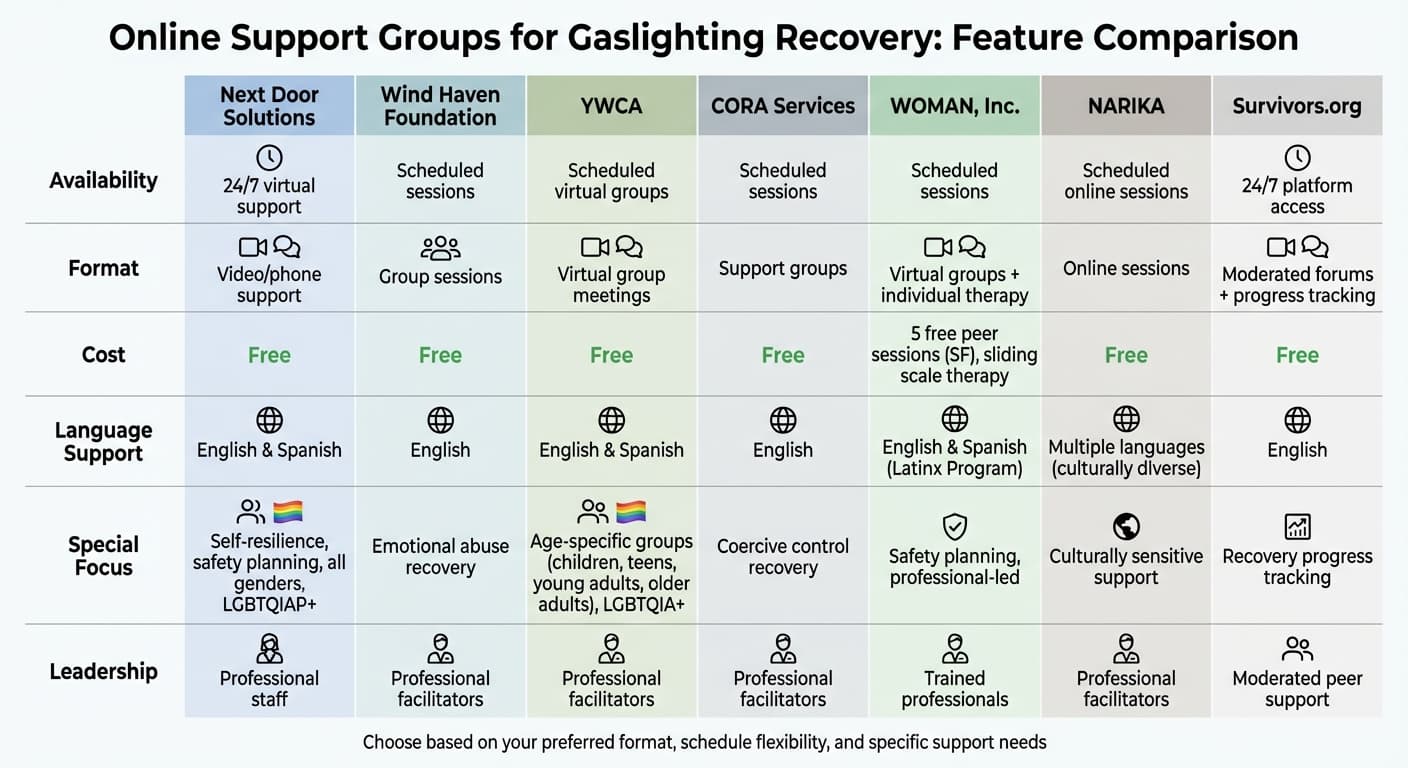
When exploring online support groups, it's important to understand how their formats influence the recovery experience. These groups vary in structure, scheduling, and levels of privacy. Some operate on fixed schedules with video calls, creating a setting similar to in-person meetings through audio and visual interaction[4]. Others provide 24/7 access via forums or chat platforms, allowing participants to join discussions at their convenience while maintaining flexible privacy options[3][14].
The leadership style of the group also plays a significant role. Peer-led groups pair survivors with trained peers who share similar experiences, fostering a sense of connection and understanding. Clinician-led groups, on the other hand, offer professional guidance and a more structured approach. For instance, Safe Space incorporates a curriculum designed by gaslighting expert Sarah Morales, focusing on education as a recovery tool[2]. Another example is ShareWell, which blends scheduled live peer sessions with continuous access to forums, giving participants both structure and flexibility[14].
Pricing models for these groups vary as well, ranging from free access to monthly subscription fees. Understanding these distinctions can help you choose the support network that best suits your needs during gaslighting recovery.
Gaslighting Check: A Digital Tool for Recovery Support

Support groups offer a sense of community, but Gaslighting Check brings a tech-driven edge to the table. This platform is designed to analyze conversations and uncover manipulation patterns in real-time. It complements the human connection provided by support groups, acting as a private tool to help you identify gaslighting tactics and make sense of confusing interactions. When emotional clarity feels out of reach, this digital solution can provide the insights you need.
Shockingly, many survivors stay in manipulative relationships for over two years before seeking help. Tools like Gaslighting Check can speed up the process of recognizing harmful patterns. Dr. Stephanie A. Sarkis, author of Healing from Toxic Relationships, emphasizes the importance of this:
"Identifying gaslighting patterns is crucial for recovery. When you can recognize manipulation tactics in real-time, you regain your power and can begin to trust your own experiences again."[15]
Privacy is at the heart of Gaslighting Check. All data is encrypted end-to-end, stored anonymously, and automatically deleted after use. These measures ensure a safe space for analyzing interactions without the fear of anyone discovering your activity.
Beyond its analysis tools, the platform also offers a 24/7 moderated Discord community, blending its technological insights with peer support to create a well-rounded recovery experience.
Key Features of Gaslighting Check
Gaslighting Check is packed with tools to help you spot manipulation. The platform allows you to paste text-based conversations or upload audio files for analysis. It evaluates tone and identifies patterns of manipulation. If you opt for the Premium Plan, you get access to features like conversation history tracking, severity scoring, and detailed reports that include actionable recommendations. The platform even provides resources to guide your recovery journey.
Looking ahead, Gaslighting Check plans to introduce private journaling features for emotional tracking in Q1 2026 and launch dedicated mobile apps for iOS and Android in Q2 2026, making it even easier to access support on the go.
Gaslighting Check Plans and Pricing
Gaslighting Check offers three pricing tiers to suit different needs:
| Plan | Price | Best For | Key Features |
|---|---|---|---|
| Free Plan | $0 | Exploring the platform | Basic text and voice analysis, data encryption, auto-deletion |
| Premium Plan | $9.99/month | Active recovery | Advanced analysis, history tracking, severity scoring, detailed reports, resource recommendations |
| Enterprise Plan | Custom pricing | Professionals and organizations | All premium features, plus customization for therapeutic or group use |
The Free Plan is a great starting point. It offers basic text and voice analysis, along with robust privacy protections like encryption and automatic data deletion. This plan is ideal if you're just testing the waters to see how conversation analysis can aid your recovery.
For $9.99/month, the Premium Plan provides a more comprehensive toolkit. With features like severity scoring and conversation history tracking, you can monitor how manipulation patterns develop over time. Detailed reports not only highlight specific tactics but also suggest actionable responses, helping you regain control.
The Enterprise Plan is designed for therapists, counselors, and organizations working with survivors. Pricing is customized to fit professional needs and includes additional tools tailored for clinical or organizational use, making it a powerful resource for supporting recovery on a larger scale.
Conclusion
Recovering from gaslighting is a journey that thrives on support. Having the right people and tools around you can mean the difference between feeling stuck in isolation and taking steps toward rebuilding your self-confidence. As WomenSV wisely states: "Abuse happens in isolation. Recovery unfolds in community."[10] Online support groups play a vital role in this process, offering validation, education, and a sense of connection with others who genuinely understand what you’ve been through.
Each group highlighted earlier brings its own strengths to the table. Your choice will depend on what feels right for you - whether it’s real-time video sessions for face-to-face interaction or text-based forums that allow for privacy and flexibility. Some survivors find comfort in the immediacy of live discussions, while others prefer the freedom to engage at their own pace.
In addition to community support, digital tools can further empower your recovery. Tools like Gaslighting Check provide round-the-clock insights into manipulation patterns, helping you make sense of your experiences. When paired with the guidance and solidarity of online groups, these tools create a well-rounded recovery plan.
The effectiveness of these resources is backed by numbers. For example, 92% of Charlie Health clients and their families would recommend their intensive outpatient program for addressing trauma and gaslighting[16]. Meanwhile, the Anxiety and Depression Association of America (ADAA) runs free peer-to-peer communities that connect over 100,000 members from 174 countries[17]. Whether you start with a free group, invest $9.99 a month in a premium tool, or combine several resources, the key is to take that first step toward reclaiming your life and rebuilding your sense of self-worth.
Your recovery begins with finding a support network that truly understands. Take that step today - you’re not alone in this journey.
FAQs
How do online support groups help with gaslighting recovery?
Online support groups create a welcoming space for those recovering from gaslighting. They give survivors a chance to share their stories, acknowledge their emotions, and connect with others who truly understand what they’ve been through. This shared sense of community can ease feelings of loneliness and help rebuild trust in oneself.
Beyond emotional support, these groups often provide practical resources like coping techniques, educational materials, and advice on regaining emotional strength. Consistent involvement can boost confidence, foster self-assurance, and help individuals take meaningful steps toward healing.
What should I look for in an online support group for recovering from gaslighting?
When selecting an online support group for gaslighting recovery, it’s important to focus on finding a space that feels safe, supportive, and private. Seek out groups led by trained professionals or experienced peer leaders who can guide discussions in a constructive way and maintain a respectful atmosphere. Privacy should be a top priority - look for platforms that enforce strict rules against screenshots or recordings and use encryption to safeguard members' interactions.
Choose a group with regularly scheduled meetings that align with your time zone, along with on-demand forums where you can seek immediate connection when needed. Many groups also provide educational resources, such as workshops or curated reading lists, to help deepen your understanding of gaslighting and equip you with effective coping strategies. Cost is another consideration - plenty of groups are free or low-cost, ensuring they remain accessible to a broad audience.
To further strengthen your recovery, tools like Gaslighting Check can be a valuable addition. These tools analyze conversations for manipulation tactics and offer detailed, private reports. By pairing these insights with the support of a compassionate community, you can work toward rebuilding your confidence and reclaiming control over your reality.
What privacy precautions should I take when joining online support groups for gaslighting recovery?
Joining online support groups focused on gaslighting recovery offers a chance to connect with people who’ve faced similar challenges. However, it’s crucial to prioritize your privacy while participating. Many of these groups rely on third-party platforms, like video conferencing tools, which might not fully ensure confidentiality. There’s always a risk that personal information could be recorded or shared, even unintentionally.
To safeguard your privacy, consider using a pseudonym and avoid sharing details that could reveal your identity. It’s also wise to review the group’s privacy policy before joining. Keep in mind that these groups are typically peer-led and don’t carry the same legal protections as therapy sessions. By taking these precautions, you can engage with the community while maintaining your personal boundaries.