Gaslighting in Politics: How It Affects Society

Gaslighting in Politics: How It Affects Society
Gaslighting in politics is a manipulative strategy where leaders distort facts, deny observable truths, and create confusion to control public perception. This tactic erodes trust in institutions, divides communities, and disproportionately harms marginalized groups. By undermining shared reality, it makes addressing critical issues like climate change or public health nearly impossible.
Key points:
- Politicians use denial, blame-shifting, and discrediting of critics to confuse and destabilize populations.
- Media and social platforms amplify false narratives, creating echo chambers and fostering mistrust.
- Marginalized communities face the brunt of these tactics, often reframing systemic issues as personal failings.
- Psychological effects include confusion, self-doubt, and loss of trust in one’s own judgment.
To counter political gaslighting:
- Recognize common tactics such as denial of facts, introduction of conflicting narratives, and emotional invalidation.
- Use tools like Gaslighting Check to analyze political rhetoric.
- Support media literacy education to help individuals identify manipulation.
- Advocate for transparency in political communication and protect independent institutions.
Understanding and resisting gaslighting is essential to restoring trust and ensuring accountability in democratic systems.
Political Gaslighting: What Every Citizen Needs To Know | Robin Stern | Medium Day 2024
How Political Gaslighting Works
::: @figure
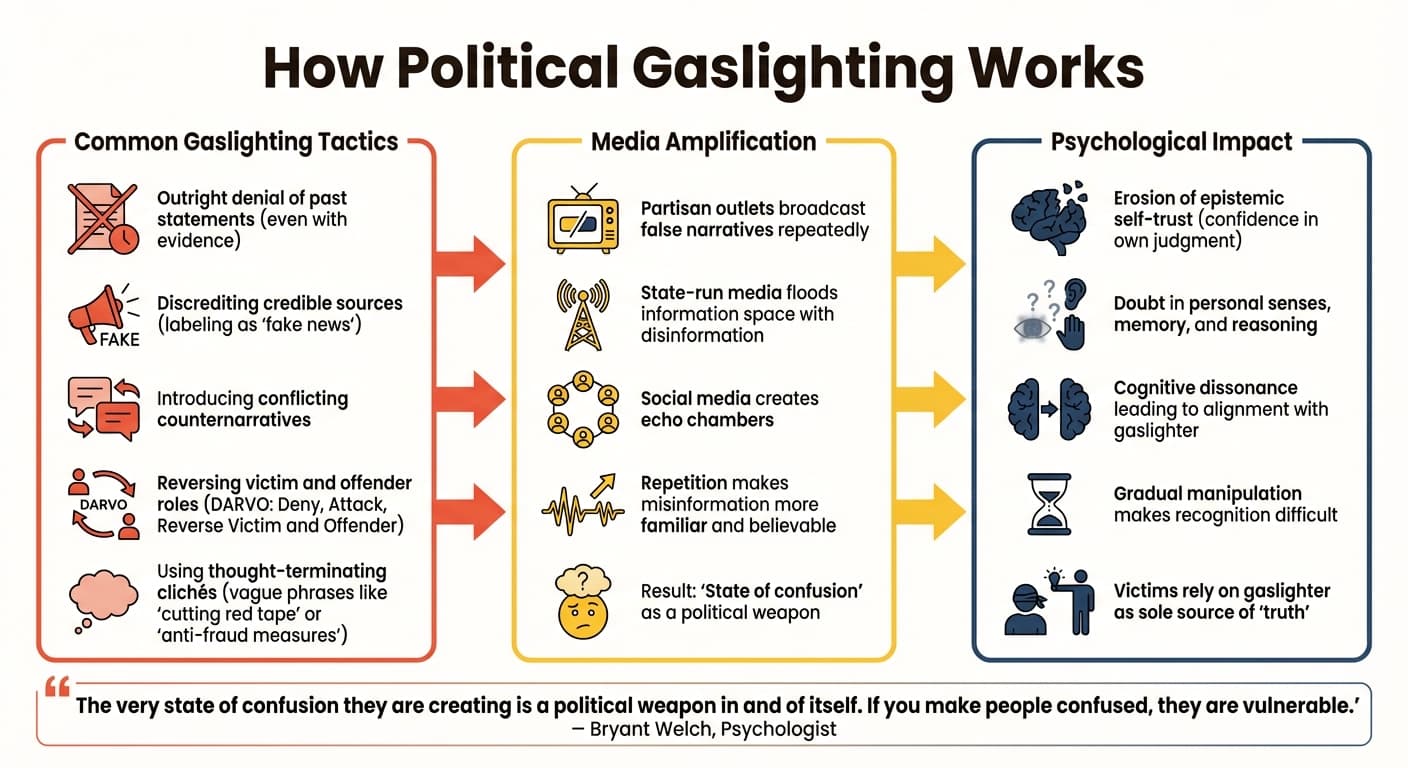
Political gaslighting undermines public trust and deepens divisions by using manipulative tactics that exploit psychological vulnerabilities. When amplified through media, these strategies gain even more power, distorting perceptions on a large scale.
Common Gaslighting Tactics
One hallmark of political gaslighting is outright denial of past statements, even when evidence proves otherwise. Another is discrediting credible sources by labeling them as "fake news." To further muddy the waters, gaslighters often introduce conflicting counternarratives, making it harder to discern the truth. A notable example is Donald Trump’s years-long questioning of Barack Obama’s birthplace. Even after admitting Obama was born in the U.S., Trump deflected responsibility by claiming, “Hillary Clinton and her campaign of 2008 started the birther controversy” and that he “finished it” [5].
Counternarratives are particularly effective in creating confusion. Take the case of Malaysia Airlines Flight 17, which was shot down over Ukraine in July 2014. Despite evidence showing a Russian BUK missile system was responsible, the Russian government flooded media with contradictory stories. These ranged from bizarre claims like the plane being filled with dead bodies before takeoff to accusations that a Ukrainian jet was responsible. Over six years, the Kremlin continued spinning new stories to obscure the facts [5].
Another tactic is reversing victim and offender roles, often referred to as DARVO (Deny, Attack, Reverse Victim and Offender). For instance, when data revealed alarming deforestation rates in Brazil, President Jair Bolsonaro dismissed the findings as politically motivated attacks and fired the head of the agency responsible for monitoring the data. He labeled the reports “sensationalist” to deflect criticism [5].
Gaslighters also rely on thought-terminating clichés - vague phrases designed to shut down deeper scrutiny. Expressions like “returning power to parents,” “cutting red tape,” or “anti-fraud measures” may sound reasonable but often mask significant policy changes or the dismantling of safeguards [2][6]. These tactics are especially effective when amplified by media, as explored in the next section.
How Media and Disinformation Spread Gaslighting
The reach and repetition of gaslighting tactics are amplified by media, making misinformation more familiar and, therefore, more believable. Partisan outlets and social media platforms play a key role, broadcasting false narratives repeatedly until they take root [5]. Governments further this agenda by using state-run media and unofficial accounts to flood the information space with disinformation [5]. This creates what psychologist Bryant Welch calls a “state of confusion,” a deliberate tactic to leave people feeling disoriented.
"The very state of confusion they are creating is a political weapon in and of itself. If you make people confused, they are vulnerable. By definition they don't know what to do." – Bryant Welch, Psychologist and Author [4]
Social media compounds the problem by fostering echo chambers - online spaces where people reinforce their own beliefs while dismissing outside perspectives. Within these environments, gaslighting narratives are repeated, critical voices are ignored, and the overwhelming flood of contradictory information leads to disengagement from political discourse [5][2].
Why Gaslighting Works: Psychological Factors
Gaslighting’s success lies in its ability to exploit psychological vulnerabilities. One of its most damaging effects is the erosion of epistemic self-trust - the confidence in one’s own senses, memory, and reasoning. Researcher Natascha Rietdijk from Tilburg University explains that gaslighting undermines this self-trust, leaving individuals doubting their own judgment [5].
"Post-truth politics does not just impair knowledge or democracy, it can also undermine our epistemic self-trust and thereby our epistemic autonomy." – Natascha Rietdijk, Researcher, Tilburg University [5]
This manipulation also preys on trust and dependency. People are especially susceptible when they feel emotionally or practically inclined to trust a leader, even if that leader’s claims contradict evidence. Supporters may align with a gaslighter’s version of reality to avoid cognitive dissonance or to maintain a sense of security [5][1].
Additionally, gaslighting often unfolds gradually, making it harder for victims to recognize the manipulation. Over time, this slow erosion of clarity leaves people questioning their perceptions and feeling disoriented. In this state, they may come to rely on the gaslighter as their sole source of “truth” [4][2].
"If Donald Trump can undercut America's trust in all media, he then starts to own them and can start to literally implant his own version of reality." – Bryant Welch, Psychologist and Author [4]
Effects of Political Gaslighting on Society
Political gaslighting reshapes how people perceive reality, undermining trust, fueling division, and disproportionately affecting the most vulnerable.
Loss of Trust and Shared Facts
One of the first casualties of political gaslighting is epistemic autonomy - our ability to trust our own judgment and discern truth from falsehood. When leaders deny observable facts and label credible sources as adversaries, they erode the shared understanding that democracy depends on. For example, despite over 60 failed court challenges and no evidence of widespread fraud, claims of a "stolen" 2020 U.S. election persisted [2].
By targeting institutions like the media, judiciary, and scientific community, gaslighters dismantle the foundation of objective truth. This creates a fragmented reality where citizens struggle to evaluate policies or hold leaders accountable. When groups live in entirely separate versions of reality, it becomes nearly impossible to find common ground, deepening societal divides.
Increased Polarization and Extremism
Gaslighting doesn’t just confuse people - it actively divides them. By painting critics as enemies, gaslighters push individuals toward more extreme positions [2]. Without agreement on basic facts, meaningful dialogue breaks down, leaving many disoriented and reliant on distorted narratives. This confusion becomes a deliberate political weapon. When leaders normalize dismissing facts as "fake news" and discredit institutions, they encourage followers to reject inconvenient truths, often leading to radicalization [4].
These divisions hit vulnerable groups the hardest, as they’re often the ones caught in the crossfire of escalating polarization.
Harm to Vulnerable Groups and Mental Health
Political gaslighting exploits existing inequalities, especially within marginalized communities. It manipulates power imbalances and taps into stereotypes [1]. For instance, leaders may deny systemic discrimination or reframe harmful policies with positive-sounding terms like "empowering local control" or "cutting red tape", effectively erasing the lived experiences of those most impacted [2].
The psychological effects can be devastating. Victims frequently report feelings of confusion, self-doubt, and even questioning their sanity. Over time, this can lead to clinical conditions like depression, anxiety, and a pervasive sense of helplessness [1]. Gaslighting undermines a person’s ability to trust their own perceptions, making it harder to engage in civic life or challenge authority. In 2022, Merriam-Webster named "gaslighting" its Word of the Year, underscoring how pervasive this tactic has become [3].
"Gaslighting is a societal problem that flourishes in relationships characterized by imbalanced power dynamics." – Vernita Perkins and Leonard A. Jason, PhDs [1]
Perhaps the most troubling aspect of political gaslighting is how it normalizes manipulation across society. As this behavior becomes more widespread, it becomes harder for individuals to recognize when they’re being deceived - whether by leaders, institutions, or even in personal relationships.
Detect Manipulation in Conversations
Use AI-powered tools to analyze text and audio for gaslighting and manipulation patterns. Gain clarity, actionable insights, and support to navigate challenging relationships.
Start Analyzing NowHow to Recognize and Resist Political Gaslighting
Recognizing gaslighting is the first step in protecting yourself against political manipulation.
How to Identify Gaslighting Patterns
Political gaslighting often follows predictable patterns. Leaders may deny making past statements - even when there's video evidence - shift blame by framing disagreements as misunderstandings, or dismiss valid concerns as mere oversensitivity. These tactics can also include introducing contradictory narratives, discrediting critics by attacking the media or experts, and outright denial of clear facts, even when evidence is undeniable[5].
If you're questioning a political claim, consider this: Is the speaker denying facts that can be verified? Are they shifting blame or invalidating legitimate emotions? If the answer is yes to any of these, you may be encountering gaslighting. Recognizing these patterns is crucial, and institutions like the media, educators, and fact-checkers play a vital role in combating such manipulation.
What Media, Educators, and Fact-Checkers Can Do
Media and educators are key players in building public awareness and resistance. According to inoculation theory, teaching people to identify misleading tactics before they're exposed to them is far more effective than correcting misinformation after the fact[8]. News outlets should go beyond fact-checking individual claims by exposing the broader strategies of manipulation.
For example, in November 2016, Donald Trump used a Twitter controversy involving the Broadway cast of Hamilton to distract from a $25 million lawsuit settlement related to Trump University, which included a $1 million penalty. Google Trends data from that time showed that public interest was overwhelmingly focused on the Broadway incident rather than the legal settlement[8].
"People can be 'inoculated' against being misled if they are taught to recognize misleading rhetorical techniques." – The Conversation[8]
By shifting the focus from sensational headlines to the underlying events, fact-checkers and educators can empower the public to question and resist manipulative tactics. These approaches also pave the way for practical tools that help individuals verify political discourse more effectively.
Using Gaslighting Check to Detect Manipulation

Turning awareness into action is easier with tools like Gaslighting Check (https://gaslightingcheck.com), which provides practical support for analyzing and countering manipulative strategies. While political gaslighting is often a large-scale issue, similar tactics can surface in everyday conversations.
The platform offers text and voice analysis, enabling users to upload political speeches, debate transcripts, or recorded conversations. Its AI scans for patterns like denial, blame-shifting, and emotional invalidation, delivering detailed reports with actionable insights. For those seeking deeper analysis, an affordable premium plan includes features like conversation history tracking to monitor recurring patterns over time.
Privacy is a major focus. Gaslighting Check employs end-to-end encryption and automatic data deletion to ensure user information remains secure. Whether you're a journalist fact-checking rhetoric, an educator teaching media literacy, or someone trying to navigate complex political messaging, this tool can help you regain confidence in your ability to discern truth from manipulation.
Solutions to Reduce Political Gaslighting
Tackling political gaslighting requires a combined effort from individuals, communities, and policymakers. Across the United States, practical steps are already being taken to address this issue.
What Individuals and Communities Can Do
The first step in protecting yourself is to maintain epistemic self-trust - confidence in your own ability to perceive and interpret reality[7]. When political leaders deny documented facts or dismiss your lived experiences, trust your judgment.
"By cultivating an environment where people feel safe to express their thoughts and feelings, communities can collectively work towards identifying and addressing instances of gaslighting."
– Vernita Perkins, PhD and Leonard A. Jason, PhD, Psychology Today[1]
Set boundaries during political discussions. If you encounter ambiguous language or contradictory claims, don’t feel obligated to interpret them charitably. Instead, verify questionable statements using credible, fact-checked sources. Tools like Gaslighting Check can help analyze political rhetoric for manipulation tactics.
Communities can also take action by organizing media literacy workshops. These workshops can teach participants to identify common gaslighting methods, such as introducing conflicting narratives, discrediting critics, and outright denying facts[7]. Open conversations with friends, family, and neighbors can build collective awareness, ensuring that if one person overlooks manipulation, others might catch it. These local initiatives work hand-in-hand with broader changes in media and education.
Changes Needed in Media and Education
Media outlets play a critical role in combating gaslighting. Instead of simply reporting false claims, they should actively challenge misinformation and redirect attention to verified facts[9]. Educational institutions also have a part to play by incorporating media literacy into their curricula. Teaching students how to spot manipulation and understand how gaslighting exploits power imbalances can help them navigate complex political landscapes[1][9]. The 1,740% surge in online searches for "gaslighting" in 2022 underscores the growing demand for this knowledge[9].
"Gaslighting could not exist without inequities in the distribution of social, political, and economic power."
– Paige L. Sweet, Researcher, Harvard University[10]
Partnering with reputable news organizations to provide real-world examples of manipulation can further empower students. Focusing on politicians’ actions rather than their words is especially important, as persuasive language often hides contradictions[10]. These efforts, combined with community initiatives, create a strong defense against gaslighting.
Policy and Legal Options
Governments can play a pivotal role by enforcing transparency in political advertising and communication, ensuring voters have access to accurate information[7]. An informed electorate is the cornerstone of democracy, and misrepresentation of facts undermines this principle.
Protecting independent oversight institutions is equally essential. The judiciary, scientific communities, and academia often become targets of gaslighting aimed at discrediting reliable sources of information[2][7]. Steps like safeguarding judicial independence, maintaining funding for research, and enforcing civil rights protections can shield these institutions. Additionally, preserving public data infrastructure is crucial to prevent the erasure of inconvenient truths about issues like race, climate, and health[2].
When governments attempt to eliminate demographic data collection or defund research exposing systemic issues, they are using gaslighting to obscure reality. Effective policies must protect these information sources while upholding First Amendment rights. Transparency, not censorship, is the key to restoring trust and ensuring a shared understanding of the truth.
Conclusion: Rebuilding Trust and Shared Reality
Political gaslighting poses a serious threat to democracy by undermining our shared understanding of facts. The key to countering this manipulation starts with recognizing it. As Natascha Rietdijk, PhD Researcher at Tilburg University, points out:
"Recognizing gaslighting empowers us to identify its occurrence. That recognition might be a crucial first step in empowering people to resist gaslighting." [5]
Once identified, combating gaslighting requires action on multiple fronts. On a personal level, individuals can safeguard themselves by trusting their instincts and cross-checking information through reliable sources. Tools like Gaslighting Check can help by analyzing political speech for manipulative patterns, providing a way to verify facts. Communities, on the other hand, can foster resilience by encouraging open conversations and offering workshops that teach people to recognize the key tactics of gaslighting: introducing distracting counternarratives, discrediting critics or experts, and outright denial of obvious truths [5][7].
The role of media and education is equally critical. Journalists and educators must emphasize fact-checking and equip the public with the skills to critically evaluate political rhetoric. Policymakers also have a responsibility to enforce transparency and ensure independent oversight. The dramatic 1,740% increase in searches for "gaslighting" in 2022 highlights the growing awareness and demand for these tools and knowledge [9].
"The antidote lies in truth-telling, transparency, solidarity, and collective defense of our shared reality. In this moment, refusing to be gaslit is not just a personal act of clarity - it is a political act of resistance."
– Center for Racial and Disability Justice [2]
FAQs
How can people protect themselves from political gaslighting?
Political gaslighting occurs when leaders twist facts, deny previous statements, or dismiss criticism to confuse and manipulate the public. This tactic can erode trust and make people second-guess their own perceptions, which is why recognizing it is crucial.
To safeguard yourself, start by cross-checking information with multiple reliable sources and fact-checking claims thoroughly. Document statements or remarks so you can identify contradictions over time. Be mindful of common gaslighting strategies, such as consistent denial or belittling critics, and expand your media consumption to avoid being trapped in echo chambers. Engaging with trusted friends or communities for discussions and emotional support can also help, as isolation often makes manipulation more effective. Additionally, tools like Gaslighting Check can assist in analyzing conversations for signs of manipulation and provide evidence when needed. By staying informed, tracking inconsistencies, and leaning on supportive networks, you can resist political gaslighting and trust your own judgment.
How do media and social platforms contribute to political gaslighting?
Media and social platforms play a powerful role in spreading political gaslighting, often amplifying distorted narratives to massive audiences. Politicians and their supporters frequently use these channels to dismiss facts, undermine critics, and promote misleading counterarguments. Social media algorithms make this even more effective by favoring content that’s sensational or emotionally charged. This creates a cycle where falsehoods gain traction, making it harder for people to trust their instincts or discern the truth.
Traditional media can also play a part by giving airtime to repeated false claims, while social networks accelerate their reach to millions. Over time, this steady stream of manipulation eats away at public trust and blurs the boundaries between fact and fiction. Tools like Gaslighting Check offer a way to push back, helping individuals spot emotional manipulation and better navigate the gaslighting tactics often embedded in media and social content.
Why are marginalized communities more vulnerable to political gaslighting?
Political gaslighting happens when leaders or systems twist facts to manipulate how people perceive reality, ultimately sowing confusion and eroding trust. Marginalized communities are especially at risk because they often face systemic discrimination, limited access to reliable information, and a long history of having their lived experiences dismissed. This lack of support makes it even harder for these groups to push back against such manipulation.
These tactics often exploit stereotypes, silence activist voices, and distort histories of oppression to maintain existing power structures. The result? Individuals feel isolated, their confidence is shaken, and mental health issues like anxiety and self-doubt are exacerbated. For communities that rely on alternative networks or resources, the effects of gaslighting can create a vicious cycle, making it even harder to counteract.
Tools like Gaslighting Check can play a crucial role in identifying manipulation as it happens. By validating people's perceptions, these tools empower individuals to resist political gaslighting and rebuild trust in their own understanding of the world.