AI-Powered Reports: Gaslighting in Conversations

AI-Powered Reports: Gaslighting in Conversations
Gaslighting is a subtle yet harmful form of emotional manipulation that can leave you doubting your memories, perceptions, and feelings. AI tools, like Gaslighting Check, are now being used to identify these patterns in conversations. By analyzing text, voice, and behavior over time, these tools detect tactics like reality distortion, blame-shifting, and emotional invalidation. They generate detailed reports with risk scores, flagged excerpts, and trends, offering clarity and validation for those experiencing manipulation. While these tools are not a substitute for professional support, they provide valuable insights to help you regain confidence and navigate your relationships more effectively.
Because "Bullshit Detector" was taken | The Human Filter Demo
Detect Manipulation in Conversations
Use AI-powered tools to analyze text and audio for gaslighting and manipulation patterns. Gain clarity, actionable insights, and support to navigate challenging relationships.
Start Analyzing NowHow AI Detects Emotional Manipulation
::: @figure
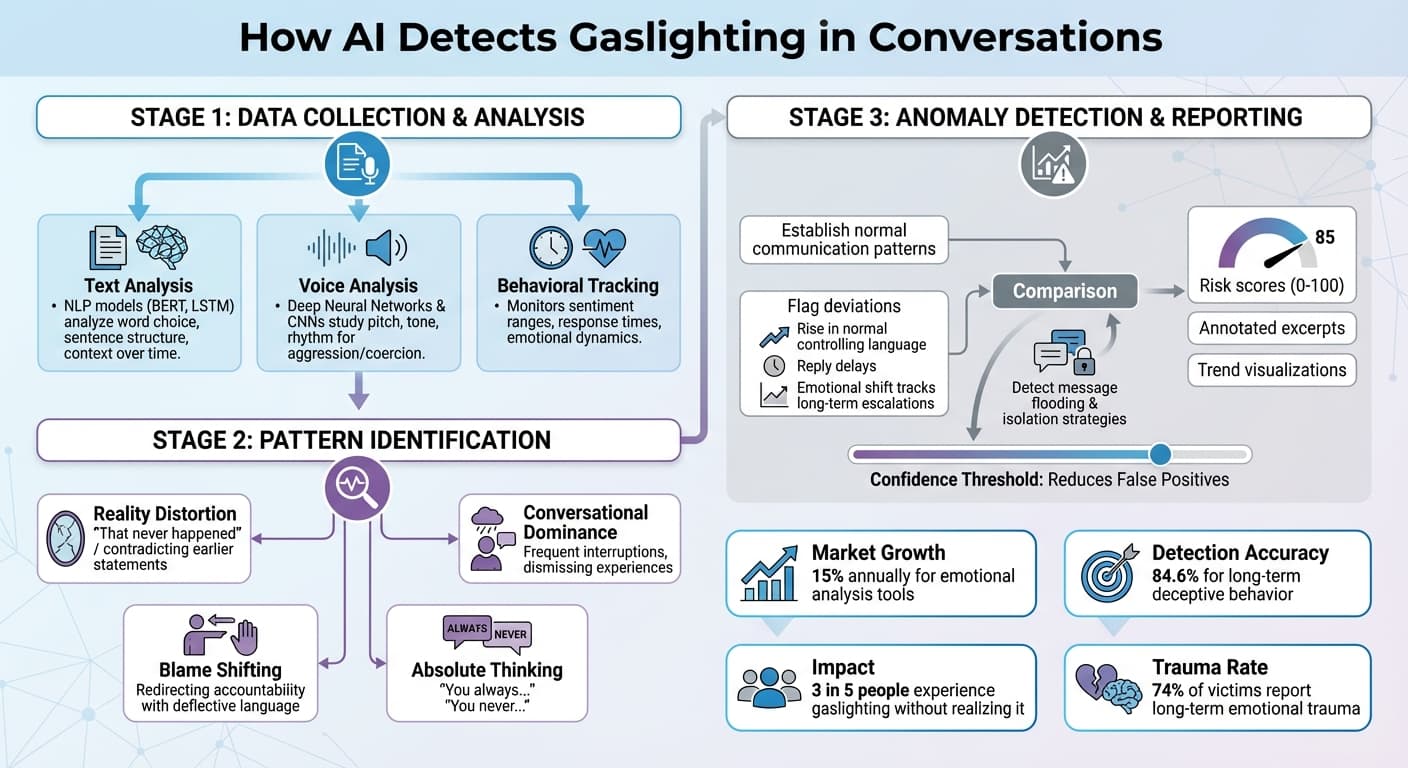
AI identifies gaslighting by analyzing text, voice, and behavioral patterns, focusing on subtle changes over time rather than just spotting obvious phrases. It uses tools like Natural Language Processing (NLP), voice biomarker analysis, and behavioral anomaly detection to create a detailed view of interactions.
Common Gaslighting Patterns AI Identifies
Once conversational data is collected, AI pinpoints specific manipulation tactics. For example, it recognizes reality distortion, where someone denies documented events with phrases like "That never happened" or contradicts earlier statements. It also detects emotional invalidation, which involves dismissive comments like "You're too sensitive", "It was just a joke", or "You're overreacting." These phrases are often used to undermine someone's feelings systematically. Blame shifting is another tactic, where accountability is redirected using accusatory or deflective language.
The system also tracks conversational dominance, identifying patterns where one person frequently interrupts or dismisses the other's experiences to control the narrative. Another red flag is "absolute thinking", marked by phrases like "you always" or "you never", which distort reality and can leave someone feeling inadequate.
Text, Audio, and Voice Analysis
Text analysis relies on advanced models like BERT and Long Short-Term Memory networks to evaluate word choice, sentence structure, and the context of conversations. Instead of flagging isolated phrases, AI examines how statements connect - or conflict - over time. Sentiment analysis adds another layer, tracking shifts in tone, such as moving from confidence to confusion or anxiety within a single exchange.
Voice analysis complements this by using Deep Neural Networks and Convolutional Neural Networks to study vocal patterns. These tools analyze pitch, tone, and rhythm to detect signs of aggression or coercion. For instance, neutral words spoken with an aggressive tone, a shaky voice, or unnaturally rapid speech can indicate manipulation. The growing demand for emotional analysis tools, with the market expanding over 15% annually, highlights the increasing use of such technologies in customer experience and security systems [2].
Gaslighting Check combines text and voice analysis to look for manipulative language patterns and tonal inconsistencies in voice recordings. This multi-layered approach improves detection accuracy, catching manipulation that might slip through if only one form of analysis were used.
Detecting Behavioral Anomalies
AI creates a baseline for normal communication in each relationship by learning typical patterns, such as sentiment ranges, tone, and response times. Deviations from this baseline - like sudden increases in controlling language, delays in replies, or shifts in emotional dynamics - are flagged as potential concerns. For example, if someone who usually responds quickly starts taking hours to reply when challenged, the system notes this change.
Using T-Pattern Analysis, AI tracks long-term behavioral trends to identify gradual escalations. It can also spot tactics like "message flooding", where a manipulator overwhelms someone with rapid texts to confuse them, or isolation strategies that subtly cut off support systems. By comparing current interactions to the established baseline, the system uncovers manipulation patterns that might otherwise go unnoticed. This detailed analysis enables the creation of precise, actionable reports.
What's in an AI-Generated Gaslighting Report
AI systems create structured reports designed to turn complex data into straightforward, actionable insights. These reports analyze manipulation patterns, flag problematic interactions, and provide a clearer understanding of relationship dynamics.
Report Components
An AI-generated gaslighting report typically includes several key sections. At the forefront are risk scores, which are numeric values between 0 and 100. These scores reflect the severity and frequency of detected manipulation tactics, with higher numbers signaling more troubling patterns. The report also features annotated excerpts - specific phrases from your conversations that are flagged and categorized by manipulation tactics like reality distortion, emotional invalidation, or blame shifting.
To make patterns easier to grasp, trend visualizations are included. These graphs, similar to sentiment analysis charts used in customer service, track emotional and linguistic shifts over time. For instance, they might show a gradual increase in controlling language or subtle changes in emotional tone over weeks or months [3].
In addition to analyzing past interactions, the reports provide response guidance. This section offers practical advice on setting boundaries or disengaging, ensuring users not only recognize manipulation but also feel equipped to respond effectively.
Benefits and Limitations of AI Reports
AI reports come with both strengths and challenges:
One of their biggest advantages is the ability to identify patterns that might go unnoticed by a person. For example, while a single instance of "You're overreacting" might seem insignificant, AI tracks how often such phrases appear as part of a larger manipulation strategy. This consistent, unbiased documentation can uncover trends that might otherwise be missed.
Another benefit is objective documentation. AI-generated, timestamped records can validate your experiences, especially when dealing with memory manipulation tactics, such as someone denying past statements.
However, AI has its limitations. It can sometimes miss context that a human would understand - like misinterpreting sarcasm or failing to account for nuances in culturally specific communication styles. This can lead to false positives, where the system flags manipulation that isn’t actually present. To address this, many tools include confidence levels to help users interpret results more accurately.
How Gaslighting Check Creates Reports

Gaslighting Check takes a multi-step approach to analyzing interactions. It starts by processing your data - whether it's text messages or audio recordings. Using advanced NLP (natural language processing) models, the system evaluates language for signs of gaslighting, focusing on semantics and discourse patterns. It also examines how statements connect or contradict over time.
For audio recordings, the platform goes a step further by analyzing vocal biomarkers like pitch, tone, and rhythm. These elements can reveal aggression or coercion that might not be obvious from words alone. By combining text and voice analysis, the system captures manipulation that could slip through with a single method.
The platform also compares current interactions against your usual communication patterns, flagging deviations like sudden increases in controlling language or shifts in emotional tone. The final report organizes findings into categories, highlights key excerpts, and includes trend data to show whether manipulation is escalating or improving.
Gaslighting Check emphasizes that its reports are tools for awareness rather than clinical diagnoses. Disclaimers make it clear that professional support and personal judgment are essential for interpreting the findings. To protect user privacy, all data is encrypted end-to-end, and automatic deletion policies ensure sensitive conversations aren’t stored indefinitely. This approach aims to provide users with clarity and a sense of control in their relationships.
Real-Time Detection in Relationships
Detailed reports can shed light on past manipulation, but real-time detection takes things a step further by actively guarding against gaslighting as it happens. AI tools monitor live conversations, flagging manipulation tactics in real time and identifying gaslighting patterns as they emerge.
Continuous Conversation Analysis
Real-time analysis works by processing conversations as they unfold - whether through live audio or text. The AI evaluates each statement, comparing it to known manipulation patterns and the individual's typical communication style. It doesn't just focus on the words but also tracks changes in tone, speech speed, and emotional cues. For live interactions, elements like voice inflection and sentiment shifts are taken into account to flag unusual behavior during exchanges [2].
Gaslighting Check’s real-time audio recording feature captures live interactions, analyzing both the content and delivery of conversations. This continuous monitoring is particularly helpful for those experiencing subtle, gradual manipulation. It can uncover patterns that might otherwise remain hidden until significant damage has occurred.
Gaslighting-Specific AI Models
These AI models are designed to detect specific behaviors often associated with gaslighting, such as memory denial (e.g., "I never said that"), reality distortion (e.g., "That’s not how it happened"), and emotional invalidation (e.g., "You’re too sensitive"). By focusing on these tactics, the models can pinpoint the ways manipulators undermine someone’s sense of reality.
Gaslighting is rarely a one-time occurrence; it’s often a slow, methodical process involving repeated, subtle manipulations. AI’s ability to track long-term patterns is especially effective here. For example, while a single harsh comment might seem benign, a series of similar remarks over time could signal a deliberate effort to manipulate. This temporal analysis has led to an impressive 84.6% accuracy rate in detecting deceptive behavior across long-term interactions [4]. By establishing a baseline for normal communication and identifying deviations, the system can distinguish between occasional disagreements and systematic manipulation. This combination of tailored models and live monitoring ensures better accuracy and reduces misinterpretations.
Reducing False Positives
One of the biggest challenges in real-time detection is avoiding false positives - mislabeling genuine arguments or heated moments as manipulation. To address this, AI systems rely on confidence thresholds and analyze multiple conversation turns instead of isolated statements. For instance, a comment like "You’re overreacting" might not immediately trigger a flag. Instead, the AI evaluates whether it’s part of a larger pattern, considers the tone, and checks for other manipulative behaviors.
Confidence thresholds help refine these insights. Rather than labeling every flagged remark as gaslighting, the system assigns probability scores to interactions. Low-confidence alerts act as early warnings, encouraging users to stay cautious, while high-confidence alerts indicate clear manipulation patterns. Gaslighting Check incorporates these confidence levels into its reports, giving users a clearer understanding of the results and helping them avoid mistaking normal relationship disagreements for intentional manipulation.
Using AI Reports for Recovery
AI reports do more than just identify manipulation - they provide a roadmap for rebuilding trust in yourself and moving forward. By analyzing patterns of manipulation, these tools help validate your experiences and offer actionable steps toward recovery.
Validating Your Experience
Gaslighting can erode your confidence in your own perceptions, making you question your memory and judgment. AI reports help counter this by offering an objective record of manipulation, complete with timestamps and frequency counts. Considering that 74% of gaslighting victims report long-term emotional trauma [1], having this kind of confirmation can be a critical first step toward healing.
These reports break down specific tactics like reality distortion, blame-shifting, and emotional invalidation. When you see these patterns clearly outlined - with dates, examples, and how often they occurred - it becomes much harder to dismiss your concerns as overreactions. Tools like Gaslighting Check provide detailed reports that track these behaviors, giving you the confidence to trust your instincts again.
Once you understand the importance of emotional validation after gaslighting, these insights can guide your next steps in recovery.
Actionable Recovery Insights
AI reports don’t just confirm manipulation - they offer practical data to help you heal. For example, they can track how often you use self-blaming language or note shifts in your emotional tone during conversations. These insights can reveal patterns, like increased anxiety or defensive responses during manipulative interactions. Therapists have noted that objective data on mood changes and anxiety markers improves their ability to assess and support clients [5].
For instance, you might notice a shift in your tone - from confident to apologetic - during certain exchanges, highlighting when manipulation is taking its toll. Tools like Gaslighting Check’s Premium Plan ($9.99/month) allow you to review conversation histories over weeks or months, giving you a clearer picture of your progress and areas that need attention.
Ethical Use of AI Reports
While AI reports provide valuable insights, it’s important to use them responsibly and with proper support. These tools are designed to enhance self-awareness and offer validation, but they aren’t substitutes for professional therapy, legal advice, or medical diagnoses. Instead, they serve as a foundation for discussions with mental health professionals who can offer tailored guidance.
Privacy is another key consideration. Gaslighting Check prioritizes your security with strong encryption and automatic data deletion, so you can explore your conversations without fear of breaches or unauthorized access. This ensures that your journey toward recovery remains private and secure.
Conclusion
AI-powered gaslighting reports provide a much-needed lens of clarity for individuals navigating the murky waters of manipulative relationships. Considering that 3 in 5 people have experienced gaslighting without realizing it at the time [1], tools that identify patterns like reality distortion, blame-shifting, and emotional invalidation can play a critical role in offering support. These tools don’t just detect manipulation - they validate your feelings and experiences, especially when self-doubt clouds your judgment. This clarity becomes a stepping stone toward recovery.
By analyzing conversation trends over time, AI uncovers manipulation cycles, helping you recognize and challenge doubts. As Dr. Stephanie A. Sarkis explains, spotting manipulation in real time is essential for survivors to regain their sense of control and rebuild trust in their own perceptions [1].
Gaslighting Check goes a step further by using both text and voice analysis to provide concrete evidence - whether you need it for personal understanding, therapy sessions, or making tough relationship decisions. This layered approach ensures manipulation is identified with precision, offering meaningful support in your recovery process.
While these AI-driven tools are powerful, they work best when paired with professional guidance. They serve as a bridge, delivering objective insights that you and your therapist can use to address manipulation more effectively. With the emotional analysis tools market growing at over 15% annually [2], these advancements are becoming an increasingly valuable resource for emotional recovery.
If you’re feeling uncertain about your relationships or questioning your reality, AI-powered analysis can cut through the confusion. By affirming your experiences, these tools help restore confidence in your perceptions and pave the way toward healing.
FAQs
How accurate are AI gaslighting reports?
AI tools designed to detect gaslighting are impressively accurate, with platforms like Gaslighting Check boasting about 94% accuracy in spotting manipulation patterns. These systems rely on advanced methods such as Natural Language Processing (NLP), voice analysis, and pattern recognition to uncover even the subtlest signs of emotional manipulation. Backed by clinical validation studies, they provide a reliable way to identify gaslighting and emotional abuse - all while prioritizing user privacy.
What should I do if the report flags my relationship?
If the report highlights concerns about your relationship, take time to carefully review the detailed findings. Look for specific behaviors such as contradiction, blame-shifting, or emotional invalidation. These observations can help you recognize patterns that might suggest manipulation. Use this information as a tool for self-reflection, examining your interactions more closely. If the findings raise deeper concerns, consider reaching out for support, whether from trusted individuals or professionals. While the report can offer valuable clarity, combining it with personal reflection or expert guidance can provide a more thorough understanding.
How does Gaslighting Check protect my privacy?
Gaslighting Check protects your privacy through several key measures. It encrypts all your data, ensuring it's secure from unauthorized access. Plus, it automatically deletes your information after a specified time, giving you peace of mind. You also have complete control over your conversation history and data-sharing settings, so you can decide what stays and what goes. These features work together to keep your information safe and private.