How Gaslighting Affects Teaching Kids Boundaries

How Gaslighting Affects Teaching Kids Boundaries
Gaslighting undermines a child's ability to trust themselves and others, making it harder for parents to teach healthy boundaries. This form of manipulation distorts reality, erodes self-confidence, and confuses children about acceptable behavior. It often leads to emotional withdrawal, damaged trust, and the adoption of manipulative behaviors by children. Parents who experience gaslighting themselves may struggle to model clear boundaries, further complicating the issue.
Key Points:
- Gaslighting Defined: Emotional manipulation that distorts reality and creates self-doubt.
- Impact on Kids: Undermines trust, self-esteem, and boundary-setting abilities.
- Parental Challenges: Gaslit parents may blur boundaries, shift blame, or trivialize emotions, confusing children.
- Behavioral Consequences: Kids may mimic manipulative tactics, seeing relationships as power struggles.
Solutions:
- Recognize Gaslighting: Identify patterns like denial, blame-shifting, and emotional invalidation by learning how to respond to gaslighting.
- Rebuild Trust: Encourage open communication and validate children's feelings.
- Model Boundaries: Show confidence in decisions and provide kids with choices to build independence.
- Use Tools: Platforms like Gaslighting Check can help identify manipulation and support recovery.
Teaching kids boundaries starts with breaking free from manipulation and fostering self-trust through clear guidance and consistent actions.
Teaching Kids to Recognize Gaslighting - Even When It’s Their Other Parent
Detect Manipulation in Conversations
Use AI-powered tools to analyze text and audio for gaslighting and manipulation patterns. Gain clarity, actionable insights, and support to navigate challenging relationships.
Start Analyzing NowHow Gaslighting Makes Teaching Boundaries Harder
::: @figure
Difficulty Modeling Clear Boundaries
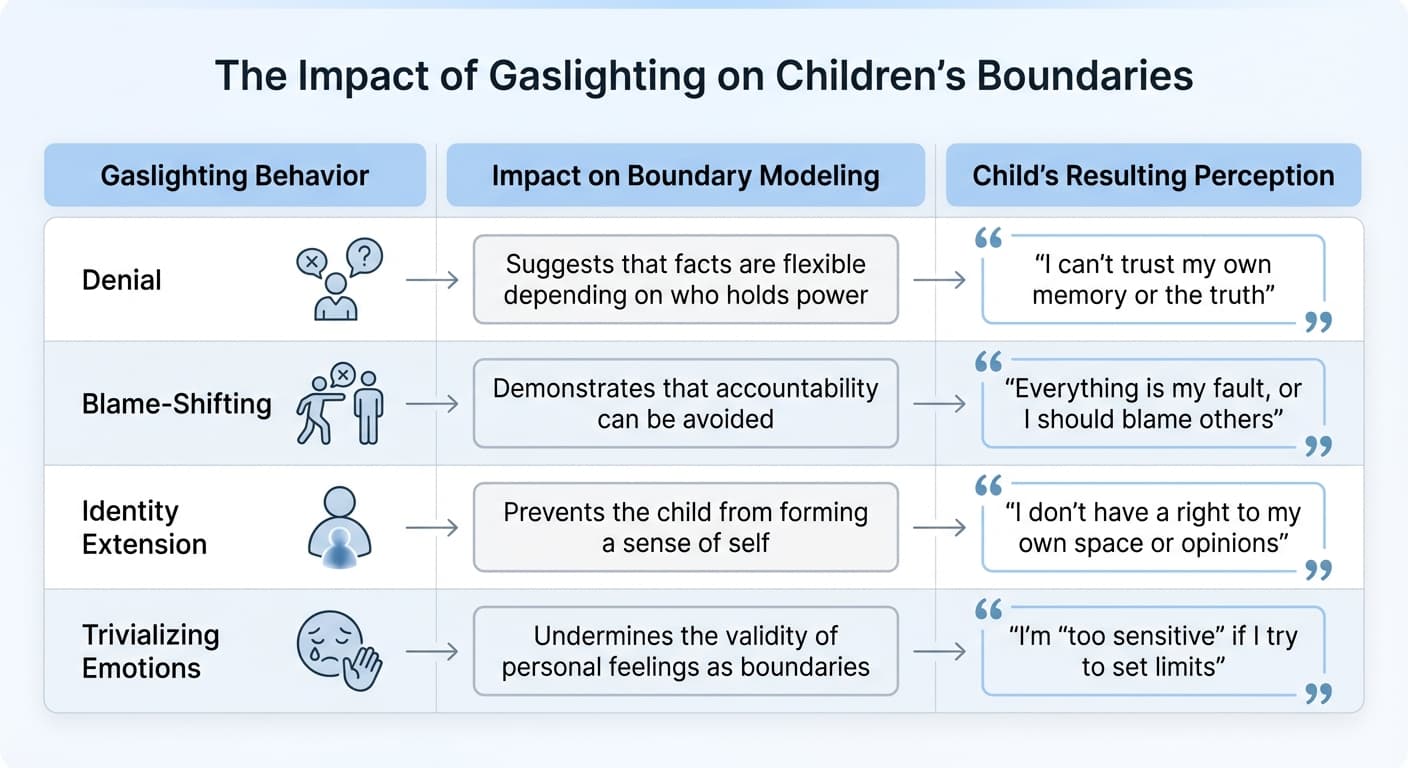
Gaslighting can make it incredibly challenging for parents to model healthy boundaries. When parents engage in gaslighting, they often blur the lines between themselves and their children, treating them as extensions of their own identity rather than as individuals with independent needs. Christine Hammond, MS, LMHC, puts it this way:
"The abusive parent leaves no room for the child to establish any boundaries of self. Rather, the child is taught that they are a 'mini-me' version of the parent." [3]
This lack of separation creates confusion for the child, making it difficult to understand where their identity begins and the parent's ends. Gaslighting parents often avoid accountability, instead shifting blame onto their children. This teaches kids that boundaries aren’t firm principles but tools to manipulate others. The unpredictable "push-pull" dynamic these parents use fosters fear rather than respect [3].
| Gaslighting Behavior | Impact on Boundary Modeling | Child's Resulting Perception |
|---|---|---|
| Denial | Suggests that facts are flexible depending on who holds power. | "I can't trust my own memory or the truth." |
| Blame-Shifting | Demonstrates that accountability can be avoided. | "Everything is my fault, or I should blame others." |
| Identity Extension | Prevents the child from forming a sense of self. | "I don’t have a right to my own space or opinions." |
| Trivializing Emotions | Undermines the validity of personal feelings as boundaries. | "I’m ‘too sensitive’ if I try to set limits." |
This lack of clarity and accountability not only confuses children but also erodes the foundation of trust needed for healthy communication.
Damaged Trust and Communication
Gaslighting doesn’t just muddle boundaries - it also damages trust and communication. For a child, trust is a cornerstone of learning to establish and maintain healthy boundaries. Gaslighting undermines this by making children question their feelings and instincts, often leading to emotional withdrawal [1]. Leon F. Seltzer, PhD, explains:
"Gaslighting seriously weakens the secure bond a child so desperately needs to establish with their parents." [1]
Some gaslighting parents may further isolate their children from friends or extended family, cutting them off from examples of respectful and healthy boundary-setting. Without these role models, children are left with a distorted understanding of relationships.
Children Learning Manipulation Tactics
When children grow up in an environment where gaslighting is the norm, they often adopt similar manipulative behaviors in their own relationships [2]. Watching their parents handle conflict through denial, blame-shifting, or distorting reality teaches them to use these tactics with siblings, peers, or even future partners [2]. Instead of learning respect for others' boundaries, these children may view relationships as power struggles. For instance, they might spread rumors or deny their actions to avoid accountability.
In such an environment, boundaries are seen not as tools for mutual respect but as vulnerabilities. This can lead to a harmful cycle where manipulation becomes the default way of navigating conflicts, perpetuating the very issues gaslighting creates.
How to Recognize Gaslighting in Your Relationships
Warning Signs of Gaslighting
Gaslighting can blur boundaries and create a fog of self-doubt, making it essential to spot the warning signs early. This form of manipulation skews your perception, often leaving you questioning your own reality. Alarmingly, 74% of women who are victims of domestic violence report experiencing gaslighting as well [4]. Identifying these behaviors is a critical step in protecting your well-being and maintaining your role as an effective parent.
Some common tactics include denying events that clearly occurred, shifting blame to make you feel at fault for their behavior, and invalidating your emotions by calling you "too sensitive" or "dramatic." Robin Stern, PhD, author of The Gaslight Effect, highlights how this can erode your self-confidence over time:
"Over time, you begin to believe that there is something wrong with you because one of the most important people in your life is telling you this." [4]
Other forms of gaslighting include rewriting family history to suit their narrative (narrative gaslighting) or attacking your character with labels like "lazy" or "selfish" when you express your needs (personal gaslighting) [5]. These behaviors go beyond normal disagreements - they are calculated efforts to undermine your trust in your own perceptions and maintain control.
How Gaslighting Changes Your Parenting
Gaslighting doesn’t just affect your sense of self; it can also disrupt your parenting. Robin Stern, PhD, Co-founder of the Yale Center for Emotional Intelligence, explains:
"Gaslighting plays off of power relationships... it can undermine [a parent's] sense of reality or make her vulnerable to second-guessing herself." [7]
The constant effort to defend your reality can leave you emotionally drained, making it harder to enforce consistent rules or remain emotionally present for your children [6]. Gaslighters often isolate their victims from supportive friends and family, further removing the external validation you need to feel confident in your parenting decisions [3][6].
Using Gaslighting Check to Identify Manipulation

If you’re unsure whether you’re experiencing gaslighting, Gaslighting Check provides a practical way to analyze your interactions. This tool uses AI to detect manipulation patterns, such as blame-shifting, emotional invalidation, and circular arguments, in both text and voice. Its real-time audio recording feature captures exact phrasing and tone, countering tactics like rewriting past conversations.
The tool also tracks patterns over time, helping you identify whether these behaviors are part of a larger cycle rather than isolated incidents. Reports flag phrases like "you're too sensitive" as invalidation tactics, offering clarity when you feel confused or unsure. Keep in mind, though, that some states require all-party consent for audio recording, so be sure to check your local laws before using this feature.
Gaslighting Check offers two subscription options: a Free Plan with basic text analysis and a Premium Plan ($9.99/month) that includes advanced voice analysis, real-time recordings, and detailed conversation tracking. All data is encrypted and automatically deleted to ensure your privacy. You can also export reports as PDFs to share with trauma-informed therapists, aiding your recovery and boundary-setting process. By identifying manipulation patterns, this tool helps you regain control and rebuild healthier communication and boundaries, both for yourself and your family.
How to Teach Children Healthy Boundaries
Once you've recognized the cycle of gaslighting in your relationships, the next step is to focus on equipping your children with the tools to rebuild trust and establish healthy boundaries.
Restoring Trust Through Open Communication
When trust takes a hit, children can begin doubting their own perceptions. A helpful way to counter this is by asking open-ended questions like, “What do you think happened?” instead of jumping in with your own interpretation[9]. This approach encourages them to process events and trust their own understanding.
For younger kids, try a simple activity called the "What's True?" game. Ask straightforward, objective questions like, “What color is the sky today?” or “Is it raining outside?” Exercises like these help them become more confident in recognizing what’s real[9]. This growing confidence makes it easier for parents to introduce and reinforce healthy boundaries.
Demonstrating Healthy Boundaries
Kids often learn more from observing your actions than from listening to your words. If you frequently second-guess yourself or engage in negative self-talk, they may pick up on those habits of self-doubt[8]. Instead, aim to model confidence in your decisions. Whether it’s choosing what to make for dinner or planning a weekend outing, express your choices clearly and decisively.
To help children develop their own decision-making skills, offer them age-appropriate options. For example, let them pick between two healthy snacks, choose from a couple of pre-selected outfits, or decide which park to visit. These small choices teach them that their preferences matter and build their ability to make judgments[8][9].
Helping Children Understand Their Emotions
Another key to teaching boundaries is helping children connect their emotions to their sense of safety. Encourage them to trust their instincts - this can be a powerful shield against manipulation[8]. When your child feels uneasy or confused, listen and validate their feelings. Let them know it’s okay to trust how they feel. By doing this, you reinforce their internal judgment, giving them the confidence to resist manipulation and maintain their boundaries.
Conclusion: Moving Forward from Gaslighting
Breaking free from gaslighting not only creates a safer space for yourself but also helps your children develop strong, independent boundaries. Addressing manipulation head-on lays the groundwork for your children to trust their own perceptions.
The first step is recognizing the patterns that distort your reality. Tools like Gaslighting Check can help by analyzing your conversations objectively. This platform identifies tactics like blame-shifting and reality distortion - behaviors that are often hard to pinpoint in the moment. With a focus on user privacy, it provides detailed reports and advanced features, offering clarity to counteract the self-doubt gaslighting can create. This newfound clarity empowers you to challenge manipulation and model healthier boundaries for your children.
Once you regain clarity, it’s essential to model strong boundaries. Trusting your own memory and feelings shows your children how to do the same. For example, using clear "I-statements" like "I remember this differently, and I trust my memory" demonstrates healthy communication. Overcoming gaslighting strengthens the boundaries that protect and empower both you and your children.
The greatest gift you can give your children is teaching them to trust their instincts. By fostering self-trust and consistently showing what healthy boundaries look like in your own relationships, you equip them with tools they can rely on throughout their lives. These skills become their natural defense against manipulation, ensuring they grow into confident, self-assured individuals.
FAQs
Is it gaslighting or just a disagreement?
Gaslighting refers to manipulative behavior intended to make someone doubt their own reality, feelings, or memories. On the other hand, a disagreement is just a difference in opinion, without any effort to distort or undermine another person's perception. The main distinction comes down to intent - gaslighting is about control and confusion, whereas disagreements are a normal aspect of healthy communication.
How do I rebuild my child’s self-trust after gaslighting?
Helping a child regain self-trust after experiencing gaslighting requires careful, intentional steps. Start by guiding them to reconnect with their emotions and acknowledge their experiences. One way to do this is through activities like journaling, which can help them process their thoughts and reinforce their sense of reality.
Establishing consistent boundaries is also crucial. This creates a sense of stability and safety, which is essential for rebuilding trust. Encourage open communication where they feel heard and respected, and support them in making their own decisions to foster independence.
To combat self-doubt, focus on affirmations and positive reinforcement. Celebrate their efforts and progress, no matter how small, to help rebuild their confidence. Keep in mind that this process requires patience and consistency - it’s a journey that thrives on care and understanding.
What should I do if my co-parent gaslights our child?
If your co-parent is manipulating your child’s perception of reality, it’s crucial to focus on your child’s emotional health. Watch for signs like your co-parent denying past events or causing your child to question their own feelings. These behaviors can be confusing and damaging, so staying alert is key.
Make sure to keep communication with your child open and honest. Let them know their emotions are valid and reassure them that their experiences are real. This helps build trust and provides them with a safe space to express themselves.
When dealing with your co-parent, establish firm boundaries. Using neutral communication methods, like email or parenting apps, can help minimize conflict. If the situation becomes severe, don’t hesitate to seek help from a mental health professional or legal expert. They can offer personalized advice and support tailored to your family’s needs.