
Empathy Tools for Leaders in High-Stress Workplaces
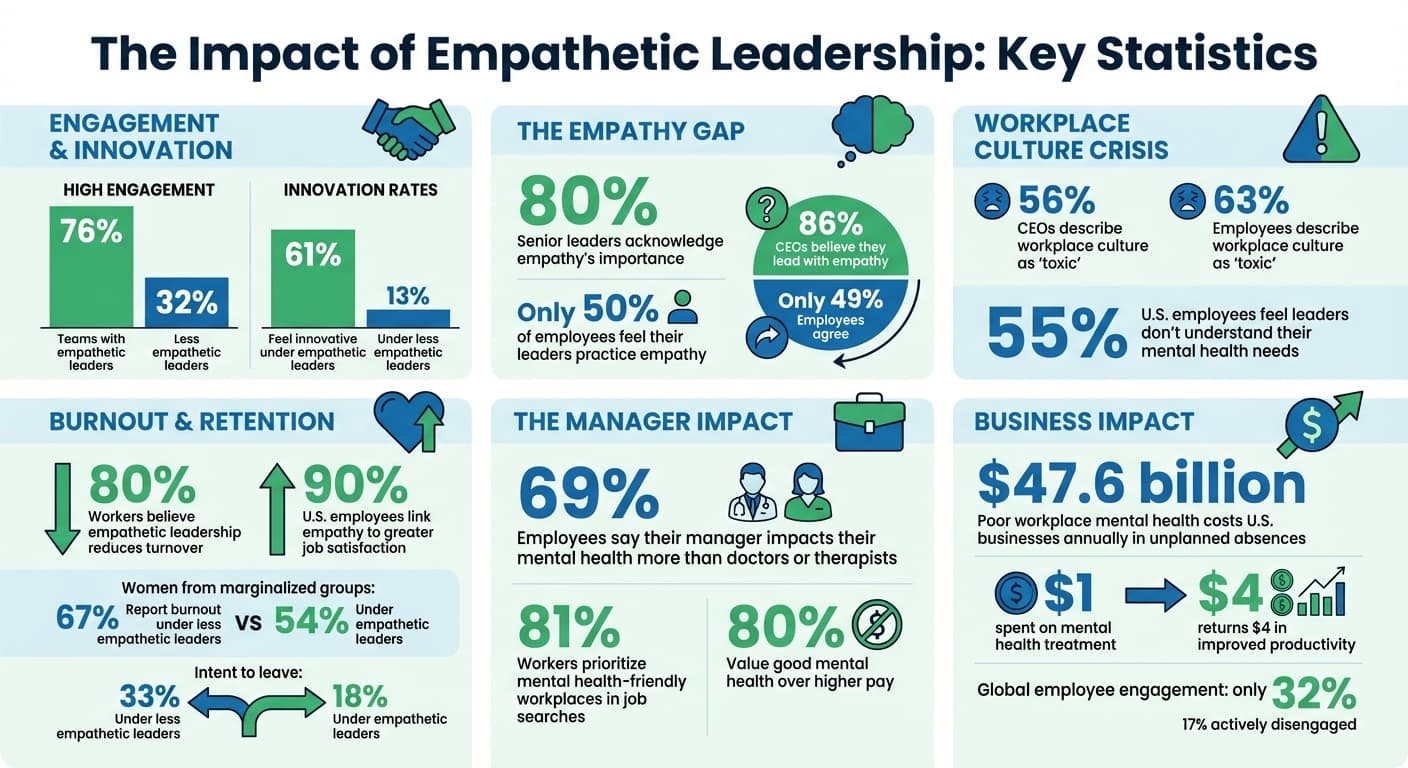
In high-pressure workplaces, leaders face growing challenges, including burnout, disengagement, and turnover. Empathy - once underestimated - has become a critical leadership skill. Why? Teams with empathetic leaders report higher engagement (76% vs. 32%) and greater innovation (61% vs. 13%). Yet, only 50% of employees feel their leaders truly practice empathy.
This guide explores practical strategies like active listening, emotional check-ins, and tools such as Gaslighting Check to detect manipulation and improve communication. It also highlights how empathy reduces burnout, improves retention, and enhances team performance. With 69% of employees saying their manager impacts their mental health more than doctors, empathy isn’t optional - it’s essential for healthier, more effective teams.
::: @figure
Empathy Fatigue Is Real: How Leaders Can Set Boundaries and Avoid Burnout
Why Leaders Need Empathy Tools
There’s a noticeable gap between what leaders aim to achieve and how employees actually feel. While nearly 80% of senior leaders acknowledge the importance of empathy, fewer than half of their organizations actively practice it [3]. Even more concerning, 56% of CEOs and 63% of employees describe their workplace culture as "toxic", signaling a dire need for an empathy-driven shift [3]. This disconnect isn’t just a cultural issue; it directly affects business outcomes, leading to higher turnover, disengaged employees, and missed opportunities for innovation.
Empathy tools help bridge this gap by turning abstract concepts into actionable steps. These include practices like active listening, emotional check-ins, and analyzing conversations to build trust - especially critical in high-stress environments. When employees see consistent, genuine support from leadership, it fosters reliability rather than skepticism.
The numbers back this up. Around 80% of workers believe empathetic leadership reduces turnover, and 90% of U.S. employees link it to greater job satisfaction [3]. Despite this, 55% of U.S. employees feel their leaders don’t understand their mental health needs [4]. This presents a huge opportunity for leaders ready to embrace empathy tools. Recognizing this gap sets the stage for understanding how stressful environments uniquely affect employees.
How High-Stress Environments Affect Employees
High-pressure workplaces trigger biological stress responses that alter how employees think and act. Leaders who rely on controlling or confrontational tactics may unintentionally activate "fight-or-flight" reactions in their teams [6]. Over time, chronic stress rewires the brain, making collaboration, innovation, and clear thinking harder.
The statistics are sobering. Global employee engagement has dropped to just 32%, with 17% of employees now actively disengaged [5]. In high-stress settings, this "episodic" stress builds up, leading to absenteeism, emotional exhaustion, and eventual turnover [6]. The impact is even more pronounced for women from marginalized racial and ethnic groups - 67% report burnout when working under leaders who lack empathy [2]. These numbers represent real people struggling to keep up in demanding roles.
As the lines between work and personal life blur, employees bring their whole selves to work - whether it’s financial worries, caregiving duties, or health concerns. Leaders who ignore these realities risk creating environments where stress spirals out of control. These challenges highlight why empathetic leadership isn’t just a nice gesture; it’s essential for maintaining performance and morale.
How Empathy Improves Leadership
Empathy isn’t just a "soft skill" - it’s a performance booster with measurable results. Managers who demonstrate empathy toward their teams are rated as stronger performers by their own supervisors [1]. Empathy fosters psychological safety, which is the foundation for innovation and risk-taking. When employees feel that their leaders truly understand their struggles, they’re more likely to share ideas, take creative risks, and persevere through tough projects.
Effective leaders practice different types of empathy: cognitive empathy to grasp others’ perspectives, affective empathy to show emotional care, and behavioral empathy to act on what they’ve learned [2]. Behavioral empathy, in particular, stands out through simple but impactful actions - like maintaining eye contact, asking thoughtful follow-up questions, or adjusting workloads for struggling team members.
"Empathy is not sympathy. Sympathy is a form of agreement. Empathy is not agreeing with someone; it is fully, deeply understanding that person, emotionally as well as intellectually." - Stephen R. Covey [3]
Empathy also transforms team dynamics. When managers show high levels of empathy, the disparity in "inclusion experiences" between men and women disappears, with both groups reporting the same inclusion rate of 42% [2]. Women from marginalized backgrounds who feel their circumstances are respected are far less likely to consider leaving their organization - 62% say they rarely or never think about it [2]. These outcomes go beyond retention; they signal that empathy creates an environment where diverse voices can thrive and contribute meaningfully. This sets the stage for practical leadership tools, which will be explored in the next section.
Identifying Emotional Manipulation and Burnout
High-stress workplaces can often conceal emotional manipulation and burnout, making it challenging for leaders to address these issues before they escalate. Recognizing these patterns early is essential for maintaining a healthy work environment. Failing to do so can lead to losing talented team members and fostering a toxic culture. While the line between employees who are simply struggling and those suffering from manipulation or burnout can be blurry, understanding the warning signs makes all the difference. Let’s explore how to identify these harmful patterns before they take root.
How to Spot Emotional Manipulation
Emotional manipulation in the workplace is often subtle and intentional, making it harder to detect. A UK survey of 3,033 respondents revealed that 58% had experienced gaslighting at work during their careers [8]. Chris Kerridge, an employee engagement expert at MHR, highlights the insidious nature of this behavior:
“Unlike bullying, which is very clear and obvious, gaslighting is a very subtle form of manipulation which can destroy a victim's confidence, leave them feeling extremely vulnerable and, in some cases, force them to quit their jobs.” [8]
Certain behaviors are telltale signs of manipulation. These include denying past events, brushing off concerns with dismissive comments like "you're too sensitive", or accusing others of actions they themselves are guilty of [7][9]. Other red flags involve withholding key information, excluding colleagues from meetings, or using cold behavior as a form of punishment [8][9]. Manipulators may also take credit for team achievements while blaming others for failures, or repeatedly question someone’s qualifications to chip away at their confidence [7][8].
Leaders can take proactive steps to address manipulation. Documenting incidents with dates, times, and specific examples creates a clear record for addressing issues with HR if needed [7][8][9]. Setting firm boundaries for acceptable behavior and ending conversations when those boundaries are crossed is also crucial [7][9].
For those needing help analyzing workplace interactions, tools like Gaslighting Check (https://gaslightingcheck.com) can be invaluable. This platform uses text and voice analysis to identify manipulation tactics, offering detailed reports while ensuring user privacy through encryption and automatic data deletion.
While emotional manipulation undermines confidence, chronic stress can lead to burnout. Let’s move on to recognizing the signs of burnout in your team.
Recognizing Burnout in Your Team
Burnout is more than just workplace stress; it’s a deeper state of emotional and physical exhaustion. According to the World Health Organization, burnout is characterized by three main symptoms: a sense of energy depletion or exhaustion, growing detachment or cynicism toward one’s job, and a noticeable drop in professional effectiveness [11]. Unlike stress, which can feel like “too much,” burnout feels like “too little” - too little energy, motivation, or care [12].
The consequences of burnout are significant. Employees experiencing burnout are 2.6 times more likely to actively look for other jobs [13]. Even before the pandemic, burnout affected over 54% of healthcare professionals and nearly 60% of medical students [12]. For businesses, the financial toll is steep - burnout-related turnover can cost organizations 15% to 20% of their total payroll, and workplace stress accounts for 8% of the national healthcare budget [11][13].
Spotting burnout involves observing behavioral changes. For instance, an employee who is usually calm and composed might become short-tempered or irritable [13]. Listen for language that signals hopelessness, such as “Why bother?” or “It’s just the way things are” [13]. Burnout can show up as withdrawal and missed deadlines or, conversely, through irritability and sudden outbursts [13].
Leaders can address burnout by regularly checking in with their teams. Ask employees what specific challenges they’re facing and adjust workloads to ensure expectations are realistic and within their control [11][13]. Autonomy is another key factor - offering flexibility in how work is done can help reduce feelings of helplessness, a major driver of burnout [11][13].
Burnout risk increases sharply for employees working more than 50 hours per week, with even greater risks at 60 hours [11]. Unlike clinical depression, which affects all areas of life, burnout is often tied to specific roles and can be alleviated with proper rest or reduced demands [10][12]. Recognizing these signs early allows leaders to take meaningful action and create a more supportive workplace.
Empathy Tools and Methods for Leaders
Spotting workplace challenges is only the first step - leaders need effective tools to bring empathy into their daily practices. A 2024 survey revealed that while 7 out of 10 managers ranked empathy among their top five skills, only half of employees felt their leaders truly demonstrated it [15]. This disconnect highlights the need for leaders to move from intention to action. Below, we explore practical methods that help leaders embed empathy into their leadership style.
Active Listening and Clear Communication
Active listening and empathic listening are often mistaken for the same thing, but they serve different purposes. Active listening focuses on understanding and confirming what someone says, while empathic listening takes it further by immersing you in the speaker's emotions and perspective [14][15]. Stephen R. Covey's advice sums it up well:
"Seek first to understand" [14]
Empathic listening involves four stages, with the most impactful being the final one: rephrasing what was said and reflecting the speaker's emotions [14]. This technique gives employees "psychological air", creating a sense of being truly heard and fostering trust [14].
Empathy itself has three dimensions that leaders should grasp:
- Cognitive empathy: Understanding another's thoughts and viewpoint.
- Affective empathy: Sharing or recognizing their emotions.
- Behavioral empathy: Showing understanding through actions, like active listening and visible engagement [2].
Simple techniques can make empathic listening a habit. For example, the "Count to Five" rule encourages leaders to pause for five seconds before responding, giving speakers room to express themselves fully [2]. Mirror energy by matching the speaker's tone and demeanor - whether they're excited or upset - to show you're tuned in [14]. Use micro-validations like "I see", "That makes sense", or "Really?" to signal engagement without interrupting [14][15].
When emotions run high, replace judgment with curiosity. Focus on understanding the other person's experience rather than evaluating their performance [14]. If you need to take notes during sensitive conversations, explain why upfront to avoid making the speaker feel dismissed [15]. This transparency strengthens trust.
Empathy-driven communication isn't just about connection - it also reduces burnout and turnover, especially among women and underrepresented groups. Leaders who master these skills can further benefit from technology to refine their communication.
Using Gaslighting Check to Analyze Conversations

Even the most skilled leaders can miss subtle manipulation in workplace interactions. This is where tools like Gaslighting Check (https://gaslightingcheck.com) come in, offering an objective way to analyze conversations for hidden patterns.
Gaslighting Check uses text and voice analysis to identify emotional manipulation tactics. Leaders can upload emails, chat messages, or meeting recordings for review. The platform's AI-powered tools detect manipulative language with accuracy rates between 78% and 91% [2], making it a reliable resource for workplace dynamics.
What makes Gaslighting Check stand out is its focus on detailed, actionable reports. Instead of just flagging problematic phrases, it explains why certain language or tone patterns might be harmful. This educative feature helps leaders build their own awareness over time. The Premium Plan ($9.99/month) includes features like conversation history tracking, which is especially useful for spotting recurring issues in team interactions or coaching managers.
For added security, the platform uses end-to-end encryption and automatic data deletion. Organizations can also opt for an Enterprise Plan, which offers tailored solutions alongside all premium features.
Practical uses for Gaslighting Check include:
- Prepping for tough conversations: Review past interactions to ensure your tone hasn’t unintentionally been dismissive.
- Post-meeting analysis: Identify moments when employees might have felt invalidated or ignored.
- Addressing manipulation reports: When employees express concerns about colleagues, the platform provides an objective assessment before HR gets involved.
By combining empathy with tools like Gaslighting Check, leaders can ensure their communication remains fair and supportive.
Daily Steps for Empathetic Leadership
Empathy isn’t a one-time effort - it’s a daily practice that builds trust and connection over time. Incorporating small, consistent actions into your routine can make empathy second nature.
Start by checking for burnout. Take a moment during the week to ask team members about their workload. A simple message like "How’s your bandwidth this week?" can uncover stress before it escalates [1].
Pay attention to non-verbal cues like body language, tone, and silence. Acknowledge these signals with comments like, "You seem unsure about this deadline. What’s on your mind?" Reflecting their emotions and reframing their statements as questions - such as "So it feels like this timeline is overwhelming?" - shows you’re listening and gives them a chance to clarify [15].
Use open-ended questions to encourage honest dialogue. Instead of saying, "Don’t you think this approach would work better?" try asking, "What approach do you think would work best?" This invites employees to share their thoughts freely [15].
Another useful method is the "Pause-Reflect-Adjust-Act" formula for staying present in conversations [14]. If you notice your mind wandering, pause and refocus on the speaker. Reflect on their last statement, adjust your attention, and ask a clarifying question if needed.
Empathetic leadership isn’t just beneficial for employees - it’s also good for your career. Research involving 6,731 managers across 38 countries found that leaders who practiced empathy were rated higher in performance by their superiors [1]. Supporting team members through personal challenges - such as a sick parent or relationship issues - fosters psychological safety and strengthens team bonds [1]. This doesn’t mean becoming a therapist, but it does mean acknowledging that life’s challenges affect work performance.
As Maya Angelou famously said:
"People will forget what you said, people will forget what you did, but people will never forget how you made them feel" [14]
Detect Manipulation in Conversations
Use AI-powered tools to analyze text and audio for gaslighting and manipulation patterns. Gain clarity, actionable insights, and support to navigate challenging relationships.
Start Analyzing NowCreating Emotional Safety Through Policies and Training
Empathy on an individual level can only go so far without the right systems in place. With 76% of U.S. workers reporting at least one mental health symptom and 84% attributing their struggles to workplace conditions [19], it’s clear that systemic changes are overdue. And while 86% of CEOs believe they lead with empathy, only 49% of employees agree [16]. This gap highlights a critical need for leaders to move beyond good intentions and adopt policies and training that make empathy a core part of their organization. By addressing employee stress and burnout through structured initiatives, companies can create workplaces that prioritize emotional safety and resilience.
Policies That Support Emotional Well-being
To truly support employees, policies should address five key areas: Safety, Connection, Work–Life Balance, Value, and Growth [19]. These aren’t abstract ideals - they translate into actionable steps that reduce burnout and improve retention.
-
Flexible work arrangements: Giving employees control over their schedules - whether through flexible hours or condensed workweeks - helps them balance personal and professional responsibilities. This approach resonates with workers, as 81% say they’ll prioritize mental health-friendly workplaces in their job search [19].
-
Paid leave: While 79% of U.S. civilian workers have access to paid sick leave, only 35% of those in the lowest wage bracket enjoy this benefit [19]. To address this disparity, companies should separate paid sick leave from vacation time, allowing employees to recover without sacrificing personal time. Adding mental health days can further signal a commitment to employees’ psychological well-being.
-
Unplugging policies: Digital overload is a growing issue, and policies that encourage employees to disconnect are crucial. Leaders can lead by example - taking their own vacation days and using tools like delayed-send for emails written outside work hours. Research even shows that managers who disconnect are more effective leaders [23].
-
Mental health resources: Offering an Employee Assistance Program (EAP) is just the start. Companies should regularly audit these programs to ensure they meet diverse needs and train managers to promote them without stigma. The financial case is compelling: for every $1 spent on mental health treatment, employers see a $4 return in improved productivity [18]. Additionally, employees who don’t use well-being programs cost companies about $1,400 more annually in medical expenses [17].
While policies set the stage, training ensures leaders can consistently reinforce these values.
Empathy Training Programs for Leaders
Only 40% of leaders are seen as proficient in empathy [21]. Training can close this gap by focusing on three key areas: Cognitive empathy (understanding others’ perspectives), Affective empathy (feeling genuine concern), and Behavioral empathy (taking meaningful action) [2]. These programs complement the everyday empathy practices discussed earlier.
The most effective training takes a multi-faceted approach. Group workshops can raise awareness of empathy’s impact, while executive coaching - using emotional intelligence assessments - can help leaders identify and address blind spots. Perspective-taking exercises, like role-playing scenarios, allow leaders to see situations through an employee’s lens [21]. Even small practices, such as 10 to 20 minutes of loving-kindness meditation daily, can lower stress hormones and encourage compassionate behavior [21].
Empathy-driven leadership doesn’t just feel good - it delivers results. It’s linked to a 48% boost in creativity and a 44% increase in employee engagement [20]. For women from marginalized racial and ethnic groups, such leadership has been shown to reduce burnout rates from 67% to 54% [2].
Another tool is Mental Health First Aid (MHFA) training, which equips managers and employees to recognize and address mental health and substance use challenges. This evidence-based program normalizes mental health discussions and reduces stigma in the workplace [18].
To make empathy training truly effective, organizations should weave it into broader systems. For example, updating hiring and promotion criteria to prioritize respect and empathy, using pulse surveys and structured one-on-one meeting templates to monitor workplace dynamics, and creating anonymous feedback channels for reporting issues without fear [21][22].
Robyn L. Garret captured the essence of empathy in leadership:
"If you can help those people understand that you really care and you can back it up with your actions, then they'll start to see you as a more empathic leader" [16].
With 69% of employees stating that their managers impact their mental health more than doctors or therapists [23], and 80% valuing good mental health over higher pay [23], the case for empathy-driven leadership is undeniable. Organizations that invest in these policies and training programs will not only attract top talent but also create workplaces where employees can truly thrive. The next challenge? Measuring how these efforts improve team performance.
Measuring How Empathy Tools Affect Team Performance
To ensure empathy strategies truly make a difference, it’s important to measure their impact. By combining key metrics with team feedback, you can gain a clearer picture of how these tools influence your team’s performance and well-being.
Metrics to Track Success
Start by tracking employee engagement, which reflects how work affects mental health. Engaged employees are five times more likely to report better mental health [25]. For instance, 76% of employees with highly empathic senior leaders report being engaged, compared to just 32% of those with less empathic leaders [2].
Another telling metric is innovation rates. Studies show that 61% of employees with highly empathic leaders feel innovative at work, while only 13% of those with less empathic leaders report the same [2]. This 48-point difference highlights how empathy can unlock creativity and adaptability.
Retention rates offer additional insights. Empathy in leadership is linked to reduced intent to leave, particularly for women from marginalized groups. Among these women, only 18% with empathic leaders consider leaving, compared to 33% with less empathic leaders [2]. This matters because poor mental health in the workplace costs U.S. businesses an estimated $47.6 billion annually in unplanned absences [25].
Monitoring burnout risk is also critical. For example, burnout rates among women from marginalized racial and ethnic groups drop significantly - from 67% under less empathic leaders to 54% under highly empathic ones [2]. Setting a goal to reduce burnout by 20% annually or reviewing workloads if over 25% of your team reports high burnout risk can help address this issue [26].
Lastly, measure psychological safety by tracking how often employees voice ethical concerns or propose new ideas without fear. A late 2021 study by Sandoz (a division of Novartis) tested a six-week intervention where managers held one-on-one meetings focused on "individuation" (treating employees as unique individuals). This approach significantly boosted psychological safety and encouraged employees to speak up about ethical issues [24].
Here’s a simple KPI framework to guide your efforts:
| KPI | Target | Data Source | Action Signal |
|---|---|---|---|
| Engagement Index | +5 pts YoY | Quarterly Survey | Escalate if down 3+ pts in a quarter |
| Burnout Risk | -20% YoY | Quarterly Survey | Trigger workload review if >25% |
| Regretted Turnover | -25% YoY | HRIS | Initiate manager coaching/retention plans |
| Innovation Rate | +10 pts YoY | Team Survey | Review empathy training effectiveness |
To calculate the financial return on your empathy tools, use this formula:
Annual ROI = (Savings from turnover + absenteeism + presenteeism + safety gains) ÷ Program cost [26].
For example, a mid-size tech company implemented "meeting hygiene" policies, reducing weekly meeting hours by 22% and adding two four-hour focus blocks. Within six months, they saw a 14-point drop in burnout risk and an 11-point improvement in on-time delivery - all without increasing defect rates [26].
These metrics provide a foundation for refining your empathy strategies, but numbers alone don’t tell the full story.
Using Team Feedback to Improve Empathy Strategies
While metrics are valuable, direct feedback from your team adds depth and context. Instead of relying solely on annual surveys, try quarterly pulse checks to avoid survey fatigue and make timely adjustments [26].
During one-on-one meetings, ask employees about their needs and priorities beyond daily tasks. Use the "count to five" rule - if an employee pauses during a conversation, silently count to five before responding. This encourages them to share more openly and shows you're actively listening [2].
Disaggregating results by team, location, and role level can help identify specific challenges. For example, a regional healthcare system reduced nurse turnover from 21% to 16% and improved patient communication scores by redesigning shift handoffs and adding two hours of dedicated documentation time per week [26].
Creating anonymous feedback channels can also enhance psychological safety. If you notice a decline in employees sharing ethical concerns or new ideas, it may signal that your empathy initiatives need adjustment [24].
"Empathy is not simply a skill that leaders should deploy during times of crisis... organizations and teams that create a culture of empathy can also encourage more human and equitable interactions and policies at all times."
The most effective approach combines subjective survey data (like engagement and burnout risk) with objective metrics (such as absenteeism and turnover rates). When these data points align, you can confidently assess the impact of your empathy tools and identify areas for improvement [26].
Conclusion
Empathy isn't just a nice-to-have in the workplace - it’s a critical driver of performance and retention [1]. By incorporating empathy-focused tools and practices, companies can create environments where employees excel, stay committed, and bring forward fresh, innovative ideas. Research shows that leaders who practice empathy consistently achieve better outcomes [1].
But the impact of empathy goes far beyond individual relationships. Organizations that prioritize empathy see a measurable reduction in turnover, particularly among women from marginalized racial and ethnic groups. For example, when senior leaders exhibit empathy, the intent to leave drops from 33% to 18% in these groups [2]. This shift doesn’t just improve workplace culture - it also leads to real financial savings and a stronger competitive position.
"Empathy is a must-have futureproofing mechanism in today's workplace." - Tara Van Bommel, PhD, Director of Research, Catalyst [2]
To fully realize these benefits, leaders need to take deliberate, consistent action. This can include using tools like Gaslighting Check to identify unhealthy communication patterns, scheduling regular one-on-one check-ins, practicing active listening, and monitoring metrics like engagement and burnout. Pairing these practices with a genuine effort to understand and support your team can transform workplace dynamics.
The good news? Empathy is a skill that can be developed. As previously mentioned, it’s something leaders can cultivate with consistent effort [1]. Start with small, actionable steps, measure your progress, and use feedback to refine your approach. The future demands leaders who can navigate complexities while valuing the humanity of their teams. Organizations that embrace this mindset will be the ones that thrive.
FAQs
What’s the best way for leaders to use empathy tools in high-stress workplaces?
Leaders can weave empathy into their leadership approach by incorporating a few straightforward habits that make a big difference. Start with active listening - ask open-ended questions, give your full attention to responses, and acknowledge emotions to show that team members' experiences truly matter. Combine this with mindfulness techniques to manage your own stress and remain present, enabling you to respond thoughtfully, even under pressure.
Technology can also play a role in fostering empathy. For instance, tools like Gaslighting Check can analyze conversations for signs of emotional manipulation, helping leaders spot and address potential issues early. Additionally, brief team surveys can offer insights into morale, while regular follow-ups ensure promises are kept. By consistently practicing empathy and finding ways to measure its impact, leaders can build workplaces that feel emotionally secure, encourage collaboration, and boost productivity.
How can I recognize signs of emotional manipulation and burnout in the workplace?
Emotional manipulation can sneak into workplace dynamics in subtle yet harmful ways. Some red flags to watch for include guilt-tripping comments, shifting blame (like saying, "It's your fault we missed the deadline"), providing conflicting instructions, or isolating certain team members. Spotting these behaviors early is crucial for fostering a positive and supportive work environment. Tools such as Gaslighting Check can be useful in identifying manipulation by analyzing conversations for harmful patterns.
Burnout often manifests in three key ways: physical and emotional exhaustion (feeling constantly drained and unable to recover), cynicism or detachment (developing a negative or disengaged attitude toward work), and reduced effectiveness (struggling with productivity or feeling like your efforts don’t matter). Other signs to look out for include feeling overwhelmed, disconnected from your team, or a noticeable drop in motivation. Tackling these issues with empathy, setting clear boundaries, and providing support can help ease the stress and bring back a sense of balance.
How can organizations evaluate the impact of empathy on team performance?
To understand how empathy affects team performance, organizations can start by gathering data on both empathy levels and performance outcomes. Empathy can be assessed through tools like empathy evaluations, 360-degree feedback surveys, or employee sentiment polls. On the performance side, metrics might include productivity rates, customer satisfaction scores (which often tie directly to revenue), employee retention rates, and well-being indicators.
By linking empathy scores with performance data using methods like correlation analysis or regression modeling, businesses can uncover how empathy impacts areas such as job satisfaction, efficiency, and team collaboration. Monitoring these metrics over time and visualizing trends with dashboards can highlight patterns and track progress. Adding qualitative insights - like feedback from focus groups - alongside the numbers gives a more complete understanding of how empathy-driven strategies can enhance team performance.