How Emotional Manipulation Affects Long-Term Memory

How Emotional Manipulation Affects Long-Term Memory
Emotional manipulation, like gaslighting, can distort your memory and perception of reality. Prolonged exposure to such tactics doesn't just confuse - it physically alters your brain, impacting how memories are formed, stored, and recalled. Here's what you need to know:
- Gaslighting involves denying or twisting facts to make you doubt your experiences.
- Stress and trauma from manipulation release cortisol, damaging the hippocampus, the brain’s memory center.
- Manipulation exploits emotional imprints, making you remember feelings (e.g., sadness) more than facts.
- Chronic manipulation leads to memory distortions, cognitive decline, and even physical brain changes.
To recover, document events, seek professional help, and consider tools like Gaslighting Check to identify manipulation patterns. Rebuilding trust in your memory is possible with the right strategies.
What Abuse Does To Your Brain
How Emotional Manipulation Impacts Long-Term Memory
::: @figure
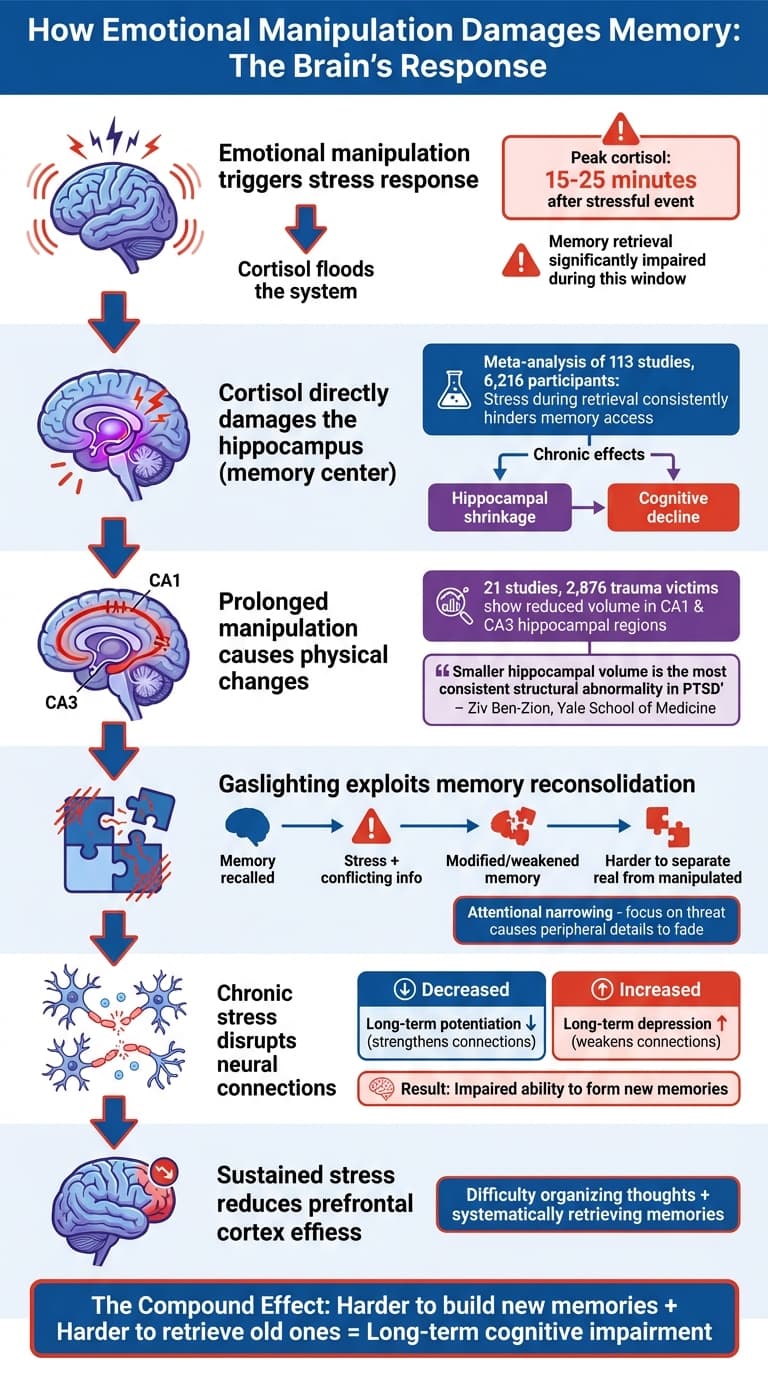
Prolonged emotional manipulation doesn't just confuse you - it physically alters your brain. These changes can distort how memories are formed, stored, and recalled, which is a key factor in the memory issues tied to gaslighting. When someone repeatedly dismisses or undermines your recollections, your brain's ability to manage memories is disrupted on a physiological level.
Stress, Trauma, and Memory Problems
Emotional manipulation activates your body's stress response, flooding it with cortisol - a stress hormone that directly impacts the hippocampus, the area of the brain responsible for forming and retrieving long-term memories [5][7]. Cortisol levels peak roughly 15 to 25 minutes after a stressful event, making it significantly harder to recall past information during that window [5].
A meta-analysis of 113 studies, including 6,216 participants, confirmed that stress occurring right before or during memory retrieval consistently hinders the ability to access stored memories [6]. While a single stressful event might cause brief "blanking", chronic emotional manipulation can lead to lasting damage, such as hippocampal shrinkage and cognitive decline [7][1].
"Exposure to extreme, traumatic, or chronic stress can have the opposite effect [of moderate stress] and cause memory loss, cognitive impairments, and stress-related psychopathologies such as anxiety disorders, depression and post-traumatic stress disorder (PTSD)." – Charles Finsterwald, Center for Neural Science, New York University [7]
These stress-induced changes in the brain lay the foundation for the memory distortions often linked to gaslighting.
How Gaslighting Distorts Memory
Gaslighting disrupts memory by creating a vicious cycle. During memory reconsolidation - a process where memories are re-stored after being recalled - stress and conflicting information can modify or weaken your recollections, making it harder to separate real memories from manipulated ones [4]. Additionally, the brain's response to manipulation shifts your focus toward the perceived threat, a phenomenon called "attentional narrowing." This intense focus on the emotional threat causes peripheral details to fade, further clouding your memory [1].
Brain Changes from Emotional Manipulation
The effects of prolonged emotional manipulation go beyond temporary lapses in memory. Studies on trauma victims, involving 21 research projects and 2,876 individuals, consistently show reduced volume in the CA1 and CA3 regions of the hippocampus - areas essential for piecing together the different elements of an event into a coherent memory [8].
"Smaller hippocampal volume is the most consistent structural abnormality in PTSD." – Ziv Ben-Zion, Yale School of Medicine [8]
On a cellular level, chronic stress disrupts long-term potentiation (the process that strengthens connections between neurons) while enhancing long-term depression, which weakens these connections. This imbalance undermines your ability to form new memories [7]. Additionally, the prefrontal cortex, which plays a critical role in organizing thoughts and systematically retrieving memories, becomes less effective under sustained stress [6]. Together, these changes make it harder to build new memories and retrieve old ones, compounding the damage caused by emotional manipulation.
Recognizing Emotional Manipulation
Understanding emotional manipulation is essential for protecting both your mental health and your memory. Manipulative behaviors can be subtle and difficult to identify, especially when your ability to trust your own perceptions has been compromised. Recognizing these tactics is key to understanding how they can interfere with memory and mental clarity.
Common Manipulation Tactics
Manipulators use a variety of methods to make you question your experiences and undermine your confidence.
One of the most harmful tactics is gaslighting, where phrases like "You're imagining things", "I never said that", or "That never happened" are commonly used. This form of manipulation is alarmingly widespread - studies indicate that 74% of female domestic violence victims have encountered gaslighting [9].
Other tactics include:
- Guilt-tripping: This leverages your sense of responsibility, making you feel selfish for asserting boundaries.
- Love bombing: Overwhelming affection early in a relationship fosters emotional dependence.
- Triangulation: Involves introducing a third party to create jealousy or tension.
- Baiting and switching: Provokes emotional reactions, allowing the manipulator to label you as irrational.
- Negging: Uses backhanded compliments to chip away at your self-esteem over time.
To better understand how gaslighting differs from healthy disagreement, the table below highlights the contrasting goals and outcomes of each approach:
| Feature | Healthy Disagreement | Gaslighting |
|---|---|---|
| Goal | Finding understanding or resolution | Gaining dominance and control |
| Reality | Acknowledges differing perspectives | Denies or distorts the truth |
| Outcome | Seeks mutual common ground | Erases the other person's perspective |
| Communication | Open and truthful | Deceptive, involving contradictions and lies |
How Manipulation Affects Victims
The psychological impact of manipulation can be profound, leaving victims doubting their perceptions and second-guessing their decisions. You may find yourself constantly apologizing or feeling uneasy, as if you're always on edge.
"The purpose of gaslighting is to achieve power and control over a victim by causing him or her to develop self-doubt and in doing so, become more complacent." – Carol A. Lambert, MSW, Psychotherapist [10]
A particularly damaging outcome is internalized gaslighting, where doubting your own judgment becomes second nature. This can lead to feelings of intellectual inadequacy, a weakened sense of identity, and isolation from loved ones. Over time, the stress caused by manipulation may result in anxiety, depression, emotional exhaustion, and even physical symptoms like headaches and insomnia [11]. These effects can create a cycle where memory distortions deepen, making it harder to trust your recollections without outside support. Recognizing these patterns is the first step toward breaking free from the grip of emotional manipulation.
Detect Manipulation in Conversations
Use AI-powered tools to analyze text and audio for gaslighting and manipulation patterns. Gain clarity, actionable insights, and support to navigate challenging relationships.
Start Analyzing NowBreaking Free from Emotional Manipulation
Recovering from the effects of gaslighting is a journey that begins with rebuilding trust in your own perception. While the damage to your memory and sense of reality won't heal instantly, there are deliberate actions you can take to reclaim your confidence and sense of self.
Steps to Reclaim Trust in Your Memory
Start by documenting conversations. Record dates, times, and direct quotes on a personal device or a secure cloud account. This way, if someone insists, "That never happened", you have a clear record to reference.
"Trusting yourself is key to coping with this type of toxic behavior." – Stephanie Sarkis, Ph.D., Licensed Mental Health Counselor [15]
In a healthy disagreement, the other person will genuinely care about your perspective rather than trying to make you question your reality [13]. If you suspect manipulation, avoid meeting with the person alone. Instead, bring a trusted witness who can provide an objective account of the interaction [15]. If they refuse to allow a witness, document that refusal too. Additionally, keep an eye on your digital security. Unexplained logins to your devices or social media could signal digital abuse, which often accompanies emotional manipulation [15]. Keeping secure digital records not only validates your memories but also helps protect you from ongoing manipulation.
For deeper insights into manipulation patterns, consider using digital tools designed to provide objective support.
Using Gaslighting Check to Spot Manipulation

When your confidence in your perceptions wavers, objective tools can be a lifeline. Gaslighting Check is one such platform that analyzes conversations to identify subtle manipulation tactics. It detects instances where someone denies facts or twists the truth to make you doubt yourself [16]. The tool also highlights blame-shifting patterns, where responsibility is unfairly deflected onto you, and tracks cycles of love bombing - excessive affection followed by sudden withdrawal - that can create emotional dependency [16].
For users in the United States, the Premium Plan is available at $9.99 per month, offering advanced features like text and voice analysis, detailed reports, and conversation history tracking. A Free Plan is also available, providing basic text analysis to assist those just beginning their recovery. To ensure privacy, all data is protected with end-to-end encryption and automatic deletion policies. The tool also includes structured assessments, enabling you to categorize behaviors from partners, employers, or family members and rate the frequency of manipulative actions on a scale from 1 (none) to 4 (frequent) [17]. This objective analysis can help you maintain mental clarity and safeguard your brain from the harmful effects of prolonged abuse [17].
Seeking Professional Guidance
While personal documentation and digital tools are helpful, professional support is essential for long-term recovery. Therapists trained in memory reconsolidation and trauma can help you process and update distorted emotional memories [12][14]. Evidence-based therapies like Cognitive Behavioral Therapy (CBT) are effective in addressing self-doubt and cognitive distortions, while Eye Movement Desensitization and Reprocessing (EMDR) can reduce the emotional intensity of traumatic memories. Prolonged Exposure Therapy can help inhibit the impact of distorted emotional memories, and emerging methods like neurofeedback can train your brain to better manage responses to triggers.
"Gaslighting is a key contributor to mental health issues, but the same factors that leave a person vulnerable to gaslighting may result in lower self-esteem, uncertainty about their own reality, anxiety, and ultimately depression." – Robin Stern, Ph.D., Co-founder of the Yale Center for Emotional Intelligence [18]
Work with your therapist to identify the "Gaslight Tango" - the recurring triggers that fuel manipulation cycles [19]. When a manipulator's logic leaves you feeling confused, focus on your emotional state. Feelings of terror or bewilderment are often reliable indicators of abuse, regardless of who seems "right" in the argument [19]. Joining peer support groups can also be incredibly healing, as they provide a space to share experiences, overcome isolation, and validate your feelings through the stories of others.
Conclusion: Recovering from Manipulation's Effects on Memory
Emotional manipulation has a profound impact on how memories are formed. The amygdala, the brain’s emotional processing center, tends to create strong emotional imprints while allowing the finer details, like specific words or actions, to fade over time. This explains why you might clearly recall the emotional pain of an abusive incident but struggle to pinpoint the exact circumstances or dialogue that occurred [2]. Unfortunately, this natural process can be exploited by manipulators, leaving you questioning your own recollections.
Prolonged emotional abuse can lead to what experts call "maladaptive" memories - persistent and deeply ingrained traces that don’t fade naturally. These memories can influence behavior and emotional responses for years, making recovery a complex process [20][3].
"Memory is freedom... being of 'sound mind' can be critical for one's freedom, self-advocacy, and health." – Kimberly Key, Ph.D., Psychologist [17]
Reclaiming control over your memory is essential for healing. Thanks to the brain's neuroplasticity, it’s possible to form new neural pathways and even reverse some of the structural changes caused by emotional manipulation [21][22]. Recovery often involves a combination of approaches: professional therapy, tools like Gaslighting Check, and consistent documentation of events. These steps can help rebuild cognitive clarity, restore self-trust, and empower you to move forward.
FAQs
How does emotional manipulation impact the brain's ability to store and recall memories?
Emotional manipulation, particularly tactics like gaslighting, can deeply impact the brain’s ability to process and recall memories. This often involves key areas of the brain, such as the amygdala and hippocampus, which play a central role in managing emotions and memory. When someone is repeatedly subjected to stress or manipulation, the amygdala releases stress hormones like cortisol and adrenaline. These hormones heighten emotional intensity, which can influence how memories are stored and prioritized. As a result, manipulated narratives may seem more vivid and convincing than they truly are.
On top of that, manipulation can interfere with the brain’s memory reconsolidation process. When a memory is revisited, it temporarily becomes flexible, creating an opportunity for it to be altered. If stress is introduced during this period, false information can be reinforced, making it increasingly difficult to correct over time. With repeated exposure to manipulation, individuals may start doubting their own memories, leading to lasting changes in how they recall events and trust their perceptions.
What are the signs that someone might be gaslighting me?
Gaslighting is a pattern of behavior that can leave you questioning your own sense of reality. For instance, you might start second-guessing your memory because someone insists that events didn’t happen the way you remember or accuses you of "misremembering." It’s also common to feel like you’re being too sensitive or overreacting when you share your emotions, only to have them dismissed or downplayed.
Other red flags to watch for include frequently apologizing for things you didn’t do, being unfairly held responsible for problems caused by someone else, or experiencing a persistent sense of confusion and self-doubt in your daily interactions. When these behaviors come from someone you trust, they can point to emotional manipulation. Recognizing these patterns is a crucial step in safeguarding your mental well-being and finding the support you need.
How can I rebuild trust in my memory after emotional manipulation?
Emotional manipulation, such as gaslighting, can deeply affect your confidence in your memory. It works by planting doubt and triggering stress, which in turn impacts the brain. Research shows that chronic stress can harm the hippocampus - the part of the brain that forms long-term memories - while ramping up activity in the amygdala, which tends to focus on negative details and distort recall. This combination often leaves people unsure of their own perceptions and memories.
If you're looking to rebuild trust in your memory, start by focusing on strategies that nurture both your mental and physical health. Trauma-informed therapies like cognitive-behavioral therapy (CBT) or EMDR can help you process distorted memories and ease emotional distress. On a day-to-day level, prioritize habits that support brain health: regular exercise, adequate sleep, and a well-rounded diet. Practices like mindfulness or meditation can help calm emotional responses and sharpen focus, while journaling events soon after they happen provides a reliable record to reference later. Memory-training exercises can also boost cognitive flexibility, and tools like Gaslighting Check can help you track manipulative behaviors, offering clarity and reinforcing your confidence in your perceptions.
By adopting these practices, you can gradually rebuild faith in your memory and create a safeguard against future emotional manipulation.