Disarming Manipulation: 5 Crisis Recovery Tips

Disarming Manipulation: 5 Crisis Recovery Tips
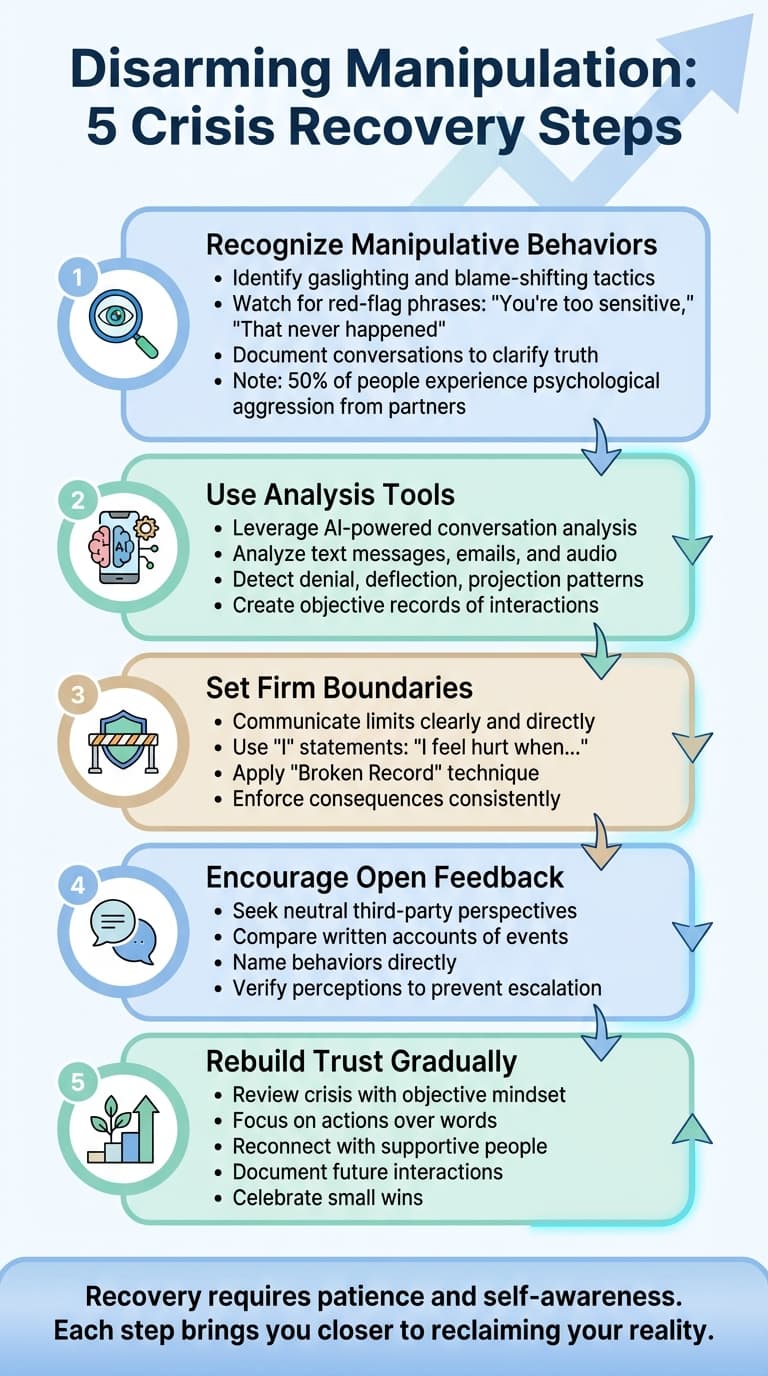
When manipulation escalates during a crisis, it can leave you doubting your reality and erode your sense of self. To recover and regain control, focus on these five steps:
- Recognize Manipulative Behaviors: Identify tactics like gaslighting and blame-shifting. Document interactions to clarify the truth.
- Leverage Tools Like Gaslighting Check: Use AI-powered tools to analyze conversations for manipulation patterns.
- Set Firm Boundaries: Clearly communicate your limits and enforce them consistently to protect your emotional well-being.
- Encourage Open Feedback: Seek neutral perspectives and use written records to address misunderstandings.
- Rebuild Trust Gradually: Reflect on past events, focus on actions over words, and connect with supportive people.
Recovery requires patience and self-awareness. With these steps, you can rebuild confidence and reclaim your sense of reality.
::: @figure
How To STOP Gaslighting And Manipulation Before It's Too Late!
1. Identify Manipulative Behaviors After a Crisis
The first step in moving forward after a crisis is recognizing manipulative tactics and calling them out for what they are. Crises often create chaos, and manipulators thrive in that environment to dodge responsibility. When you can pinpoint these behaviors, you shift your mindset from "What's wrong with me?" to "What is being done to me?" That shift is essential for breaking free from self-blame.
Be on the lookout for red-flag phrases that signal manipulation. Statements like "You're too sensitive", "That never happened", or "I only did that because you [X]" are classic attempts to distort reality or sidestep accountability. Peg Streep, author and expert on toxic relationships, explains, "The person doing the gaslighting or blame-shifting is actually more interested in feeling powerful or in control... than they are emotionally connected to their target" [3]. Recognizing this makes it clear that these behaviors are about control - not a reflection of your value.
Pay attention to how your body reacts during conversations. Feelings of tension, confusion, or a sudden drop in confidence can often be your body's way of alerting you to manipulation before your mind fully processes it. Research shows that nearly 50% of men and women in the U.S. have experienced psychological aggression from an intimate partner, including tactics like humiliation and coercive control [4]. These reactions are valid, and you're not alone in experiencing them.
It can also help to document conversations - write down what was said, when it happened, and how you responded. This creates a clear record to rely on when someone tries to convince you that "it wasn’t that bad" or that "you’re remembering it wrong." Having written evidence can cut through the fog of manipulation and give you a firm grip on reality.
Spotting manipulation early is key to protecting yourself. It helps calm your nervous system, which might otherwise stay stuck in fight-or-flight mode. Early recognition allows you to start healing and prevents the manipulator’s voice from turning into your own inner critic. By identifying these tactics, you take back control of your reality and rebuild self-trust. From here, you can even use tools like Gaslighting Check to analyze your interactions further.
2. Use Gaslighting Check to Analyze Your Conversations

After identifying manipulative behaviors, the next step is to verify your experiences with objective tools. Gaslighting Check provides a helpful way to analyze your conversations - whether they’re text messages, emails, or recorded audio - and uncover manipulation tactics that might otherwise slip by unnoticed.
This platform dives deep into communication layers. Its AI-powered text analysis scans for signs of manipulation, such as denial, deflection, projection, and blame-shifting. Meanwhile, the voice analysis feature evaluates tone and speech patterns to detect emotional volatility or aggressive undertones. Psychotherapist Simon Hitchcock explains:
"Manipulation is a behavioral strategy used to influence or control someone's actions or emotions for one's own benefit, often at the expense of the manipulated individual" [5].
These insights help you build a clearer understanding of your interactions and take steps toward recovery.
One standout feature is the real-time audio recording, which creates an objective record of conversations, bypassing the distortions that memory can introduce. Additionally, the conversation history tracking tool enables you to monitor recurring patterns over time.
The platform’s detailed reports label specific behaviors in your interactions, replacing vague feelings with clear terms like "reality distortion" or "emotional invalidation." You can even export these reports as PDFs to share with a therapist or counselor. Gaslighting Check offers a free plan for basic text analysis, while the premium plan - priced at $9.99/month - includes voice analysis, detailed reports, and full conversation history tracking.
3. Set Clear Boundaries and Communicate Consistently
Once you've identified manipulation patterns in your interactions, the next step is to take charge by setting firm boundaries. Think of boundaries as personal guardrails - they help safeguard your well-being and prevent further manipulation [10][11]. Without them, manipulators often exploit the gray areas.
Be direct and assertive when expressing your needs. For example, instead of making a vague request, say something like: "I need you to respect my feelings." Clinical and Forensic Psychologist Ahona Guha, D.Psych, emphasizes the importance of being specific:
"I noticed that you often give me ultimatums or say you will leave me when I hold a view different to yours" [8].
This kind of clarity eliminates room for misinterpretation and makes it harder for the manipulator to evade accountability.
Consistency is key. Reinforce your boundaries every time to prevent backsliding. A useful tool here is the "Broken Record" technique: calmly repeat your boundary without engaging in debate. For example, if the discussion turns circular, you can say, "I have already explained why I refuse, and I won't discuss it further" [7]. Be clear about consequences ahead of time - such as, "If you call me names, I will end the conversation immediately" - and stick to them without exception.
It’s equally important to stay emotionally neutral. Manipulators often thrive on eliciting emotional reactions, so keeping your responses calm and detached can make a big difference. This is known as the "Gray Rock" approach [6]. Use "I" statements like, "I feel hurt when my concerns are dismissed", to keep the focus on your emotions and avoid triggering blame-shifting.
Finally, remember that boundaries are not the same as ultimatums. A boundary focuses on your actions to protect yourself, such as, "I will leave the room if you yell", rather than trying to force someone else to change, like saying, "You must stop yelling" [9]. This distinction helps maintain control over your own well-being without escalating conflict.
Detect Manipulation in Conversations
Use AI-powered tools to analyze text and audio for gaslighting and manipulation patterns. Gain clarity, actionable insights, and support to navigate challenging relationships.
Start Analyzing Now4. Create Open Feedback Channels
Once you've established firm boundaries, the next step is to encourage open feedback channels. These channels help you validate your understanding of situations and ensure that manipulation tactics are caught early. Just as boundaries protect your emotional well-being, feedback channels protect your grasp on reality by offering clarity and confirmation.
Honest and direct communication plays a key role here. Open feedback allows you to verify your perceptions and address misunderstandings before they grow into bigger issues. This is especially important when you're recovering from a crisis, as miscommunication can easily escalate.
One way to strengthen these channels is by naming the behavior directly. Licensed Mental Health Counselor Natalie Rosado highlights the importance of seeking an outside perspective:
"It's an additional person who can be an objective party - someone who can help them gauge their experiences" [12].
This could involve turning to a therapist, a trusted mentor, or even an HR representative if the issue arises in a workplace setting. These neutral third parties can serve as a reality check when you're unsure of your recollection or interpretation of events.
A practical approach to maintaining clarity is to compare written accounts. Ask each party involved to document their version of a conversation or incident separately and then review them together [12]. This creates a record that can highlight discrepancies in memories or interpretations. If someone denies something happened, you can calmly respond:
"We seem to have different memories of that conversation. Here is what I remember happening" [12][7].
This kind of documentation not only provides evidence but also equips you to address manipulative behavior directly.
Ahona Guha, D.Psych, underscores the importance of clarity when confronting manipulation:
"To accurately challenge any behavior, it is important to first understand specifically what the behavior of concern is because you cannot ask someone to change something that neither of you understands" [8].
Being specific is crucial. For instance, you might say:
"I noticed you often give me ultimatums when we disagree" [8].
This kind of direct acknowledgment disrupts the manipulator's ability to control the narrative and forces the behavior into the open.
5. Review the Crisis and Rebuild Trust
Take a step back and review the crisis with a clear and objective mindset. Instead of revisiting old arguments, focus on documenting events to identify patterns of manipulation. For example, keeping a record of conversations can help highlight moments where facts were twisted or agendas were subtly shifted [1].
Pay attention to the intent behind manipulative behavior. Is it an attempt to avoid accountability, gain an advantage, or enforce control? Notice if discussions about sensitive topics, like finances or family, tend to trigger these patterns [8][1]. When conversations devolve into a battle over who's "right" instead of addressing the actual issue, it may be a sign of a deeper power struggle [1]. This process of reflection lays the groundwork for rebuilding trust and fostering healthier connections.
Rebuilding trust takes time and consistency. Start with small, steady actions that demonstrate sound judgment, allowing trust to grow naturally through behavior rather than empty promises. As Stephanie A. Sarkis, Ph.D., wisely states:
"Forgiveness is giving up the hope that the past can be changed" [2].
Reconnecting with supportive friends and family can also play a crucial role. Engage in low-pressure activities like volunteering or attending small social gatherings to nurture meaningful relationships [2][14]. If you've felt isolated, consider writing heartfelt letters to past friends as a way to rekindle old bonds [14]. Cheryl Cirelli offers a powerful reminder:
"Every step you take in recovery deserves recognition. Every choice you make to keep going, even when it's hard, is worth celebrating" [13].
Moving forward, document future interactions to ensure actions align with words. This can help verify that apologies remain sincere, even during disagreements. If uncertainty persists, seek guidance from a trusted therapist or an impartial third party to help navigate the situation.
Conclusion
Recovering from manipulation isn’t about erasing what happened - it's about reclaiming your sense of self and learning to trust your instincts again. The first step is recognizing that the abuse was never your fault. Identifying behaviors like gaslighting, blame-shifting, or reality distortion allows you to name the problem and regain control of your story. This awareness is a crucial foundation for rebuilding your confidence and using tools to affirm your perspective.
Establishing clear boundaries and keeping detailed records of interactions can help you stay grounded in your reality. Jot down dates, times, and key phrases from conversations to counter any confusion that may arise later. Tools like Gaslighting Check can also provide clarity by analyzing text and audio interactions for hidden patterns. With features such as real-time recording, encrypted storage, and in-depth reports (available with the premium plan), these tools offer a reliable way to navigate the disorientation caused by manipulation.
Rebuilding trust in yourself takes patience and practice. Start small - make decisions that help you differentiate between your intuition and trauma responses. Use a simple "Catch it, Check it, Change it" method: catch negative thoughts, verify them with facts, and turn them into positive, empowering beliefs. Celebrate your progress with a "Ta-da!" list, where you track daily wins to remind yourself of how far you’ve come. These small steps create momentum for bigger changes.
As you build confidence, opening transparent feedback channels can further strengthen your recovery. Share your feelings using "I" statements to avoid blame, and work with a trauma-informed therapist to explore detailed reports from analysis tools. These insights can guide conversations about patterns and boundaries, helping you solidify your growth.
Each step matters, no matter how small. Whether it’s reviewing past interactions, leaning on supportive friends, or simply choosing to press forward on a tough day, you’re building resilience. Take action today - document your experiences, explore helpful tools, and trust that clarity and emotional freedom are possible. You’ve got this.
FAQs
What’s the best way to document manipulative interactions?
To thoroughly document manipulative interactions, start by noting the essential details: exact quotes, dates, times, locations, and your emotional responses. Keep complete digital records, such as message threads or screenshots, and make sure they include timestamps to maintain authenticity. Organizing these records in chronological order can make it easier to spot patterns over time.
Whenever possible, rely on secure tools that encrypt your data and automatically add timestamps. Regularly reviewing your documentation can help you recognize repeated manipulation tactics and may serve as critical evidence if you decide to seek guidance from a therapist, counselor, or legal professional. However, before recording any conversations, ensure you’re familiar with your state’s consent laws to avoid legal issues.
What tools does Gaslighting Check provide to detect emotional manipulation?
Gaslighting Check provides a range of tools to help users spot emotional manipulation during conversations. These tools include real-time audio recording, text and voice analysis, and detailed reports that pinpoint potential manipulation tactics. The platform also offers conversation history tracking, enabling users to revisit and evaluate past interactions.
Privacy is a core focus, with features like encrypted data storage and automatic deletion policies designed to keep sensitive information safe. These resources are built to support individuals in recognizing manipulation and taking steps toward emotional healing.
How can I set boundaries without causing conflict?
To establish boundaries without stirring up conflict, focus on calm and straightforward communication. One effective approach is using "I" statements to express your needs. For example, you might say, "I need 30 minutes of quiet so I can concentrate on work." This keeps the focus on your feelings and needs rather than pointing fingers. Steer clear of phrases like "You always..." which can sound accusatory. Instead, address specific behaviors and explain how they affect you. If someone pushes back against your boundary, calmly restate your position. If tensions rise, taking a brief step away can help diffuse the situation.
Keeping track of boundary violations - note the date, time, and details of what happened - can help you stay level-headed and avoid reacting based on emotion. Being aware of manipulative behaviors, such as gaslighting or shifting blame, can also help you stay grounded. Lean on support from trusted friends, a therapist, or a peer group to validate your feelings and reinforce your confidence. When boundaries are repeatedly disregarded, calmly follow through with consequences, like reducing contact. Consistency is key in showing that your limits are firm and non-negotiable.