
Common Gaslighting Tactics That Undermine Respect
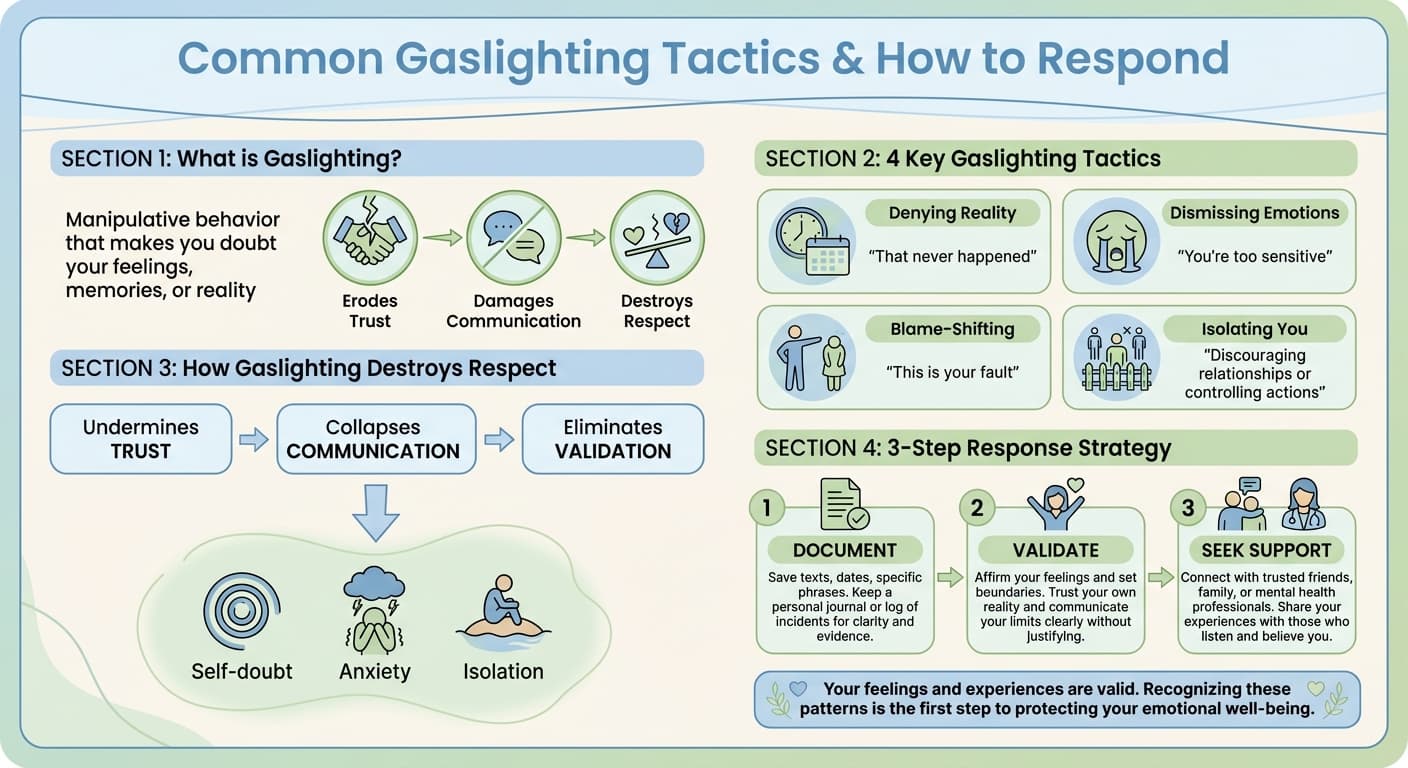
Gaslighting is a manipulative behavior where someone makes you doubt your feelings, memories, or reality. It often involves dismissing your experiences, denying events, or shifting blame, leaving you confused, anxious, and isolated. This behavior erodes trust, damages communication, and destroys respect in relationships. Recognizing these tactics is the first step to protecting your emotional well-being.
Key gaslighting tactics include:
- Denying reality: "That never happened."
- Dismissing emotions: "You're too sensitive."
- Blame-shifting: "This is your fault."
- Isolating you: Discouraging relationships or controlling your actions.
How to respond:
- Document interactions (e.g., texts, dates, specific phrases).
- Validate your feelings and set boundaries.
- Seek support from trusted people or professionals.
Gaslighting can deeply affect your confidence and self-worth, but identifying these behaviors and using tools like documentation can help you regain clarity and self-respect.
::: @figure
EVERY Gaslighting Tactic EXPLAINED in 12 Minutes
How Gaslighting Destroys Respect
Respect in any relationship rests on three essential elements: trust, open communication, and emotional validation. Gaslighting methodically dismantles each of these. When someone denies events or conversations - saying things like, "I never said that. You must be imagining things" - it shakes your confidence in your own memory and experiences [1][2][5]. Over time, this constant manipulation undermines trust in shared moments, creating a shaky foundation for the relationship. These cracks in trust and communication pave the way for even more manipulative tactics.
Open communication collapses when concerns are consistently deflected or dismissed. Phrases designed to misdirect, such as "You're too sensitive", shut down meaningful dialogue and make it impossible to address issues constructively [1][2][4]. Without open conversations, emotional validation disappears, leaving you feeling unheard and disrespected. This dynamic fosters an environment where voicing your thoughts feels not only pointless but potentially dangerous.
The long-term impact of gaslighting is profound. It fosters self-doubt, making you question your every thought and memory. Anxiety grows as confusion clouds your sense of reality, leaving you hypervigilant and unsure of what to trust [6][7]. Often, isolation follows. Gaslighters may recruit others to reinforce their distorted narrative, spreading rumors that you’re "crazy" or unstable [1][3][5]. This can make you feel so alienated that withdrawing from relationships seems like the only safe option.
Recurring Gaslighting Patterns
Recognizing the recurring behaviors of gaslighting helps illuminate how it systematically destroys respect. Gaslighters often deny events outright with statements like "That never happened", or dismiss emotions with comments like "You're overreacting", leaving you doubting your own reality [1][2][3][5][6].
Blame-shifting is another common tactic. Phrases like "You made me do this" or "This is your fault" push responsibility for their actions onto you, confusing accountability and eroding your sense of personal agency [1][2][4][5]. Additionally, gaslighters frequently isolate their targets by spreading rumors, cutting off vital support systems [1][3][5]. These patterns don’t just damage respect - they chip away at your self-esteem and make it harder to set and maintain boundaries.
Gaslighting Tactics and How to Stop Them
Denying Reality and Lying About Events
When someone says, "That never happened" or "You're imagining things", they’re challenging your memory and perception. This tactic is designed to confuse you, making you doubt what you know to be true. Over time, it can undermine your confidence and make their version of events seem more believable than your own.
To combat this, keep a detailed record of conversations, including dates, times, and exact phrases. Save texts, emails, and voicemails that contradict their denials. If they insist, "I never said that", calmly respond with facts, like, "I remember you said X on Tuesday." Keep your response brief and factual. If they continue to deny, state your disagreement and move on - protecting your energy is key. Sharing specific incidents with a trusted friend, therapist, or using tools like Gaslighting Check can also help you privately analyze patterns of manipulation. Tools like this offer encrypted data storage and automatic deletion, keeping your documentation secure. These strategies not only protect your clarity but also help you regain control over the narrative.
Dismissing and Trivializing Emotions
Hearing phrases like "You're too sensitive", "It was just a joke", or "You're overreacting" can make you feel like your emotions are invalid. Over time, this kind of dismissal can lead you to suppress your feelings, doubt your reactions, and question your self-worth.
The first step to counter this is self-validation. Acknowledge your feelings by saying to yourself, "I feel hurt, and that's okay." Use assertive "I" statements to communicate your emotions, such as: "When you say it was just a joke after I express my feelings, I feel dismissed." If the dismissive behavior continues, set boundaries by saying, "If you keep calling me too sensitive, I’ll have to end this conversation." When emotional dismissal becomes a pattern, consider limiting what you share with that person and seek support from those who show empathy. Documenting these instances can help you see that the issue lies with their behavior - not your sensitivity.
Shifting Blame and Attacking Character
Blame-shifting statements like "This is all your fault", "You made me act this way", or "You're crazy" are designed to make you feel responsible for the other person's actions. Sometimes, it might even sound like, "If you were a better partner, I wouldn’t lose my temper." These attacks can chip away at your self-esteem, making you doubt your worth.
Remember, their behavior reflects their own issues, not your value. If blame-shifting starts, you can respond with a statement like, "I’m willing to discuss my actions, but I won’t take responsibility for yours." If the attacks persist, consider ending the conversation to protect yourself. Keep a record of these interactions, noting what happened, what was said, and how blame was shifted. Look for patterns - are their criticisms specific and constructive, or are they vague and shaming, like "You’re a failure"? Recognizing these patterns helps you maintain perspective and reclaim your sense of self.
Isolating Targets and Using Affection as Control
Isolation tactics might include discouraging you from seeing friends, causing conflicts when you connect with others, or saying things like, "Your friends are bad for you." They might monitor your phone, control your finances, or make you feel guilty for spending time with family. Sometimes, affection is used as leverage, with phrases like, "If you loved me, you wouldn’t need anyone else", or by withholding love until you comply.
To resist isolation, reconnect with trusted friends or seek support through online groups or therapy. Use discreet methods to safeguard your communications. Take small steps toward independence, such as setting aside personal funds, exploring local resources like hotlines or shelters, or building skills that enhance your financial stability. Document coercive behaviors, like when calls are monitored or funds are restricted. Tools like Gaslighting Check can help you track these patterns securely. Regaining independence is essential for your emotional safety, but it’s wise to consult a domestic violence or mental health expert before making major changes. A safety plan can help you navigate these situations, especially since efforts to reclaim autonomy can sometimes provoke further controlling behavior.
Detect Manipulation in Conversations
Use AI-powered tools to analyze text and audio for gaslighting and manipulation patterns. Gain clarity, actionable insights, and support to navigate challenging relationships.
Start Analyzing NowTools and Methods for Rebuilding Respect
Using Documentation and Analysis Tools
Keeping a record of events can be an effective way to challenge gaslighting and reaffirm your sense of reality. When someone repeatedly says things like, "That never happened", or "You're imagining it", having dated notes, saved texts, or email screenshots provides a concrete reference. Write down key conversations, including dates (e.g., 12/17/2025), exact phrases used, and your emotional reactions. Over time, this practice can reveal patterns that might otherwise be hard to spot.
A tool like Gaslighting Check can take your raw records and turn them into structured insights. It analyzes text messages or recorded audio for signs of manipulation, such as denial, blame-shifting, or trivializing your concerns. The platform then provides clear reports and summaries, showing how often these behaviors occur and whether they escalate over time. Plus, with features like end-to-end encryption and automatic data deletion, your records remain private and secure - a critical feature if you're worried about retaliation or monitoring. When you have reliable documentation, you’re better equipped to move toward healthier communication dynamics.
Building Healthy Communication Habits
Healthy communication stands in stark contrast to gaslighting. In respectful conversations, people take responsibility for their actions, genuinely listen, and acknowledge emotions - even when they don't agree. For example, someone might say, "I can see why that upset you; let's work through it", or "I remember it differently, but I believe that’s how it felt to you." Disagreements focus on specific actions and solutions rather than personal attacks, leaving you feeling understood instead of confused or doubting yourself.
Just as documentation helps ground your reality, respectful communication fosters trust. To develop these habits, try using clear "I" statements, like, "I feel dismissed when my concerns are mocked." Set boundaries for discussions, such as, "I’m open to talking about this event, but not about my character as a whole." If a conversation becomes overwhelming, allow yourself to take a break. When faced with accusations like "You're wrong" or "You're imagining things", ask for specific examples or evidence, and calmly restate your key points rather than getting trapped in circular arguments.
Over time, these practices not only reinforce your sense of self-worth but also establish clear limits on what behavior you will and won’t tolerate. By combining documentation tools, self-validation, and assertive communication, you can begin to rebuild respect - both from others and, most importantly, from yourself.
Conclusion: Rebuilding Emotional Safety and Self-Respect
Gaslighting, as we've discussed, systematically erodes mutual respect by invalidating your sense of reality. Through tactics like denial, trivialization, distortion, isolation, and controlling affection, it shakes your confidence and makes you question your truth. Recognizing these patterns is a powerful first step toward breaking free. Remember, you're not "too sensitive" or "making things up" - those are classic gaslighting phrases meant to make you doubt yourself.
Understanding these strategies equips you to regain your footing. Healing hinges on three key practices: validating your feelings, establishing and maintaining boundaries, and reality-checking through documentation and trusted feedback. It's important to remind yourself that feeling hurt, confused, or angry is a natural response to manipulation - not a flaw in your character. Practice affirming phrases like, "My emotions are valid, even if others disagree", or "Discomfort is a signal worth paying attention to." These small but meaningful affirmations are steps toward reclaiming your dignity.
Clear boundaries are essential for recovery. They create a space of emotional safety, even in relationships you may not be able to leave right away. Start with manageable steps: calmly point out the behavior ("When you say I'm 'imagining things,' it dismisses my perspective"), state your limit ("I won't continue this conversation if my feelings are mocked"), and follow through by stepping away if the boundary is crossed. Tools like Gaslighting Check, which securely document instances of manipulation, can also help you rebuild self-respect over time.
Recovery is a gradual process, and it's natural to feel uncertain or scared as you challenge old patterns. Seek support from trauma-informed therapists, trusted friends, or support groups who can validate your experiences and help you navigate this journey. Each act of self-validation, boundary-setting, and reality-checking strengthens your sense of self-worth, even if the gaslighter never changes. You deserve relationships where your feelings and experiences are respected. Rebuilding that respect starts with honoring your own reality - one small, courageous step at a time.
FAQs
How can I tell if my partner is gaslighting me?
Gaslighting often reveals itself through actions such as denying facts, distorting the truth, shifting blame, or causing you to second-guess your memory. Be mindful if your partner brushes off your emotions, challenges your experiences, or makes you question what you know to be true.
If you find yourself feeling disoriented or uncertain after conversations, trust your gut. It may help to find a neutral method - like journaling or discussing with a trusted confidant - to review interactions and gain perspective. Spotting these behaviors is an essential step toward addressing emotional manipulation.
How can I protect myself from gaslighting?
Protecting yourself from gaslighting begins with learning to trust your gut feelings. If something doesn’t sit right, it’s worth paying attention. Gaslighting often involves manipulative behaviors like denying facts, shifting blame, or dismissing your emotions - recognizing these patterns is key.
One way to stay anchored in reality is to keep a record of important interactions. This can serve as a reminder of what actually happened, especially when someone tries to distort the truth. It's also crucial to set firm boundaries with those who attempt to manipulate you. Surround yourself with trusted friends, family, or professionals who can offer objective insights and support. Spotting these tactics early can help you reclaim your confidence and stay in control of your narrative.
How does gaslighting impact mental health and self-esteem?
Gaslighting can take a serious toll on your mental health and self-esteem. It often leaves you feeling confused, filled with self-doubt, and emotionally drained. Over time, it can erode your confidence in your own perceptions and memories, which might lead to anxiety, depression, and even a sense of worthlessness.
Breaking away from gaslighting is crucial for restoring your emotional balance and rebuilding your confidence. Recognizing the warning signs and reaching out for support are key steps toward trusting yourself and your experiences again.