5 Cognitive Distortions Caused by Gaslighting

5 Cognitive Distortions Caused by Gaslighting
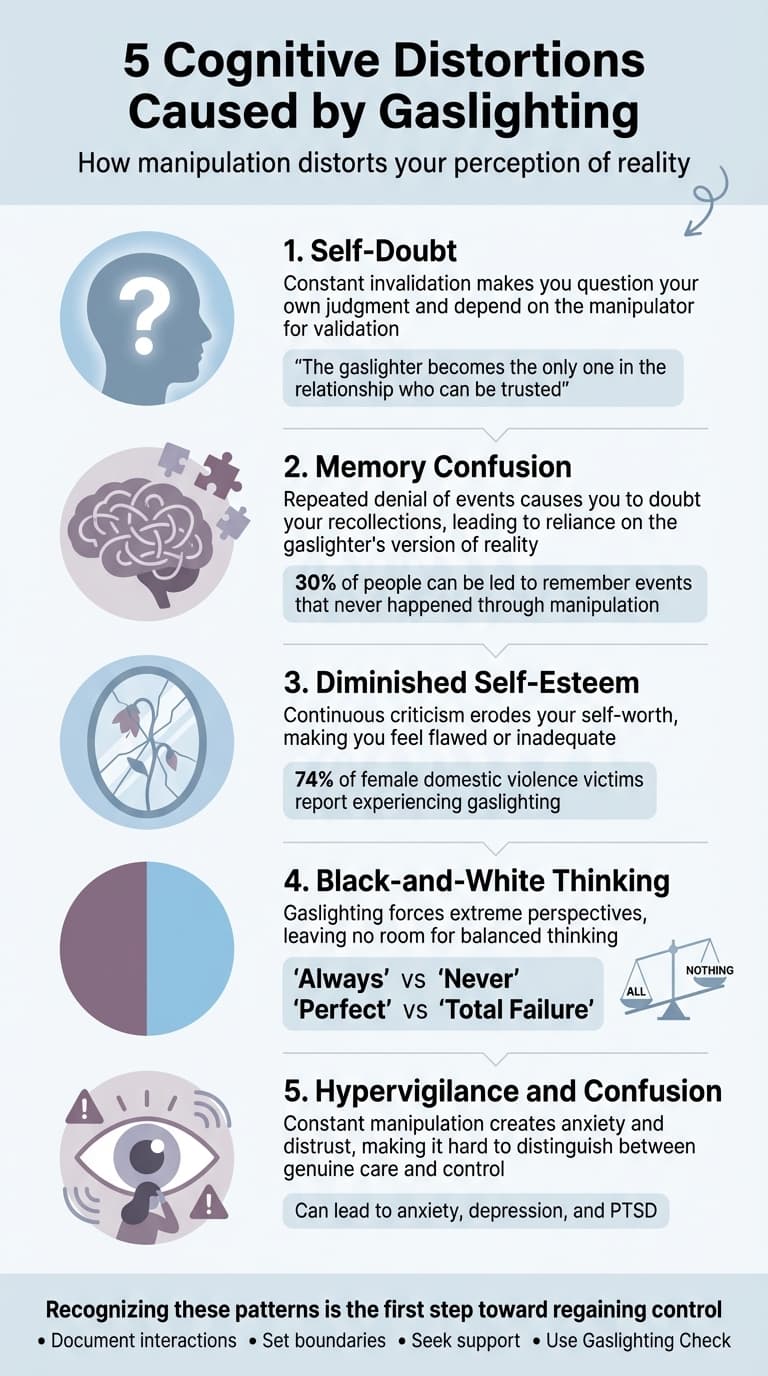
Gaslighting is a form of manipulation that distorts your perception of reality, causing you to question your memory, emotions, and judgment. Over time, this can lead to harmful thinking patterns, known as cognitive distortions. These include:
- Self-Doubt: Constant invalidation makes you question your own judgment and depend on the manipulator for validation.
- Memory Confusion: Repeated denial of events causes you to doubt your recollections, leading to reliance on the gaslighter's version of reality.
- Diminished Self-Esteem: Continuous criticism erodes your self-worth, making you feel flawed or inadequate.
- Black-and-White Thinking: Gaslighting forces extreme perspectives, leaving no room for balanced thinking.
- Hypervigilance and Confusion: Constant manipulation creates anxiety and distrust, making it hard to distinguish between genuine care and control.
Recognizing these patterns is the first step toward regaining control. Tools like journaling events or using platforms such as Gaslighting Check can help you document interactions, identify manipulation, and rebuild trust in yourself.
::: @figure
Can Gaslighting Cause Mental Illness? - The Drama Reel
1. Self-Doubt
Self-doubt is one of the most damaging effects of gaslighting. Manipulators chip away at your confidence through constant denial and invalidation [4][5]. When someone repeatedly tells you that your memories are false, your feelings are misplaced, or your perceptions are inaccurate, it’s hard not to start believing them.
As your trust in yourself fades, you begin to depend entirely on the manipulator for validation. Sarah Winnig, MA, captures this dynamic perfectly:
"The gaslighter becomes the only one in the relationship who can be trusted" [4].
This dependency isn’t accidental - it’s the gaslighter’s primary goal. By positioning themselves as the sole authority on what’s "real", they strip you of your autonomy and leave you feeling powerless.
Ellen Hendriksen, Ph.D., explains how this cycle becomes ingrained:
"At this stage, your gaslighter has you right where they want you: beginning to doubt yourself and your ideas even when they're not there to continue enforcing the message" [1].
Eventually, you start questioning your own experiences without any external prompting. Was that conversation as you remember it? Are you overreacting? Could you be imagining things? This creeping self-doubt makes even simple decisions feel impossible [4]. You might find yourself apologizing constantly, second-guessing your every move, or even defending the manipulator’s actions to others.
To combat self-doubt, start documenting events as soon as they happen. Having an objective record can help you push back against the gaslighter’s denials when you feel uncertain [4][6]. Avoid trying to convince the gaslighter of your reality - it’s a losing battle. Instead, use firm, direct statements like, "I know what happened", to shut down circular arguments [6]. Most importantly, share your experiences with trusted friends or a therapist who can help you regain clarity and rebuild your confidence outside of the manipulator’s influence [4][6].
Next, we’ll look at how gaslighting distorts your memories, making the effects of self-doubt even more severe.
2. Memory Confusion
Memory confusion happens when a gaslighter repeatedly denies past events, making you doubt your own recollections. They don’t just dismiss your feelings - they go further with phrases like, "I never said that" or "That’s not how it happened." Over time, this relentless denial can leave you questioning whether your memory is reliable at all.
Robin Stern, Ph.D., Co-founder of the Yale Center for Emotional Intelligence, highlights the psychological impact of this manipulation:
"When someone you have chosen to trust, respect and love speaks with certainty - especially if there is a grain of truth in it - it can be extremely difficult not to believe them." [2]
Gaslighters often start small, distorting minor details, but gradually escalate to rewriting major events. This steady tactic chips away at your confidence in your own perceptions. Cognitive psychologist Elizabeth Loftus’s research found that about 30% of participants could be led to "remember" events that never actually happened through manipulated cues [8]. Gaslighters take advantage of this natural vulnerability by rewriting the narrative repeatedly, making their version of events feel more believable than your own.
This manipulation doesn’t just confuse - it erodes trust in your own judgment. Over time, you may find yourself second-guessing everything and relying on the gaslighter’s account to make sense of reality. This dependency is intentional. By labeling you as "forgetful" or "unstable", the gaslighter ensures that any attempts you make to challenge them are easily dismissed.
To combat memory confusion, consider keeping a "Reality Journal." Write down conversations and events as soon as they happen, including specific details and even dialogue. This practice can help you identify patterns where the gaslighter twists facts or shifts the focus. If a conversation starts to feel like a battle over whose memory is "correct", disengage rather than trying to prove yourself. The more you resist their attempts to distort reality, the harder it becomes for them to deepen your confusion and control.
3. Diminished Self-Esteem
Gaslighting has a devastating way of chipping away at your self-worth. Through relentless invalidation and criticism, manipulators plant seeds of self-doubt. You might catch yourself thinking, "Maybe I'm just not good enough" or "There must be something wrong with me." Carol A. Lambert, MSW, a psychotherapist with expertise in emotional abuse, describes this painful process:
"By internalizing the false accusations of the gaslighter, you begin the painful process of doubting yourself - a process that negatively impacts your perception of the world, self-esteem, and personal identity." [9]
This erosion of confidence isn’t accidental - it’s intentional. Trauma-informed therapist Amelia Kelley, Ph.D., highlights the manipulator’s aim:
"The payoff for the gaslighter is the erosion of their target's self-esteem, which allows them to gain control over the other person and perpetuate various cycles of abuse." [10]
The effects of this self-doubt quickly spill into everyday life.
You may find yourself apologizing constantly, even when there’s no reason to. Decisions that once seemed simple can suddenly feel overwhelming because you've been trained to mistrust your own instincts. Many people in this situation describe an exhausting habit of replaying conversations in their minds, trying to avoid saying anything that might invite further criticism. This constant self-editing disconnects you from your true self and reinforces the belief that you’re somehow inherently flawed.
The numbers paint a grim picture: 74% of female victims of domestic violence report experiencing gaslighting from their partner or ex-partner [7]. The fallout often disrupts every corner of life - work, friendships, and even the smallest daily routines. Over time, you may lose sight of the things you once admired about yourself, replaced by a deep sense of disappointment in the person you’ve become under the manipulator’s influence.
Breaking free begins with reclaiming your self-trust. Let go of the need for the gaslighter’s approval. Start making decisions on your own terms, lean on trusted friends or a therapist for support, and practice speaking to yourself with kindness - just as you would comfort a friend in the same situation.
Detect Manipulation in Conversations
Use AI-powered tools to analyze text and audio for gaslighting and manipulation patterns. Gain clarity, actionable insights, and support to navigate challenging relationships.
Start Analyzing Now4. Black-and-White Thinking
Gaslighting thrives on extremes, forcing you to see everything - including yourself - as either flawless or completely flawed, right or wrong, with no middle ground. This mindset, much like self-doubt and memory confusion, chips away at your sense of reality. When a gaslighter presents you with a stark choice between their version of events and your own, disagreeing isn’t just unwelcome - it earns you labels like “crazy,” “unstable,” or “wrong.” Over time, this leaves no room for balanced or nuanced thinking.
In this environment of forced absolutes, you might find yourself chasing perfection just to avoid conflict. Any mistake, no matter how small, can feel like total failure. Psychologist Chivonna Childs, Ph.D., sheds light on the disorienting effects of gaslighting:
"The person who's doing the gaslighting may or may not realize they're doing it. But either way, when you're on the receiving end, it can feel confusing and be very damaging" [11].
The labels gaslighters use - “liar,” “incompetent,” “worthless” - don’t just sting in the moment; they start to shape how you see yourself.
This distorted thinking seeps into everyday life. A minor error at work might convince you that you’re entirely incapable, pushing you to abandon your goals. Decision-making becomes paralyzing because there’s no middle ground - only absolute success or devastating failure. Rebecca Joy Stanborough, MFA, explains this phenomenon:
"When you believe you're destined for success or doomed to failure, and others are either angelic or evil, you're engaging in polarized thinking" [3].
To break free from this cycle, start by identifying absolute words like “always,” “never,” “perfect,” or “total failure.” When you notice yourself slipping into extreme thoughts, take a moment to consider other possibilities. Write down alternative explanations and document events to keep yourself grounded in reality. Recognizing how gaslighting skews your perception is a crucial first step toward reclaiming balanced judgment and clarity.
5. Hypervigilance and Confusion
Repeated gaslighting pushes your mind into survival mode, where you’re constantly scanning conversations for signs of manipulation. This heightened state of alertness leaves you feeling tense and uneasy, even in situations that seem safe. Over time, this constant vigilance becomes exhausting, especially when paired with the unpredictable behavior of a gaslighter.
Gaslighters often mix moments of kindness with sudden shifts in their demeanor. One moment, they may appear loving and supportive; the next, they deny things they've said or twist situations to make you feel at fault. This erratic pattern keeps you guessing, always bracing for their next move.
The confusion caused by these interactions doesn’t just stay in the moment - it seeps into your perception of relationships and trust. Gaslighting erodes your confidence in others and, more painfully, in yourself. You begin to question your memories, your instincts, and even your worth. As Robin Stern, Ph.D., author of The Gaslight Effect, puts it:
"Over time, you begin to believe that there is something wrong with you because one of the most important people in your life is telling you this" [7].
This loss of self-trust makes it incredibly difficult to tell the difference between genuine care and manipulation. You may find yourself second-guessing every interaction, unsure of what’s real and what’s not.
The psychological effects are profound. Studies show that hypervigilance from gaslighting can lead to anxiety, depression, and even suicidal thoughts. Many victims develop PTSD and struggle to rebuild trust in others long after the gaslighting ends [7].
Recognizing this pattern of hypervigilance is an important step toward regaining control. When you feel that creeping doubt or confusion, pause and reflect. Ask yourself: Is this person denying clear memories? Are they dismissing your emotions as “too much”? Instead of trying to prove who’s right, focus on how you feel. If you sense manipulation or feel attacked, disengage from the situation [2].
How Gaslighting Check Can Help You Recover

Recovering from gaslighting isn't just about recognizing manipulation - it’s about rebuilding trust in your own perceptions. That’s where Gaslighting Check steps in. By documenting and analyzing your interactions, it provides the clarity you need to counter the confusion gaslighting creates. When you’re stuck doubting your memory or second-guessing your experiences, having an objective record can be a game-changer.
The platform uses advanced tools to analyze both text and voice interactions, identifying emotional manipulation tactics. With real-time recording, you can capture conversations as they happen, cutting through the "he-said, she-said" noise. Saving texts, emails, and audio recordings gives you concrete evidence to challenge the self-doubt gaslighting often causes [13]. This documentation is especially helpful when you start questioning whether your reactions are valid or if you’re misremembering events.
To ensure your privacy, Gaslighting Check employs encrypted data storage and automatic deletion policies. This means you can safely analyze sensitive interactions without worrying about security risks. Detailed reports break down conversations, highlighting specific manipulation patterns, so you can better understand what’s happening in your relationships.
Here’s a quick look at the platform’s plans:
| Feature | Free Plan | Premium Plan | Enterprise Plan |
|---|---|---|---|
| Price | $0.00 | $9.99/month | Contact for Pricing |
| Text Analysis | Basic pattern recognition | Advanced manipulation detection | Bulk analysis & priority processing |
| Voice/Audio Analysis | Not included | Full voice & tone analysis | Full voice & tone analysis |
| Real-Time Recording | Limited to 5 minutes | Unlimited | Unlimited with multi-user access |
| Privacy Protections | Standard encryption | Enhanced privacy & stealth mode | Enterprise-grade security & compliance |
| Insights & Reports | Basic summary | Detailed actionable insights | Custom reporting & data exports |
The Free Plan is a great starting point, offering basic tools to spot manipulation patterns. For $9.99/month, the Premium Plan unlocks unlimited recording and advanced insights powered by AI. If you’re part of an organization or support group, the Enterprise Plan provides tailored solutions to meet your needs. Choose the plan that aligns with where you are in your recovery journey.
Conclusion
Gaslighting distorts your perception of reality, leading to self-doubt, memory confusion, low self-esteem, black-and-white thinking, and hypervigilance. These cognitive distortions can make it difficult to trust your own judgment, leaving you vulnerable to accepting a version of reality shaped by the abuser [2][12]. Recognizing these patterns is the first step toward breaking free.
It's important to remember that these distortions are habitual thinking errors, not absolute truths [3]. As Robin Stern, Ph.D., Co-founder of the Yale Center for Emotional Intelligence, explains:
"As soon as you understand that it doesn't matter how right you are, the closer you will be to freedom" [2].
The focus shouldn't be on winning arguments or earning approval. Instead, the priority is reclaiming your independence and emotional well-being.
To start regaining control, take decisive steps. Document conversations as soon as they happen to preserve accurate details [2][12]. Establish firm boundaries with phrases like, "It seems we remember things differently, so let's move on" [12]. Seek support from trusted friends, family, or professionals who can provide an objective perspective - even one outside perspective can help restore confidence in your own perceptions [1]. Additionally, tools like Gaslighting Check can assist in organizing your thoughts and rebuilding trust in your reality.
FAQs
How can I tell if I’m being gaslighted in a relationship?
Gaslighting is tricky to identify because it works by making you doubt your own sense of reality. Some telltale signs include a partner denying things they’ve said or done, brushing off your emotions as overreactions, or insisting that you’re imagining things. You might hear phrases like “You’re too sensitive,” “I didn’t say that,” or “You need help,” which are often used to shift blame and warp your perspective.
You may find yourself second-guessing your decisions, apologizing excessively, or feeling increasingly isolated and unsure of your own judgment. To identify these patterns, try keeping a record of conversations. This can help you spot recurring behaviors like denial, contradictions, or emotional dismissiveness. Tools like Gaslighting Check can also analyze your interactions and highlight manipulative tactics, helping you regain a clearer perspective.
If these patterns leave you feeling confused or doubting your reality, listen to your instincts. You could explore setting firm boundaries, reaching out to a professional, or tapping into resources that can guide you toward breaking free from this cycle of manipulation.
How can I rebuild my self-esteem after being gaslighted?
Rebuilding self-esteem after experiencing gaslighting is a journey that demands time, patience, and intentional effort. The first step is to acknowledge the toll the manipulation has taken on you and to validate your feelings. Remember, gaslighting is meant to sow seeds of self-doubt, but it does not determine your value.
To regain confidence, focus on small, manageable actions. Be kind to yourself by challenging negative self-talk and replacing it with more compassionate and realistic thoughts. Establish healthy boundaries to shield yourself from further emotional harm, and minimize exposure to people or situations that make you question your worth. Lean on a support system - trusted friends, support groups, or a therapist can provide a safe space to process what you've been through and help rebuild a positive self-image.
Through steady self-care, professional help, and the support of those who care about you, it’s possible to restore your confidence and reclaim your sense of self.
How does Gaslighting Check help identify gaslighting and support recovery?
Gaslighting Check is designed to spot gaslighting by analyzing conversations for manipulation tactics like denial, blame-shifting, emotional invalidation, and reality distortion. By using real-time audio recording and text analysis, it pinpoints moments of manipulation and generates detailed reports. These reports compare what was originally said to any later distortions, helping reduce self-doubt and confusion around your memories.
The tool also aids in recovery by tracking conversation histories and identifying recurring manipulation patterns. This insight can empower you to recognize tactics being used against you and take protective measures, such as setting boundaries, seeking professional support, or documenting instances of abuse. To ensure your privacy, the platform includes features like encrypted data storage and automatic deletion, so you can use it with confidence and peace of mind.