
Cognitive Bias in Gaslighting: 3 Case Studies
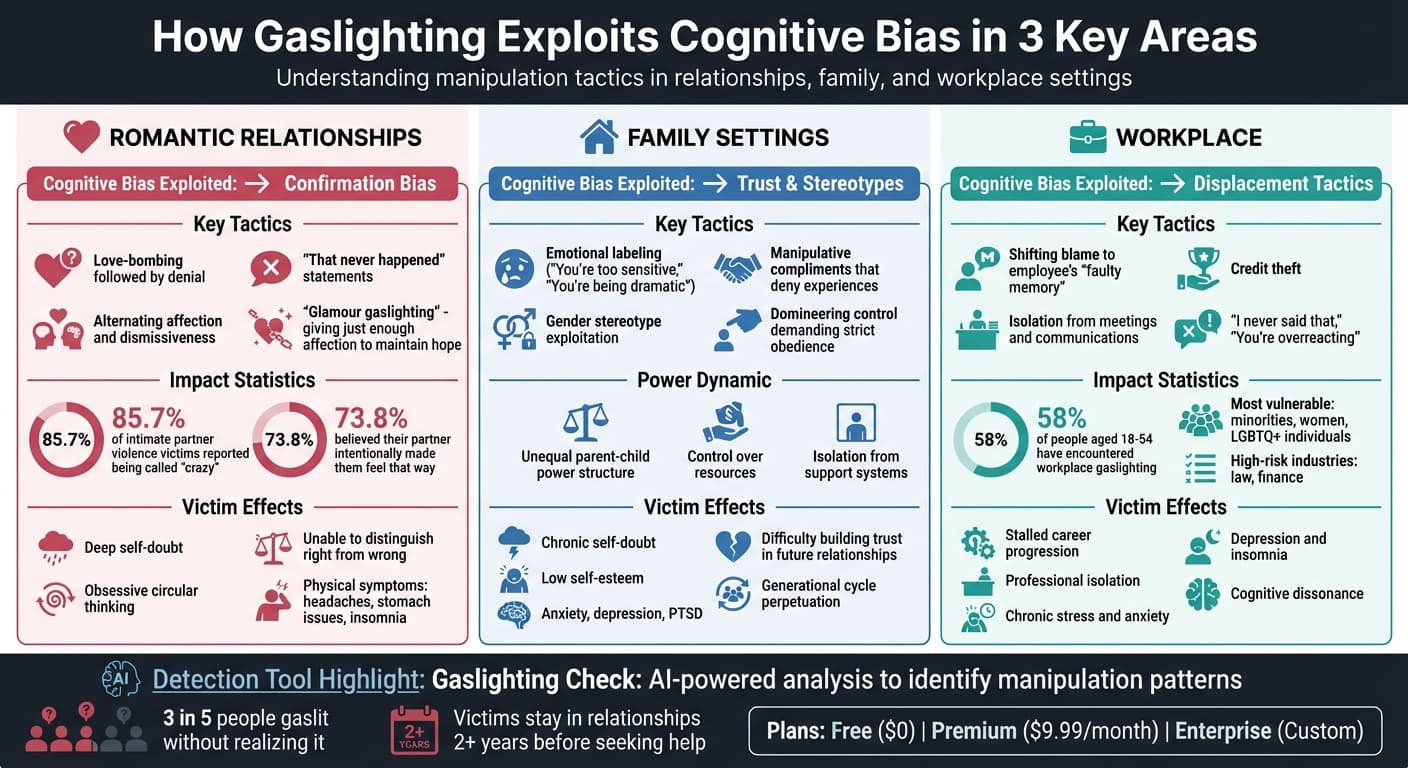
Gaslighting manipulates your perception of reality, often exploiting cognitive biases to create confusion, self-doubt, and dependency. This article explores how gaslighting operates in three key areas - romantic relationships, family dynamics, and workplaces - using tactics like confirmation bias, emotional labeling, and displacement. Key insights include:
- Romantic Relationships: Gaslighters use confirmation bias by alternating affection and denial, making victims question their memories and cling to idealized versions of the relationship.
- Family Settings: Parents may invalidate a child’s emotions using stereotypes or emotional labels, causing long-term self-doubt and dependency.
- Workplaces: Manipulative managers employ tactics like shifting blame or isolating employees, eroding confidence and professional growth.
Gaslighting Check, a tool offering real-time analysis of conversations and texts, helps identify these behaviors. Plans range from free to $9.99/month, with features like voice recording, text analysis, and manipulation pattern tracking.
Understanding gaslighting tactics is the first step to regaining trust in your own perception and breaking free from manipulation.
::: @figure
Case Study 1: Confirmation Bias in Romantic Relationships
Confirmation bias - when people seek out information that supports their existing beliefs while ignoring evidence that contradicts them - is a key tool for gaslighters. They create an idealized version of reality that their victims cling to, even when faced with evidence that challenges it.
Example: Love-Bombing and Denial
Gaslighting often starts with love-bombing, where excessive affection paints a picture-perfect relationship. This sets a positive foundation that victims hold onto, even as the gaslighter's behavior shifts. Over time, the gaslighter alternates between affectionate and dismissive behaviors. When confronted about their actions, they may confidently say, "That never happened", exploiting the victim's natural tendency to trust repeated messages. The more often something is repeated with confidence, the more "true" it feels, even if it contradicts personal memories [8].
Take Leah, a student at Ohio State University in 2024, as an example. Her partner, who had a strong social presence, used his charm to make her doubt her own perceptions. When she questioned his actions, he deflected by saying, "You have to get it together. Maybe you should see someone", leaving her questioning her own reality [9]. His public charm contrasted sharply with his private cruelty, deepening her confusion and making her believe she was the problem.
This tactic, sometimes referred to as "glamour gaslighting", involves giving just enough affection to keep the victim hopeful for a return to the initial love-bombing phase [5]. As a result, the victim’s confirmation bias shifts, focusing on any signs that the relationship is still "good" and dismissing red flags as minor misunderstandings. Research highlights this dynamic: 85.7% of individuals who experienced intimate partner violence reported being called "crazy", while 73.8% believed their partner intentionally made them feel that way [5].
This cycle reinforces the victim's reliance on their distorted perception of the relationship, leading to deep self-doubt.
Effects on the Victim
The psychological impact of gaslighting is immense. Victims often find themselves caught in what psychologist Robin Stern calls the "Gaslight Tango." In this cycle, victims adjust their understanding of events to align with the gaslighter's narrative, often driven by a need for approval or a desire to maintain the relationship [7, 18].
Author Lily Dunn, in her memoir Sins of My Father, shares how her father’s refusal to acknowledge her feelings of exploitation as a teenager led to obsessive and circular thinking in her later relationships [9]. This kind of manipulation erodes a person’s trust in themselves, leaving them feeling hollow and unsure of their own reality [10]. Many victims report being unable to distinguish right from wrong, a state of confusion that can be deeply damaging [9].
As Dr. Robin Stern explains:
"Gaslighting may not be the only factor leading to mental illness, but the same factors that leave a person vulnerable to gaslighting may result in lower self-esteem, uncertainty about their own reality, anxiety, and ultimately depression" [7].
The emotional toll of gaslighting often spills over into physical symptoms. Many victims report experiencing headaches, stomach issues, and trouble sleeping, all stemming from the relentless self-doubt and stress caused by this form of manipulation.
Case Study 2: Trust and Stereotypes in Family Settings
Moving away from romantic relationships, gaslighting within families often preys on the natural trust children place in their parents. As Dr. Robin Stern explains, gaslighting thrives "when there is an unequal power dynamic or when the gaslighted has shown respect to the gaslighter" [1]. This imbalance creates fertile ground for manipulation and control within family dynamics.
Parents who engage in gaslighting often rely on what researchers refer to as "domineering control", where strict obedience is demanded to shape a child's beliefs and emotions [11]. This isn't about healthy discipline - it’s about invalidating a child’s experiences, whether those involve trauma, feelings of isolation, or genuine concerns. The goal is to make the child question their own memories and sense of reality [11].
Example: Parental Manipulation Using Emotional Labels
One common tactic is emotional labeling. Phrases like "You're too sensitive", "You're being dramatic", or "You're making a big deal out of nothing" are used to trivialize a child's feelings and concerns [11].
Alicia Muñoz, a licensed therapist, highlights how even compliments can become tools of manipulation:
"Compliments can be a form of gaslighting when they negate or deny a child's experience of a situation, or of themselves, or when they're a form of manipulation" [11].
For example, a parent might say, "You're such a strong kid" to dismiss a child’s pain, or "You're so smart - you should know better" to shift blame onto the child for the parent’s actions. These statements, while seemingly positive, can undermine the child’s emotions and reinforce the parent’s control.
Gender stereotypes further complicate the issue. Gaslighting often exploits societal norms that dismiss women's emotions as overreactions, effectively silencing their voices [3][4]. A daughter challenging her father’s behavior might be labeled "hysterical", while a son expressing vulnerability could be called "weak" or "overly emotional." These labels serve a purpose: they frame the child’s reality as irrational, allowing the parent to avoid accountability and maintain control [1]. Over time, this teaches the child to distrust their own perceptions, accepting the parent's narrative as the only valid truth.
Power Imbalances and Long-Term Damage
The harm caused by family gaslighting goes beyond emotional dismissal. Power imbalances, such as parental control over resources, can isolate children from external support systems [2].
Historical examples show just how far gaslighting can go. In 1969, researchers Barton and Whitehead published three case studies in The Lancet that explored "the gas-light phenomenon" in family settings. One case involved a retirement home manager who deliberately gave an elderly resident laxatives to induce incontinence. The manager then used the resulting symptoms as "evidence" to have the woman transferred to a psychiatric hospital under the pretense of dementia [5].
The consequences of such manipulation are profound. Dr. Robin Stern explains:
"Over time, you begin to believe that there is something wrong with you because one of the most important people in your life is telling you this" [4].
Victims of family gaslighting often struggle with chronic self-doubt, low self-esteem, anxiety, depression, and even PTSD. These effects make it challenging to build trust and maintain healthy relationships later in life [4].
What’s particularly troubling is how gaslighting can perpetuate itself across generations. Without intervention, victims may internalize these behaviors and repeat them, continuing the cycle of manipulation within families [11]. This pattern highlights how cognitive biases and learned behaviors are passed down, reinforcing the cycle of harm.
Case Study 3: Displacement Tactics in the Workplace
Workplace gaslighting, much like in personal or family settings, manipulates cognitive bias to distort an employee's perception of reality. Here, managerial authority often disguises manipulation as constructive feedback, making it even harder to recognize.
Recent statistics reveal that 58% of individuals aged 18–54 have encountered gaslighting at work [12]. Dr. Craig Malkin, a clinical psychologist at Harvard Medical School, sheds light on this phenomenon:
"It requires a position of power to pull it off with impact and effectiveness. The person bolsters their own sense of self-confidence and self-esteem by undermining yours" [12].
Displacement tactics in the workplace are a hallmark of this behavior. These involve shifting blame from the gaslighter's actions to the employee's supposed shortcomings or faulty memory. For instance, a manager might alter deadlines without notice and then accuse the employee of "misremembering" the original timeline. In another scenario, they might privately support an employee's idea but later criticize it in a public forum, denying any prior approval. These actions not only deflect accountability but also chip away at the employee's confidence, creating an environment where self-doubt thrives. This erosion of trust in one's own abilities often leads to further undermining tactics.
Example: Undermining Employee Credibility
Phrases like "I never said that", "You're misremembering", and "You're overreacting" are common verbal tools used to destabilize an employee's confidence.
Take credit theft, for example. A manager might praise an employee's innovative idea during a private discussion, only to present that same idea as their own in a leadership meeting. If the employee confronts them, the manager might respond dismissively with, "You never mentioned that earlier - you must be confused."
Isolation tactics are another subtle yet damaging strategy. An employee might be excluded from key meetings or left off essential email threads. When they ask about the exclusion, the gaslighter might say, "You're being too sensitive" or "You must have missed the notification." The underlying message is clear: the issue isn't the exclusion itself, but the employee's reaction to it.
Mary Abbajay, president of Careerstone Group, LLC, describes the calculated nature of these behaviors:
"Gaslighters know how to fly under the radar. They are adept at undermining an employee's self-esteem, confidence, and sense of reality in subtle, sneaky, and hard-to-prove ways" [12].
This subtlety is what makes workplace gaslighting so insidious. The ambiguous nature of these actions leaves victims struggling to gather concrete proof, while their credibility and professional growth suffer.
Career and Mental Health Consequences
The effects of workplace gaslighting extend far beyond the office. It can stall career progression, isolate employees, and lead to chronic stress, anxiety, depression, and even insomnia. The cognitive dissonance it creates - experiencing something but being told it didn’t happen - breeds confusion and deep self-doubt. Research highlights that minorities, women, and LGBTQ+ individuals are particularly vulnerable due to pre-existing power imbalances [12].
Certain industries are more prone to gaslighting, especially high-pressure fields like law and finance, where the drive to succeed often normalizes manipulation and blame-shifting [12].
Dr. Chivonna Childs, a psychologist at Cleveland Clinic, explains the core misdirection in gaslighting:
"Gaslighting is a form of projection... It's like a magic trick: They make you look to the left so you don't see what's going on to the right" [2].
This misdirection keeps employees preoccupied with their supposed flaws, diverting attention from the manipulator's behavior. Without intervention, this cycle can persist for years, leaving lasting damage to both careers and mental health.
Detect Manipulation in Conversations
Use AI-powered tools to analyze text and audio for gaslighting and manipulation patterns. Gain clarity, actionable insights, and support to navigate challenging relationships.
Start Analyzing NowDetecting Cognitive Bias Exploitation with Gaslighting Check

The earlier case studies shed light on the harmful tactics of gaslighting, making it clear that identifying these behaviors is essential to breaking the cycle. Gaslighting distorts reality, creating a disconnect between personal experiences and imposed narratives. This phenomenon, referred to as error-adjustment[6], fosters self-doubt and allows manipulation to persist.
Gaslighting Check leverages AI to analyze texts, emails, and live audio, helping individuals detect these manipulative behaviors. Research shows that 3 in 5 people have been gaslit without realizing it at the time, and many victims remain in such relationships for over two years before seeking help[13].
Stephanie A. Sarkis, Ph.D., a mental health counselor and author, underscores the importance of recognizing these patterns:
"Identifying gaslighting patterns is crucial for recovery. When you can recognize manipulation tactics in real-time, you regain your power and can begin to trust your own experiences again."[13]
Whether dealing with a controlling partner, a manipulative family member, or a toxic boss, Gaslighting Check offers tools to validate your experiences and empower you to make informed choices. These features are at the heart of its functionality.
Key Features
- Real-time audio recording: Captures live conversations - whether in person or over the phone - and analyzes them instantly. The AI detects subtle language and tone shifts that might go unnoticed during emotionally charged moments.
- Text analysis: Reviews emails, chat logs, and messages for phrases like "I never said that", "You're overreacting", or "You must be confused", explaining their manipulative context.
- Detailed reports: Breaks down the tactics used and clarifies how they distort your perception. One user shared that these insights helped them make critical life decisions.
- Conversation history tracking: Highlights recurring manipulation patterns over time.
- Privacy-first design: End-to-end encryption and automatic data deletion ensure your sensitive information stays secure.
Pricing Plans
| Plan | Monthly Cost | Key Features | Best For |
|---|---|---|---|
| Free | $0.00 | Basic text analysis, limited insights | Testing the platform |
| Premium | $9.99 | Text & voice analysis, detailed reports, conversation history tracking | Individuals needing full protection |
| Enterprise | Custom | All Premium features plus customization options | Organizations, therapists, support groups |
The Premium plan at $9.99 per month is ideal for individuals navigating toxic relationships, challenging family dynamics, or manipulative workplaces. For larger-scale needs, Enterprise plans provide tailored solutions for therapists, organizations, and support groups addressing broader gaslighting issues.
Conclusion
Gaslighting thrives on the trust we place in close relationships, pushing victims to question their own perceptions and memories[6]. The examples explored - confirmation bias in romantic relationships, stereotypes in family dynamics, and trivialization in workplace settings - highlight how gaslighters exploit natural cognitive tendencies to distort reality. By manipulating the brain's instinct to reduce prediction errors, gaslighters lead victims to accept a warped version of events[6]. Recognizing these tactics is a crucial step toward regaining control over your sense of reality.
The calculated nature of gaslighting underscores how deeply it can infiltrate daily interactions. As Paige L. Sweet, a Harvard researcher, explains:
"Gaslighting could not exist without inequities in the distribution of social, political, and economic power"[7].
Breaking free from gaslighting begins with reclaiming your voice. This might involve documenting interactions, seeking independent perspectives, and using tools designed to identify manipulative behaviors.
Platforms like Gaslighting Check provide practical support to counter these tactics. With features like text analysis, real-time audio recording, detailed reports, and conversation history tracking, it helps users uncover subtle manipulations and rebuild trust in their own perceptions. Whether you opt for the free plan or invest $9.99 per month for more comprehensive features, taking action to validate your experiences is an essential step toward emotional recovery and empowerment.
FAQs
How do gaslighters use cognitive biases to manipulate others?
Gaslighters take advantage of cognitive biases - the mental shortcuts we rely on to process information - to manipulate and control others. For example, they lean on confirmation bias by repeatedly presenting situations in a way that reinforces the victim's existing doubts. Over time, this makes the manipulator's version of events feel more convincing. They also exploit memory bias and the misinformation effect by denying or altering past events, leaving the victim unsure of their own recollections.
In personal relationships, a gaslighter might accuse their partner of "always overreacting" (confirmation bias) while subtly tweaking the details of past disagreements (memory bias). Within families, someone might invoke authority bias, insisting, "This is how we’ve always done it", to shut down any opposing views. In the workplace, a manager could use anchoring by starting a performance review with a single negative comment and then framing the rest of their argument around it, making it difficult for the employee to push back. Spotting these tactics is a key step toward breaking free from manipulation and rebuilding confidence in your own perceptions.
What impact does gaslighting have on a person’s mental health?
Gaslighting can have a profound impact on a person’s mental health, chipping away at their confidence in their own thoughts and perceptions. Over time, victims might start questioning their memory, judgment, or even their grasp on reality. This can lead to overwhelming feelings of confusion, self-doubt, and a shaken sense of identity.
The emotional toll is significant, often manifesting as anxiety, depression, and a noticeable drop in self-esteem. Victims may feel trapped or powerless, and the ongoing manipulation can make it harder to focus, make decisions, or maintain overall mental well-being. Recognizing these harmful patterns is a key step toward recovery. Tools like Gaslighting Check can play an important role in identifying manipulative behaviors and safeguarding mental health.
How does the Gaslighting Check tool help detect emotional manipulation?
The Gaslighting Check tool leverages advanced AI to spot patterns of emotional manipulation in conversations. It analyzes both spoken and written exchanges, pinpointing subtle tactics like gaslighting, blame-shifting, and emotional invalidation. By evaluating elements such as word choice, tone, and power dynamics, the tool identifies moments where emotions like guilt, fear, or confusion might be used as tools of control.
This tool operates in real-time, capturing audio, transcribing text, and performing voice analysis. It then generates detailed, easy-to-understand reports that highlight suspicious phrases, tone shifts, and conversational imbalances. To protect your privacy, the system uses encrypted data and automatic deletion policies, giving you a secure way to recognize and address manipulative behaviors.