
Can Gaslighting Cause Long-Term Cognitive Damage?
Gaslighting can cause lasting harm to your mental health and cognitive abilities. It manipulates your perception of reality, leading to self-doubt, memory issues, and impaired decision-making. Over time, victims may experience chronic stress, anxiety, depression, and even changes in brain function. Research highlights how gaslighting disrupts your ability to trust your own thoughts and memories, often leaving you reliant on the abuser's version of events.
Key takeaways:
- Memory Problems: Gaslighting damages memory and creates confusion about past events.
- Critical Thinking: Victims doubt their judgment, leading to indecision and dependence.
- Stress Effects: Chronic stress from gaslighting can cause PTSD-like symptoms and physical health issues.
- Brain Changes: Prolonged stress may alter brain areas like the hippocampus, affecting memory and emotional regulation.
Recovery is possible through therapy, reconnecting with trusted people, and tools like journaling or apps that help identify manipulation patterns. Early detection and support are crucial to healing and regaining self-trust.
::: @figure
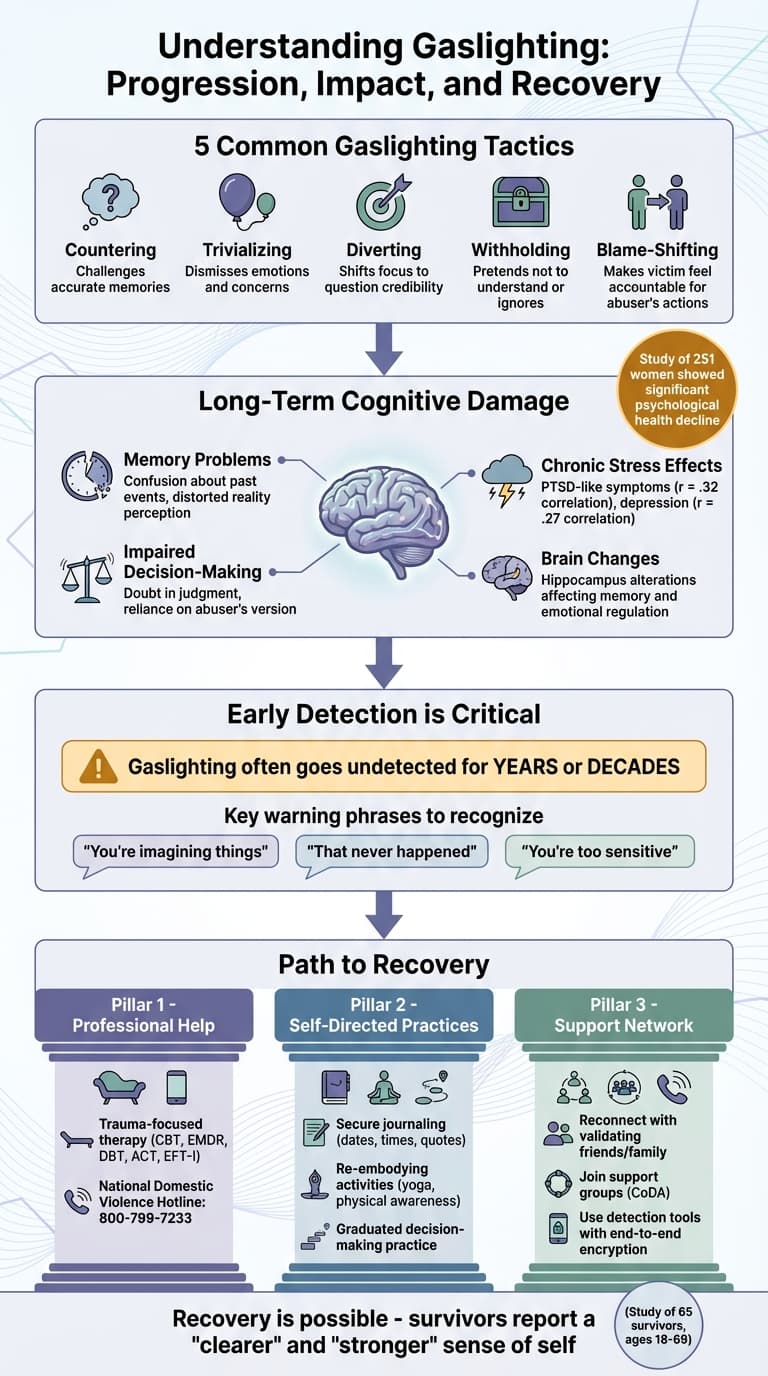
How Gaslighting Affects Mental Health and Cognitive Function
Common Gaslighting Tactics
Gaslighting involves manipulative strategies that chip away at a person’s trust in their own perceptions. For instance, countering challenges accurate memories, leaving the victim confused and doubtful of their own recollection [1]. Trivializing dismisses the victim’s emotions or concerns, making them question the validity of their pain and needs [1][4]. Diverting shifts the focus from actual events to questioning the victim’s credibility, weakening their confidence in speaking up [1]. Another tactic, withholding, involves pretending not to understand or outright ignoring the victim, which fosters feelings of isolation and helplessness [1]. Lastly, blame-shifting makes the victim feel accountable for the abuser’s actions, often leading to excessive apologizing and a diminished sense of self-worth [5].
Together, these tactics push victims to distrust their instincts and experiences. Dr. Peggy Loo, Director of Manhattan Therapy Collective, highlights this psychological impact:
"When someone experiences gaslighting over time, they learn to mistrust or ignore their instincts, feelings and senses as valuable tools to use in their lives." [4]
A study of 65 survivors, ranging in age from 18 to 69, revealed that gaslighting undermines a person’s ability to discern truth, leaving them with a fragmented sense of self [9]. These manipulations create a breeding ground for chronic stress, which further disrupts cognitive functioning.
Chronic Stress and Cognitive Strain
The constant manipulation forces victims into a state of hypervigilance, where they are perpetually on edge, scanning for signs of deceit. This heightened state of alertness is both mentally and physically draining, often manifesting as issues like insomnia and persistent headaches [4]. Over time, the stress erodes self-confidence, a phenomenon researchers call "epistemic damage", which leads to relentless self-doubt and blurred distinctions between reality and fabrication [9][6].
Studies involving 251 women have shown that gaslighting significantly undermines psychological health and overall well-being [8]. Victims often find themselves paralyzed by indecision and reliant on constant reassurance, further eroding trust in their own judgment [4][5]. Additionally, the abuser’s repeated denial of events causes victims to doubt their memory, creating a disorienting sense that their mind is betraying them [1][4]. Recognizing these impacts is essential to addressing and reducing the long-term cognitive harm caused by gaslighting.
Research on Long-Term Cognitive Damage
Memory Problems and Distorted Reality Perception
Gaslighting has been described as a "uniquely epistemic" form of abuse because it erodes a victim's trust in their own ability to perceive and interpret reality [6]. Victims often lose confidence in their senses, emotions, and memories. Manipulative tactics, like countering and intentional forgetting, actively damage memory [6]. Over time, victims begin to adopt the abuser's perspective, leading to cognitive distortions that blur the line between what is real and what is fabricated. This prolonged manipulation often results in hypervigilance and emotional numbness - key symptoms of post-traumatic stress disorder (PTSD) [7]. These distorted memories can severely impair decision-making, leaving victims increasingly dependent on the abuser's version of events [6].
Impaired Critical Thinking and Decision-Making
Prolonged gaslighting makes victims question their own decisions and doubt their judgment in even the most routine situations [5]. As they internalize the manipulator's perspective, they may start to see their own thoughts and feelings as irrational or unreliable [7]. This erosion of self-trust undermines their ability to think independently. For example, a study involving 251 women revealed that gaslighting significantly predicted poorer psychological health and lower eudaimonic well-being - a measure of one’s sense of purpose and control over their environment [8]. This gradual breakdown in self-confidence makes it incredibly difficult for victims to trust their own perceptions when faced with challenges. Dr. Chivonna Childs from Cleveland Clinic puts it succinctly:
Gaslighting targets your mental health by undermining your ability to think for yourself [5].
Brain Structure and Function Changes
Although direct neuroimaging studies on gaslighting are scarce, research on chronic stress and interpersonal trauma offers valuable insights. Chronic stress caused by gaslighting has been linked to measurable changes in the brain. In April 2023, researchers at the University of Melbourne conducted a systematic review of 68 studies on coercive control, a category that includes gaslighting, published in Trauma, Violence, & Abuse. Led by Susanne Lohmann, the study found moderate associations between coercive control and PTSD (r = .32) as well as depression (r = .27) [11]. The review highlighted that the persistent fear and entrapment typical in these scenarios are major contributors to Complex PTSD.
Additionally, studies on the hippocampus - a brain region central to memory - show that chronic stress can impair relational memory. This refers to the ability to recall how events, objects, or experiences are connected in time and space [12]. Such impairments align with the confusion gaslighting victims often experience, where they may remember an event but feel uncertain about its context or sequence. The stress induced by gaslighting can also lead to severe psychiatric consequences, including paranoia and, in extreme cases, psychotic episodes [7].
Using Gaslighting Check to Identify and Prevent Cognitive Harm

What Gaslighting Check Offers
Gaslighting Check is designed to catch manipulation tactics early, aiming to shield users from lasting cognitive harm. The platform works by recording conversations in real-time and analyzing both text and voice patterns to identify common gaslighting techniques. It flags phrases like "You're imagining things", "That never happened", and "You're too sensitive", which are often used to undermine someone's perception of reality. The tool focuses on detecting behaviors such as countering (questioning someone's memory) and trivializing (dismissing feelings as overreactions) [13][1]. Users receive detailed reports that break down these patterns, alongside a conversation history feature that creates an objective record to combat any memory distortion.
Privacy Protection and Affordable Access
Gaslighting Check prioritizes user privacy with end-to-end encryption and automatic data deletion. It offers three pricing tiers to suit different needs:
- Free Plan: Includes basic text analysis, making it accessible without any financial commitment.
- Premium Plan ($9.99/month): Adds voice analysis and conversation history tracking for a more in-depth experience.
- Custom Enterprise Options: Tailored solutions for organizational use.
This tiered approach ensures that users can access essential tools at a level that fits their budget and requirements.
Benefits of Early Detection for Recovery
Spotting gaslighting early is critical, as this form of manipulation often remains undetected for years or even decades [1]. Gaslighting Check provides objective evidence through recorded conversations and detailed analysis reports, helping users counteract the erosion of self-trust and distorted reality. This is vital because unchecked gaslighting can lead to long-term cognitive harm, such as diminished self-confidence and a weakened sense of agency [9][2][14]. Early identification of these manipulation patterns enables quicker access to recovery resources, potentially preventing issues like memory problems, impaired decision-making, and other cognitive changes. By catching these tactics early, the tool serves as a bridge to recovery strategies discussed in the next section.
Detect Manipulation in Conversations
Use AI-powered tools to analyze text and audio for gaslighting and manipulation patterns. Gain clarity, actionable insights, and support to navigate challenging relationships.
Start Analyzing NowRecovering from Cognitive Damage
Therapy Options for Cognitive Recovery
Healing from the cognitive toll of gaslighting often requires trauma-focused therapy. Therapists may employ techniques such as Cognitive Behavioral Therapy (CBT), Eye Movement Desensitization and Reprocessing (EMDR), or Dialectical Behavior Therapy (DBT) to help process traumatic experiences and manage PTSD-like symptoms.
Other approaches, like Acceptance and Commitment Therapy (ACT) and Emotion Focused Therapy (EFT-I), are particularly helpful for addressing hypervigilance and reshaping how individuals respond to intrusive thoughts [4]. However, if gaslighting is deliberate and ongoing, couples therapy is generally not effective. In such cases, ending the relationship may be the healthiest option [5]. For immediate assistance, the National Domestic Violence Hotline (800-799-7233) offers access to therapists experienced in handling emotional abuse [1][10]. Beyond therapy, regaining trust in your perceptions is a crucial step toward recovery.
Restoring Confidence in Your Perception and Memory
Rebuilding trust in your reality starts with reconnecting to your internal cues, such as heart rate, hunger, or physical discomfort. A July 2023 study led by Willis Klein at McGill University examined the recovery of 65 survivors (primarily women, ages 18–69) who had endured gaslighting relationships for at least four months. Published in Personal Relationships, the study highlighted six key recovery themes, including "re-embodying activities" like yoga and spending time with supportive individuals. Survivors who engaged in these practices reported feeling a much "clearer" and "stronger" sense of self-identity after recovery [9].
Journaling can also be a powerful tool to separate truth from the distorted narratives created by an abuser [1][5][15]. Securely document events with notes, photos, or voice memos, including specific dates, times, and quotes. When facing new situations, practice an "intentional pause" by tuning into your initial gut reactions and physical sensations before your mind starts rationalizing or doubting them [4]. Strengthen your independent judgment through graduated decision-making: begin with small, everyday choices without seeking external validation, then gradually take on larger decisions [4][16].
Building a Support Network
Social support is a cornerstone of recovery, complementing therapy and self-directed efforts. Gaslighters often isolate their targets, so reconnecting with friends and family who validate your experiences is essential to breaking free from manipulation. As psychologist Peggy Loo, Ph.D., explains, rebuilding trust in your perceptions is "like a muscle that we can return to and strengthen with use and time" [4]. Regular check-ins with supportive individuals can help you stay grounded and resist distorted narratives.
"Spending time with others was key for recovery... What seemed paramount was being with people who did not undermine survivors' interpretation of reality." - Vinita Mehta, Ph.D., Ed.M. [9]
Joining groups like Codependents Anonymous (CoDA) can provide a sense of community among people who understand emotional abuse dynamics. Peer validation can be a powerful counterbalance to a gaslighter's control over your interpretation of reality [16]. Additionally, tools like Gaslighting Check can offer an objective perspective by analyzing conversations for manipulation patterns you might not recognize. When using digital tools, prioritize those with end-to-end encryption and robust data privacy practices to ensure your information remains secure [10][15].
Gaslighting - What Happens In The Brain And Body
Conclusion
Gaslighting can have profound and lasting effects on a person’s cognitive and emotional well-being. Victims often struggle with chronic memory distrust, impaired decision-making, and an ongoing inability to differentiate real experiences from manipulated ones. In extreme cases, this mental toll can lead to psychotic episodes or PTSD-like symptoms, such as hypervigilance and intrusive flashbacks [7]. As Willis Klein from McGill University explains, gaslighting systematically dismantles a victim's perception of reality [3].
Because gaslighting often begins subtly and intensifies over time, early detection is essential. Tools like Gaslighting Check offer practical solutions by using real-time audio recording, text analysis, and detailed reporting to help identify manipulation patterns that might otherwise go unnoticed. These tools can provide much-needed clarity and validation for those questioning their experiences.
Recovery, while challenging, is possible with the right support. Trauma-focused therapies like EMDR and CBT can help survivors process the psychological damage caused by gaslighting. Additionally, practices like yoga and other re-embodying activities can help individuals reconnect with their internal signals. Rebuilding trust in one’s own perceptions takes time, but survivors who seek therapy, lean on supportive relationships, and utilize documentation tools often regain a stronger sense of self than they had before the abuse [9].
To move forward, consider therapy, secure journaling, or digital tools to reclaim your cognitive and emotional autonomy. Taking these steps validates your experiences and sets the foundation for healing. If you’re still in a manipulative relationship, support is available - resources like the National Domestic Violence Hotline (800-799-7233) provide immediate assistance and guidance.
FAQs
How can I tell if someone is gaslighting me?
Gaslighting can be tricky to recognize because it often creeps in subtly. You might find yourself feeling unsure about what’s real, second-guessing your memory, or doubting your own judgment. A gaslighter might deny things you know happened, dismiss your emotions, or use manipulative phrases that make you feel like you’re to blame. Over time, this kind of behavior chips away at your confidence and trust in yourself.
The impact of gaslighting isn’t just emotional - it can affect your mental clarity, too. Many people dealing with it report constant self-doubt, heightened anxiety, or feeling utterly drained. Spotting these patterns early is key. Tools like Gaslighting Check are designed to help you recognize manipulative tactics in conversations, giving you the insight you need to confront and address these behaviors.
What are the best ways to recover from gaslighting?
Recovering from gaslighting involves taking deliberate steps to rebuild self-trust and emotional health. One of the most effective ways to start is by seeking therapy or counseling. A therapist provides a safe environment to unpack your experiences, work through the emotional damage caused by manipulation, and rebuild your confidence. Therapy can also address lingering challenges, such as memory lapses or persistent self-doubt.
Equally important is creating a support network of trusted individuals, whether they’re friends, family members, or support groups. These connections can validate your feelings and help counter the confusion and isolation that gaslighting often leaves behind. Understanding how gaslighting works and learning to spot manipulative tactics can also be empowering. Recognizing these behaviors allows you to set firm boundaries and protect yourself from further harm. Tools like Gaslighting Check can assist by analyzing conversations to identify emotional manipulation.
While recovery is a gradual process, combining professional guidance, a solid support system, and increased self-awareness can help you regain control and rebuild stability in your life.
Can gaslighting cause lasting effects on the brain?
Yes, gaslighting can have lasting effects on both the mind and emotions. Over time, it can weaken memory, chip away at self-confidence, and warp how someone perceives reality. These changes might make it harder to think critically, make decisions, or trust personal judgment.
In more severe cases, being subjected to gaslighting for an extended period can lead to chronic stress, anxiety, and depression, which can also impact brain function. While not everyone sustains permanent harm, the emotional and psychological strain can be immense. This highlights the importance of finding support and using recovery strategies to regain mental clarity and rebuild emotional strength.