
AI Text Analysis for Safer Communication
AI text analysis is transforming how we detect and address harmful communication. It identifies patterns like gaslighting, emotional manipulation, and aggressive language in real-time, offering tools to improve personal and workplace interactions. By analyzing text and voice, these tools provide objective insights, detailed reports, and privacy-focused features to help users navigate challenging conversations. While not a replacement for human judgment or therapy, they serve as a practical aid for fostering healthier communication.
Key Features:
- Sentiment Analysis: Evaluates emotional tone to spot hostile or manipulative language.
- Pattern Recognition: Flags harmful linguistic patterns, such as blame-shifting or invalidation.
- Real-Time Monitoring: Processes communications instantly to send timely alerts.
- Privacy Measures: End-to-end encryption and automatic data deletion ensure user security.
Tools like Gaslighting Check offer both free and premium plans ($9.99/month) with features like voice analysis, history tracking, and timestamped reports. These tools are especially useful for validating experiences, supporting mental health recovery, and improving workplace dynamics.
AI-Enabled Employee Sentiment Analysis | What kind of technology is that and what it means?
How AI Text Analysis Works
::: @figure
AI text analysis pulls out data points to uncover patterns in conversations that might not be immediately obvious. By examining word choices, sentence structures, emotional tone, and other linguistic markers, this technology can identify signs of harmful communication - ranging from subtle manipulation to outright aggression. It uses computational power to analyze written exchanges objectively, making it an invaluable tool for detecting and addressing communication risks.
The process kicks off with text parsing, where algorithms break messages into manageable parts. From there, several analytical layers come into play: sentiment analysis gauges emotional tone, context evaluation examines surrounding language to grasp intent, and pattern recognition identifies risky communication patterns. These techniques are not limited to any one setting - they can enhance safety in personal conversations as well as workplace communications. The next section dives into the features that make this possible.
Main Features of AI Text Analysis Tools
Modern AI text analysis tools are equipped with a range of capabilities designed to assess communication safety. Here's a closer look at some of the core features:
- Sentiment Analysis: This evaluates emotional tone, categorizing messages as positive, negative, or neutral[5]. It helps identify hostile, manipulative, or distressing language.
- Pattern Recognition: By detecting specific keywords and linguistic markers, this feature flags unusual language patterns that may indicate insider threats, data breaches, or emotional manipulation[1].
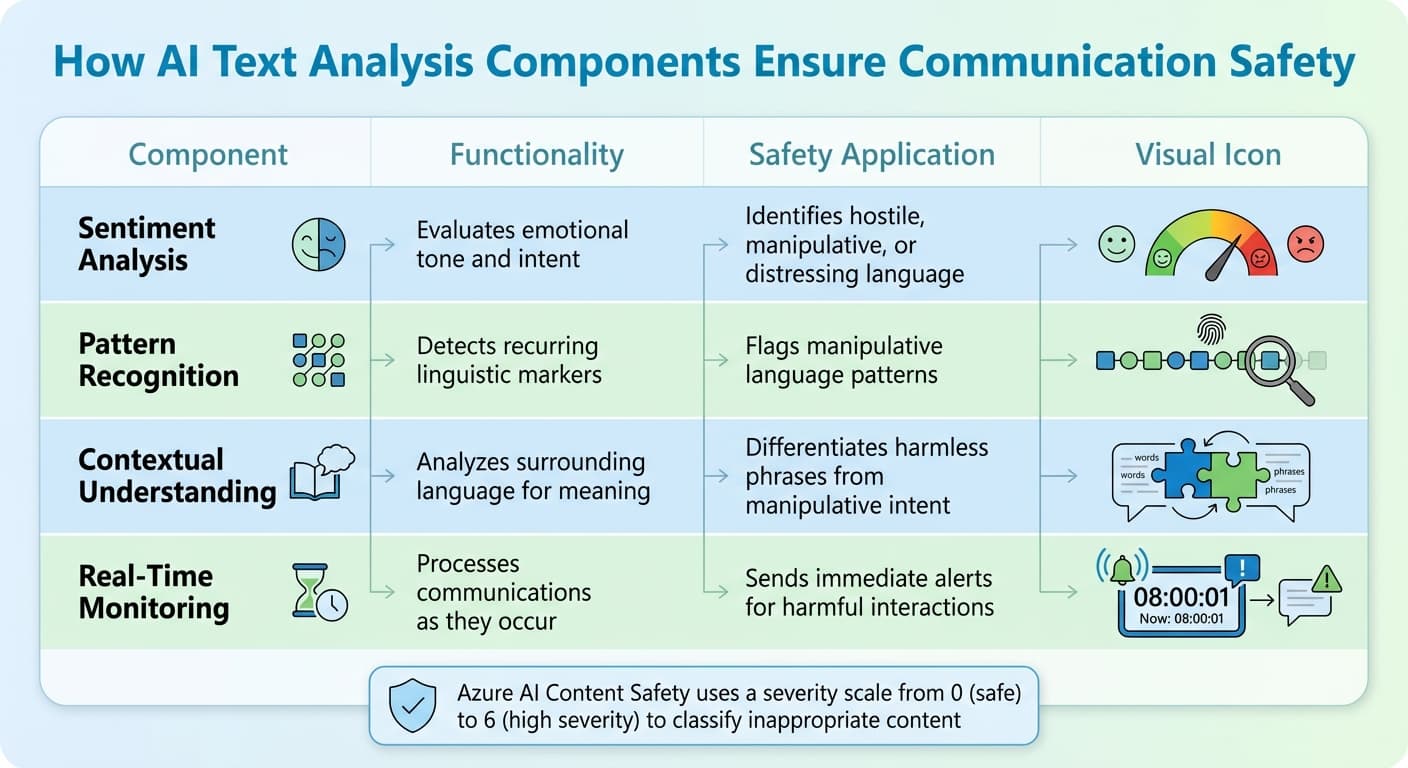
- Real-Time Monitoring: Unlike traditional methods that rely on manual reviews, AI can analyze massive volumes of data - like logs, incident reports, social media posts, and direct messages - in real time. For example, Azure AI Content Safety uses a severity scale (ranging from 0 for safe to 6 for high severity) to classify inappropriate content[7].
| Component | Functionality | Safety Application |
|---|---|---|
| Sentiment Analysis | Evaluates emotional tone and intent | Identifies hostile, manipulative, or distressing language |
| Pattern Recognition | Detects recurring linguistic markers | Flags manipulative language patterns |
| Contextual Understanding | Analyzes surrounding language for meaning | Differentiates harmless phrases from manipulative intent |
| Real-Time Monitoring | Processes communications as they occur | Sends immediate alerts for harmful interactions |
While these tools are powerful, human oversight is still essential. AI-generated outputs should always be reviewed by communication experts to ensure they are accurate and appropriate before being acted on or deployed[4].
How Machine Learning Recognizes Patterns
Machine learning takes the capabilities of AI text analysis a step further by refining its ability to detect harmful communication through extensive training. These algorithms analyze large datasets to establish what normal communication looks like and how it differs from potentially harmful language[1]. By incorporating human feedback, these models become more accurate over time. Partner systems like OpenAI also use bias mitigation techniques, such as filtering harmful content during pre-training and involving human oversight, to further improve detection accuracy[2].
What sets machine learning apart is its ability to go beyond memorizing phrases. It understands linguistic structures and can pick up on manipulation tactics even when they’re phrased in new or subtle ways. For example, the system can detect patterns in invalidating language, such as phrases like "You're imagining things" or "That never happened", even if the wording changes slightly.
Another strength lies in its adaptability. By analyzing diverse datasets, these models can recognize linguistic patterns across different communication styles and stay effective as language trends evolve[5]. For instance, they can flag sudden shifts in tone, an increase in invalidating statements, or signs of information manipulation. They can even process data from various sources - like reports, social media, and direct communications - to identify potential risks[1].
However, machine learning models aren’t a “set-it-and-forget-it” solution. Their accuracy can decline over time as language evolves and user expectations shift[3]. To maintain effectiveness, organizations need to regularly monitor and validate these systems, incorporate feedback loops for improvement[2], and check for unintentional bias in outputs to ensure they meet quality standards[6].
Where AI Text Analysis Helps Communication
AI text analysis is transforming how we navigate difficult conversations by offering objective insights. Whether it's dealing with a manipulative partner, managing workplace conflicts, or recovering from past emotional wounds, these tools provide tangible evidence to help validate experiences. Let’s dive into how AI detects emotional manipulation and fosters healthier interactions.
Detecting Emotional Manipulation and Gaslighting
AI text analysis can pinpoint gaslighting by identifying specific linguistic patterns, such as phrases like "That never happened" or "You're too sensitive." More than just recognizing keywords, it analyzes semantic structures to uncover manipulation, even when it's cloaked in subtle or seemingly harmless language.
| Manipulation Tactic | AI Detection Method | Common Indicators |
|---|---|---|
| Reality Distortion | Pattern matching & context analysis | "That never happened", "You're remembering it wrong" |
| Emotional Invalidation | Sentiment analysis | "You're too sensitive", "You're overreacting" |
| Blame Shifting | Semantic analysis | Deflecting responsibility, "You are the one with the problem" |
| Memory Questioning | Frequency tracking | "You must be confused", "Are you sure about that?" |
| Control/Isolation | Linguistic pattern recognition | Restricting independent choices, undermining autonomy |
A practical example of this technology is its ability to generate timestamped interaction reports, which can serve as concrete documentation. This feature is especially helpful in countering the self-doubt often caused by gaslighting, making it harder for manipulative behaviors to be dismissed as overreactions.
Improving Workplace and Personal Relationships
In professional environments, AI tools refine communication by adjusting tone and identifying early signs of conflict. They handle repetitive tasks like summarizing calls, drafting emails, and spotting potential misunderstandings, freeing up employees to focus on building authentic connections.
Research published in Management Science in January 2025 by Ties de Kok at the University of Washington showcased AI's ability to detect linguistic subtleties, achieving 96% accuracy in identifying "non-answers" during earnings calls[8].
These same principles apply to everyday workplace interactions. For instance, AI can identify what relationship expert John Gottman refers to as the "Four Horsemen" - criticism, contempt, defensiveness, and stonewalling - in digital communications. It flags character attacks (e.g., "You always" or "You never" statements), sarcasm or mockery, blame-shifting, and withdrawal behaviors like minimal responses or long silences.
For tense interactions, AI can assist in drafting BIFF (Brief, Informative, Friendly, Firm) responses, helping maintain professionalism. It also tracks workplace morale by analyzing emotional undertones in emails, Slack messages, and surveys, offering early warnings about burnout before it escalates into staff turnover.
Beyond the workplace, these insights are invaluable for personal recovery and emotional well-being.
Supporting Mental Health and Emotional Recovery
Recovering from manipulative relationships often requires validation, and AI text analysis provides just that - objective clarity when self-doubt creeps in. While it doesn’t replace therapy, it complements it by offering clear evidence of communication patterns.
When combined with voice analysis, the technology becomes even more effective. Text analysis identifies blame-shifting and denial, while voice analysis captures aggression or dismissiveness in tone. Together, they provide a full picture of communication dynamics.
For example, Gaslighting Check’s Premium Plan ($9.99/month) offers tools like conversation history tracking and personalized insights. With end-to-end encryption and automatic data deletion, it ensures privacy - critical for users dealing with abusive situations. This documentation can also be invaluable during therapy, where concrete examples help therapists better understand relationship dynamics without relying solely on memory.
Generative AI models add another layer of nuanced support. While only 1% of organizations report advanced AI integration in HR today, nearly 35% are actively exploring its use for employee relations. This growing interest highlights AI’s potential to enhance emotional well-being and underscores the importance of clear, objective communication analysis in protecting mental health.
Detect Manipulation in Conversations
Use AI-powered tools to analyze text and audio for gaslighting and manipulation patterns. Gain clarity, actionable insights, and support to navigate challenging relationships.
Start Analyzing NowWhat Gaslighting Check Offers for Safer Communication

Gaslighting Check uses AI-driven text and voice analysis to help users spot emotional manipulation in their interactions. By processing written messages and audio recordings, it identifies patterns and provides clear, objective insights. Here's a closer look at how its features translate advanced analysis into practical tools.
Text and Voice Analysis
With natural language processing (NLP) and machine learning, Gaslighting Check evaluates word choices and sentence structures to flag manipulation tactics, such as phrases like "That never happened" or "You're remembering it wrong." On the audio side, it examines pitch, tone, stress, volume, and pauses to detect emotional cues like aggression or dismissiveness.
The system also tracks recurring behaviors, such as cycles of love-bombing followed by withdrawal or repeated blame-shifting. It processes data in milliseconds, making it possible to identify these patterns even during live conversations. Users can start with the Free Plan for basic text analysis or opt for the Premium Plan at $9.99/month, which includes voice analysis, detailed reports, and history tracking.
Real-Time Recording and Detailed Reports
The audio recording feature captures conversations as they occur, providing timestamped documentation to support your evidence. After processing, the platform generates reports with toxicity scores, highlights harmful patterns, and offers psychological insights you can act on. These tools help counter the self-doubt that often accompanies gaslighting, giving you validation when you’re unsure if your feelings are justified.
You can save text messages, emails, or transcripts to give the AI concrete material to analyze, avoiding reliance on potentially distorted memories. The history tracking feature helps identify recurring themes, such as a consistent dismissal of your concerns, over time. Think of these insights as an impartial "second opinion" to complement, not replace, professional therapy.
Privacy and Security Features
Gaslighting Check goes beyond detection with strong privacy measures to keep your data secure. All text messages, voice recordings, and reports are protected with end-to-end encryption, ensuring no third party can access your information during transmission or storage. Automatic data deletion policies erase sensitive information after analysis, minimizing the risk of unauthorized access. Users also have full control over their logs, with options to view, edit, or delete personal data anytime.
The platform complies with major privacy regulations like GDPR, CCPA, and CPRA, operating under a strict "Data Fortress" policy. This means your information is never sold or shared for commercial purposes. For premium features like history tracking, data is stored in an anonymized format, ensuring it cannot be linked back to your identity. Manual deletion options allow you to purge logs once they’re no longer needed for evidence or therapy.
Conclusion
AI text analysis tools are reshaping how we ensure safer communication by identifying harmful patterns that might otherwise slip through the cracks. Instead of relying solely on hindsight, these systems offer real-time insights. For instance, tools like Gaslighting Check analyze both text and voice to highlight concerning language, monitor recurring behaviors, and create detailed reports that help you better understand the dynamics in your relationships.
These tools don't just stop at detection. They also provide tangible support to back up your instincts and challenge the self-doubt that manipulation often fosters. Features like timestamped records and encrypted storage allow you to document conversations securely, offering reassurance and validation of your experiences. Gaslighting Check’s Premium Plan, priced at $9.99 per month, offers in-depth analysis and 24/7 accessibility, making it a practical option for those seeking continuous support.
Privacy is a top priority, with end-to-end encryption, automatic data deletion, and strict compliance with GDPR and CCPA regulations, ensuring your data remains secure and confidential.
While AI tools are incredibly helpful, they work best when paired with human judgment. They’re not meant to replace professional guidance but rather to identify patterns, validate your experiences, and act as a bridge to therapy or other support systems when needed. Whether you’re navigating challenges in personal relationships, workplace interactions, or recovering from emotional manipulation, AI text analysis can provide the clarity and assurance needed to communicate more effectively and safely. Together, these tools and human insight create a stronger foundation for safer communication.
FAQs
How does AI detect gaslighting and emotional manipulation in communication?
AI can spot gaslighting and emotional manipulation by examining language patterns, tone, and context with the help of Natural Language Processing (NLP) and sentiment analysis. It looks for behaviors like shifting blame, twisting facts, and dismissing emotions within conversations.
These technologies are capable of picking up on subtle emotional shifts and cues, whether in real-time or from previous interactions. By identifying these manipulative patterns, AI plays a role in promoting clearer and more honest communication.
How does Gaslighting Check protect my privacy when analyzing conversations?
Gaslighting Check takes your privacy seriously and employs strong protections to keep your information secure. All data is encrypted, both while it’s being transmitted and when it’s stored, so your sensitive details stay safe and out of reach from unauthorized access.
To add another layer of privacy protection, the platform follows automatic data deletion policies. This means conversation histories and analysis reports are not kept permanently. By minimizing how long data is stored, the platform reduces potential risks while ensuring your confidentiality. These steps let you use the service for real-time feedback and in-depth analysis without worrying about your personal information being compromised.
Can AI tools fully replace human judgment in handling communication issues?
AI text analysis tools have come a long way in spotting harmful communication patterns, like emotional manipulation or abusive language. They can highlight potential red flags, offer insights, and even monitor trends over time. This makes them a helpful resource for encouraging safer and healthier interactions.
That said, AI isn't a substitute for human judgment. It often falls short when it comes to grasping complex emotions, understanding cultural subtleties, or picking up on the finer nuances of a conversation. While these tools are great for assisting decision-making and providing early alerts, human involvement remains crucial for interpreting the bigger picture, showing empathy, and making balanced decisions. AI shines when used as a supporting tool to enhance human insight, rather than as a standalone solution.