
AI Text Analysis: Limits in Detecting Manipulation
AI tools for detecting emotional manipulation face major challenges. Text-only models often miss subtle cues like tone, intent, and context, which are critical for identifying tactics such as gaslighting or denial. For example, phrases like "I'm just trying to help" can have vastly different meanings depending on delivery. Without vocal or historical context, these systems struggle to differentiate between genuine concern and manipulation.
Key findings:
- Text-only models revise correct answers under adversarial tactics, with accuracy dropping by up to 46.15%.
- Cultural differences and lack of empathy further limit these models, leading to misinterpretations.
- Tools like Gaslighting Check improve detection by analyzing both text and voice, identifying vocal cues like pitch and stress.
However, even multi-modal tools have limitations, such as biases in training data and privacy concerns. While they provide deeper insights, they also process more personal data, raising ethical questions. For reliable results, users should pair AI tools with professional guidance.
AI Detects Covert Manipulation (You Won't Believe)
Why Text-Only AI Models Struggle with Manipulation Detection
Text-only AI models stumble because they process words but miss the human context that gives those words meaning. Take the phrase, "I'm just trying to help." It could be genuine support - or biting sarcasm. Without vocal tones or facial expressions, these models can’t tell the difference. That’s a major blind spot.
The problem goes beyond missing audio. Smaller language models often misread intentions, flagging harmless phrases or common profanity as manipulative behavior [1]. At the same time, manipulative speech often mirrors everyday language, making it tricky to separate from normal conversations [1]. These systems lean heavily on word patterns and frequency, which leaves them blind to emotional undertones.
Cultural and linguistic differences add another layer of complexity. For example, in the U.S., emotions like anger or pride are often seen as constructive, while shame and guilt are discouraged. In contrast, East Asian cultures prioritize calmness and harmony, viewing anger or pride as disruptive. If a model is trained mostly on Western data, it might misinterpret culturally appropriate expressions as manipulative - or fail to catch manipulation that uses culturally specific strategies.
Then there’s the empathy gap. AI lacks the ability to grasp social nuances. For instance, if someone says, "You're being too sensitive", it could be a stressed partner venting, or it could be a gaslighter chipping away at someone’s confidence. The difference lies in the relationship dynamics, history, and intent - none of which a text-only model can evaluate. These systems are also easily swayed by emotional or authoritative prompts, making them even less reliable for detecting manipulation.
Even advanced methods like dictionary-based approaches or machine learning models struggle here. They can spot familiar patterns but falter when faced with creative manipulation or subtle intent. Sentiment analysis, while useful for tracking emotional shifts, often misfires when sarcasm, irony, or idiomatic expressions are involved. Without vocal cues - where most of communication’s impact lies - text-only models will always fall short in fully understanding psychological manipulation.
1. Gaslighting Check

Gaslighting Check takes things a step further by combining text and voice analysis to assess both the content of conversations and the tone in which they're delivered. This layered approach aims to address the limitations of text-only systems by focusing not just on what is being said but also on how it’s being said.
Accuracy in Emotional Manipulation Detection
The platform works to identify emotional manipulation by linking linguistic patterns with emotional cues, flagging tactics such as control and invalidation. A 2025 report from the Responsible AI Foundation describes Gaslighting Check as performing "pretty well" with "reasonable accuracy" in recognizing manipulation. It offers users direct feedback to help them spot harmful dynamics in their interactions. However, the system isn’t perfect. Biases in its training data can lead to misreadings - like interpreting quietness in certain cultural expressions as signs of depression. This highlights a key limitation: while AI can detect patterns, it often struggles to fully grasp the nuanced emotional layers of real-life experiences [2]. By addressing these gaps, the platform improves upon the shortcomings of earlier text-only models.
Handling Subtle Manipulation Tactics
Gaslighting Check doesn’t just stop at surface-level analysis. Its tools include tracking conversation history and generating detailed reports to uncover manipulation patterns that might otherwise go unnoticed. The addition of voice analysis is particularly helpful, as it picks up on tonal shifts - such as hints of contempt, condescension, or insincere concern - that text-based systems often miss.
Privacy and Ethical Considerations
To protect users, Gaslighting Check employs end-to-end encryption and automatic data deletion. While these features are designed to empower individuals, they also raise ethical questions. Inferring emotional states without explicit consent can feel invasive, and as the Responsible AI Foundation points out, emotion detection systems often lack transparency. Users might not fully understand how their emotional data is being processed or stored. There’s also the risk of misuse - potentially enabling someone to refine manipulative tactics by studying the analysis. Given these concerns, the platform advises users to pair its insights with professional mental health support for a more comprehensive approach [2].
Detect Manipulation in Conversations
Use AI-powered tools to analyze text and audio for gaslighting and manipulation patterns. Gain clarity, actionable insights, and support to navigate challenging relationships.
Start Analyzing Now2. Text-Only AI Models
Accuracy in Emotional Manipulation Detection
Text-only AI models often fall short when it comes to detecting emotional manipulation because they rely entirely on analyzing word patterns. This approach misses the deeper nuances of interpersonal dynamics. For instance, smaller models might mistakenly classify general toxicity or offensive language as manipulation due to what experts call "semantic indistinguishability." Essentially, manipulative and non-manipulative sentences can look very similar without additional context. Soroush Vosoughi, an Assistant Professor of Computer Science at Dartmouth College, puts it this way:
"Our work shows that while large language models are becoming increasingly sophisticated, they still struggle to grasp the subtleties of manipulation in human dialogue. This underscores the need for more targeted datasets and methods to effectively detect these nuanced forms of abuse." [3]
Even the most advanced models show significant performance gaps, with accuracy ranging from 65.2% to 89.7%. In more subtle cases, their effectiveness can drop by as much as 51% [4]. This is largely because these systems lack access to vocal cues like tone or pitch, which are often essential for interpreting emotional intent. Without these additional layers of context, their ability to detect manipulation remains limited.
Handling Subtle Manipulation Tactics
Text-only systems also struggle with indirect manipulation tactics, such as sarcasm, passive-aggressive remarks, or messages cloaked in a caring tone. For example, a phrase like "I'm just worried about you" could express genuine concern - or it could be a subtle attempt at control. Without vocal cues or nonverbal context, these systems can only analyze the words themselves, often failing to grasp the underlying intent.
Privacy and Ethical Considerations
In addition to their technical shortcomings, text-only models raise important privacy and ethical concerns. Analyzing personal conversations through text alone can expose sensitive information, even when encryption and data deletion measures are in place (typically within 30–90 days). While these models don't process vocal data, the text itself can still reveal intimate details about relationships and dynamics.
Research into AI companion apps has brought these ethical concerns into sharper focus, particularly when manipulation is involved. The need for transparency and human oversight is crucial, especially in emotionally sensitive contexts. Clinical validation becomes a key factor here, ensuring that AI systems are complemented by professional guidance to mitigate risks and improve outcomes.
Pros and Cons
::: @figure
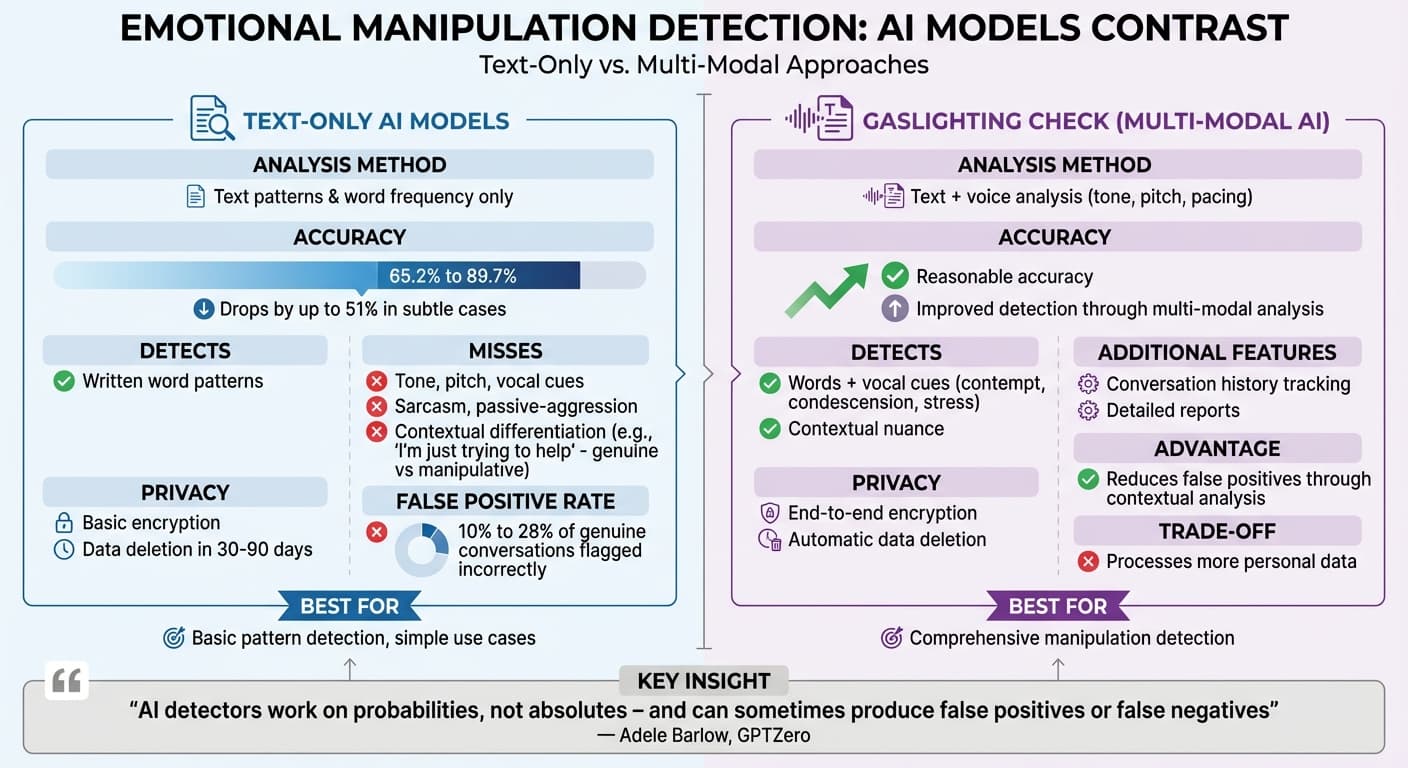
When you compare these approaches, the differences in detecting emotional manipulation become clear. Gaslighting Check stands out by combining text and voice analysis, enabling it to pick up on vocal cues like tone, pitch, and pacing - signals that often reveal manipulation. On the other hand, text-only models focus solely on written words, missing the emotional subtleties that come through in spoken conversation. Let’s break down the strengths and weaknesses of each method.
Text-only systems often struggle to differentiate between genuine concern and subtle manipulation. Without vocal context, phrases can be misinterpreted. Gaslighting Check's multi-modal approach solves this by analyzing both what is said and how it’s said, adding a layer of depth that text alone can’t provide.
Privacy is another key factor. Gaslighting Check prioritizes security with strong encryption and automatic data deletion. In contrast, text-only models may leave sensitive information more exposed due to their lack of contextual safeguards.
As Adele Barlow, Content and Media Lead at GPTZero, points out:
"AI detectors work on probabilities, not absolutes – and can sometimes produce false positives or false negatives" [5].
This uncertainty applies to both methods. However, the additional context from voice analysis can help reduce errors compared to text-only systems.
Ultimately, the trade-off lies between depth and simplicity. Gaslighting Check delivers detailed analysis, tracking conversation history and generating actionable insights. Text-only models, while often free and easy to use, tend to miss the subtle cues that reveal indirect manipulation. Research indicates that traditional text-only detectors can incorrectly flag between 10% and 28% of genuine human conversations [6], highlighting their limitations in grasping full context.
For those facing potential emotional manipulation, the choice hinges on their needs. If basic pattern detection is enough, text-only models may suffice. But for a more thorough understanding of conversational dynamics, a multi-modal approach like Gaslighting Check provides a richer perspective - albeit with the trade-off of processing more personal data.
Conclusion
Text-only AI models struggle with detecting emotional manipulation because they rely solely on the literal meaning of words, missing the subtle cues that often reveal manipulative intent. For example, a phrase that seems supportive in writing can take on a completely different tone when delivered with sarcasm or condescension. This gap highlights a major limitation of text-only systems and points to the need for more comprehensive solutions.
Multimodal methods, which combine text analysis with voice or tonal data, address this limitation by capturing nuances that single-mode tools miss. Tools like Gaslighting Check show how integrating multiple data sources can provide a fuller understanding of conversational dynamics. By analyzing both what is said and how it is said, these systems can detect patterns of manipulation that would otherwise go unnoticed.
The evidence suggests that improving AI's ability to detect emotional manipulation requires moving beyond simplistic, text-only approaches. While text-based systems are straightforward and easy to use, they often fall short in contexts where tone and delivery are critical. Multimodal tools, on the other hand, offer a more accurate and actionable way to uncover subtle manipulation cues.
At the same time, prioritizing user privacy is essential. Features like encryption and automatic data deletion ensure that enhanced detection capabilities do not come at the expense of personal data security.
Although no system is flawless, this integrated approach marks a meaningful advancement in detecting and addressing emotional manipulation. By leveraging multiple data sources, these tools bring us closer to more reliable and context-aware solutions.
FAQs
How does Gaslighting Check detect emotional manipulation better than tools that only analyze text?
Gaslighting Check stands out by analyzing both text and voice cues to detect emotional manipulation. While text-only models can catch manipulative phrases or emotional shifts, they often miss critical nuances like sarcasm, ambiguous wording, or vocal tone. By incorporating voice analysis, Gaslighting Check dives deeper, evaluating elements such as tone, pitch, and emotional fluctuations for a more comprehensive understanding of communication.
With the help of advanced machine learning techniques - like sentiment analysis and natural language processing (NLP) - Gaslighting Check identifies patterns linked to manipulation tactics, such as gaslighting or guilt-tripping. This dual approach provides detailed insights and real-time alerts, empowering users to recognize and address emotional manipulation more effectively.
What privacy risks come with using AI tools to detect emotional manipulation?
AI tools designed to detect emotional manipulation come with privacy concerns, particularly because they process sensitive personal data. These tools often examine things like text, voice tone, and behavioral patterns, which can expose deeply personal emotions. Without clear user consent and strict protections, this data could be mishandled, stored improperly, or even fall victim to breaches.
Another layer of concern lies in the emotional insights these tools generate. Since they rely on AI interpretations, they may misread human intent or context, leading to inaccurate classifications or potential misuse of the information. To tackle these challenges, it’s crucial to focus on transparency, obtain explicit user consent, and implement strong privacy safeguards when deploying such technologies.
Why is it difficult for AI to detect emotional manipulation across different cultures?
AI faces challenges in identifying emotional manipulation across different cultures because emotional expressions and communication styles are far from universal. What might be considered manipulative in one region could be entirely acceptable - or even polite - in another. These variations can result in misinterpretations or biases when AI tries to analyze tone, context, or emotional signals.
For instance, a phrase that seems harmless in one culture might carry a manipulative undertone elsewhere. Without a thorough grasp of these cultural subtleties, AI struggles to accurately discern emotional intent, making this task far more complex than it appears.