
How AI Powers Gamified Communication Training
AI-powered gamified training is transforming the way people improve communication skills, especially in challenging areas like recovering from emotional manipulation or navigating tough workplace conversations. By combining real-time feedback with interactive, game-like scenarios, these tools offer a safe space to practice and refine communication techniques.
Key Takeaways:
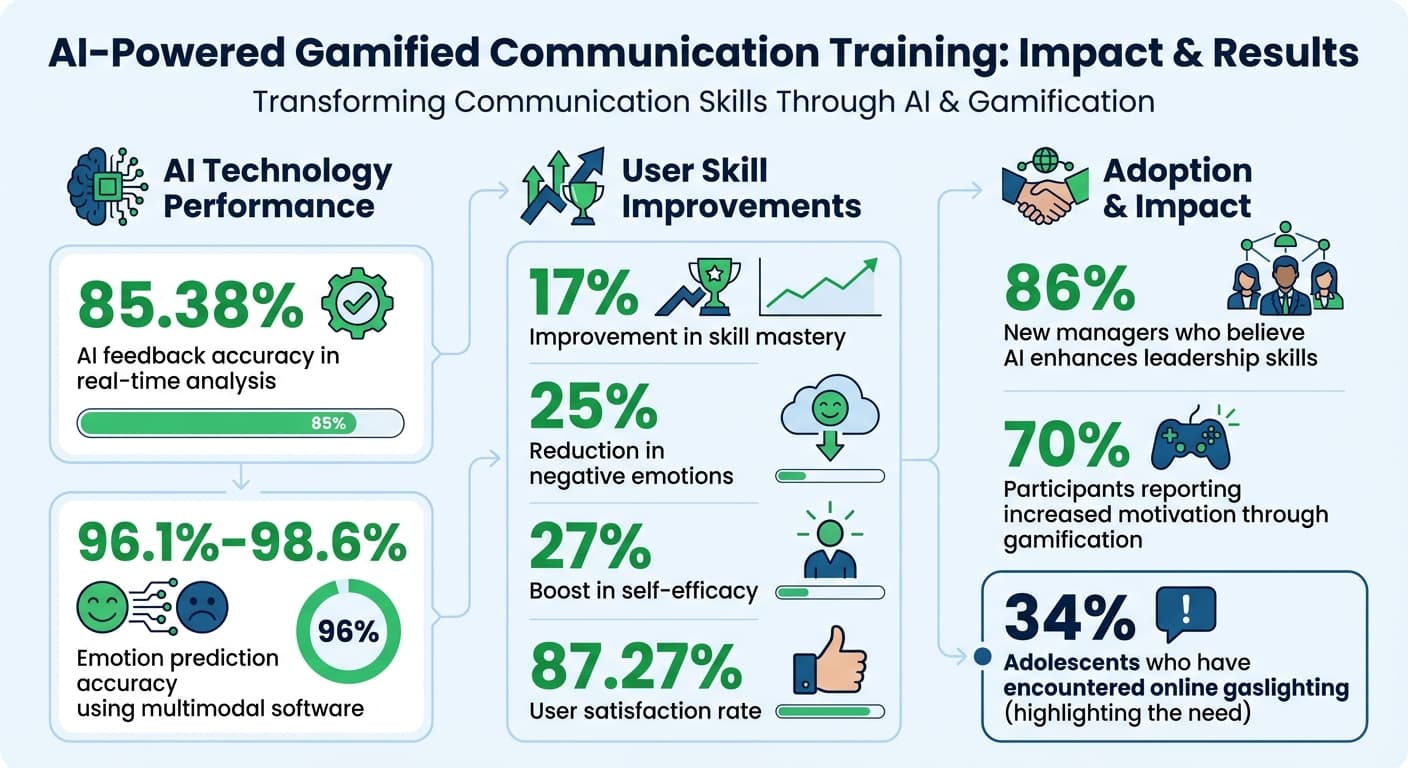
- AI analyzes voice and text in real time, identifying tone, word choices, and emotional cues with up to 85.38% accuracy.
- Gamified systems, like the Gaslighting Check tool, help users detect manipulation and develop healthier responses.
- Studies show a 17% improvement in skill mastery, a 25% reduction in negative emotions, and an 87.27% satisfaction rate among participants.
- Tools like IMBUE and CommCoach provide tailored simulations and feedback, helping users build confidence and adopt better communication habits.
While these tools show promise, challenges like data privacy, accessibility, and long-term effectiveness still need attention. With advancements in AI, gamified training is becoming a practical way to build communication skills and emotional resilience.
::: @figure
How AI Improves Gamified Learning Modules
AI-Driven Personalization
AI has paved the way for tailored learning experiences that adjust to individual communication styles. For example, a study conducted at Xi'an University involving 486 undergraduates demonstrated that adaptive learning paths significantly enhanced language proficiency, with results showing F(3,482)=1,131.607, p<.000 [9].
The IMBUE system, a collaborative effort by Stanford University and Microsoft, further illustrates the power of AI in education. In a trial with 86 participants, it delivered 28% more expert-like feedback, leading to a 17% rise in skill mastery and a 27% boost in self-efficacy [5][6]. Researcher Inna Lin noted:
The improvement in skill mastery is the only measure that is transferred to new and more difficult situations; situation-specific training is necessary for improving self-efficacy and emotion reduction [5].
This level of personalization not only enhances skill-building but also makes gamified learning more engaging and effective.
Better Engagement Through Gamification
Gamified learning modules have replaced traditional static role-play with interactive, AI-driven scenarios. These systems craft dynamic dialogues that adapt to user choices, enabling repeated practice and exploration of various conversational outcomes. In the Xi'an study, adaptive learning paths not only improved language proficiency but also significantly boosted learner motivation, with findings showing F(3,482)=529.318, p<.000 [9].
Additionally, a survey revealed that 86% of new and aspiring managers believe AI has the potential to enhance their leadership skills, with nearly half citing improvements in communication as a key benefit [7]. These AI systems strike a balance between offering high interactivity and meeting clear learning objectives, all while avoiding cognitive overload [10].
Such advancements highlight AI's growing role in creating immersive and effective communication training.
Research Studies on AI and Gamified Training
Recent research continues to validate the impact of AI on gamified training. For instance, simulations featuring just-in-time feedback improved skill mastery by 17% and reduced negative emotions by 16% [5][6]. Another example is the CommCoach system, developed at Virginia Tech and tested with 17 managers in May 2025. This tool offers practical training environments through features like a "scenario editor", which allows users to create custom simulations of high-pressure workplace conversations, helping users identify manipulative patterns in professional settings, and a "coach agent" that provides real-time, transparent feedback. As Lance T. Wilhelm explains:
AI-assisted communication training should balance personalization, structured learning objectives, and adaptability to different user styles and contexts [7].
Voice and Text Analysis in Gamified Communication Training
AI-powered voice and text analysis takes gamified communication training to the next level, offering precise tools to refine and enhance communicative skills.
AI Voice Analysis
AI can transform spoken language into measurable data by analyzing factors like pitch, volume, speaking pace, and prosodic features such as stress and intonation. Trained on vast datasets of annotated conversations, neural networks identify vocal markers tied to emotional states [11] [12].
In gamified settings, AI is particularly adept at detecting emotional inconsistencies. For instance, it can recognize when a calm tone conceals manipulative or hurtful intent. By breaking down speech into individual elements, it identifies subtle patterns - such as distinguishing between a raised voice used to express emotion during an argument and one used to intimidate in a calm discussion. Sudden shifts in volume or stress might hint at aggression, while hesitations or filler words could signal evasiveness. Multimodal software achieves impressive accuracy rates of 96.1%–98.6% in emotion prediction using specialized classifiers [13].
In a study focused on gamified speech training, 70% of participants reported that incorporating serious games and gamification significantly boosted their motivation to practice and improve emotional speech [11].
Text Analysis for Detecting Manipulation
AI text analysis leverages advanced models like BERT combined with LSTM to understand both the contextual meaning and sequential flow of long conversations [15]. These systems can detect linguistic shifts - such as moving from respectful language to informal speech - that reveal changes in power dynamics.
Pattern recognition algorithms are also capable of spotting specific manipulation tactics. These include accusatory language that shifts blame, deceptive statements that deny responsibility while accusing others, and tactics like responsibility inversion [14] [15]. Tools like IMBUE integrate frameworks such as Dialectical Behavioral Therapy (DBT) and the "DEAR MAN" model to assess interpersonal effectiveness and emotional regulation in written exchanges [5] [6].
The need for such tools is underscored by research showing that 34% of adolescents have encountered online gaslighting [15]. Solutions like Gaslighting Check use AI-driven text and voice analysis to identify subtle manipulative patterns, empowering users to better understand and address emotional manipulation.
By identifying manipulation in text, these tools pave the way for real-time corrective guidance.
Real-Time Feedback Systems
Real-time feedback is a game-changer for gamified training, offering immediate guidance during interactions rather than waiting until the session ends. For example, a study by the Tuebingen Institute for Medical Education (February–June 2025) involved 28 physicians in 20-minute simulated interactions using a GPT-4 chatbot. The AI feedback achieved 85.38% accuracy and significantly improved the use of recommended communication techniques [4] [16].
Echoing earlier research, real-time feedback enhances training outcomes by boosting skill mastery, self-confidence, and emotional regulation. As Lea Herschbach, MSc, from the Tuebingen Institute for Medical Education, explained:
The combination of real-time practice and immediate feedback may foster sustained improvements in physician-patient interactions. [4]
These systems create low-risk "sandbox" environments, allowing users to experiment with various conversational approaches. They can revise and retry messages based on feedback, encouraging reflective learning without the pressures of real-world consequences [7].
Applications of AI-Gamified Communication Training
AI's ability to analyze voice and text in real time has paved the way for gamified modules that create practical, interactive spaces to refine communication skills. These tools provide a judgment-free environment to practice assertiveness, empathy, and boundary-setting without the pressures of real-life consequences [1][7]. By offering immersive practice scenarios, they help users build confidence and develop healthier communication habits.
Developing Healthy Communication Skills
Gamified modules shine in teaching structured communication techniques within low-pressure settings. For example, a study conducted at the University Hospital of Tübingen between February and June 2025 involved 28 physicians using a GPT-4-based chatbot to practice methods like Roger's therapeutic stance and Linehan's validation techniques. The results were striking: participants showed a marked increase in the use of these techniques during actual sessions (Poisson regression β=1.365, P<.001) [4][16].
Another success story comes from the IMBUE system, which was tested in February 2024 with 86 participants. This system simulated training for the DEAR MAN framework, leading to a 17% improvement in skill mastery and a 25% reduction in negative emotions during challenging conversations [5]. Dr. Friederike Holderried, MME, MD, from the University of Tübingen, emphasized the value of these tools:
AI-based simulations provide realistic patient interactions, offer subsequent feedback on history-taking, and generate mostly plausible responses [4].
These simulations allow users to adapt their communication techniques in a controlled setting, fostering growth through continuous feedback. For instance, the Gaslighting Check tool uses AI-driven analysis to detect manipulation patterns in conversations, reinforcing users' skills through regular practice and tailored guidance.
Benefits and Limitations
Research highlights the effectiveness of AI-driven feedback, with 87.27% of participants finding it helpful and feedback accuracy reaching 85.38% [4][16]. Additionally, users reported a 27% increase in self-efficacy when practicing with interactive AI systems [5]. However, these tools are not without their challenges.
| Advantages | Drawbacks/Limitations |
|---|---|
| Provides immediate, personalized feedback [4] | May occasionally produce false positives in language analysis [4][16] |
| Creates a safe environment for practicing tough interactions [7] | Lacks the full nuance and authenticity of human interaction [2] |
| Reduces negative emotions by up to 25% during training [5] | Potential bias in AI-generated personas [7] |
| Improves skill mastery by 17% compared to simulation-only training [5] | Requires consistent practice for lasting results |
| Allows repeatable practice without social repercussions [1][7] | Effectiveness depends on the quality of the AI models |
The combination of structured frameworks and private, repeatable practice makes AI-gamified tools an excellent resource for building communication skills. These systems empower users to experiment with different approaches, receive instant feedback, and track their progress - all while preserving their privacy and control over the learning process. By blending technology with practical training, these tools offer a unique way to rebuild confidence and refine communication techniques.
Challenges and Future Directions
This section explores the hurdles and next steps for improving AI-powered gamified training, building on earlier evidence of its potential in communication skill development. While the technology shows promise, challenges related to privacy, accessibility, and understanding its long-term effects remain significant.
Data Privacy and Security
One of the biggest concerns is safeguarding sensitive user data. Mallory Knodel and colleagues highlight a key issue:
Using end-to-end encrypted content to train shared AI models is not compatible with E2EE [17].
This creates a conflict between advancing AI capabilities and maintaining strong encryption. Experts suggest that processing data locally on users' devices and requiring explicit opt-in consent for privacy-sensitive features could help address these concerns [17].
Incidents like the March 2023 ChatGPT bug, which exposed user names, emails, and partial credit card details, underscore the risks [18]. Additionally, AI agents that mimic human behavior might unintentionally encourage users to overshare personal information, especially those less aware of privacy risks [18]. Platforms like Gaslighting Check must prioritize encryption and automatic data deletion to maintain user trust.
Resolving these security challenges is critical before scaling access to AI tools.
Making Training More Accessible
Accessibility remains a major barrier. While 86% of new managers see AI as essential for leadership, and nearly half recognize its role in improving communication, many face obstacles like high costs, hardware limitations, and lack of digital skills [7].
To address this, low-resource solutions like the HAWKI platform - tested at a German university in 2025 - can make AI training more affordable and accessible, even with limited connectivity or older devices [3]. AI-driven role-playing exercises also offer an effective, low-risk way to practice difficult conversations, potentially filling mentorship gaps for underrepresented groups [7].
Breaking down these barriers requires further research into how to optimize systems for broader use and measure their long-term impact.
Areas for Future Research
There’s still much to learn about the lasting effects of AI training. Most studies focus on immediate improvements, leaving unanswered questions like: Do the skills gained through AI-based training hold up six months or a year later? [4].
Hybrid systems could strike a balance between cost and effectiveness. For instance, a system developed by Activision Publishing in September 2024 combined a lightweight classifier for simple cases with GPT-4o for more complex situations. This approach cut inference costs by 70% while maintaining 90% accuracy [19]. Similar architectures could make real-time communication feedback more affordable.
Experts also recommend human-AI refinement loops to prevent "definition drift", where AI gradually misinterprets its original guidelines. This process ensures the system stays aligned with authentic human communication patterns [19]. Future research should explore whether AI-driven gamified training not only builds communication skills but also supports emotional recovery and adaptability in diverse workplace settings [8].
Conclusion
AI-powered gamified training is reshaping the way people develop communication skills and learn to navigate emotional manipulation. Research highlights that platforms like IMBUE can lead to a 17% improvement in skill mastery, a 25% reduction in negative emotions, and a 27% boost in self-efficacy [5].
These systems provide a risk-free space for users to try out various communication strategies without facing real-world consequences. Unlike traditional training methods that often build confidence limited to specific scenarios, AI-driven simulations help users develop skills that carry over to more complex, real-life situations. This addresses a crucial need, as 86% of new and aspiring managers believe AI could enhance their leadership abilities, with nearly half pointing to its potential to improve communication and workplace relationships [20].
Building on these findings, platforms now offer specialized tools to tackle practical challenges. For example, Gaslighting Check uses AI to detect manipulation in real time by analyzing text and voice inputs. Its premium plan, priced at $9.99 per month, includes features like conversation history tracking and advanced analysis, empowering users to identify and counter manipulation effectively.
These advancements show how AI is evolving from a simple tool into a dynamic coach. As Lance T. Wilhelm and his team at Virginia Tech observed:
AI-assisted role-play becomes most effective when it offers customization, iterative feedback, and contextual adaptation [7].
This transformation from assistant to coach enhances the development of empathy and assertiveness. While concerns around privacy and long-term impact remain, the evidence clearly shows that AI-powered gamified training delivers measurable progress in communication skills and emotional resilience.
FAQs
How does AI protect user privacy in gamified communication training?
AI takes user privacy seriously in gamified communication training by using advanced methods to safeguard sensitive information. One such technique is prompt obfuscation, which modifies user inputs before they’re processed. This ensures that personal details stay private while the system continues to function effectively.
Platforms like Gaslighting Check go a step further by implementing encrypted data storage and automatic deletion policies. These features ensure that audio recordings, text analyses, and other sensitive conversation data remain secure and confidential. This approach balances effective training with strong privacy safeguards, giving users peace of mind while they learn.
What are the long-term advantages of using AI in communication training?
AI brings long-term advantages to communication training by making the learning process more tailored and impactful. It allows learners to engage with realistic scenarios designed specifically for their needs, while offering detailed, actionable feedback to help them improve steadily over time.
With AI-driven tools, continuous learning becomes more accessible through adaptive simulations and real-time feedback. This means individuals can refine their communication skills without needing significant resources or constant supervision. AI also excels at simulating complex social interactions, offering context-aware responses that help users build emotional intelligence and strengthen interpersonal skills. These capabilities promote better communication habits, benefiting both personal and professional relationships.
By integrating AI into communication training, learners gain ongoing engagement, personalized skill development, and the soft skills necessary for long-term success.
How does real-time feedback improve communication training?
Real-time feedback plays a key role in communication training by delivering immediate, actionable insights. This allows learners to fine-tune their approach while the interaction is happening. With AI-powered tools, users receive instant responses, helping them identify and correct mistakes, strengthen positive behaviors, and develop self-awareness - all in a safe, low-pressure setting.
Studies highlight that instant feedback not only keeps learners more engaged but also speeds up skill development compared to feedback that's delayed. By witnessing the immediate effects of their communication choices, learners can absorb techniques more effectively, making the entire training process more interactive and results-driven.