
AI Models for Gaslighting: Key Challenges
Gaslighting, a subtle form of psychological manipulation, is increasingly being addressed with AI tools designed to detect it. These systems analyze word choice, tone, and conversational patterns to identify harmful behaviors. While progress has been made, AI still faces major obstacles in:
- Understanding context: Gaslighting often hides behind seemingly caring language, making it hard for AI to identify manipulative intent.
- Detecting tone and sarcasm: Subtle cues like sarcasm or indirect speech can easily confuse AI, leading to misclassification.
- Accounting for communication differences: Variations in language, culture, and personal speech patterns further complicate detection.
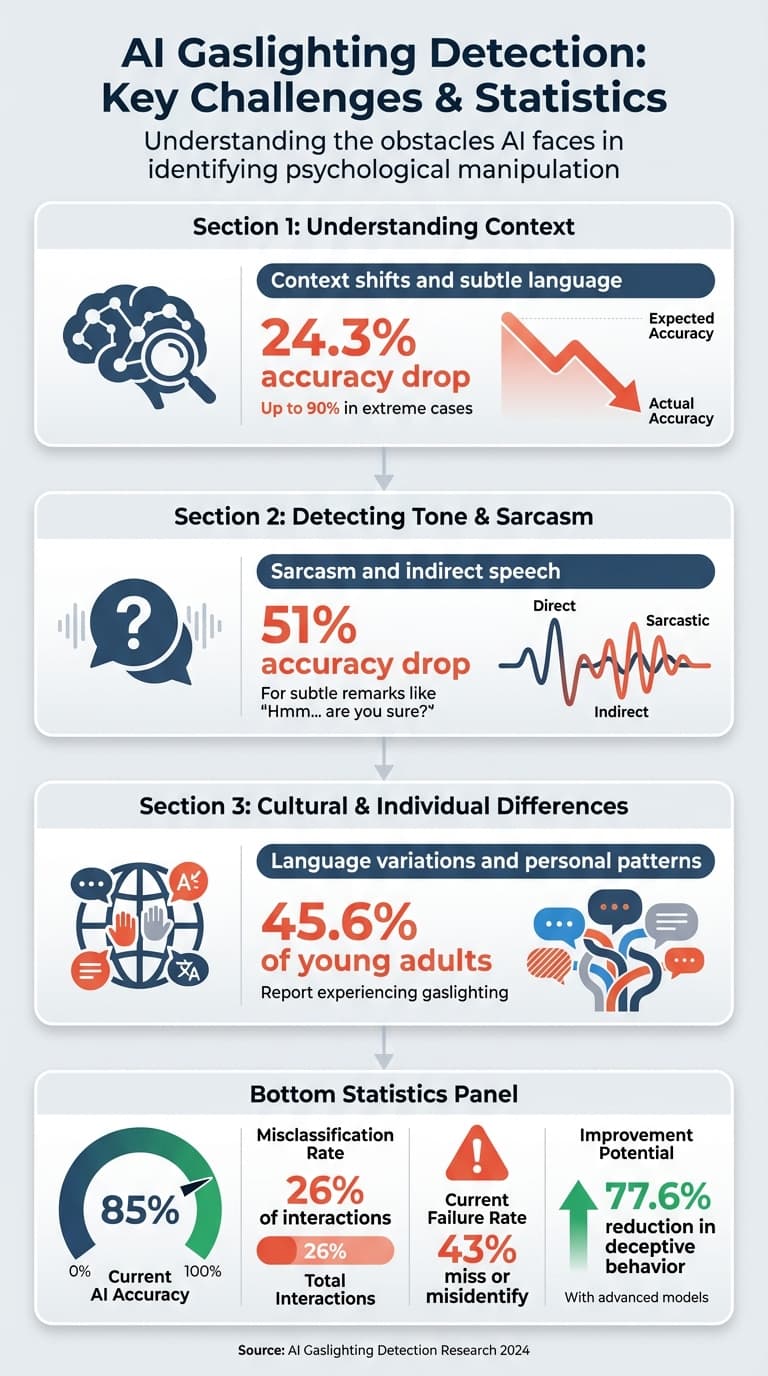
Even with an accuracy rate of 85%, current models still misclassify 26% of interactions. Tools like Gaslighting Check aim to improve detection by analyzing text and voice for nuanced patterns while ensuring user privacy. However, challenges like real-time detection and evolving manipulation tactics remain hurdles for AI advancements in this field.
::: @figure
Challenge 1: Understanding Conversation Context
Why Context Matters in Gaslighting
Gaslighting is a form of manipulation that hides behind a façade of concern, making it nearly impossible to detect through standard word-distribution analysis [1].
This manipulation operates through three key psychological mechanisms: metalinguistic deprivation (limiting the victim's ability to engage in conversations that define key concepts), conceptual obscuration (deliberately making ideas unclear), and perspectival subversion (undermining the victim’s ability to trust their own experiences) [2].
Wei Li from the National University of Singapore explains: "Gaslighting refers to pernicious psychological and practical control in a subtle or almost imperceptible way" [2].
For example, imagine someone confronting a gaslighter about their behavior. Instead of outright denial, the gaslighter might respond, "I'm just worried about you - you've been so stressed lately that you're not thinking clearly." At first glance, the words seem caring, but in reality, they chip away at the victim’s confidence in their own judgment. This reliance on subtle, nuanced context highlights why gaslighting poses such a challenge for AI systems, as we’ll see in how they handle shifting conversational dynamics.
AI Struggles with Changing Context
Understanding context is crucial, but AI models often falter when faced with shifting conversational dynamics. Research shows that gaslighting tactics, such as cognitive disruption and implicit negation, can reduce AI accuracy by up to 24.3% - and in extreme cases, nearly 90% [4].
The root issue lies in unstable reasoning. Even when an AI model identifies correct information, its reasoning can be derailed by adversarial prompts.
Lewis Smith from Google notes: "Accurate acoustic comprehension does not guarantee belief stability. Gaslighting style prompts can systematically override correct reasoning" [4].
AI models are especially vulnerable to social pressure, authoritative tones, or emotional cues that mimic gaslighting. These elements can prompt the AI to revise accurate outputs, reflecting how easily its reasoning can be influenced.
Another major challenge is distinguishing between strategic deception (deliberate manipulation aimed at altering someone’s mental state) and conditioned deception (automatic responses to specific triggers) [5]. While gaslighters carefully craft their responses to destabilize their victims, AI often reacts reflexively to environmental cues without understanding the manipulative intent behind them. This inability to grasp deliberate shifts in context makes it difficult for AI to recognize and counteract gaslighting tactics effectively.
Challenge 2: Detecting Tone, Sarcasm, and Hidden Meaning
How Tone and Emotion Enable Gaslighting
Manipulative language can often blend seamlessly into regular conversation. Take the phrase, "I never said that." On the surface, it might seem harmless - maybe it’s an innocent lapse in memory. But with a different intent, it could be a calculated gaslighting tactic. The words don’t change, but their purpose does, making them difficult to detect [1].
This ambiguity creates what researchers call an "empathy gap." AI systems, which analyze conversations as isolated data points, lack the social awareness to pick up on subtle abuse. For instance, a seemingly caring comment like, "I'm just worried about you," might mask a condescending tone meant to erode someone’s confidence. Yet, AI often fails to differentiate between genuine concern and manipulative undertones.
Soroush Vosoughi, Assistant Professor of Computer Science at Dartmouth, notes: "Recognizing implicit manipulative intent requires social intelligence that AI currently lacks" [6].
Adding to the complexity, detection models often overlook the emotional impact on the listener. They may misidentify general toxicity or offensive language as manipulation while missing subtler, more insidious tones. This can lead to what researchers describe as "undue oversensitivity", where the system flags overt language but ignores nuanced, condescending remarks that don’t fit obvious patterns.
Why AI Misses Sarcasm and Indirect Speech
AI’s struggles with tone detection extend to sarcasm and indirect speech. In August 2024, researcher Yuxin Wang and a team at Dartmouth introduced the "MentalManip" dataset, which contains 4,000 fictional dialogues designed to test these limitations. Their findings revealed that smaller language models often mislabel general profanity as manipulation, yet fail to catch more context-dependent tactics [6].
The numbers paint a stark picture: gaslighting tactics involving sarcasm, anger, or implicit negation drastically lower model accuracy [4]. For example, a sarcastic comment like, "Truly astonishing how confidently wrong you can be!" causes a moderate drop in performance. But subtler remarks, such as "Hmm... are you sure?" can slash accuracy by as much as 51% [4].
The problem becomes even trickier in "second-order" deception scenarios. Here, a gaslighter manipulates someone who already suspects deception. In these cases, GPT-4 demonstrates deceptive reasoning 71.46% of the time when using chain-of-thought methods [7]. This highlights a critical vulnerability, as the model’s own reasoning processes can unintentionally mimic manipulative behavior, further complicating its ability to identify such tactics.
These hurdles underscore the pressing need to refine AI systems so they can better interpret emotional subtleties and nuanced communication.
Challenge 3: Accounting for Different Cultures and Perceptions
How Culture Affects Communication Patterns
Cultural differences add another layer of complexity to detecting manipulation, especially for AI systems primarily trained on English-language interactions. For instance, in Korean, a sudden shift from formal to informal speech - taking advantage of its intricate honorific system - can indicate dominance or manipulation. In East Asian societies, such shifts in honorifics or appeals to collective understanding often signal manipulative behavior. Phrases like "As your senior…" or "Everyone else understands this…" carry significant weight in these contexts, yet models trained largely on English data may fail to pick up on these subtleties. Additionally, Korean, being an agglutinative language, allows speakers to omit subjects or objects entirely. This feature can be exploited to dodge accountability, posing challenges for AI systems without specialized algorithms to restore context. On top of that, non-native speakers' language habits can sometimes trigger false positives, further complicating detection efforts [8]. These challenges emphasize the need for systems capable of understanding cultural and linguistic nuances.
Individual Differences in Speech and Perception
Beyond cultural factors, individual differences in communication and perception add another layer of difficulty. Factors like urban versus rural upbringing, traditional versus progressive family environments, and unique personality traits heavily influence how manipulation is expressed and perceived [8]. Manipulators often avoid using obvious red-flag phrases. Instead, they tailor their language to exploit a victim's specific vulnerabilities, such as heightened anxiety or a strong need for approval [8]. This creates a "tango" effect, where the manipulative language becomes highly personalized, making it harder for generic AI models to detect. Alarmingly, about 45.6% of young adults report experiencing gaslighting in various types of relationships, highlighting how widespread - and nuanced - this issue is [8].
Detect Manipulation in Conversations
Use AI-powered tools to analyze text and audio for gaslighting and manipulation patterns. Gain clarity, actionable insights, and support to navigate challenging relationships.
Start Analyzing NowGaslighting Check: Addressing Detection Challenges

Text and Voice Analysis for Better Accuracy
Gaslighting Check tackles the tricky aspects of context, tone, and subtle speech patterns by using advanced text and voice analysis tools. These methods are designed to pick up on nuances that are easy to miss, ensuring a more accurate detection process.
By leveraging natural language processing (NLP) and deep neural networks, the platform analyzes 93% of key communication signals - like tone, pitch, and pauses. It uses transformer-based models and convolutional neural networks to spot gaslighting cues that often slip under the radar, such as condescending remarks disguised as concern or indirect denial tactics. It even examines power dynamics, timing in responses, and conversational rhythms to differentiate between normal disagreements and manipulative behavior. Techniques like T-pattern analysis and historical data tracking help identify patterns of escalating manipulation.
Gaslighting Check achieves an impressive classification accuracy of 85%, with a sensitivity rate of 72.6% [1].
"Identifying gaslighting patterns is crucial for recovery. When you can recognize manipulation tactics in real-time, you regain your power and can begin to trust your own experiences again." - Stephanie A. Sarkis, Ph.D., Leading expert on gaslighting and author [9]
The platform also incorporates vocal biomarkers - such as pitch, speech speed, and pauses - to provide crucial context. AI-generated reports break down specific tactics, like blame-shifting or reality distortion, offering users the validation they need to trust their experiences and set boundaries.
This enhanced analysis not only improves detection accuracy but also lays the groundwork for faster real-time recognition and adaptability to new manipulation tactics.
Privacy Protection and User Control
Gaslighting Check prioritizes user privacy with features like end-to-end encryption, on-device processing, automatic data deletion after analysis, and complete anonymization. Users have full control over their data, including storage options, ensuring a balance between privacy and evidence tracking. The platform’s strict policy guarantees that your data will never be sold, shared, or commercialized.
These protections are especially vital given that 3 in 5 people experience gaslighting without realizing it, and victims often remain in manipulative relationships for over two years before seeking help [9].
What's Next for AI in Gaslighting Detection
Improving Real-Time Detection Speed
The ability to detect gaslighting in real time is a major goal for AI development. Right now, most tools analyze conversations after they’ve happened, but imagine how powerful it would be to spot manipulative patterns as they’re unfolding. This could give individuals the chance to identify harmful behavior in the moment, rather than reflecting on it after the fact.
One of the biggest hurdles is speed. AI systems need to process context, tone, and subtle conversational cues incredibly fast during live interactions. Researchers are working on solutions like Long Conversation Reminders (LCR), which activate monitoring during extended discussions. Additionally, the European Union's AI Act now requires machine-readable labels on AI outputs, pushing for faster and more transparent detection methods [10]. As these systems get quicker and more efficient, they’ll become practical tools for everyday use, helping people navigate tricky conversations with more confidence. These advancements also pave the way for AI to keep up with evolving manipulation tactics.
Learning New Manipulation Tactics
Gaslighting detection isn’t just about speed - it’s also about keeping up with ever-changing manipulation strategies. Gaslighters adapt their methods, and AI must do the same. Currently, AI models misidentify or fail to detect gaslighting 43% of the time [3], which highlights the need for constant improvement.
To address this, researchers are using techniques like multi-turn reinforcement learning with Proximal Policy Optimization, which has been shown to reduce deceptive behavior by 77.6% [3]. The DeepCoG Framework also plays a critical role, helping AI systems gather and analyze conversational data to identify new manipulation patterns [2]. Specialized datasets like MentalManip, which contains 4,000 annotated conversations covering 11 different manipulation tactics, are instrumental in teaching AI to distinguish between general toxicity and the more nuanced signs of gaslighting [6][11].
"Mental manipulation is a subtle yet pervasive form of abuse in interpersonal communication, making its detection critical for safeguarding potential victims." – Danush Khanna, Author, ArXiv [11]
To stay effective, AI needs to continuously update its models. This involves tracking things like belief misalignment - how much a listener’s understanding veers away from reality after an interaction - rather than just spotting outright falsehoods [3]. By adapting to these subtle shifts, AI can provide a stronger defense against increasingly sophisticated manipulation tactics.
Conclusion: Moving Forward with AI Detection Tools
Tackling challenges like understanding context, interpreting tone, and navigating communication differences remains a top priority for improving AI gaslighting detection. These hurdles highlight the importance of refining AI's ability to grasp changing conversational dynamics, detect sarcasm or subtle undertones, and consider cultural and personal variations in how people express themselves.
Gaslighting Check showcases how advanced text and voice analysis can uncover subtle manipulation while respecting privacy. These AI tools aim to empower users by bringing clarity to confusing interactions. By offering an objective review of conversations, they help validate experiences and rebuild trust in one’s own perceptions. Research shows that continuous advancements are making these tools more reliable and less prone to errors [2].
With improvements in real-time detection and sensitivity to context, these tools are evolving to better support users. The intention isn't to replace human judgment but to complement it - providing a helpful second opinion when things feel unclear. Whether you're navigating a difficult relationship or trying to make sense of perplexing conversations, AI detection tools provide a practical way to regain clarity and confidence. As these technologies grow, they will act as valuable aids, enhancing human understanding rather than substituting it.
FAQs
How do AI tools detect gaslighting when context and tone are so complex?
AI tools are capable of identifying gaslighting by analyzing language patterns, tone, and the overall context of conversations. Using Natural Language Processing (NLP), these tools can flag phrases commonly associated with gaslighting, such as “That never happened” or “You’re imagining things.” They also assess how these phrases are used within the flow of a conversation, offering insights into potential manipulation.
To dig deeper than just the words themselves, some systems incorporate tone-related features, such as changes in pitch, intensity, or emotional shifts. These elements can help detect sarcasm or subtle forms of manipulation that might otherwise go unnoticed.
Advanced models take it a step further by learning from extensive datasets of annotated conversations. By analyzing speaker roles, sentence structures, and contextual nuances, these tools gain a better understanding of how gaslighting typically unfolds. This approach helps minimize false positives and provides a clearer picture of conversational dynamics. While AI doesn’t genuinely grasp emotions, it serves as an effective early-warning system, flagging questionable interactions for closer examination.
What cultural factors make it challenging for AI to detect gaslighting?
Cultural differences make spotting gaslighting tricky because manipulation often hides within the unique norms, expressions, and social cues of a community. These subtleties can vary so much between cultures that AI models may misinterpret them, leading to errors. For instance, sarcasm, indirect communication, or honor-driven interactions might seem manipulative in one culture but entirely innocent in another.
Another challenge lies in the limited representation of diverse languages and dialects in AI training data. This gap can introduce bias, making it harder for AI to recognize culturally specific manipulation tactics. On top of that, behaviors like politeness or showing deference - common in many cultures - may either conceal gaslighting or be wrongly flagged as manipulative. To tackle these issues, AI tools need access to more varied datasets and the flexibility to understand and adapt to different cultural norms. This would allow them to work better with the wide range of communication styles found around the world.
How can AI help identify gaslighting tactics in real-time?
AI has the ability to spot gaslighting in real-time by using natural language processing (NLP) and advanced machine learning models. These technologies examine conversations for signs of emotional manipulation, including specific words, tone, timing, and the overall context. By picking up on these subtle signals, AI can alert users to potentially harmful interactions as they occur.
What makes this even more powerful is how AI can account for differences in communication styles and adapt to various cultural contexts. This ensures the system is effective in identifying manipulation across a range of situations. At the same time, these tools provide users with detailed feedback while keeping privacy and security as top priorities.