How to Spot Dismissive Language in Texts

How to Spot Dismissive Language in Texts
Dismissive language in texts often invalidates your feelings or dismisses your experiences, leaving you feeling unheard or doubting yourself. It can take many forms, such as curt responses like "K" or "Fine", phrases that minimize your emotions like "You're overreacting", or even denial of events with statements like "That never happened." Over time, these patterns can harm your emotional well-being and relationships.
Key Signs of Dismissive Language:
- Short, abrupt replies: "Whatever", "Cool", or "Fine" signals disinterest.
- Minimizing feelings: "Calm down", "You're being dramatic."
- Denying reality: "You're imagining things", "That never happened."
- Sarcasm or jokes: "Oh poor you", "I was just joking."
- Blame or generalizations: "You always ruin things", "You never listen."
How to Identify Patterns:
- Look for repeated dismissive phrases.
- Compare the tone and effort in their replies to yours.
- Note timing, such as dismissive responses after setting boundaries.
Emotional Impact:
Repeated dismissive communication can erode trust, self-esteem, and emotional health, leading to anxiety or even depression. Documenting patterns and setting boundaries can help protect yourself.
Tools like Gaslighting Check (free or $9.99/month for premium features) can analyze text conversations to highlight dismissive behaviors and track patterns over time.
Takeaway: Recognizing dismissive language is the first step toward addressing it. Trust your feelings, set boundaries, and seek respectful communication.
Common Dismissive Phrases and Patterns
::: @figure
It's important to recognize the common ways people dismiss or invalidate feelings through texts. These patterns often undermine meaningful communication and can leave you feeling unheard or doubting yourself. Below, we break down some of these behaviors with examples to help you spot them quickly.
Short, Abrupt Responses
Replies like "K", "Fine", "Whatever," or "Cool" often signal a refusal to engage in meaningful conversation. These one-word responses shut down dialogue without addressing the issue at hand. When someone consistently uses these terse replies, it creates emotional distance and leaves you feeling dismissed.
Phrases That Minimize Your Feelings
Statements like "You're overreacting," "You're too sensitive," or "It's not a big deal" invalidate your emotions and suggest that your feelings are unwarranted.
Psychologist Dr. Cortney S. Warren explains: "By accusing you of being dramatic, the gaslighter is attempting to dismiss your concerns as irrational and unfounded" [2].
Other examples include "Calm down," "You're being dramatic," and "It's not that serious." These phrases can make you question the legitimacy of your emotions. A helpful response might be: "Whether or not you agree with me, this is how I feel right now" [2].
Denying or Rewriting What Happened
Some people use phrases like "That never happened," "You're imagining things," or "I never said that" to deny reality outright. They might also claim "You're remembering it wrong" to make you doubt your memory. This tactic creates confusion and self-doubt, often making you rely on their version of events instead of trusting your own recollection.
Generalizations and Sarcastic Comments
Statements like "You always ruin things" or "You never listen" use absolutes to attack your character. These sweeping generalizations are impossible to argue against and frame you as fundamentally flawed. Sarcasm, such as "Oh, here we go again," "Sure, whatever you say," or "Oh poor you," is another way people dismiss concerns while maintaining what therapist Sharie Stines calls "plausible deniability." If confronted, they might claim they were "just joking" [4].
Other examples include "Everyone agrees with me" or "You're the reason why we're always late" [2][3][4]. If someone dismisses a hurtful comment as a joke, you can respond with: "That comment might have been funny to you, but it hurt my feelings" [2].
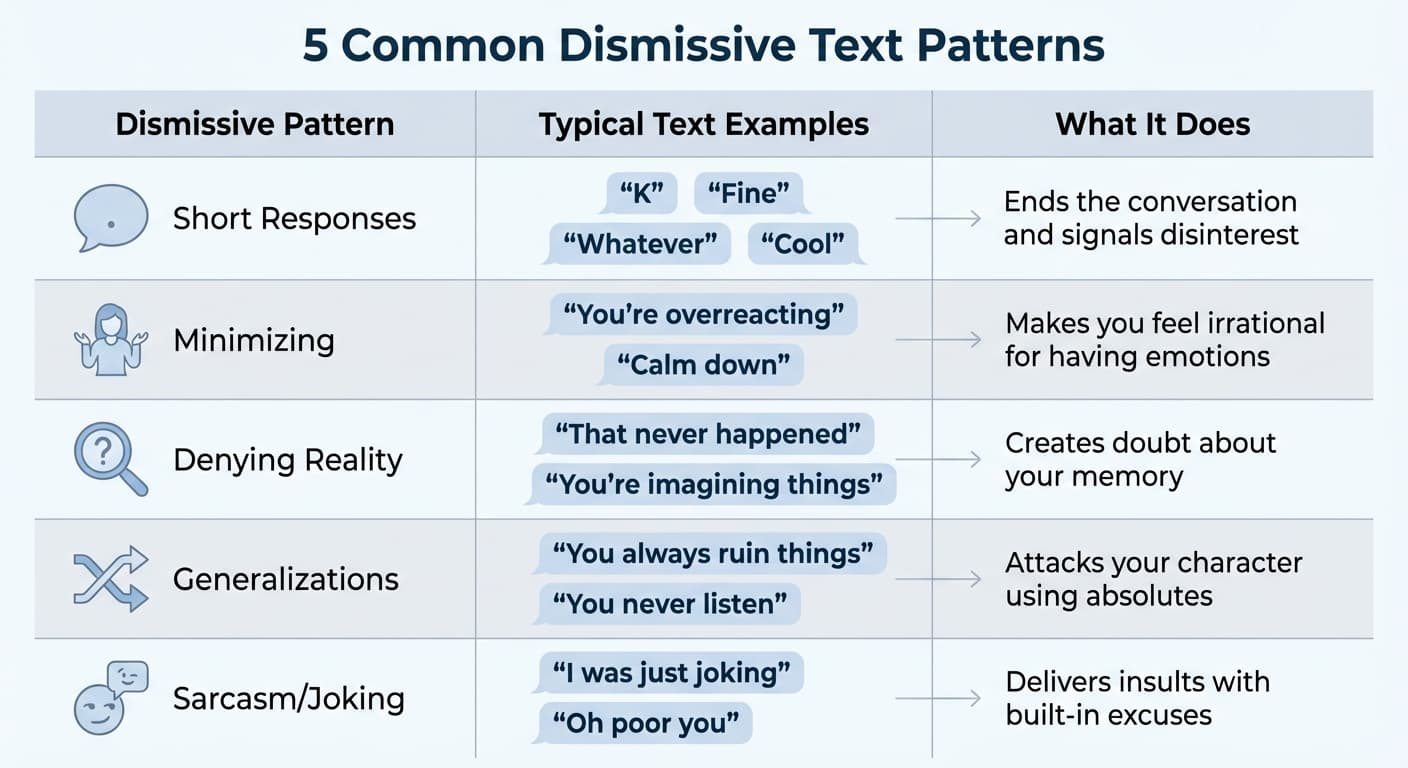
Here’s a quick summary of these dismissive patterns, their common text examples, and how they affect communication:
| Dismissive Pattern | Typical Text Examples | What It Does |
|---|---|---|
| Short Responses | "K", "Fine", "Whatever", "Cool" | Ends the conversation and signals disinterest |
| Minimizing | "You're overreacting", "Calm down" | Makes you feel irrational for having emotions |
| Denying Reality | "That never happened", "You're imagining things" | Creates doubt about your memory |
| Generalizations | "You always ruin things", "You never listen" | Attacks your character using absolutes |
| Sarcasm/Joking | "I was just joking", "Oh poor you" | Delivers insults with built-in excuses |
How to Spot Dismissive Language in Your Conversations
Once you're familiar with dismissive phrases, the next step is recognizing how they show up in your conversations. It's not just about the words themselves - it’s also about patterns and context. For example, a single "K" might seem harmless, but if it’s part of a habit of brief, unengaged replies when you’re opening up about something meaningful, it might signal dismissiveness. Here’s how to evaluate whether dismissive communication is at play.
Check Timing and Response Patterns
Pay attention to how quickly someone responds and the effort they put into their replies. If you’re sending thoughtful, detailed messages and consistently getting one-word answers like "Fine" or "Whatever", that’s worth noting. Timing can also be revealing - does this behavior increase after you’ve set a boundary or made an independent decision? These patterns may indicate intent. According to research from the Gottman Institute, stonewalling (a form of shutting down communication) predicts relationship failure with over 90% accuracy [1]. Similarly, prolonged silences or the "silent treatment" used as a form of punishment are ways of withholding communication to make you feel ignored or invisible.
Compare Your Message to the Response
Look at the contrast between the effort or emotion in your message and the reply you receive. If you share something personal or vulnerable and the response is sarcastic, dismissive, or mocking, it’s a form of emotional invalidation. Another red flag is shifting blame - this might sound like, "You’re the one with the problem", or it could involve bringing up unrelated past mistakes to deflect attention from the current issue. If a response leaves you questioning your own memory or doubting your feelings, trust your gut - this could be a sign of dismissive communication.
Identify Repeated Dismissive Behavior
A single dismissive comment could be a misunderstanding, but repeated patterns are more telling. Keep track of how often phrases like "You’re overreacting" or "That never happened" come up in your conversations. If discussions frequently go unresolved and leave you feeling drained or like you’re "walking on eggshells", it’s a sign of a larger issue [3]. Some dismissive communicators also use intermittent reinforcement - alternating between intense affection and cold withdrawal - to create a cycle that can feel emotionally addictive. Research shows there’s a strong link between perceived emotional invalidation and psychological distress [1]. Documenting these patterns can help you protect yourself and gain clarity.
If spotting these patterns feels overwhelming, tools like Gaslighting Check can help. This platform analyzes texts to flag dismissive language and manipulation tactics. Its free plan ($0) offers basic text analysis, while the premium plan ($9.99/month) includes features like conversation history tracking to monitor behavior over time. These tools can be a valuable resource, especially as you explore strategies for responding to dismissive communication, which we’ll cover next.
How to Analyze and Respond to Dismissive Texts
Once you've identified dismissive language, the next step is to analyze it carefully and decide how to respond. This process helps you protect your emotional well-being and stay grounded in your own reality.
Examine the Exact Words
Pay close attention to the specific words or phrases used. Phrases like "You're overreacting", "That never happened", or "You're being crazy" do more than dismiss your feelings - they can make you question your own experiences. When you notice these kinds of statements, take a step back and separate your emotional reaction from the actual message. Ask yourself if the person is genuinely addressing your concerns or just deflecting. Writing down these phrases can help you identify recurring patterns, making it easier to see if dismissive language is a habit.
Look for Patterns Over Time
One dismissive comment might just be a slip-up or a misunderstanding. But if it happens repeatedly, it could point to a deeper issue. Track how often phrases like "You're too sensitive" or "I was just joking" show up in your conversations. Timing matters too - are these comments more frequent after you’ve set a boundary or made a decision for yourself? Keeping a simple log of dates and specific quotes can help you stay clear-headed, especially if someone later tries to deny or rewrite what happened. Combining a personal log with digital tools can also provide an objective view of the situation.
Leverage Tools to Spot Patterns
It’s not always easy to see manipulation when you’re in the thick of it. Tools like Gaslighting Check can analyze your text conversations and flag dismissive language or manipulative tactics. These tools can validate your experiences and help you respond more confidently. For instance, you might say:
"Whether or not you agree with me, this is how I feel right now" – Dr. Cortney S. Warren, Harvard-trained Psychologist [2].
Such responses assert your feelings without needing the other person’s agreement, which can be empowering in the face of dismissive behavior.
How to Protect Yourself from Dismissive Communication
Once you've identified dismissive language, the next step is to safeguard your emotional well-being. This involves setting firm boundaries and recognizing harmful patterns. These actions empower you to actively protect your emotional space.
Recognize Harmful Communication Patterns
It’s important to distinguish between an occasional dismissive comment and a recurring issue. If dismissive remarks continue, especially after you’ve set boundaries, it could indicate a deeper problem. Studies show that over 65% of people have experienced dismissive behavior from someone they care about [5]. Additionally, if reading certain texts triggers physical anxiety - like a racing heart or tightness in your chest - it might be a sign of toxic communication.
Keep a Record of Your Interactions
Tracking your conversations can provide clarity and help you stay grounded. Jot down dates, specific quotes, and your feelings after each interaction. This practice can help you identify patterns and protect yourself if the other person tries to distort past events. Tools like Gaslighting Check can be useful for documenting conversations and spotting manipulation.
By keeping a record, you not only gain a clearer understanding of the situation but also reinforce your personal boundaries.
Establish Clear Boundaries
Protecting yourself starts with clearly defining your limits. Communicate your non-negotiables in a direct but calm manner. For instance, if a comment meant as a joke hurts your feelings, explain that humor doesn’t justify hurtful remarks. Similarly, if someone dismisses your reaction by saying you’re overreacting, reaffirm that your feelings are valid regardless of their opinion. Keep your responses concise and to the point. As Kia-Rai Prewitt, PhD, a psychologist at Cleveland Clinic, advises:
"If you feel safe and comfortable doing so, you can try using assertive communication to express that the behavior is not okay and you're not going to allow it to continue."
If your boundaries are repeatedly ignored, it might be time to pause the conversation or limit the sharing of personal information. Robin Stern, Ph.D., Co-founder of the Yale Center for Emotional Intelligence, offers this reminder:
"The key to remaining gaslight-free in any relationship is to not let your self-worth depend on someone else's approval."
Using assertive communication can help you maintain control over your emotional well-being and reinforce the boundaries you’ve set.
Conclusion
Spotting dismissive language in texts is a crucial step in reclaiming clarity and balance in your relationships [7]. Recognizing phrases that downplay your emotions, dismiss your experiences, or shut down discussions empowers you to safeguard your emotional health. Therapist Sharie Stines emphasizes this point:
"Emotional abuse is insidious. It's often invisible. It's frequently designed so that only the target knows she's being abused, and on the surface, the abuser looks 'normal.'" [4]
Once you’ve identified these dismissive patterns - such as curt responses, emotional invalidation, or repeated disregard - you can take decisive action. Trust your instincts when something feels off, and use clear "I" statements like "I remember it differently" or "That wasn’t my experience" to assert your perspective [7].
Setting firm boundaries is another key step. Keep track of interactions that leave you feeling undermined or manipulated. Tools like Gaslighting Check offer a practical way to analyze your conversations and spot harmful patterns. With plans starting at $0, these tools provide an accessible way to document interactions and gain clarity when needed.
Dr. Kia-Rai Prewitt reminds us of the importance of trusting our feelings:
"If the behavior is harming you, makes you feel lesser or is being used to control you, then something is wrong. Abuse is abuse." [6]
Your emotions are valid, and you deserve communication that respects and honors your feelings.
FAQs
How can I tell if a comment is dismissive or just a misunderstanding?
Dismissive comments are often deliberate attempts to undermine or invalidate what someone has said. They typically include short, indifferent phrases like “Whatever” or “You’re overreacting,” which signal disinterest or a lack of concern. On the other hand, misunderstandings arise from genuine misinterpretations or missed details. These responses are usually more open-ended, with phrases like “Can you clarify?” or “I didn’t quite get that.”
In text communication, spotting the difference requires noticing patterns. Dismissive remarks often feel abrupt or final, relying on absolutes like “That never happened” or minimal responses such as “Ok.” Misunderstandings, however, are more likely to involve questions or efforts to seek clarity. If someone repeatedly uses dismissive language across various conversations, it might indicate a pattern of invalidation rather than an isolated miscommunication.
If you're uncertain, asking for clarification can help. But if the responses consistently dismiss your feelings or shut down the dialogue, it’s probably dismissive behavior. Tools like Gaslighting Check can assist in identifying recurring dismissive language, offering insights into whether this behavior points to a broader pattern of emotional manipulation.
How can I effectively respond to dismissive language in text messages?
If you come across dismissive or minimizing language in a conversation, addressing it calmly and confidently can make a difference. Start by naming the behavior with an "I" statement to express your feelings without escalating the situation. For instance: "I feel dismissed when you say I’m being ‘too sensitive.’ Could we talk about this in a more constructive way?" This approach helps set the tone for a more productive discussion.
If the dismissive tone continues, it’s okay to set boundaries. You might say something like: "I’m not comfortable continuing this conversation if my feelings aren’t being taken seriously." Should the behavior persist, consider keeping a record of the interactions - note dates, times, and specific messages. You can also reach out to a trusted friend, a therapist, or use tools like Gaslighting Check to better understand and assess the communication.
Your emotional well-being matters. If necessary, step away from the conversation to give yourself space until a respectful dialogue can resume.
How can Gaslighting Check help identify dismissive language in texts?
Gaslighting Check leverages advanced AI to spot subtle dismissive language in text conversations. It flags common phrases such as “You’re overreacting” or “That’s not a big deal”, drawing attention to patterns of invalidation or minimization that might otherwise go unnoticed.
What sets this tool apart is its ability to analyze not just individual comments but the bigger picture. By examining tone, timing, and context, it identifies recurring behaviors rather than focusing solely on isolated remarks. This real-time insight helps users recognize harmful communication patterns early on, enabling them to set boundaries and safeguard their emotional well-being.