
How Social Interaction Improves Mental Health Recovery
Social interaction plays a key role in mental health recovery, particularly for those healing from gaslighting and emotional manipulation. Reconnecting with others helps rebuild self-esteem, reduce stress, and restore clarity. Here’s what you need to know:
- Gaslighting damages mental health by creating self-doubt and isolation.
- Healthy relationships counteract this by offering validation and emotional support.
- Social support reduces depression and strengthens resilience.
- Tracking interactions and setting boundaries can help identify and maintain positive connections.
Social Relationships, Stress, and Loneliness: Harnessing Social Connections to Promote Health
How Social Interaction Improves Mental Health Recovery
Recovering from gaslighting isn’t just about regaining your sense of self - it’s also about rebuilding connections. Social interaction goes beyond simple companionship; it actively helps counteract the damage caused by manipulation. Here’s how connecting with others can make a tangible difference in your mental health journey.
Emotional Support Reduces Stress
Empathy and accessible support are powerful tools for reducing stress. When you have trusted individuals who truly understand and care, their empathy acts as a buffer against the psychological strain of abuse. A meta-analysis [6] highlights a consistent link between social support and improved mental well-being.
"Social support provides physical and psychological advantages for people faced with stressful physical and psychosocial events, and is considered as a factor reducing the psychological distress when faced with stressful events."
– Tayebeh Fasihi Harandi, Ph.D., Assistant Professor, Alborz University of Medical Sciences [6]
Interestingly, it’s not just about receiving help - it’s about knowing that help is there if you need it. This sense of security calms your body’s stress response, lowering blood pressure and strengthening immune function, both of which are often compromised by chronic abuse [4][6][8]. Even a small circle of trusted individuals can make all the difference [4].
Validation Rebuilds Self-Esteem
Gaslighting often leaves behind a deeply ingrained negative self-image [1]. Social validation, however, can directly counteract this. When people you trust acknowledge your experiences and affirm your worth, it helps restore the autonomy that manipulation may have taken from you. Rebuilding self-esteem is a cornerstone of recovery.
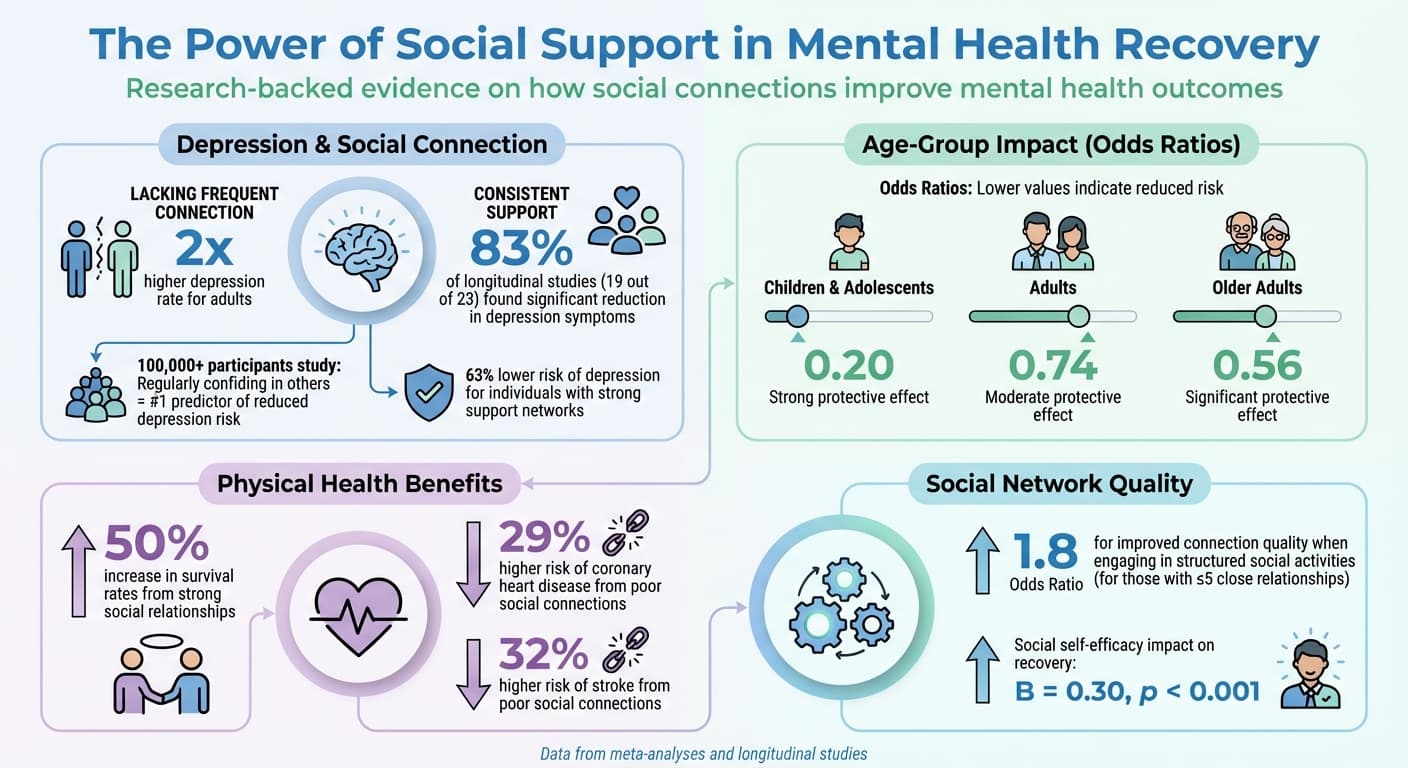
In fact, 83% of longitudinal studies (19 out of 23) found that social support significantly reduced symptoms of depression [7]. One large-scale study involving 100,000 participants identified frequent confiding in others as the strongest predictor of lower depression risk among more than 100 modifiable factors [7]. This kind of validation reinforces your right to seek and accept support [1][9].
"Having strong social support can actually make you more able to cope with problems on your own, by improving your self-esteem and sense of autonomy."
– American Psychological Association [4]
Rebuilding confidence doesn’t have to start with major actions. Begin with small, manageable steps like practicing micro-assertiveness - expressing simple preferences, such as choosing a movie to watch, with trusted individuals. These small victories help you regain confidence in your own judgment over time [9].
Advice and Perspective Help Restore Clarity
Gaslighting often leaves you doubting your own reality. This is where trusted perspectives become invaluable. External viewpoints offer much-needed clarity, helping you regain a sense of what’s real. Research [5] shows that stronger social self-efficacy - essentially, confidence in your ability to interact socially - leads to better recovery outcomes (B = 0.30, p < 0.001).
Trusted advice can also help you recognize common gaslighting tactics like countering, withholding, and diverting information. Understanding these patterns equips you to avoid similar situations in the future. Moreover, having someone to talk to can shift the blame away from yourself and onto the manipulator, where it belongs.
"Empathy helps an individual understand another individual's world and experiences, creating a reciprocal understanding and building the foundation for support, decision, and recovery."
– Maribel G. Dominguez and Louis D. Brown, University of Texas Health Science Center [5]
When self-doubt arises, sharing your experiences with a trusted third party can help you see things more objectively. Tools like Gaslighting Check (https://gaslightingcheck.com) can also assist by documenting conversations and identifying manipulation patterns. These resources, combined with trusted advice, can help break the cycle of second-guessing yourself and pave the way toward recovery.
Research on Social Support and Mental Health Recovery
::: @figure
Expanding on the idea that emotional support helps alleviate stress and rebuild self-esteem, research continues to highlight how vital social connections are in recovering from mental health challenges.
Lower Rates of Depression and Anxiety
Studies reveal a stark difference in mental health outcomes between those with and without regular social support. Adults who lack frequent social connections experience depression at twice the rate of those with consistent support [11]. This isn't just a coincidence - research confirms that loneliness can directly lead to major depression. At the same time, depression often increases feelings of loneliness, creating a vicious cycle that meaningful social interactions can help break [11].
"Loneliness is both a cause and a consequence of major depression; thus, public health strategies to reduce loneliness may potentially be effective in preventing the onset of depression."
– Julianne Holt-Lunstad, Ph.D. [11]
The impact of social support varies across different age groups. For example, strong social connections have an odds ratio of 0.20 for children and adolescents, 0.74 for adults, and 0.56 for older adults [10]. In a massive study involving 100,000 participants, the act of regularly confiding in others emerged as the most powerful predictor of reduced depression risk among more than 100 modifiable factors [7]. These findings emphasize how social support not only reduces depression but also fosters resilience and reinforces self-esteem.
Better Resilience and Coping Skills
Social support does more than just prevent mental health issues - it actively builds your ability to confront and manage them. By acting as a buffer against stress, social connections make life’s challenges feel less overwhelming [14][7]. When you have trusted people to lean on, you're better equipped to navigate the mental toll of difficult experiences, such as emotional manipulation.
The benefits extend beyond mental health. Strong social relationships increase survival rates by 50%, surpassing the effects of regular exercise or maintaining a healthy weight [11][8]. On the flip side, poor social connections raise the risk of coronary heart disease by 29% and stroke by 32% [11]. Social support also helps quiet that harsh inner critic, the one that constantly reminds you of perceived failures - a common mental scar left by manipulation [1].
This ability to foster resilience works hand in hand with the role of social validation, helping to rebuild a sense of self-worth.
Social Validation Improves Self-Worth
The belief that support is available when needed - often referred to as "esteem support" - plays a key role in mental health recovery [6]. Social validation, where others affirm your experiences and reinforce your value, directly counters the distorted self-perception that manipulation can create. Long-term studies have shown that social support reduces depression symptoms significantly, with 83% of cases demonstrating protective effects [7].
Interestingly, it’s not always the actual help you receive that matters most - it’s your perception of its availability. This belief in support tends to have a stronger protective effect on mental health than the assistance itself [8][13].
"Social support alone is not important, but what is important is the belief in the existence of social support."
– Tayebeh Fasihi Harandi, Ph.D. [6]
Esteem support - when others reassure you of your competence and worth - is especially important in rebuilding self-confidence after experiences like gaslighting [13]. Research on individuals with limited social networks (defined as five or fewer close relationships) found that engaging in structured social activities significantly improved both the quality and depth of their connections, with an odds ratio of 1.8 [12]. Recovery, it turns out, is not a solitary process - it thrives in the context of a supportive social network [12].
How to Build Social Support During Recovery
Understanding the research is one thing - putting it into action is another. Many survivors of gaslighting find themselves isolated, having lost touch with friends and family during manipulative relationships. Reconnecting and building healthy relationships is possible, but it takes deliberate effort. These practical strategies can help guide you toward emotional recovery.
Using Tools to Monitor Healthy Conversations
One of the hardest parts of recovery is figuring out which interactions are healthy and which are manipulative. After experiencing gaslighting, your sense of what’s “normal” may feel off. That’s where keeping track of conversations can make a big difference.
Try maintaining a journal where you note specific details about conversations - dates, times, and what was said. Over time, this can help you spot patterns, like someone frequently twisting your words or steering the focus away from your concerns to suit their own agenda[2]. If a discussion starts feeling like a power struggle, where the goal is to “win” rather than to understand, it’s often a sign to step back[2].
For extra clarity, tools like Gaslighting Check (https://gaslightingcheck.com) can help you identify when a conversation shifts from genuine communication to manipulation. The platform provides detailed reports, tracks conversation history, and offers actionable feedback to help you evaluate whether your interactions are supportive or harmful. It also prioritizes privacy with end-to-end encryption and automatic data deletion. While the free plan covers basic text analysis, the premium version ($9.99/month) offers additional features.
When it feels safe, consider sharing snippets of conversations with a trusted confidante for an objective perspective[3][21]. The goal here isn’t to gather evidence for legal purposes but to validate your experiences as you work toward recognizing healthy communication.
Creating a Supportive Social Network
Rebuilding your social circle can feel overwhelming, especially if you’ve been isolated. Start small by reconnecting with familiar faces. Look through old journals or social media to find people who once brought you joy and connection. A simple message like, “I’ve been thinking about you and would love to catch up,” can reopen doors you thought were closed[16].
Don’t rely on just one person for emotional support - it’s better to have a network. Different people can fulfill different roles. Maybe one friend is great for discussing work stress, while another offers insight on personal matters. Expand your connections by engaging with colleagues, neighbors, or new acquaintances[4].
Shared activities can make socializing feel less intimidating. Join a book club, sign up for a pottery class, or volunteer at a local organization[4][16]. These activities provide natural opportunities to connect with others over common interests. For support specific to your experience, consider joining a survivor group where others understand the effects of psychological manipulation[4][16][17].
Make a list of people who consistently bring positivity into your life and set a realistic schedule for reaching out[15]. Aim for at least one meaningful interaction each day - whether it’s a phone call, coffee, or even a thoughtful text. Be upfront about your needs, saying things like, “I could use a sympathetic ear” or “I’d appreciate your perspective on this.” This helps others understand how best to support you[15][16].
Setting Boundaries While Staying Connected
Recovery is all about finding balance - connecting with others while protecting your well-being. Healthy boundaries are essential for lasting progress. Start by identifying your values and deciding what behaviors you will or won’t accept[18]. If someone crosses a line, respond with clear, assertive statements like, “My feelings are not up for debate” or “I know what I experienced.” These statements affirm your reality without inviting unnecessary discussion[18].
Maintain a few close friendships and aim for one to three hours of social interaction daily to combat loneliness[20]. This doesn’t mean lengthy hangouts - a quick coffee break, a short walk, or a brief check-in with a neighbor can be enough. Balance your “strong ties” (close friends and family) with “weak ties” (acquaintances and neighbors) to meet both emotional and practical needs[20].
When forming new connections, look for “green flags” like empathy, active listening, and respect for your boundaries[19]. On the flip side, be cautious of “red flags” such as veiled insults, constant gossip, or people who dismiss your experiences[19]. If someone leaves you feeling drained or like you’re walking on eggshells, trust your instincts and create some distance[19]. Healthy relationships should leave you feeling supported and at ease, not anxious or confused.
Be patient with yourself as you rebuild your social network. Every small step counts[16]. If socializing feels overwhelming, consider working with a therapist who can help you develop social skills and regain confidence[4][15]. Keep in mind, low levels of social interaction can impact your health as much as smoking nearly a pack of cigarettes a day[15]. Building your support system isn’t just helpful - it’s a critical part of your recovery. Paired with conversation tracking and clear boundaries, these efforts can make a lasting difference in your emotional well-being.
Tracking Recovery Through Social Interaction Metrics
Rebuilding trust and confidence in your social connections takes time, but tracking specific social interaction metrics can provide tangible proof of your progress. By focusing on these measurable aspects, you can gain a clearer picture of how your relationships are evolving and how they’re contributing to your recovery.
Logging Positive Interaction Frequency
Start by keeping track of your positive interactions. While the number of interactions you have is important, the quality of those interactions matters even more. According to a study involving 591 adults, pleasant and understanding conversations were linked to greater reductions in psychiatric symptoms compared to simply having more frequent interactions [22].
To capture these moments accurately, log your interactions within 30 minutes of them happening. You can use event-contingent recording methods for this, but a simple journal works just as well. Jot down the date, time, and your emotional response to the conversation. If you prefer digital tools, platforms like Gaslighting Check (https://gaslightingcheck.com) can help automate the process by tracking interactions in detail.
When evaluating each interaction, consider these factors: Did the conversation flow naturally? Did you feel heard and understood? Did you and the other person share common values? Researchers have identified six key qualities that make up what’s known as the "pleasantness" metric, which is strongly tied to better mental health outcomes [22]. In one study analyzing over 64,000 interaction reports, individuals who consistently rated their conversations as pleasant experienced significant reductions in anxiety and depression over time [23].
Identifying Patterns Through Conversation Reports
After a few weeks of tracking, you’ll likely notice patterns in your interactions. These patterns can help you distinguish between relationships that are supportive and those that are draining.
Pay attention to what researchers call "interpersonal turbulence", which refers to the emotional ups and downs in your interactions [23]. If your conversations with someone feel great one moment and terrible the next, it could indicate an unstable or even manipulative relationship. On the other hand, consistent warmth and validation are hallmarks of healthy connections. Tools like Gaslighting Check can analyze your interaction data and highlight trends, saving you from manually reviewing every conversation. The platform’s text and voice analysis can even detect subtle tone or language shifts that might signal manipulation.
Another useful metric to track is "overwarming." This occurs when you perceive yourself as being warmer or more open than the other person during a conversation [23]. Interestingly, studies show that people who rate themselves as interpersonally warm - even when others seem less so - tend to have higher self-esteem and fewer depressive symptoms. This underscores the importance of focusing on your own behavior and self-perception during interactions. Tracking this metric can reveal when you’re starting to reclaim your sense of self-worth and confidence.
Measuring Self-Esteem Growth Through Social Validation
Ultimately, tracking social interactions isn’t just about analyzing others’ behavior - it’s about understanding how these interactions affect your self-esteem. After experiencing gaslighting, many survivors grapple with self-doubt and second-guess their perceptions. Social validation - feeling seen, understood, and accepted - can play a crucial role in reversing this damage [22].
A study involving 268 peer workers found that social self-efficacy, or confidence in navigating social situations, had a greater impact on recovery than simply having a larger support network [5]. This means you should pay close attention to how confident you feel during interactions. Are you speaking up more? Are you setting boundaries without hesitating or doubting yourself? These are strong indicators that your self-esteem is improving.
"Pleasant interactions could also plausibly promote mental health by leading individuals to feel as though their genuine self is seen, understood, and accepted by others." – Brian N. Chin, Department of Psychology, Trinity College [22]
Make a habit of recording moments when you felt validated. It could be as simple as a friend acknowledging your feelings without trying to "fix" you or a family member respecting a boundary you set. Over time, these moments should become more frequent. If they don’t, it might be time to reconsider your social circle or reinforce your boundaries. The goal isn’t to achieve perfection but to make steady progress. Even small improvements in feeling understood and valued can lead to meaningful gains in your mental health and self-worth.
Conclusion: Using Social Connection to Support Mental Health Recovery
Recovering from gaslighting often finds its foundation in meaningful social connections. Studies highlight that social connection is the strongest protective factor against depression, with individuals who have strong support networks facing a 63% lower risk of depression [24]. Even a small circle of trusted confidants can play a key role in rebuilding self-trust.
The goal is to surround yourself with people who offer emotional support and practical help - free from criticism or manipulation. Research suggests that positive interactions can significantly reduce negative self-perceptions, which often link to other depressive symptoms [1]. Feeling seen, understood, and accepted by others makes you less susceptible to future manipulation. As Gina Pera, a well-known author and educator, explains:
"When you ground yourself in solid knowledge, you become less vulnerable to another person's machinations" [25].
However, not all social interactions are helpful. While positive experiences can rebuild self-esteem, negative ones - such as criticism or excessive demands - can increase stress and anxiety [24]. Tools like Gaslighting Check (https://gaslightingcheck.com) can help identify manipulation tactics, such as blame-shifting or hoovering, and provide valuable insights into unhealthy dynamics.
Regularly reflecting on your social interactions can reinforce your progress and guide your recovery. Building a supportive and diverse network takes time, but it’s essential to focus on relationships where you feel comfortable setting boundaries, expressing yourself, and trusting your own judgments. Consider joining groups that align with your interests or exchanging support with others who understand your experiences. Tools like these can help maintain safe and supportive interactions, while consistent self-assessment ensures you're moving toward healthier, more fulfilling relationships.
FAQs
How can I build and maintain healthy relationships while recovering from gaslighting?
Building strong and meaningful relationships begins with surrounding yourself with people who respect your boundaries, listen with empathy, and create an environment where you feel safe and valued. Take a moment to reflect: Does this relationship leave you feeling supported and uplifted, or does it leave you feeling drained and uncertain? Positive connections often come from trusted friends, family members, or support groups that prioritize open communication and mutual respect.
To keep these relationships thriving, it’s important to set clear boundaries, communicate openly, and regularly check in with yourself and others about how the relationship is evolving. Show yourself kindness by celebrating small victories, planning regular meet-ups or calls, and cherishing positive moments that build trust and deepen the bond. Be mindful of relationships where your boundaries are disregarded or your feelings minimized - these dynamics can be harmful and may stand in the way of your growth.
What are some practical ways to rebuild self-esteem after experiencing gaslighting?
Rebuilding self-esteem after gaslighting begins with acknowledging the effects of manipulation and making space for healthier habits. Start by pinpointing situations that spark self-doubt, and ask yourself whether your thoughts are grounded in reality or influenced by past manipulation. Challenge overly critical thoughts by replacing them with more balanced and supportive ones. Keeping a journal to jot down daily achievements, compliments, or moments when you trusted yourself can help nurture a stronger sense of self-worth.
Using grounding techniques, like the 5-4-3-2-1 sensory method (naming five things you see, four you feel, and so on), can ease anxiety and keep you focused on the present. Analyzing past conversations can also help you untangle distorted perceptions and rebuild trust in your own judgment.
Building a supportive social circle is another key step. Reach out to empathetic friends, family, or support groups, starting with small, low-pressure interactions. As these connections grow, the emotional support they provide can help combat the isolation caused by gaslighting, giving you a solid base to rebuild your confidence and sense of self.
How does social interaction help reduce depression symptoms?
Social interaction plays a crucial role in easing depression symptoms by providing both emotional and practical support. Spending time with supportive friends or family can help stabilize your mood, lower stress levels, and create a sense of belonging. These connections can counteract the feelings of worthlessness and hopelessness often associated with depression.
Engaging in positive social activities also stimulates the brain's reward system, nudging you toward enjoyable or meaningful experiences that might have been overlooked during depressive episodes. For those recovering from gaslighting, replacing manipulative relationships with healthier, supportive ones can make a big difference. Tools like Gaslighting Check can help identify harmful communication patterns, empowering individuals to build stronger, more uplifting relationships.