How to Set Boundaries in Peer Support Networks

How to Set Boundaries in Peer Support Networks
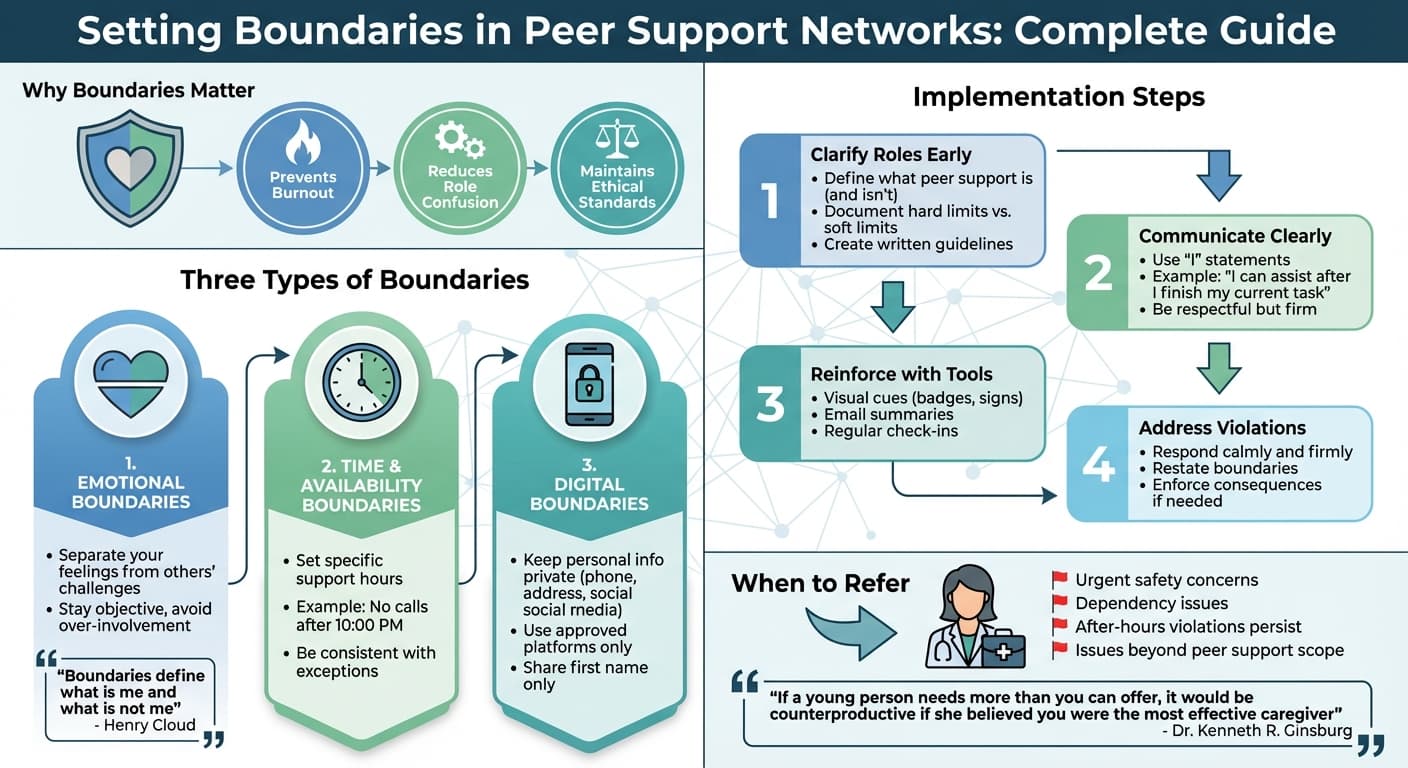
Setting boundaries in peer support is about creating clear limits to protect both the supporter and the person seeking help. Without boundaries, supporters risk burnout, and peers may develop unhealthy dependencies. Here’s what you need to know:
- Why Boundaries Matter: They prevent burnout, reduce role confusion, and maintain ethical standards in peer support relationships.
- Types of Boundaries:
- Emotional: Separate your feelings from others’ challenges.
- Time: Define availability to avoid overcommitment.
- Digital: Limit personal information and communication methods.
- How to Set Boundaries:
- Clarify roles and expectations early.
- Use clear, respectful language to communicate limits.
- Reinforce boundaries with tools like schedules or written guidelines.
- Handling Challenges: Address violations calmly, and refer peers to professionals when needed.
Boundaries ensure peer support remains effective, ethical, and manageable for everyone involved.
::: @figure
Balancing Roles & Boundaries in Peer Support Relationships with Monica F., NCPRSS/CRC-Supervisor, MA
The Need for Boundaries in Peer Support
Peer support thrives on shared experiences but is not the same as friendship. The absence of boundaries can lead to challenges for both supporters and those seeking help. Setting boundaries isn’t about creating emotional distance - it’s about protecting everyone involved and ensuring the support remains effective.
When boundaries are unclear, serious issues can arise. These include role confusion and conflicts that can disrupt the dynamics of a support group. This highlights why having clear boundaries is so important [3].
Preventing Burnout and Role Confusion
Burnout is a common reason why supporters step away from their roles. It often occurs when they take on more than they can handle. Without limits on their time and availability, supporters may find themselves receiving calls at all hours or being approached far more often than they can manage. Over time, this constant demand can lead to stress, feelings of being overwhelmed, and eventual withdrawal. This not only affects the supporter but also impacts those who rely on consistent help [1].
Clear role definitions help prevent confusion and ensure that supporters can focus on addressing peers’ needs without overstepping into areas they’re not equipped to handle. For instance, situations involving suicide threats or abuse require professional intervention, not peer support [5].
In addition to self-care, ethical practices play a significant role in maintaining the integrity of peer support.
Maintaining Ethical Standards
Ethical peer support is built on transparency, trust, and clear guidelines about what’s appropriate within the relationship. Without these standards, unhealthy dynamics can develop. For example, a supporter might unintentionally create a dependency where the individual relies solely on them rather than building a broader support network or learning personal coping strategies [5]. Such dependency can slow down the recovery process.
Boundaries also help protect against manipulation and ensure that interactions remain safe. When supporters understand and communicate their limits, both parties know what to expect. This predictability is especially important for individuals who have experienced trauma, as it fosters the sense of trust necessary for trauma-informed care [1]. Additionally, clear ethical guidelines help supporters recognize when a peer needs professional help [5].
Types of Boundaries to Set
Let’s dive into the essential boundaries you can establish to protect yourself while providing effective peer support. These boundaries fall into three main categories: emotional, time-related, and digital. Each plays a vital role in maintaining healthy, respectful relationships.
Emotional Boundaries
Emotional boundaries help you separate your feelings and responsibilities from those of others. In peer support, this means offering understanding and compassion without becoming overly entangled in someone else’s challenges [2].
As Henry Cloud puts it:
"Boundaries define us. They define what is me and what is not me. A boundary shows me where I end and someone else begins, leading me to a sense of ownership." [2]
In a peer support setting, the focus should remain on the person you’re helping, not on creating a mutual friendship [3]. When this balance shifts, it can cloud your objectivity and disrupt the group’s dynamic [3].
To maintain emotional boundaries, identify your limits early on and stay alert for signs of over-involvement, like constantly thinking about someone else’s struggles [2][3]. If a boundary is crossed, respond calmly but firmly. As Jaiya John wisely notes:
"Your boundary need not be an angry electric fence that shocks those who touch it. It can be a consistent light around you that announces: 'I will be treated sacredly.'" [2]
Time and Availability Boundaries
Time boundaries are crucial for avoiding burnout. They establish when and how often you’re available to provide support [1]. For instance, you might set specific hours for meetings or decide not to take calls after 10:00 PM [1][4].
A.Y. Julien Ebanda Ndabo emphasizes the importance of consistency:
"It's important to be consistent because if you make exceptions, people will learn that your boundaries are not real." [4]
Digital Communication Boundaries
In today’s world, digital boundaries are just as important. They dictate how and through which platforms communication happens. To avoid feeling constantly accessible, keep personal details - like your phone number, home address, and social media accounts - private [3]. Use only approved communication tools, such as email or designated platforms, and consider sharing just your first name to protect everyone’s privacy [3].
JC Vishal Shah, Founder & CEO, advises:
"Setting appropriate boundaries while supporting a peer involves clear communication and respect. Clearly define your role and limits." [4]
Establish these boundaries at the very start of the relationship, and reinforce them through written guidelines or welcome materials [3]. If someone crosses a digital boundary - say, calling you late at night - address it directly by saying something like, "I don’t take calls after 10:00 PM because I need to rest" [4]. If the behavior continues, restate your expectations, outline consequences, or even limit future contact if necessary [3].
How to Create and Implement Boundaries
Setting boundaries effectively from the outset is key to a successful peer support relationship. Establishing clear expectations early on creates a structure that safeguards both you and the person you're supporting.
Clarify Roles and Expectations Early
Start by defining what peer support entails. It's crucial to emphasize that a peer supporter is not a friend, romantic partner, or family member. This distinction keeps the focus on the recipient's needs and prevents the relationship from turning into a social or personal bond.
Consider hosting a group session to collaboratively outline real-world guidelines. Identify your "hard limits" - things you absolutely cannot accept - and "soft limits", which may allow some flexibility depending on the situation. Be upfront about the time and energy you can realistically commit. Document these expectations in writing, including the consequences of any boundary violations. By addressing these points early, you minimize misunderstandings and lay the groundwork for a healthy relationship. From here, it’s important to communicate your boundaries clearly.
Express Your Needs Clearly and Respectfully
When it’s time to communicate your boundaries, use straightforward and respectful language. Lean on "I" statements to express your limits. For example, instead of saying, "You're taking too much of my time", try, "I can assist after I finish my current task." This approach feels less accusatory and keeps the conversation constructive.
Rob Page, Director of Customer Success, offers a valuable perspective on how to approach boundaries:
"I think often people perceive boundaries as 'I won't' or 'not beyond here'. But they can also be hugely empowering. 'I'm happy to discuss or work on something up to this point'. It enables people to better understand without having to infer or perceive the limits of what might be possible."
This positive framing helps maintain the relationship while still protecting your limits. Be clear about your preferred communication methods and set boundaries around "off-limits" times. Consistency is critical - frequent exceptions can weaken the boundaries you've worked hard to establish. Once you've communicated your limits, you can reinforce them with practical tools.
Use Tools and Visual Cues
Sometimes boundaries are most effective when they’re visible. For instance, use visual cues like badges to signal your availability. After interactions, follow up with an email summarizing what was discussed and agreed upon - this creates a record that helps prevent misunderstandings.
Posting reminder signs in shared spaces can also reinforce the boundaries for everyone involved. Additionally, schedule regular check-ins to evaluate how well the boundaries are working and make adjustments as needed. These tools and practices help keep the peer support framework strong, addressing potential issues before they become larger problems. This proactive approach ensures boundaries remain effective over time.
Handling Boundary Challenges and Making Referrals
Even with well-defined boundaries, violations can still happen. Addressing them promptly is essential to protect both yourself and those you’re supporting.
Responding to Boundary Violations
Common boundary issues include dependency, after-hours contact, and confusion about roles [3][4].
When someone crosses a boundary, respond firmly and clearly. For example, if you receive a call at 11:00 PM, you could say: "I have a boundary of not taking calls after 10:00 PM" [4]. If someone becomes overly dependent, remind them: "I’m here to support you during our scheduled times only." If violations continue despite clear communication, escalate the situation. This could mean enforcing consequences you’ve previously outlined, reducing contact, or involving supervisors or authorities if the issue becomes severe [4]. If direct communication doesn’t resolve the problem, consider transitioning to referral protocols.
Knowing When to Refer to Professional Support
Peer support has its limits and should never replace clinical care. Referrals are an important part of maintaining ethical boundaries. When someone faces urgent safety concerns, significant risks, or exhibits signs of what’s known as a "rescue fantasy" [3][6], it’s time to connect them with a professional. Frame referrals as a positive and empowering step to help reduce stigma. Once you’ve identified the need for professional help, avoid delving too deeply into the issue - this allows the individual to build a stronger therapeutic relationship with the professional providing care [6].
As Dr. Kenneth R. Ginsburg explains:
"If a young person needs more than you can offer, it would be counterproductive if she believed you were the most effective caregiver she could have" [6].
If boundary violations persist, referring the individual to professional support is often the best course of action.
Using Tools to Detect Manipulation
When standard approaches don’t work, specialized tools can help identify subtle forms of manipulation. Emotional manipulation, for instance, can show up in how someone reacts to your boundaries - by ignoring them, challenging them, or cutting you off entirely [7][8]. Recognizing these patterns requires self-awareness and paying attention to how interactions affect your emotions, mood, and sense of self-worth [7].
One helpful resource is Gaslighting Check (https://gaslightingcheck.com), a tool designed to detect emotional manipulation in conversations. It works with both text and voice communication, offering features like real-time audio recording, detailed reports, and conversation history tracking. The premium version costs $9.99/month, and all data is encrypted and automatically deleted to ensure privacy. By using tools like this, you can better understand what’s happening in your interactions and safeguard your boundaries more effectively. This can be especially useful if you’re unsure whether you’re being manipulated or misinterpreting the situation.
These strategies help maintain the integrity of peer support networks while ensuring both parties are respected and protected.
Conclusion: Building Healthy Peer Support Networks
Setting boundaries is the cornerstone of fostering relationships where both supporters and peers can flourish. Clear boundaries ease anxiety and build trust, creating an environment where individuals feel safe to share without the fear of being overwhelmed or overstepping.
Boundaries help establish where one person’s responsibilities end and another’s begin, giving each party a sense of autonomy and clarity [2]. For supporters, this means safeguarding their well-being, while peers gain a stronger sense of control over their recovery process.
Maintaining open conversations about boundaries is just as important as setting them. Needs evolve, and regular discussions can ensure boundaries remain effective. Simple practices like scheduling consistent meeting times, using clear communication methods, and reflecting on interactions can help maintain healthy dynamics [3]. When boundaries are crossed, addressing the situation with calm firmness - rather than frustration - can reaffirm limits while preserving the relationship [2].
FAQs
How can I tell if someone is crossing my boundaries in a peer support setting?
If you often feel uneasy, frustrated, or emotionally drained after certain interactions, it might be a sign that your boundaries are being overstepped. This could happen when someone disregards the limits you've set - like asking for more help than you can reasonably give, invading your personal space, or bringing up topics you've explicitly marked as off-limits.
These feelings are your internal cues, urging you to address and reinforce your boundaries. Establishing and upholding clear limits isn't just about protecting your well-being; it's also key to fostering a balanced and respectful environment for everyone involved.
What should I do if someone in my peer support network becomes too dependent on me?
If someone starts leaning on you too heavily - whether for emotional or practical support - it’s crucial to address it early on. Watch for signs like constant contact outside agreed-upon times, requests that stretch beyond your responsibilities, or a habit of seeking your input on decisions they could handle themselves. Spotting these patterns early can help you avoid burnout and keep boundaries intact.
When it’s time to address the issue, have a straightforward yet kind conversation to reset expectations. Clearly outline the type of support you’re able to offer, how much time you can dedicate, and what’s outside your scope. For instance, you could say something like, “I’m here to check in with you twice a week, but I won’t be available to answer messages after 8 p.m.” Stick to these boundaries consistently.
To encourage their independence, guide them toward other resources, such as professional counselors or crisis hotlines, and remind them of their own strengths and coping abilities. If they continue to ignore your boundaries, you might need to involve a supervisor or step back from the role altogether to safeguard your own well-being.
When should I encourage a peer to seek professional help instead of offering support myself?
When a peer's situation goes beyond what you can handle through informal support, involves safety risks, or requires mandatory reporting, it's crucial to encourage them to seek professional help. For instance, if they talk about harming themselves or others, reveal abuse or neglect, or need clinical care such as therapy or medication, guiding them toward a professional is both ethical and responsible.
Other indicators that professional intervention is necessary include ongoing self-destructive behaviors, severe mental health challenges, or repeated boundary violations even after clear communication. Continuing to provide informal support in these cases can lead to emotional exhaustion for you and may not offer the level of care they genuinely need. A thoughtful transition - explaining why a professional is better equipped to help and sharing resources like crisis hotlines - can preserve trust while prioritizing their well-being.
If you notice signs of emotional manipulation or gaslighting, tools like Gaslighting Check can help confirm these behaviors. Once identified, connecting the person to a therapist or counselor can provide them with a safe environment to address these issues and work toward healing.