Case Studies: Scaling Peer-Led Support with Experts

Case Studies: Scaling Peer-Led Support with Experts
Peer-led support programs empower individuals with shared experiences to help others. However, scaling these systems often faces challenges like resource shortages, inconsistent service quality, and burnout. Integrating professional resources - such as expert training, clinical oversight, and digital tools - can resolve these issues. This article outlines three case studies from India, California, and England that demonstrate how combining peer-led support with expert guidance improves outcomes, reduces costs, and ensures safety. Key takeaways include:
- Case Study 1 (England): Expert peers facilitated collaboration in healthcare systems, leading to improved decision-making and action plans across NHS sites.
- Case Study 2 (California): Peer recovery coaches integrated into addiction treatment programs doubled patient engagement and reduced overdose risks.
- Case Study 3 (India): Structured supervision of peer workers enhanced service quality and patient dignity in mental health programs.
Each example highlights how blending peer support with expert oversight ensures better results, credibility, and scalability. Practical strategies like real-time manipulation detection tools (e.g., Gaslighting Check) and structured training models further enhance these systems' effectiveness.
Case Study 1: Adding Expert Guidance to Health System Peer Programs
Program Overview and Goals
The Leading Integration Peer Support (LIPS) program ran from 2021 to 2024, spanning 18 integrated care systems [5][8]. Unlike the typical peer support model - where individuals with lived experience assist others - this program introduced "expert peers." These were senior healthcare leaders who served as "critical friends" to local health systems [5][8].
The program aimed to tackle priority gaps across NHS hospitals, local government, primary care practices, and voluntary organizations, which often operated independently. To address these divides, expert peers facilitated activities like peer reviews, one-on-one mentoring, and workshops. These efforts focused on collaboration and tackling issues such as health inequalities and access to urgent care [5][6].
For instance, in Oxfordshire, Place Director Dan Leveson led a collaborative initiative from January 2022 to March 2024. The goal was to shift from isolated organizational efforts to a relationship-driven approach. This involved conducting in-depth interviews with provider CEOs, local authority leaders, and GPs, which helped create a "maturity matrix." This framework guided improvements in areas like children and young people’s services, mental health, urgent care, and addressing health disparities [6]. These efforts laid the groundwork for operational improvements, as highlighted below.
Results and Impact
The introduction of expert guidance reshaped system operations. In Oxfordshire, the partnership achieved joint decision-making on community-based initiatives and urgent care - progress that had seemed unattainable just a year earlier [6]. Dan Leveson noted:
We have been able to take decisions as a place-based partnership that were not possible 12 months ago, so taking part in this peer process has made a real difference [6].
In Gloucestershire, a peer review in March 2022 engaged over 90 participants through 10 focus groups and numerous one-on-one sessions [7]. This process evolved the traditional Clinical Council into a more inclusive Clinical and Care Professional Council, incorporating voices from social care and the voluntary sector. The result was a detailed action plan with 20 specific initiatives [7]. Similarly, in Cheshire and Merseyside, the peer-to-peer challenge fostered behavioral changes and strengthened collective accountability for long-standing issues [5]. These outcomes helped refine the program’s design for future iterations.
What We Learned
The LIPS program highlighted the importance of an external perspective. Expert peers used a "mirror approach", employing interviews and focus groups to help partners critically assess their systems [6][8]. This external input not only secured senior-level commitment but also ensured that action plans were executed rather than ignored.
Careful timing and planning of focus groups and peer reviews encouraged broad participation. Preparatory surveys helped stakeholders reflect on their current state before interventions began [7]. A senior leader from Coventry and Warwickshire shared:
The workshops have helped us to develop and mature as a place partnership. The support gave all the partners an equal voice. That for us all was a great gift that enabled us to do the work we needed to do [5].
This case demonstrates how structured professional guidance can enhance peer-led efforts, reinforcing one of the central ideas of this article.
Detect Manipulation in Conversations
Use AI-powered tools to analyze text and audio for gaslighting and manipulation patterns. Gain clarity, actionable insights, and support to navigate challenging relationships.
Start Analyzing NowCase Study 2: Peer-Led Addiction Recovery Support
Connecting Peers and Professionals
Since 2019, Massachusetts General Hospital and Mass General Brigham have integrated peer recovery coaches into various clinical settings, including bridge clinics, primary care, behavioral health units, and street medicine teams. This approach connects formal treatment with critical social support systems [9].
The results speak for themselves. Patients working with these interdisciplinary teams engaged in treatment nearly twice as often as before [9]. In Kentucky, Medicaid members who accessed peer support services were more likely to begin buprenorphine treatment and showed a measurable reduction in opioid overdose risk [9]. Similarly, the University of Pennsylvania Health System's "Penn Integrated Model" embedded peer support specialists within primary care networks to assist individuals with opioid use disorder. Data from Pennsylvania Medicaid (2016–2019) revealed that adults with substance use disorders who received peer support had significantly fewer acute care readmissions and maintained lower readmission rates even 90 days after discharge [9]. By combining lived experience with professional care, these programs created a safety net that neither approach could achieve alone.
Vanessa Finisse from the Center for Health Care Strategies described the role of these workers:
Peer support workers - often called peer recovery coaches, peer mentors, or peer specialists - are non-clinical professionals who use their lived experience with substance use disorder (SUD) and/or overdose to connect with and support others [9].
By 2026, 48 state Medicaid agencies were set to cover peer support services for individuals with mental health or substance use disorders. Financial sustainability for these programs was achieved through a combination of funding sources, including Medicaid reimbursements, grants, contracts, and opioid settlement funds [9]. This foundation has paved the way for using new tools to strengthen these support networks further.
Using Gaslighting Check in Support Networks

Addiction recovery environments can be particularly vulnerable to emotional manipulation. Gaslighting often involves the denial of substance use, leaving supporters and family members questioning their perceptions [11]. Gaslighting Check addresses these challenges by detecting manipulation tactics - like minimizing, blame-shifting, and script-flipping - using real-time audio recording, text and voice analysis, and detailed reporting. The platform prioritizes privacy with end-to-end encryption and automatic data deletion, offering affordable subscription plans starting at $9.99/month [11][12][13].
For peer recovery coaches, tools like this help build trust by verifying whether commitments are being met honestly and effectively [10]. The real-time audio recording feature provides concrete evidence of conversations, ensuring clarity and accountability for all parties involved [11][12].
Results and Best Practices
Collaborations between organizations, such as the Multnomah County Sheriff's Office (MCSO) in Oregon and the Mental Health & Addiction Association, as well as partnerships like the Richmond Behavioral Health Authority and SAARA, have shown that embedding peer navigators in justice settings and fostering cross-organizational efforts can significantly improve recovery outcomes and career opportunities. Captain Asboe of MCSO highlighted the impact of these collaborations, noting that having peers and officers co-present at town halls helped dispel myths about recovery within the community [15].
Captain Asboe also pointed out the career growth opportunities created by peer-run organizations:
[Peer-run organizations] show individuals who may be looking for something different in life... that, hey, I can be boots on the ground, I can be a middle manager, I can be an executive leader because all these other people have attained this [15].
Emerging best practices from these initiatives include using peer-to-peer supervision instead of clinical supervision to maintain authenticity and avoid "peer support drift." Organizations are encouraged to establish formal communication protocols and documented data-sharing agreements to protect participant confidentiality. Additionally, involving peer-run organizations as key stakeholders from the planning stage ensures their contributions are valued and integrated effectively [9][15].
The numbers paint a clear picture: an estimated 50.2 million Americans are in recovery from substance use or mental health challenges, and seven in ten U.S. adults have faced substance use issues at some point [14]. Integrating professional resources with peer-led support has proven to be an effective, scalable model that not only saves lives but also reduces healthcare costs.
Developing an Action Plan to Integrate Peer Support Services
Case Study 3: Peer-Led Chronic Disease Management
::: @figure
Training Peer Leaders for Long-Term Results
The University of Michigan developed a comprehensive training program to prepare peer leaders effectively. Between 2011 and the program’s conclusion, nine African-American adults completed a 46-hour, 12-week course focused on empowerment-based facilitation and active listening. All participants met the required standards for diabetes knowledge and facilitation skills [19].
Dr. Anthony Jerant's "Homing in on Health" program (July 2004–February 2008) trained four peer leaders using a standardized, week-long curriculum monitored through audits. This approach resulted in improvements in self-efficacy, with effect sizes of 0.27 at six weeks and 0.17 at six months [24].
One key element across successful programs was action planning. Peer leaders guided participants in setting small, manageable health goals - like walking more or cutting back on sugary drinks - rather than overwhelming them with drastic lifestyle changes [25][26]. Dr. Michele Heisler from the University of Michigan highlighted the power of peer support:
People with similar health challenges can truly lift each other up [25].
The Michigan Men's Diabetes Project, launched in April 2022, addressed a critical gap: Black men are often underrepresented in diabetes self-management programs, comprising less than 10% of participants [17]. Led by Dr. Jaclynn Hawkins, this study focused on Black men aged 55 and older in Metro Detroit. Training emphasized cultural awareness and created a "brotherhood" environment to break down barriers like medical mistrust and rigid masculine norms [17].
Effective training programs balanced structured curricula with flexibility to address participants' immediate life challenges [17]. Programs that included quarterly audits and regular feedback maintained higher standards over time [24].
These structured training models provide a foundation for comparing peer-led approaches to professional-only methods.
Peer-Led vs. Professional-Only Approaches
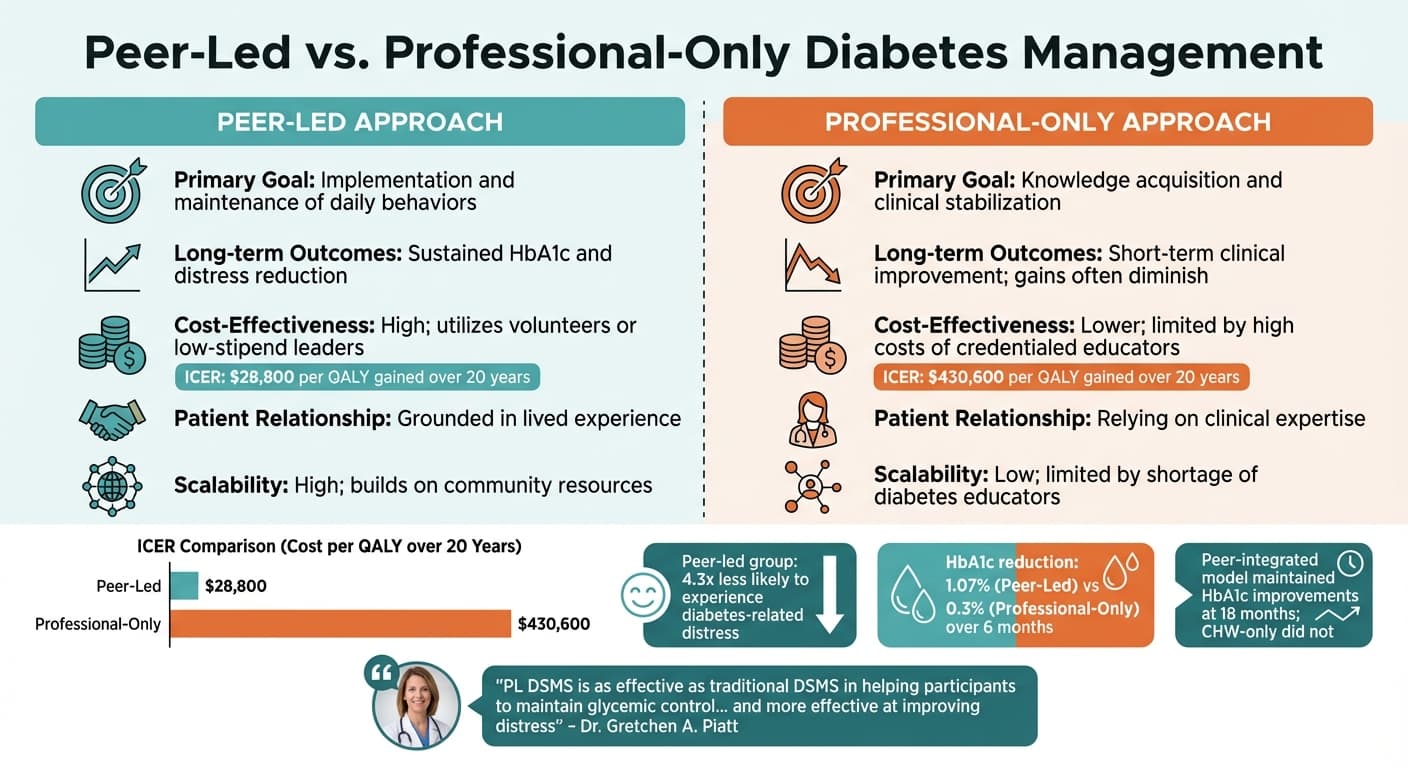
Research shows that peer-led models are not only effective but also sustainable. The REACH Detroit Partnership (2009–2013) compared two approaches: a six-month professional Community Health Worker (CHW)-led program followed by 12 months of peer-led group sessions, versus a CHW-only model. The peer-integrated group maintained HbA1c improvements at 18 months, while the CHW-only group did not. The cost-effectiveness of the peer-integrated model was clear, with an Incremental Cost-Effectiveness Ratio (ICER) of $28,800 per QALY gained over 20 years, compared to $430,600 per QALY for the CHW-only approach [21].
In Project SEED, 221 participants were randomized into two groups: one receiving traditional professional-led support, and the other combining Diabetes Self-Management Education (DSME) with a peer-led model. Those in the peer-led group were 4.3 times less likely to experience diabetes-related distress compared to the traditional group [22]. Dr. Gretchen A. Piatt from the University of Michigan commented:
PL DSMS is as effective as traditional DSMS in helping participants to maintain glycemic control... and more effective at improving distress [22].
In San Francisco public health clinics, peer health coaching led to a 1.07% drop in HbA1c levels over six months, compared to just 0.3% with standard professional care [19]. Dr. Wen Ye from the University of Michigan remarked:
The 6-month CHW-led DSME intervention without further postintervention CHW support was not cost effective in Latino adults with T2D [21].
| Feature | Peer-Led Approach | Professional-Only Approach |
|---|---|---|
| Primary Goal | Implementation and maintenance of daily behaviors [21] | Knowledge acquisition and clinical stabilization [21] |
| Long-term Outcomes | Sustained HbA1c and distress reduction [21][22] | Short-term clinical improvement; gains often diminish [21][19] |
| Cost-Effectiveness | High; utilizes volunteers or low-stipend leaders [21] | Lower; limited by high costs of credentialed educators [21] |
| Patient Relationship | Grounded in lived experience [17][23] | Relying on clinical expertise [17][18] |
| Scalability | High; builds on community resources [22] | Low; limited by shortage of diabetes educators [22] |
Adapting Models Across Cultures and Regions
The success of peer-led programs isn’t confined to the U.S. In Lilongwe, Malawi, Kamuzu Central Hospital launched a diabetes peer support program in 2014 with funding from the World Diabetes Foundation. Using the "Peers for Progress" curriculum, the program grew to 30 groups with 1,088 members by 2018. Members showed improved self-efficacy, with 94.9% successfully managing hypoglycemia compared to 76.9% of non-members. This is particularly important as an estimated 80% of people with diabetes will live in low-income countries by 2030, where healthcare worker shortages make peer-led models indispensable [16].
In San Diego, California, Project Dulce demonstrated the impact of cultural mediation. From 2007 to 2009, the Scripps Whittier Diabetes Institute implemented a promotora-led program for 207 Mexican-American patients with HbA1c levels above 8%. These "promotoras" addressed misconceptions about insulin and folk remedies. After 40 hours of training over three months, participants achieved a 1.7% reduction in HbA1c within four months. Each additional class attended further reduced HbA1c by 0.3% to 0.4% [20].
Similarly, Project ECHO Diabetes, launched in 2019, deployed Diabetes Support Coaches (DSCs) across 23 federally qualified health centers in Florida and California. These coaches, living with diabetes themselves, provided one-on-one support and created resource guides in Spanish and Creole. During the COVID-19 pandemic, the program shifted to mostly phone-based encounters, which increased discussions about stress and medication [18]. One DSC shared:
From a firsthand perspective, [the DSC] really helps patients out, to not feel alone, to feel like they can actually confide in somebody that understands them on a level that is not somebody who's better than them [18].
Successful programs often recruit peer leaders in community spaces like churches, barbershops, and health centers. This approach addresses barriers such as financial challenges, low health literacy, and transportation issues - factors that traditional professional models may overlook [17][18].
How to Scale Peer and Expert Support Integration
Proven Integration Methods
Scaling peer and expert support requires structured and thoughtful approaches. One effective method is structured supervision, where experienced peers mentor newer ones. For instance, the Mental Health Action Trust in Kerala, India, conducted a 12-month pilot from August 2020 to April 2021. During this time, two senior Lay Mental Health Workers supervised 12 junior staff members. Using Social Cognitive Theory, they focused on building confidence through one-on-one sessions and on-site observations. The result? Improved patient dignity and better clinical care quality [1].
Another key factor is preparing clinical teams. Nurses, ward teams, and doctors need training to understand the value peer workers bring. A great example is the ENRICH trial in England, where 62.5% of participants with at least two peer worker contacts were significantly less likely to be readmitted to the hospital [3].
Co-production forums also play a crucial role. These forums bring together service users, general practitioners, and community organizations to collaboratively design support systems. A standout example is the Rushcliffe Primary Care Network, which worked with the charity Imroc to deploy 15 trained peer support workers. They used "The Green Book" for goal setting and achieved a projected 100% return on investment within a year by reducing crisis calls to ambulance services [4]. A key takeaway from this program was the importance of responding to new referrals within 24 to 48 hours to build trust in the peer-led system [4].
Telementoring models, like Project ECHO, further enhance integration. These models create an "all teach, all learn" environment, where specialists and generalists share knowledge openly. This approach fosters intellectual honesty, allowing specialists to admit gaps in their knowledge, which encourages a safe and collaborative learning space [27].
These strategies provide a solid foundation for incorporating digital tools to further strengthen peer support systems.
Using Tools Like Gaslighting Check
Digital tools can take these methods to the next level by ensuring secure data handling and actionable insights. Gaslighting Check is one such tool that fits seamlessly into peer support environments, where trust and confidentiality are critical. The platform offers end-to-end encryption and automatic data deletion policies, ensuring sensitive conversations remain private - an essential feature when addressing complex emotional challenges.
Gaslighting Check also analyzes conversations for signs of manipulation and generates actionable reports. Its conversation tracking feature, available through the Premium Plan ($9.99/month), allows leaders to monitor progress over time without compromising privacy.
The Help@Hand Project across 14 California counties (September 2020 to January 2023) highlights how peers can actively shape digital solutions. At 85.7% of sites, peers participated in technology testing, and 90.9% of sites piloted digital tools [2]. This project showed that peers could be more than just service recipients - they can be co-creators in designing and implementing digital tools. Using participatory design processes, tools like Gaslighting Check can be refined based on peer feedback before full-scale deployment.
Comparison of Integration Models
The table below compares different integration models, focusing on their strengths, challenges, and scalability.
| Integration Model | Key Enablers | Challenges Addressed | Scalability |
|---|---|---|---|
| Primary Care Integration (Rushcliffe) | Co-production forums and health coaches [4] | - | High through community partnerships |
| Inpatient-to-Community (ENRICH) | Clinical team preparation and peer principles [3] | Barriers between NHS and non-profits; rural geography [3] | Moderate; requires health system buy-in |
| Task-Shifting (MHAT Kerala) | Senior peer supervision and Social Cognitive Theory [1] | Cultural resistance to non-hierarchical approaches [1] | High in low-resource settings |
| Telementoring (Project ECHO) | "All teach, all learn" model and case-based learning [27] | Keeping focus without explicit facilitation [27] | Global via telecommunication |
| Digital Innovation (Help@Hand) | Peer Leads, digital literacy training, cross-site collaboration [2] | COVID-19 outreach restrictions; resource disparities [2] | Highest for rapid, large-scale deployment |
Digital innovation stands out for its scalability, especially when peers take on leadership roles. In the Help@Hand project, Peer Leads completed 72% of surveys, despite 54% of them initially having less than 25% of their time allocated to the project [2]. To manage integration effectively, Peer Leads should dedicate at least two full days per week to these efforts [3].
Conclusion
Common Themes Across Case Studies
Three key patterns stand out in every successful integration model: building trust, defining clear role boundaries, and establishing rapid response systems. For instance, the Rushcliffe Primary Care Network highlighted the importance of a quick referral process in fostering trust between peers and professionals [4]. Similarly, the ENRICH trial showed that participants who connected with peer workers at least twice were significantly less likely to be readmitted to the hospital [3].
Maintaining role clarity is another critical factor. Researchers caution against "over-professionalization", where peer workers risk losing their unique, non-clinical perspective [3]. By keeping their roles distinct, peer supporters can remain genuine while avoiding clinical responsibilities like diagnosis or crisis management.
Digital tools also play a role in supporting these principles. Platforms like Gaslighting Check ensure privacy with end-to-end encryption and automatic data deletion, safeguarding sensitive conversations. The Help@Hand project in California demonstrated the value of peer involvement in technology, with 90.9% of sites integrating peers into pilot programs [2]. When peers contribute to the design and use of tools, trust grows, and adoption rates improve.
These recurring themes provide a foundation for actionable strategies to strengthen peer and expert collaboration.
Steps for Implementation
To put these lessons into practice, consider the following steps:
Start by preparing clinical teams before introducing any peer support program. The ENRICH trial noted that high-fidelity sites - those with strong supervision and positive team dynamics - achieved greater participant engagement compared to sites with internal conflicts [3]. Regular orientation sessions can help explain the peer support model and address challenges like staff turnover. Integrating AI self-help modules can further support these teams by providing consistent resources during transitions.
Next, shift to peer-led supervision models. For example, the Mental Health Action Trust in Kerala demonstrated this approach by having two experienced Lay Mental Health Workers oversee 12 newer staff members between August 2020 and April 2021. This method not only improved clinical outcomes but also provided emotional support at a lower cost [1]. Peer-led supervision fosters shared learning and boosts confidence among team members.
Lastly, include peers in all decision-making processes. The Help@Hand project revealed that 78.6% of sites involved peers in creating training and educational materials [2]. Allocate at least two days per week for peer leaders to engage in administrative and planning activities [3]. When peers help shape the systems they work within, programs remain focused on recovery and better address community needs.
FAQs
How do you scale peer support without losing quality?
Scaling peer support while keeping quality intact means blending professional resources and proper organizational backing into peer-driven systems. To make this work, it's important to focus on a few key strategies:
- Encouraging a supportive culture: Build an environment where peer involvement is genuinely valued and encouraged.
- Offering structured training and supervision: Equip peers with the skills and guidance they need to provide effective support.
- Using technology wisely: Digital tools can help maintain consistent quality and streamline processes.
By following these steps, peer-led programs can grow successfully without compromising the quality of support or the positive outcomes for those involved.
What’s the right balance between peer roles and clinical oversight?
Balancing the contributions of peer roles with clinical oversight means tapping into the unique strengths of peers while maintaining safety and quality through professional guidance. Achieving this balance requires cultivating a workplace culture that respects and values peer contributions, alongside implementing clear processes and reliable supervision. One effective approach is adopting hybrid models. These models train, support, and supervise peers under the guidance of professionals, ensuring that safety and efficiency are priorities. This structure is particularly helpful when expanding peer-led initiatives, as it keeps roles well-defined and backed by strong oversight systems.
How can tools like Gaslighting Check fit into peer-led programs safely?
Tools like Gaslighting Check bring a new layer of support to peer-led programs by using AI to detect emotional manipulation, including gaslighting. With features like real-time conversation analysis, privacy safeguards, and detailed reporting, these tools help flag harmful interactions before they escalate.
When used alongside professional oversight, they contribute to creating safer spaces, giving participants more confidence while ensuring trust and accountability within peer-led initiatives.