5 Steps to Reframe Thoughts with AI

5 Steps to Reframe Thoughts with AI
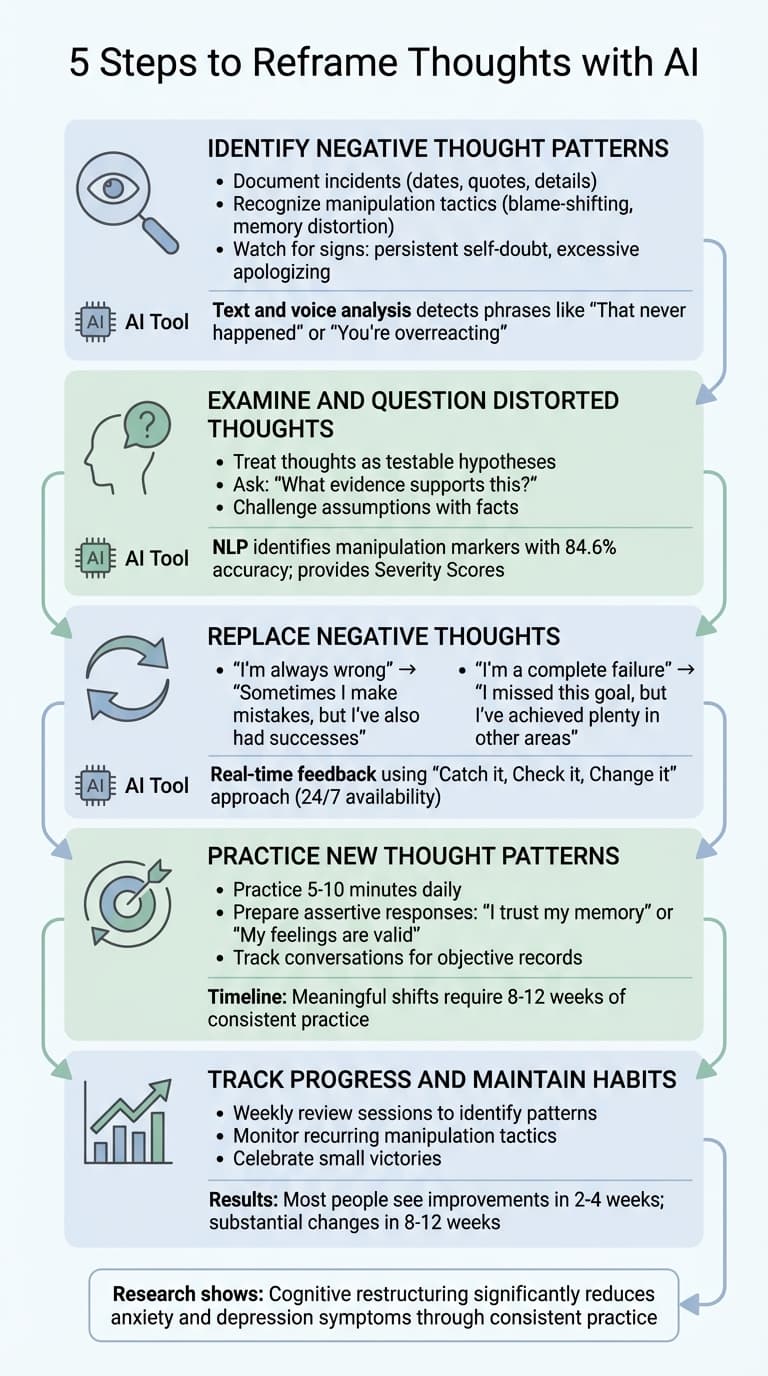
Gaslighting can distort your reality and erode your self-confidence. Cognitive reframing is a proven method to recognize and challenge these harmful thought patterns. With AI tools like Gaslighting Check, you can identify manipulation tactics, question distorted thoughts, and replace them with balanced perspectives. Here's how to start using AI for cognitive reframing:
- Spot Negative Patterns: Document incidents and use AI to detect manipulation tactics like blame-shifting or memory distortion.
- Challenge Thoughts: Treat your thoughts as hypotheses. Use AI-generated reports to validate your experiences.
- Replace Negativity: AI can suggest balanced alternatives to harmful thoughts.
- Practice Regularly: Consistency is key - use AI for real-time feedback and track your progress.
- Monitor Growth: Review AI reports weekly to identify patterns and measure improvements.
AI tools provide objective insights, helping you rebuild trust in your perceptions and strengthen your mental resilience.
::: @figure
5 AI Prompts to Ease Anxiety (Research Informed)
Step 1: Identify Negative Thought Patterns
The first step in breaking free from gaslighting is learning to recognize when it’s happening. Gaslighting can distort your perception and make you question your reality. Kristin Wilson, Chief Experience Officer at Newport Healthcare, puts it clearly:
"Gaslighting is a form of emotional abuse because it can cause someone to doubt their own sanity." [3]
Pay attention to common signs like persistent self-doubt, feeling the need to apologize excessively, or walking away from conversations feeling confused. You might even begin to question your memories. These feelings often stem from manipulation tactics such as denying events that happened, dismissing your emotions (e.g., being labeled as "too sensitive"), or twisting your version of events.
To combat this, start documenting incidents. Write down dates, quotes, and specific details to create a clear record, even when emotions might cloud your judgment. Pairing these notes with AI-driven tools can help uncover patterns you might not notice on your own.
How AI Detects Gaslighting
AI tools like Gaslighting Check use advanced text and voice analysis to expose subtle manipulation tactics. The platform scans conversations for phrases like "That never happened", "You’re overreacting", or "Are you sure that happened?" It also flags behaviors such as blame-shifting, where responsibility is unfairly placed on you, and instances where your words are twisted.
These AI-generated reports provide objective, detailed insights that can help you regain confidence in your perceptions and see the situation more clearly.
Step 2: Examine and Question Distorted Thoughts
After identifying negative thought patterns, the next step is to question their accuracy. Gaslighting often creates confusion between what’s real and what’s influenced by emotions.
"Most people think an upsetting event is what causes your stress or anxiety... it's how you think about it that impacts how you feel!" [1]
The idea here is to treat your thoughts like hypotheses that can be tested. Ask yourself questions like, "What evidence supports this thought? Am I interpreting facts or just reacting emotionally? What would I tell a friend in this situation?" For instance, if you catch yourself thinking, "I'm always wrong", challenge it by listing instances where you were correct. Or, if you assume, "They're mad at me", consider other explanations like, "Maybe they're just busy." This shift helps you move from emotional assumptions to a more evidence-based perspective on your experiences.
This process of critical self-reflection creates a foundation for AI tools to provide clear, unbiased insights into your thought patterns.
Using AI Reports to Analyze Your Thoughts
Gaslighting Check’s detailed reports serve as an impartial resource to validate your experiences [7]. By leveraging Natural Language Processing, the platform identifies manipulation markers and flags problematic phrases such as "I never said that" or "You're overreacting again." Each report includes a Severity Score and outlines common manipulation tactics. Additionally, the voice analysis feature detects stress markers in tone that may indicate condescension or emotional pressure. Research shows AI systems can achieve up to 84.6% accuracy in identifying deceptive behavior through long-term pattern analysis [7]. These objective insights not only help you align evidence with your experiences but also provide a documented record to counter distorted narratives [6].
Step 3: Replace Negative Thoughts with AI Help
Once you've spotted negative thoughts, the next move is to replace them with more balanced, realistic alternatives. The goal isn’t to force unrealistic positivity but to shift toward perspectives that are constructive and grounded in reality - and AI can be a great tool to guide this process.
By using advanced linguistic analysis, AI can help craft balanced alternative thoughts. For example, instead of thinking, "I'm always wrong", AI might suggest, "Sometimes I make mistakes, but I’ve also had successes." Similarly, "I'm a complete failure for missing a goal" could be reframed as, "I missed this goal, but I’ve achieved plenty in other areas" [2][4][1].
"It's not the presumably stressful event itself; it's how we perceive and react to it. And if our automatic reaction is irrational, negative, and ultimately detrimental to our mental health? That, in a nutshell, is a cognitive distortion." - Dr. Taylor Chesney, Psychologist [1]
Studies show that regularly using AI-guided reframing techniques can improve mental health outcomes [2]. The trick lies in consistency - treating negative thoughts like hypotheses and testing them against evidence. AI plays a key role here by offering an unbiased perspective, making it easier to challenge distorted thinking patterns with objective data [2].
Getting Real-Time AI Feedback for Reframing
Once you know how to reframe your thoughts, AI can provide real-time feedback to ensure you’re applying these strategies effectively.
Gaslighting Check, for instance, offers instant support by analyzing your thoughts as they arise. Unlike traditional therapy sessions that might occur weekly, AI is available 24/7 to help challenge harmful beliefs [2]. The platform follows the "Catch it, Check it, Change it" approach [5]. Here’s how it works: first, it identifies automatic negative thoughts through text or voice input. Next, it evaluates those thoughts against evidence from your conversation history or detailed reports. Finally, it suggests personalized reframes tailored to your situation. Over time, the system learns your patterns and provides increasingly customized feedback to help you reshape your mental habits [2].
Step 4: Practice Your New Thought Patterns
Understanding how to reframe your thoughts is a great start, but the real transformation happens when you put those new perspectives into practice during daily interactions. This is especially important when dealing with individuals who manipulate or gaslight you.
Once you've learned reframing techniques, the next step is consistent practice. Changing old habits takes time because deep-seated patterns often resist change. For instance, when someone twists your words or challenges your memory, your mind might default to self-doubt. That’s why sticking with regular practice is crucial. Studies suggest that meaningful shifts in thought patterns generally require 8 to 12 weeks of consistent cognitive restructuring.
When you notice a negative thought creeping in, interrupt it by saying, “Stop!” in your mind. Then, replace it with a more balanced perspective. You can also prepare in advance. If certain phrases - like “You’re too sensitive” or “That never happened” - tend to shake your confidence, rehearse assertive responses. Try something like, “I remember the situation differently, and I trust my memory,” or “My feelings are valid.”
Track Conversations to Strengthen Your Confidence
Gaslighting Check’s conversation history tracking (available with the Premium Plan for $9.99/month) can be a helpful tool. It allows you to review past interactions, providing an objective record of what was said. For those dealing with gaslighting, this kind of documentation can act as a reality check.
To make the most of these insights, schedule a weekly review session. Set aside time to go through your conversation history and the AI-generated reports. Look for patterns - maybe certain situations consistently trigger self-doubt or reveal repetitive manipulation tactics. Use this information to identify your triggers and prepare reframed responses ahead of time.
Keep a record of moments when you successfully stood your ground, like ending a conversation when it turned manipulative. These small victories not only reinforce your confidence but also help you trust your perceptions over time. By tracking your progress, you’ll develop a stronger sense of self and be better equipped for future interactions.
Step 5: Track Progress and Keep Up Positive Habits
Tracking your progress is a key part of reinforcing new thought patterns. It helps you see how far you've come and keeps you motivated to stick with your practice. Change doesn’t happen overnight, but consistent effort pays off.
Keep your daily practice short and focused - just 5 to 10 minutes of challenging negative thoughts as they arise. These brief sessions help rewire your mental habits, making it easier to reframe negativity without overthinking. To get a clearer picture of your progress, set aside time each week to review your notes and AI-generated reports. This gives you insight into patterns and trends rather than isolated incidents.
Research backs this up: systematically challenging distorted thoughts through cognitive restructuring can significantly reduce symptoms of anxiety and depression [2]. By consistently using AI tools for this process, you're not just tackling individual moments of self-doubt - you’re building emotional resilience for the long haul.
Review AI Reports for Patterns and Growth
AI reports can be a powerful tool for spotting patterns and improving your ability to counteract negative thinking. For example, Gaslighting Check provides detailed reports that track your conversations and thought processes. If you opt for the Premium Plan ($9.99/month), you’ll also get access to conversation history and in-depth trend analysis - helping you catch things you might overlook on your own.
Dedicate one day a week to a "reality check" session. During this time, review your reports to identify recurring themes. Are certain manipulation tactics showing up repeatedly? Are specific situations consistently triggering self-doubt? Use the reports as evidence to test your thoughts. Treat negative beliefs like hypotheses: ask yourself questions such as, "What would a video replay show?" or "What facts contradict this thought?" This approach helps you stay grounded in reality.
Pay close attention to any worsening patterns. For example, if your weekly reports reveal more frequent use of shaming language or denial of facts, it might be time to reassess your boundaries or seek professional help. The AI can also highlight specific cognitive distortions, like catastrophizing or black-and-white thinking, which you can address with tailored reframing techniques [2][4]. Rest assured, your data is secure - everything is protected with end-to-end encryption, and if you delete your account, all information is erased within 30 days.
Conclusion
Reframing your thoughts with AI isn’t about forcing yourself to "think positive" - it’s about taking back control of your emotions after gaslighting has distorted your reality. By working through the five steps - spotting manipulation patterns, questioning distorted thoughts, replacing them with balanced perspectives, practicing regularly, and monitoring your progress - you create a strong foundation for recovery. These steps, explained earlier, allow you to rebuild your emotional stability and trust in yourself.
This approach works because it restores something gaslighting often strips away: objective evidence. AI tools like Gaslighting Check offer neutral validation when your perceptions have been manipulated, helping you align your feelings with actual facts. For instance, in September 2024, Esme used AI to review messages, uncovering several manipulation tactics. This helped her regain trust in her instincts and stand up for herself [6]. As Esme described:
"By offering a neutral perspective, AI can help individuals recognize and respond appropriately to gaslighting tactics which are used to silence us and destroy our boundaries and sense of self" [6].
Research backs up these methods, showing that most people see noticeable improvements within 2–4 weeks of consistent effort, with more substantial changes emerging over 8–12 weeks [2]. The key is daily practice - even dedicating 5–10 minutes a day to challenging negative thoughts can reshape mental habits and reduce anxiety and depression. Over time, this balanced way of thinking becomes second nature, allowing you to handle challenges thoughtfully instead of reacting on impulse.
No one should have to face these struggles alone [8]. Using AI to analyze conversations and track thought patterns creates a secure record of your experiences and progress. Tools like Gaslighting Check prioritize privacy with end-to-end encryption and automatic data deletion, ensuring your information stays protected.
Start small, stay consistent, and trust the process. These AI-supported techniques not only help you overcome self-doubt but also rebuild your identity and inner strength. By sticking with these steps, you’ll reinforce the progress outlined in this guide and move closer to reclaiming your sense of self.
FAQs
How does AI identify gaslighting in conversations?
AI leverages natural language processing (NLP) to identify common gaslighting tactics in conversations. It picks up on phrases that distort reality, such as denying events (e.g., "That never happened"), downplaying emotions (e.g., "You’re overreacting"), or shifting blame (e.g., "If you really cared, you would..."). In addition to specific phrases, the system examines tone, timing, and sudden language shifts to detect more subtle forms of manipulation.
The AI doesn’t just focus on isolated incidents - it tracks patterns over time. By analyzing how often and in what sequence manipulative behaviors occur, it can identify recurring tactics like guilt-tripping or denial. When such patterns are flagged, the system provides a detailed report with examples and practical suggestions for establishing boundaries. All of this is done using encrypted data, ensuring that user privacy remains protected.
Can AI tools really help improve my mental health?
Yes, AI tools can play a meaningful role in supporting mental health by helping you recognize and reframe negative thought patterns. These tools can analyze your language, identify recurring negative tendencies, and suggest more balanced alternatives. This process makes it easier to break out of unhelpful thought loops and adopt healthier perspectives. Studies have shown that techniques like cognitive restructuring can help reduce anxiety, improve sleep quality, and enhance overall mood over time.
For individuals dealing with gaslighting, AI tools offer an additional layer of support. They can analyze recorded conversations to flag manipulation tactics and provide detailed, privacy-protected reports. This kind of validation can help counter self-doubt and foster a stronger sense of confidence. When combined with a structured process - such as identifying harmful thoughts, examining the evidence, and creating balanced alternatives - the feedback from AI tools becomes a valuable resource for building emotional resilience and improving mental well-being.
How can I build a consistent routine for using AI tools to reframe my thoughts?
Creating a routine to use AI tools for reframing your thoughts doesn’t have to be complicated. Start by picking one AI tool and setting it up correctly - create an account, enable features like thought-capture, and take some time to understand how it works. Once you're ready, carve out a regular time each day, maybe 5–10 minutes in the morning, to sit down and reflect on your thoughts. Treat this as a fixed appointment with yourself.
When you’re using the tool, try a straightforward three-step process: catch a negative thought, check if it’s accurate, and change it into a more balanced perspective with the AI’s assistance. To track your progress, keep a log of the original thought, the AI’s suggestions, and how much the new thought resonates with you. At the end of the week, review your notes to spot any patterns or areas where you could improve. Use this reflection to guide your focus for the week ahead. With consistent effort, this practice can naturally become part of your daily routine.