5 Psychological Traits of Gaslighters

5 Psychological Traits of Gaslighters
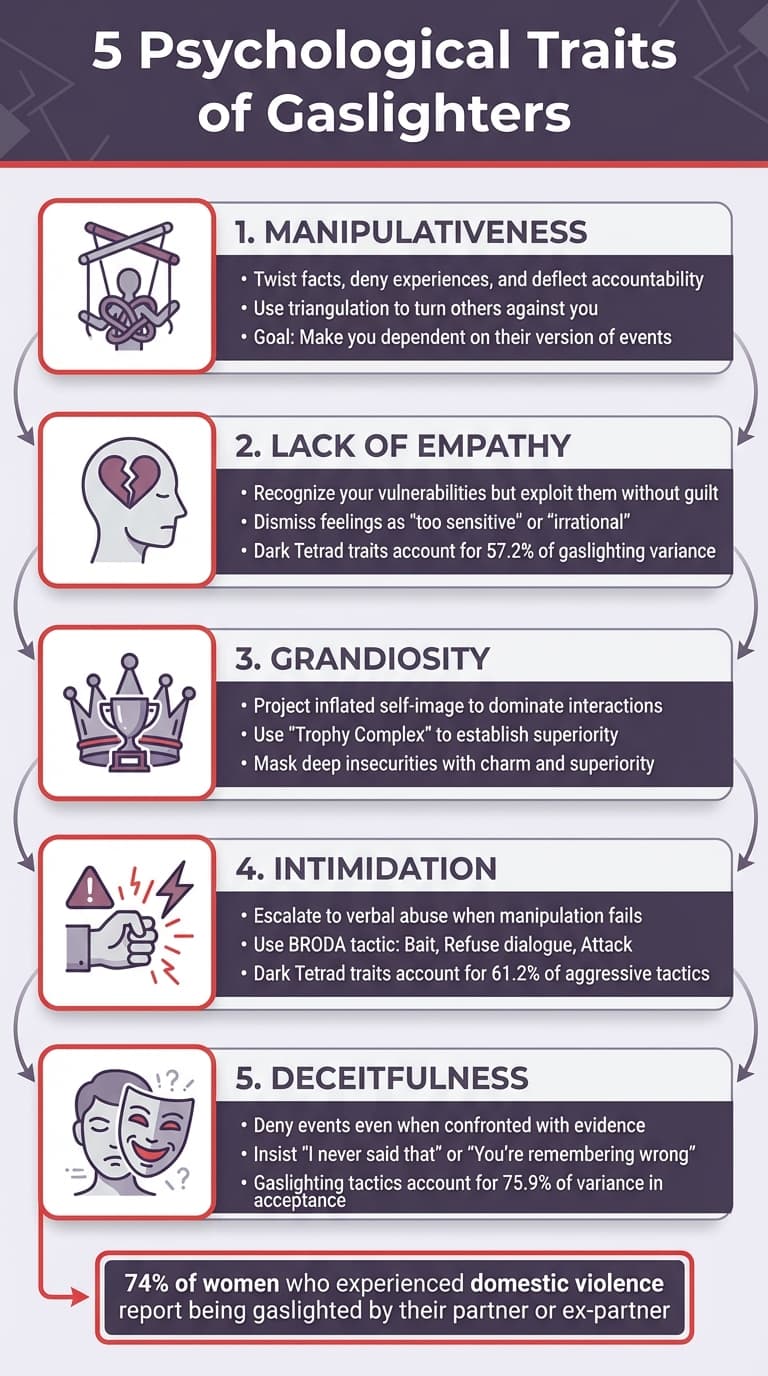
Gaslighters use manipulation to distort your reality and gain control. Their behavior revolves around five key traits:
- Manipulativeness: They twist facts, deny experiences, and employ tactics like lying, deflecting, and triangulation to create doubt.
- Lack of Empathy: They recognize your vulnerabilities but exploit them without feeling guilt, often dismissing your emotions as "too sensitive."
- Grandiosity: They project an inflated self-image to dominate interactions, often masking insecurities with charm and superiority.
- Intimidation: When manipulation fails, they escalate to aggression, verbal abuse, and blame-shifting to silence opposition.
- Deceitfulness: They rely on lies and denial, even when faced with evidence, to make you question your memory and judgment.
Gaslighting thrives on confusion and emotional manipulation. Recognizing these traits can help you protect yourself and regain confidence in your own perceptions.
::: @figure
Dr. Ramani Explains How-To Spot a Gaslighter
1. Manipulativeness
Manipulativeness is the cornerstone of gaslighting, a method gaslighters use to exert power and control by distorting reality. This deliberate manipulation forces victims to question their own experiences, memories, and perceptions, leaving them dependent on the gaslighter's version of events [5]. By undermining their sense of reality, gaslighters create a cycle of self-doubt in their victims [2].
Gaslighters employ a range of calculated tactics to achieve this. They lie outright, deny events that have been proven, and dismiss emotions by labeling victims as "overreacting" or "too sensitive." They also deflect accountability by changing the subject or attacking the victim's credibility. One of the more sinister strategies is triangulation - turning others against the victim by claiming a collective agreement with the gaslighter's perspective.
"The ultimate goal is to gain power and control by making the victim dependent on the gaslighter's version of events." - Bonnie Mitchell, Clinical Director of Healthy Life Recovery [5]
This quote highlights the essence of gaslighting, which is further supported by research. Studies indicate that traits such as manipulative Machiavellianism and emotionally detached psychopathy are strong predictors of gaslighting behavior [4]. These characteristics allow gaslighters to exploit and harm others without remorse or emotional involvement.
Gaslighting often begins with a tactic known as love bombing - showering the victim with excessive praise and premature emotional intimacy to build trust quickly. Once this trust is established, the gaslighter's behavior shifts, leaving the victim confused and questioning whether the initial kindness was ever genuine. This calculated manipulation lays the groundwork for understanding the psychological strategies gaslighters use to maintain control.
2. Lack of Empathy
Gaslighters' manipulation thrives on their lack of empathy. Unlike most people who feel discomfort when witnessing someone else's pain, gaslighters function differently. They exhibit what researchers refer to as cognitive (instrumental) empathy - the ability to recognize your fears and vulnerabilities without being emotionally affected by them [8]. Instead of offering support, they use this understanding as a tool for manipulation.
"They do see what's going on inside your mind, but rather than be emotionally affected by your fears, your uncertainty, or your confusion, they capitalize on those feelings in such a way as to exacerbate your anxiety." - Suzanne Degges-White Ph.D., Licensed Counselor and Professor [8]
This emotional detachment fuels their manipulative behavior. Gaslighters often dismiss your feelings, labeling you as "too sensitive" or "irrational" [5][6]. Their lack of concern allows them to shift blame, accusing you of provoking their harmful actions [5][7]. During emotional conflicts, they may resort to stonewalling, silencing your voice and leaving you feeling ignored [5][6].
A 2025 study revealed that traits from the Dark Tetrad - narcissism, Machiavellianism, psychopathy, and sadism - account for 57.2% of the variance in the acceptance of gaslighting tactics [9]. Among these, primary psychopathy, marked by callousness and low empathy, emerged as a key predictor of gaslighting behavior [9]. This explains why gaslighters can invalidate your thoughts and priorities so consistently - and without guilt [7].
Their lack of empathy enables them to weaponize your values and emotions. For instance, they might say, "I thought you were a more understanding person", to make you question your principles [5]. This emotional detachment also allows them to break promises and distort your reality, all to protect their own self-image. By ignoring the impact of their actions, they ensure their manipulative tactics remain effective.
3. Grandiosity and Need for Admiration
Gaslighters don't stop at manipulation or emotional detachment. They take it further by crafting an inflated self-image designed to dominate every interaction.
They construct a persona of superiority and success, often referred to by researchers as the "Trophy Complex". This involves flaunting material possessions, career milestones, or social standing to send a clear message: "I'm better than you" [10]. This grandiose facade hides deep insecurities while creating a power imbalance that works in their favor.
"Narcissists replace their true selves with an alternate persona that is grandiose, 'above others,' self-absorbed, and highly conceited." - Preston Ni, Professor and Author [10]
This carefully curated image does more than conceal vulnerability - it becomes a cornerstone of their manipulation. Their need for admiration drives them to charm their targets in the beginning, often adopting a "glamour" persona. This charm isn’t genuine; it’s a calculated tactic to build dependency [9]. Over time, this dependency makes their manipulation harder to detect, allowing them to maintain control while avoiding accountability.
Studies back up the link between grandiosity and gaslighting. Research involving 315 participants found a strong connection between grandiose narcissism and psychological abuse in intimate relationships [9]. Narcissists often crave admiration to shore up fragile self-esteem, but they also use their exaggerated sense of self to dominate and manipulate. By positioning themselves as the ultimate authority on reality, they make others question their own perceptions and judgment [10].
Their grandiosity becomes even more apparent when their superiority is called into question.
"Gaslighting, historically, is used to establish dominance. This is a key feature of someone who struggles with narcissistic personality disorder because the security of their lens depends on the other party being wrong." - Meaghan Rice, PsyD, LPC [11]
When their self-image is threatened, gaslighters double down. They dismiss your perspective, mock your achievements, and use intellectual posturing to make you doubt your memory or reasoning [10]. This defensive behavior ensures they never have to confront their own flaws - because acknowledging them would dismantle the carefully built facade they rely on for control.
4. Intimidation and Aggression
Gaslighters don’t just rely on manipulation and narcissism to maintain control - they often turn to outright aggression when their usual tactics fall short. This shift to intimidation is a deliberate move, aimed at silencing opposition and reinforcing their dominance.
When subtle manipulation fails, gaslighters escalate to overt bullying and harsh criticism, intentionally diminishing their targets. A prime example of this is the BRODA tactic - short for "Bait, Refuse Open Dialogue, and Attack" - a strategy designed to pull victims into toxic, disorienting exchanges that leave them overwhelmed and defenseless [1].
Verbal abuse becomes their weapon of choice, with tactics like name-calling (e.g., "You're stupid"), yelling, and dismissive remarks. If confronted with evidence of their behavior, gaslighters often respond with what’s known as narcissistic rage - a volatile outburst meant to deflect blame and regain control.
Research sheds light on the psychology behind these behaviors. In a study involving 315 participants, traits from the Dark Tetrad - narcissism, Machiavellianism, psychopathy, and sadism - accounted for 61.2% of the variance in the acceptance of gaslighting tactics [4]. Among these, primary psychopathy, marked by traits like dominance and emotional coldness, stood out as a strong predictor for embracing aggressive manipulation strategies.
This aggression isn’t just about winning an argument or exerting temporary control. It’s a calculated effort to destabilize the victim, making them doubt their abilities and even their sanity. By undermining their confidence, gaslighters ensure their version of reality goes unchallenged. This systematic pattern of aggression highlights the urgent need for effective tools to recognize and address gaslighting behaviors.
5. Deceitfulness and Denial
Deceitfulness is a key weapon in the gaslighter's arsenal, amplifying the confusion and doubt experienced by their victims. At its core, gaslighting involves a deliberate pattern of lying and denial - even when confronted with undeniable evidence. This isn’t about occasional dishonesty; it’s a calculated strategy designed to make victims question their own memory and judgment.
When presented with evidence, a gaslighter will often deny their past words or actions outright. For example, if called out for breaking a promise, they might respond with a flat "I never said that" [5]. Similarly, they may dismiss witnessed events by insisting, "You're remembering it wrong" [12]. These repeated denials create a deeply disorienting experience for victims, making them second-guess their perceptions of reality.
Psychologist Ellen Hendriksen, Ph.D., explains the power of repetition in this context:
"If you repeat a lie often enough, it becomes truth" [2].
This sentiment is echoed by PhilSTAR Life, which describes the gaslighter's mindset:
"Gaslighters tend to live in their own version of reality - one that is convenient to them - which is why they so staunchly deny other facts, observations, thoughts, or sentiments that run counter to it" [14].
When challenged, gaslighters often react with intense indignation, deflecting blame onto the victim. They might feign forgetfulness to avoid accountability or selectively recall events to rewrite the narrative. Research conducted with 315 participants using the Gaslighting Questionnaire revealed that gaslighting tactics accounted for 75.9% of the overall variance in the acceptance of such behaviors in intimate relationships [4].
To combat these deceptive tactics, it’s crucial to rely on tools that document reality. Keeping a journal to record conversations, events, and dates can serve as an objective reference point when a gaslighter tries to distort the truth. If discrepancies arise, address them calmly and with evidence, such as: "You say this didn’t happen, but I have a photo of it. Can you explain what you meant?" Above all, trust your instincts when something feels off, and seek support from trusted friends or professionals who can help you stay grounded in reality.
How Detection Tools Can Help Identify Gaslighting
Gaslighting thrives on confusion and self-doubt, making it hard to trust your own memory. That’s why having objective documentation is so important. Tools designed to analyze conversations can provide concrete evidence, helping you confirm what actually happened. One such tool, Gaslighting Check, offers a way to document interactions and counter manipulation.
Gaslighting Check works by creating a reliable record of conversations through real-time audio capture, ensuring the recordings remain unchanged [15]. It also uses text and voice analysis to identify phrases often used in gaslighting, like "You're crazy", "It's all in your head", or "You're overreacting" [15][16]. These features help flag manipulative language that can undermine your sense of reality.
Another critical feature is its ability to track behavioral patterns, such as intermittent reinforcement, where praise is mixed with criticism to confuse and control [3][5]. The tool also detects tactics like blame-shifting and trivializing - common strategies gaslighters use to deflect responsibility or dismiss your emotions [12][5].
Jared Belsher, MA, LCPC, from Saint Alphonsus Employee Assistance Program, highlights the importance of documentation in gaslighting scenarios:
"Often, the gaslighter changes the victim's memories of the past so often that the victim feels the need to tape record conversations to confirm what was said" [15].
This need for verification is a practical response to manipulation. Alarmingly, 74% of women who have experienced domestic violence report being gaslighted by their partner or ex-partner [12], illustrating how widespread this issue is.
Beyond recording conversations, tools like Gaslighting Check generate detailed reports that can help you take action. These reports reveal patterns of manipulation, offering insights you can share with trusted friends, family, or mental health professionals. By exposing the gap between affectionate words and harmful actions, the documentation helps you make clearer decisions about your relationships [12][16]. Plus, with end-to-end encryption and automatic data deletion, your records remain private and secure as you work toward reclaiming control.
Conclusion
Gaslighters tend to share five defining traits - manipulativeness, lack of empathy, grandiosity, intimidation, and deceit. Together, these traits create a toxic pattern that undermines self-trust and distorts reality. Studies reveal that psychological abuse, such as gaslighting, can have longer-lasting effects on a victim's well-being than physical abuse [9], illustrating just how damaging this form of manipulation can be.
Ellen Hendriksen, Ph.D., a psychologist, highlights the power of validation in overcoming gaslighting:
"Having just one person validate your experience can be a lifeline that begins the process of reeling yourself in from all the lies to believing your own truth again" [2].
This insight underscores the importance of recognizing and addressing gaslighting behaviors. If you notice these traits in someone close to you, consider securely documenting key interactions to protect yourself from their attempts to twist the truth. Setting clear boundaries is also critical for safeguarding your mental health. Lean on trusted friends, family, or a licensed therapist to help rebuild your confidence and, if necessary, plan a safe way to distance yourself from the toxic relationship.
Another effective approach is to use objective tools, like Gaslighting Check, to analyze conversations and document manipulative patterns. Combining self-awareness with these tools can help you identify recurring behaviors and regain confidence in your perceptions.
Spotting gaslighting early is crucial for preventing deeper harm. It allows you to protect your sense of agency and avoid the complete erosion of your reality [13]. Remember, your feelings and perceptions are valid, and no one has the right to make you doubt them. You deserve to trust yourself.
FAQs
How can I tell if someone is gaslighting me?
Gaslighting shows up in behaviors that make you question your own reality. Some common tactics include denying facts you know are true, twisting past events, or belittling your emotions with phrases like, "You're overreacting" or "That never happened." Gaslighters often exploit your vulnerabilities, shift blame for their actions onto you, or insist you're "making things up", leaving you feeling unsure of yourself.
If you recognize these patterns, you might feel disoriented, anxious, or start doubting your memory and judgment. One way to regain clarity is to keep track of conversations and notice repeated contradictions or dismissive comments. Tools like Gaslighting Check can help identify manipulation in conversations while keeping your information private. Additionally, maintaining a written record and confiding in a trusted friend or therapist can make it easier to recognize and address gaslighting early on, helping you safeguard your mental health.
How can I protect myself from gaslighting?
Recognizing gaslighting is the first step to protecting yourself from it. Gaslighters often rely on tactics like denial, shifting blame, and twisting the truth to make you question your memory and judgment. To counter this, keeping detailed records of events - such as dates, times, and the exact wording of conversations - can help you stay anchored in reality.
Some effective ways to safeguard yourself include documenting interactions, setting clear boundaries, and reducing contact with the gaslighter whenever possible. Sharing your experiences with trusted friends, family, or a therapist can also offer much-needed validation and support. On top of that, tools like Gaslighting Check can analyze conversations to highlight manipulation tactics, giving you a clearer perspective.
By combining these strategies, you can strengthen your ability to trust your instincts and maintain confidence in your own perceptions.
How does a lack of empathy enable gaslighters to manipulate others?
Gaslighters often lack empathy, which makes it easier for them to manipulate others without concern for the emotional pain they cause. They’re not moved by their victim’s confusion, fear, or self-doubt. Instead, they see these reactions as hurdles to overcome, not as genuine signs of distress. This absence of care enables them to use tactics like denial, misdirection, and outright lying without feeling any guilt or remorse.
Studies on traits like narcissism and psychopathy - both commonly tied to manipulative behavior - show how a lack of empathy plays a central role in gaslighting. This emotional disconnect not only helps gaslighters twist reality to their advantage but also allows them to continue their harmful behavior over time. They remain indifferent to the deep and lasting harm they cause, making it easier for the cycle of manipulation to persist.