Power Dynamics in Gaslighting Explained

Power Dynamics in Gaslighting Explained
Gaslighting is a form of manipulation where someone makes another person question their reality, often leveraging power imbalances to maintain control. This behavior thrives in relationships, workplaces, and families, where one party holds more authority, resources, or emotional influence. Gaslighters use tactics like denying events, trivializing concerns, or isolating victims to reshape reality and undermine confidence. Recognizing these patterns is key to regaining control. Tools like documentation or AI-driven analysis can help identify manipulation, while building a support network ensures safety and validation. Knowing the signs empowers you to protect yourself and reclaim your perspective.
What's wrong with me? The Power of Gaslighting to Confuse and Control
How Power Dynamics Work in Gaslighting
::: @figure
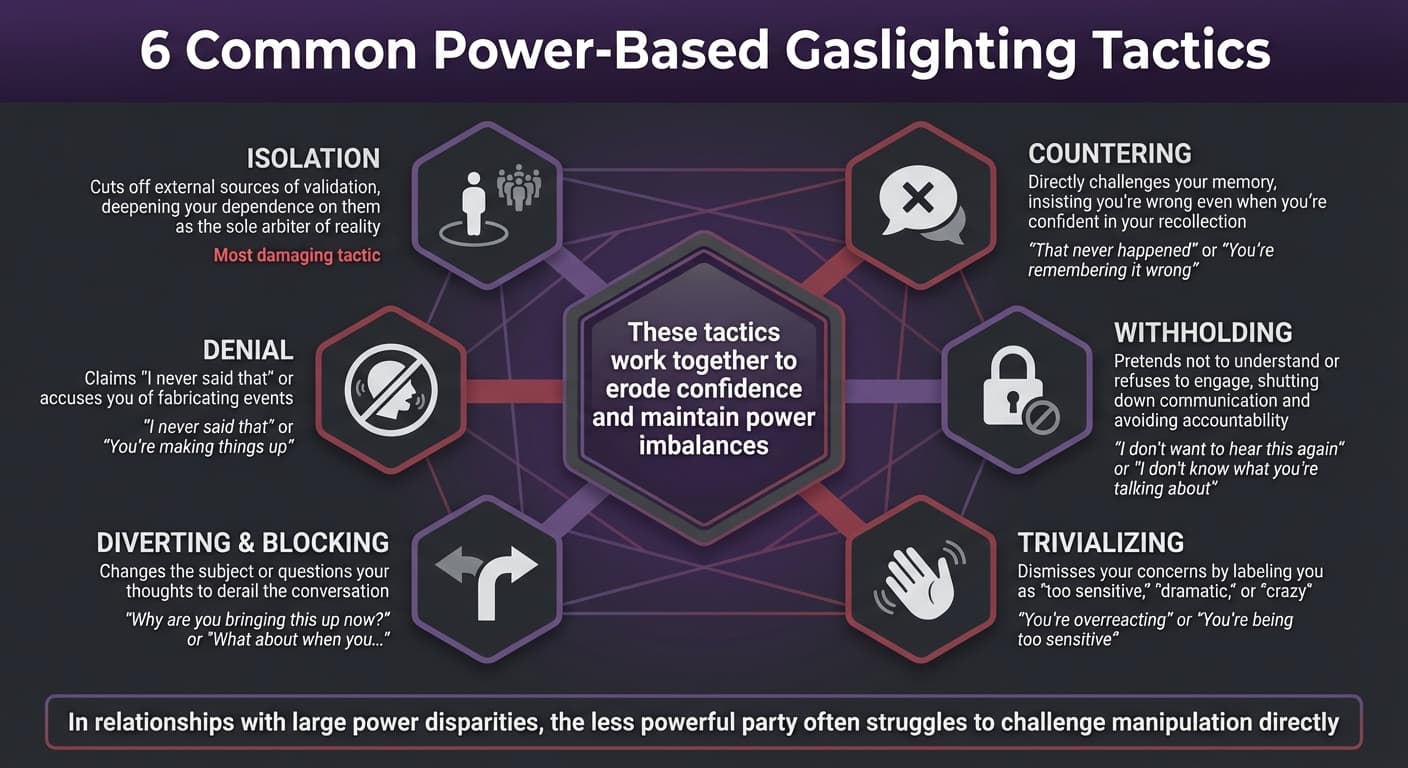
Understanding Power Imbalances
Power in relationships can come from various sources - authority (like a boss or parent), control over resources (such as finances or information), social standing (reputation or connections), or dependence (emotional or practical reliance). When one person holds significantly more power, the relationship becomes ripe for manipulation.
A study published in the Journal of Social and Personal Relationships examined 298 college students (average age 19, with 73% identifying as female) and found that individuals at either end of the power spectrum - those with very low or very high power - experience more gaslighting than those in balanced power dynamics. In relationships with large power disparities, the less powerful party often struggles to challenge the hierarchy directly. This imbalance creates an environment where the more powerful individual may resort to manipulation to maintain control.
How Gaslighters Control Reality
Gaslighters exploit these power gaps by systematically reshaping reality. They achieve control through a tactic known as "claiming the frame" - essentially dictating the context, timeline, and narrative of events so that their perspective becomes the dominant one. This strategy shifts the focus from objective facts to the gaslighter's constructed version of reality.
Robin Stern, Ph.D., Co-founder of the Yale Center for Emotional Intelligence, explains this dynamic in what she calls the "Gaslight Tango":
Gaslighting is always a creation and interplay of two people: A gaslighter, who needs to be right to preserve their own sense of self and to keep a sense of power in the world; and a gaslightee, who is manipulated into allowing the gaslighter to define their sense of reality because they idealize the gaslighter and seek their approval[5].
This manipulation often targets the victim's core identity and self-esteem. Psychologist Chivonna Childs, PhD, adds:
Gaslighting can be a form of projection... They make you look to the left so you don't see what's going on to the right[1].
By exploiting the victim's insecurities, gaslighters make their targets doubt their own judgment, ultimately accepting the manipulator's version of events as truth[1][3].
Common Power-Based Gaslighting Tactics
Gaslighters use a range of tactics to maintain control, often leveraging existing power imbalances. One common method is countering, where the gaslighter directly challenges the victim's memory, insisting they’re wrong - even when the victim is confident in their recollection[7]. Another is withholding, where the gaslighter pretends not to understand or outright refuses to engage, effectively shutting down communication and avoiding accountability[7][8].
Trivializing is another tactic, where the gaslighter dismisses the victim’s concerns by labeling them as "too sensitive", "dramatic", or "crazy", invalidating their feelings and experiences[1][7][8]. When confronted, gaslighters may use diverting and blocking - changing the subject or questioning the victim's thoughts to derail the conversation[7]. They may also resort to denial, claiming, "I never said that", or accusing the victim of fabricating events[7][8].
Perhaps the most damaging tactic is isolation. By cutting off external sources of validation, gaslighters deepen the victim's dependence on them as the sole arbiter of reality[1][2][8]. Additionally, they often shift blame, twisting the narrative so the victim feels responsible for the gaslighter’s abusive behavior or the conflict at hand[1][8]. These tactics work together to erode the victim's confidence, leaving them more vulnerable to manipulation.
Power Dynamics in Relationships, Workplaces, and Families
Gaslighting in Intimate Relationships
In close relationships, power imbalances can create a dependency that leaves victims reliant on their abusers for emotional, financial, and even perceptual affirmation. Research reveals that significant power disparities are often linked to increased gaslighting, especially in cases of domestic abuse[2][9].
One of the most effective tools for maintaining control in these situations is economic abuse. When one partner controls all the finances or prevents the other from working, the victim may feel powerless to leave. Other manipulative strategies include love bombing - showering the victim with excessive attention to establish control - and hoovering, which involves drawing the victim back into the relationship after they try to leave. Abusers may also exploit children or pets, using threats of custody battles or harm to coerce compliance. As Natacha Duke, a Registered Psychotherapist, explains:
At the core of domestic violence, abusers have a sense of entitlement and a belief that they should be in control[9].
On average, victims attempt to leave seven times before successfully breaking free from an abusive relationship[9].
Gaslighting in Workplaces
Gaslighting isn’t confined to personal relationships - it’s also prevalent in professional environments, where hierarchical structures can amplify manipulative behavior. Research highlights two key forms of workplace gaslighting: trivialization, which belittles a subordinate’s opinions or contributions, and affliction, where the target is subjected to emotional distress and torment. Managers may take credit for an employee’s work while alternating between criticism and praise, creating a confusing and destabilizing atmosphere.
In some cases, organizations engage in institutional gaslighting, systematically distorting reality to protect their reputation. This can leave employees doubting their own decisions, feeling uneasy around supervisors, and even apologizing for things they didn’t do wrong. Over time, this toxic environment erodes both confidence and interest in work, spilling over into personal life.
Gaslighting in Families
Family dynamics, with their built-in hierarchies, often create fertile ground for gaslighting. Authority figures in families may silence dissent by emphasizing their status, making it difficult for others to challenge their perspective. Robin Stern, PhD, Co-founder of the Yale Center for Emotional Intelligence, explains:
Gaslighting is psychological manipulation repeated over time, where one person, the gaslighter - who is more powerful - insists that the way they see things is the reality[10].
In these situations, victims are often conditioned to question their own perceptions and comply without resistance[10]. For some, these behaviors are learned early, modeled by parents who used similar manipulative tactics during their own upbringing[3]. The hierarchical nature of families can make it especially challenging for children or dependent adults to push back against the gaslighter’s version of events.
How to Recognize and Address Power-Based Gaslighting
Warning Signs of Power-Based Gaslighting
Power-based gaslighting often thrives on creating confusion and undermining confidence. A major red flag is when discussions stop being about resolving issues and instead become battles for control, with the gaslighter insisting they are always right to maintain dominance [5]. Tactics like dismissing your perspective - claiming you’re "remembering things wrong" or calling you "crazy", "overreacting", or "too sensitive" - are designed to make you second-guess your own memory and feelings [1][6].
Other signs include retaliatory behaviors such as giving you the silent treatment, withdrawing emotionally, or making frequent threats to the relationship, all aimed at keeping you unsteady [4]. Gaslighters may also try to isolate you from friends and family who could validate your experiences, increasing your reliance on their narrative [1][6]. In workplaces, this can take the form of "whistle-blower gaslighting", where supervisors manipulate employees reporting misconduct into doubting their interpretations of events to avoid accountability [6]. Alarmingly, research reveals that 74% of women who have experienced domestic violence report being gaslit by a partner or ex-partner [6].
Using Technology to Detect Manipulation Patterns
Technology can be a powerful ally in identifying gaslighting. Documenting interactions is key - keep dated screenshots of messages or notes from conversations to separate fact from distortion [1][5][11]. This evidence can help you recognize patterns of manipulation over time.
Tools like Gaslighting Check (https://gaslightingcheck.com) use AI to analyze text and voice communications, generating detailed reports and tracking conversation histories. Available for $9.99/month, the premium plan offers immediate validation of manipulative behavior. By providing clear, objective evidence, these tools not only expose gaslighting but also help restore a sense of control to those affected.
Protecting Your Privacy and Safety
Safeguarding your documentation is essential. Use incognito browsing and regularly clear your history to protect your privacy [9][11]. Email important files to a trusted friend or contact and delete local copies to prevent unauthorized access [11].
Gaslighting Check enhances security with end-to-end encryption and automatic data deletion, ensuring your evidence remains private. If you’re in immediate danger, develop a safety plan with a secure location, an emergency bag containing critical documents, and a reliable support network [9][11]. It’s worth noting that survivors often need an average of seven attempts to leave an abusive relationship fully [9].
Conclusion
Power imbalances lie at the heart of gaslighting, whether it happens at home, in the workplace, or within larger institutions. As Harvard researcher Paige L. Sweet explains:
Gaslighting could not exist without inequities in the distribution of social, political, and economic power [6].
Understanding these dynamics is the first step toward reclaiming your sense of reality. When you recognize gaslighting for what it is - a tool of manipulation meant to maintain control - you can start to remove yourself from its grip. Robin Stern, Ph.D., co-founder of the Yale Center for Emotional Intelligence, offers this advice:
As soon as you understand that it doesn't matter how right you are, the closer you will be to freedom [5].
Instead of trying to convince the manipulator, focus on your own feelings and knowledge.
Clarity is empowering. Modern tools like Gaslighting Check (https://gaslightingcheck.com) allow you to document interactions, track conversation histories, and identify manipulation patterns. This objective evidence can make it easier to see the situation for what it is.
Your experiences and emotions are valid. With the right tools and support, you can confront gaslighting, rebuild your self-trust, and take back control over your life.
FAQs
How can I tell if someone is gaslighting me in a relationship or at work?
Gaslighting is a manipulative tactic that can make you doubt your memory, judgment, or even your sense of reality. It often shows up in subtle but persistent ways, like someone repeatedly denying events you clearly remember, accusing you of being "too sensitive" or "dramatic", or twisting past conversations to suit their version of events. Over time, this can leave you feeling confused, apologizing constantly, or questioning your own sanity.
In personal relationships, gaslighting might involve dismissing your emotions, blaming you for their actions, or isolating you from friends and family. In the workplace, it could look like a manager or coworker undermining your contributions, taking credit for your ideas, or blaming you for errors you didn’t make. At its core, these behaviors often aim to create control or maintain a power imbalance.
If you recognize these patterns, start documenting conversations and outcomes to spot inconsistencies. For extra support, Gaslighting Check provides tools to analyze interactions and identify manipulation, all while keeping your data secure.
What are the common tactics gaslighters use to manipulate and control others?
Gaslighters rely on manipulative tactics to confuse and control their targets, often making them second-guess their own perceptions and sense of reality. Some of the most common methods include:
- Flat-out denial or lying, even when there's clear evidence to the contrary.
- Twisting past events, leaving the victim questioning their own memory.
- Shifting blame and projecting faults, with statements like, "You're the one being unreasonable."
- Dismissing emotions, using phrases such as, "You're overreacting", to invalidate feelings.
- Creating isolation, cutting the victim off from friends, family, or other sources of support.
- Speaking in vague or contradictory terms, which fosters confusion and uncertainty.
- Using belittling comments, like "You're too sensitive", to chip away at self-esteem.
These tactics are designed to undermine confidence and create a sense of dependency on the gaslighter. Spotting these behaviors early is crucial for reclaiming control and safeguarding your sense of self.
How can technology help identify and document gaslighting behavior?
Technology has become a game-changer in identifying and documenting gaslighting, turning what often feels like a subjective experience into something more measurable. AI-driven tools can analyze conversations for telltale signs like fact denial, blame-shifting, and emotional invalidation. By using natural language processing and machine learning, these tools can evaluate text messages, emails, chats, and even voice tones, helping to pinpoint manipulative behaviors that might otherwise slip under the radar.
Take platforms like Gaslighting Check, for example. They offer features such as real-time audio recording, transcription, voice analysis, and detailed logs of flagged interactions. These tools help users securely document incidents and identify harmful patterns over time. With encrypted data storage and automatic deletion policies, they ensure privacy while equipping individuals with the resources to better understand and address gaslighting.