How Neurofeedback Builds Emotional Safety

How Neurofeedback Builds Emotional Safety
Neurofeedback can help you better manage stress and emotions by training your brain to regulate itself. It uses real-time feedback from your brain activity to improve emotional control, reduce fear responses, and strengthen connections between key brain regions like the prefrontal cortex and amygdala. This process can enhance your ability to stay calm under pressure and handle challenging situations effectively.
Key Takeaways:
- What It Does: Neurofeedback provides visual or auditory feedback to help you adjust brain activity, improving emotional regulation.
- How It Works: Targets areas like the amygdala (fear processing) and prefrontal cortex (emotional control).
- Proven Results: Studies show improved stress recovery, reduced anxiety, and better emotional resilience after multiple sessions.
- Why It Matters: Chronic stress impacts mental health, relationships, and physical well-being - neurofeedback offers a drug-free way to address these issues.
If you’re struggling with stress or emotional regulation, neurofeedback might be worth exploring. It’s a practical tool to help retrain your brain and support long-term emotional stability.
Moving From Dysregulation to Emotional Self-Regulation
Emotional Safety Challenges in High-Stress Environments
Before diving into how neurofeedback can help, it’s important to grasp the emotional hurdles people face in high-pressure settings.
Common Emotional Dysregulation Patterns
High-stress environments often lead to ongoing anxiety, overreactive behaviors, and repetitive negative thought cycles - essentially keeping the brain stuck in a stress response [6][9][10]. In professional settings, individuals frequently struggle to maintain emotional control to meet workplace expectations [8]. Other patterns like hypervigilance, social withdrawal, and impulsive actions are also common. These aren’t personal shortcomings - they’re signs that the brain’s emotional regulation systems are overwhelmed.
Impact on Well-Being and Relationships
Chronic stress doesn’t just affect emotions; it takes a serious toll on physical health too. It increases the risk for conditions like heart disease, chronic pain, diabetes, and insomnia. On top of that, it disrupts personal and professional relationships, leading to conflicts, poor communication, and lower productivity at work [8][6]. In the UK alone, stress, depression, and anxiety are responsible for 44% of work-related health issues, while 54% of lost working days stem from mental health struggles [8]. Over time, prolonged stress erodes resilience, damages self-esteem, and makes individuals more susceptible to anxiety disorders and clinical depression [6][8].
As Linlin Yu et al. from Frontiers in Human Neuroscience explain:
"Failing to regulate negative emotions often adversely affects our social functioning, cognitive abilities, and somatopsychic health, and can even lead to the development of affective disorders." [1]
These realities highlight just how critical effective emotional regulation strategies are in managing stress and maintaining overall well-being.
How Neurofeedback Builds Emotional Safety
::: @figure
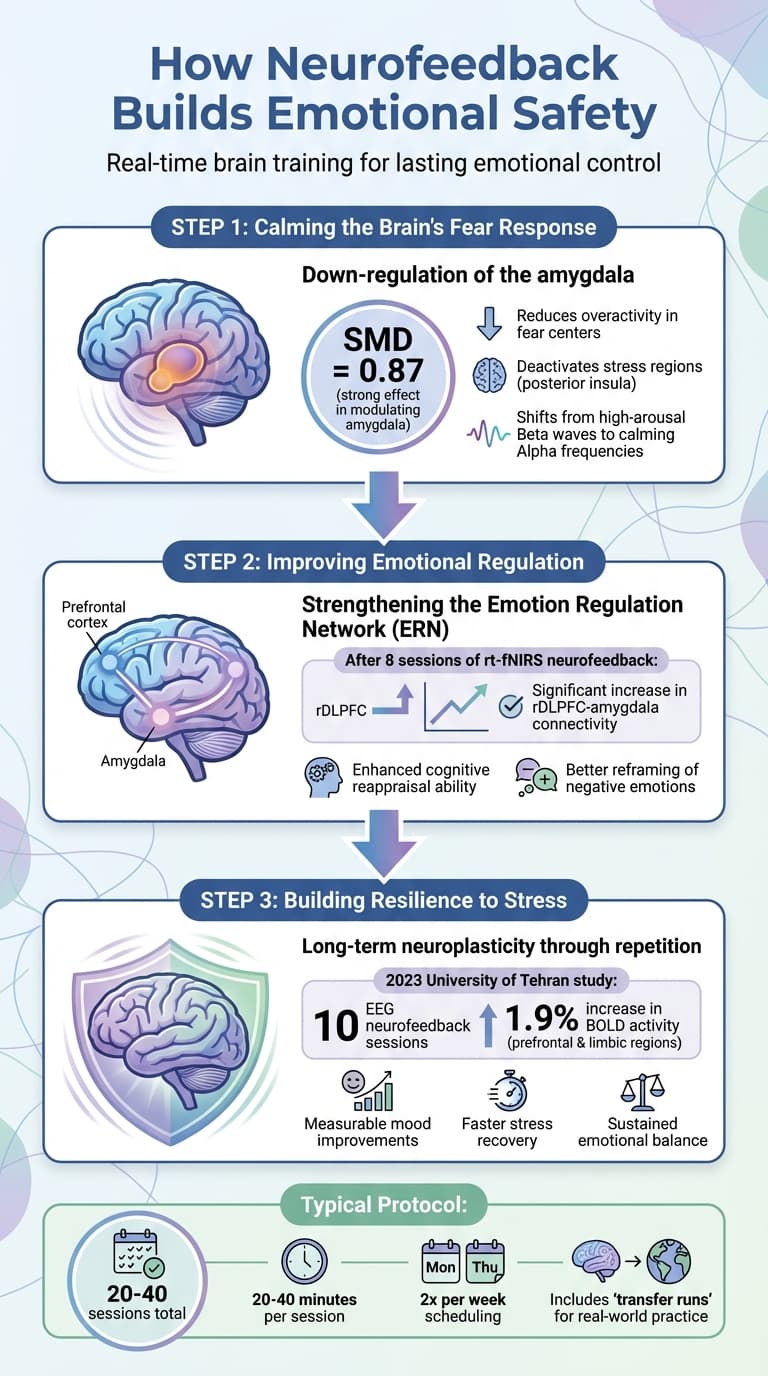
Neurofeedback offers your brain a real-time window into its activity, giving you the tools to manage emotional responses more effectively. By using sensors to monitor brain signals, it translates this data into visual or auditory cues. This feedback helps strengthen the connection between cognitive areas like the prefrontal cortex and emotional centers such as the amygdala. The result? A shift in brainwave patterns from high-arousal Beta waves to calming Alpha frequencies [16][17]. Let’s dive deeper into how neurofeedback calms fear responses and enhances emotional regulation.
Calming the Brain's Fear Response
Think of the amygdala as your brain’s built-in alarm system - it’s responsible for triggering fear responses. Neurofeedback helps you take control of this system through a process called "down-regulation", which can reduce overactivity in the amygdala and deactivate stress-related regions like the posterior insula [14][15].
Ana Rita Barreiros, a researcher at the University of Coimbra, highlights its importance:
"The amygdala is a critical region for the generation, expression, and experience of emotions... therapeutic strategies targeting this structure are of major importance." [14]
Research backs this up. Studies focusing on amygdala-targeting neurofeedback have shown a strong effect (SMD = 0.87) in successfully modulating this brain region [15].
Improving Emotional Regulation
Neurofeedback doesn’t just calm your brain - it also builds better connections. Specifically, it strengthens the link between the right dorsolateral prefrontal cortex (rDLPFC) and the amygdala, forming what’s known as the Emotion Regulation Network (ERN) [1]. This improved network provides you with tools to manage negative emotions by rethinking stressful situations, a process called cognitive reappraisal.
In March 2021, researchers at Southwest University in Chongqing, China, conducted a study with 30 young adults. After just eight sessions of real-time functional near-infrared spectroscopy (rt-fNIRS) neurofeedback targeting the rDLPFC, participants showed a significant increase in resting-state connectivity between the ERN and the amygdala. The study found that these strengthened prefrontal control regions directly enhanced participants’ ability to reframe negative emotions [1].
Linlin Yu, a researcher involved in the study, explained:
"Improving the functionality of prefrontal cognitive control regions may help treat and prevent emotional dysregulation." [1]
Importantly, this method avoids exposing participants to distressing stimuli. Instead, it reinforces neural pathways through neutral tasks, making the process more manageable [1].
Building Resilience to Stress
Achieving long-term emotional stability requires repetition. Neurofeedback works by consistently reinforcing healthier brain patterns. Over time, this helps shift brain activity from anxiety-prone frequencies to states of relaxation and focus [18]. With repeated sessions, individuals recover from stress more quickly and maintain emotional balance for longer periods.
A compelling example comes from a 2023 study at the University of Tehran. Researchers worked with 20 healthy male participants, who underwent 10 EEG neurofeedback sessions while being monitored via fMRI. Using positive autobiographical memories to guide visual feedback, the experimental group saw up to a 1.9% increase in BOLD activity in prefrontal and limbic regions. This was accompanied by measurable mood improvements compared to a control group receiving sham feedback [3].
Because neurofeedback taps into neuroplasticity - your brain’s ability to reorganize itself - it typically requires multiple sessions to move from temporary calm to lasting resilience [18][13]. Longer training durations often lead to more significant changes in brain signal patterns. To ensure these skills carry over into daily life, many protocols include “transfer runs,” where participants practice self-regulation without feedback [14].
Evidence Supporting Neurofeedback for Emotional Safety
Clinical Research on Neurofeedback
Studies continue to highlight neurofeedback's effectiveness in easing PTSD symptoms. A 2025 systematic review by the Defense Health Agency's Psychological Health Center of Excellence found that EEG neurofeedback produced moderate to large improvements in PTSD symptoms when compared to passive controls [19].
One significant study conducted by the Trauma Center at JRI, led by Bessel van der Kolk, examined 52 adults with treatment-resistant PTSD. Between July 2012 and July 2015, participants were randomly assigned to either 24 EEG neurofeedback sessions or a waitlist. The results were striking: only 27.3% of those in the neurofeedback group still qualified for a PTSD diagnosis post-treatment, compared to 68.2% of the waitlist group. On average, participants in the neurofeedback group saw a 40.35-point drop on the Clinician Administered PTSD Scale (CAPS), far surpassing the 20-point threshold for meaningful clinical improvement. At the one-month follow-up, 58% of these participants were in remission, compared to just 10% of the control group. They also reported better emotional regulation and reduced tension - key factors for daily emotional safety. As van der Kolk observed:
The effect sizes of NF (d = -2.33 within, d = -1.71 between groups) are comparable to those reported for the most effective evidence-based treatments for PTSD
[21].
Another study, published in March 2024, explored Amygdala-Derived-EFP neurofeedback for chronic PTSD in both veterans and civilians. Over eight weeks, participants completed 15 sessions, and at the three-month follow-up, 66.7% achieved a clinically meaningful improvement, with an average CAPS-5 score reduction of 13.5 points [20]. Additionally, research involving 24 women with Borderline Personality Disorder demonstrated that amygdala down-regulation training significantly reduced symptoms and lessened emotion-triggered startle responses [12]. These findings underscore how neurofeedback translates into practical emotional benefits.
Success Stories from Real-World Applications
The impact of neurofeedback extends beyond clinical trials into everyday life. In the March 2024 chronic PTSD study, participants not only experienced fewer PTSD symptoms but also showed progress in areas like depression, measured by the PHQ-9, and overall clinical impressions (CGI) [20]. These improvements suggest that neurofeedback equips individuals to better manage their emotional responses in the situations that matter most.
Using Neurofeedback for Long-Term Emotional Safety
Typical Neurofeedback Protocols
Neurofeedback programs generally involve 20–40 sessions, each lasting 20–40 minutes, typically scheduled twice a week to maximize the benefits of distributed learning [22][23]. However, not everyone finds it easy to gain voluntary neural control - studies suggest that 10%–50% of participants may face challenges in this area, making personalized protocols essential [2]. To address this, clinicians often tailor sessions by focusing on specific brain regions, such as the right dorsolateral prefrontal cortex (rDLPFC), or by incorporating individualized strategies like recalling positive memories or engaging in mental calculations during training [1][3]. Once neural control is achieved, the improvements can last for weeks or even months [2]. These personalized approaches also serve as a foundation for incorporating additional techniques.
Complementary Practices for Better Outcomes
Pairing neurofeedback with other practices can significantly enhance its effectiveness. For example, mindfulness, cognitive reappraisal, and biofeedback are valuable additions. A study conducted by Seoul National University Hospital revealed that a four-week neurofeedback-assisted mobile mindfulness program led to notable increases in resilience scores [24]. Cognitive reappraisal, which involves reinterpreting emotional situations in a new light, helps strengthen prefrontal control regions during neurofeedback sessions [1]. Similarly, combining neurofeedback with biofeedback - which tracks metrics like heart rate variability, skin temperature, and muscle tension - ensures that your body’s stress responses align with your brain training [18].
For those navigating emotionally manipulative situations, such as gaslighting, tools like Gaslighting Check can help identify manipulation patterns, further supporting emotional well-being. Immersive virtual reality (VR) environments also offer a unique way to practice emotional regulation by simulating high-stress scenarios [2][5]. Looking ahead, wearable devices like smartwatches or headphones may provide real-time feedback through haptic or auditory cues, helping users reinforce their regulation techniques throughout the day [2]. Together, these practices create a comprehensive approach that extends the benefits of neurofeedback into daily life.
Non-Invasive and Drug-Free Benefits
Neurofeedback offers a non-invasive, drug-free way to teach your brain self-regulation by strengthening connections between the prefrontal cortex and the limbic system [1][11]. Unlike medications, it doesn’t carry the risk of dependency or chemical side effects, making it an appealing choice for those who prefer to avoid pharmaceuticals [2][4].
This training promotes long-term brain plasticity, leading to structural and functional changes in neural networks that support emotional safety [2]. Research shows that over 75% of clinical participants experience behavioral improvements, particularly in conditions like major depressive disorder and PTSD [11]. Because neurofeedback is highly customizable, it can be tailored to address specific emotional challenges, whether it’s managing anxiety, recovering from trauma, or building resilience against workplace stress. As Lucas R. Trambaiolli of McLean Hospital–Harvard Medical School notes:
"Neurofeedback training can lead to symptom improvements that last for weeks after intervention" [2].
Conclusion
Neurofeedback provides a non-invasive, drug-free approach to achieving emotional stability by teaching the brain to self-regulate under stress. It tackles the core of emotional dysregulation by shifting brainwave activity - from high-beta patterns to more calming alpha and theta rhythms [25][16]. This process enhances critical brain connections, such as those between the prefrontal cortex and the amygdala, promoting a transition from impulsive reactions to more thoughtful, deliberate responses [16][27]. These neurophysiological changes are well-supported by scientific research.
Studies highlight neurofeedback’s effectiveness. For example, a 2019 study reported that participants undergoing neurofeedback experienced significantly reduced anxiety symptoms compared to control groups [26]. Another study noted a 40% improvement in executive function after 24 sessions [27]. Considering that 264 million people globally are affected by anxiety disorders [7], these findings point to neurofeedback's broad potential.
To further support emotional regulation, additional tools can be helpful. For instance, platforms like Gaslighting Check offer a way to identify manipulation tactics, helping individuals manage stress and validate their emotional experiences.
If you’re dealing with emotional dysregulation in high-stress situations, exploring neurofeedback with a BCIA-certified professional could be a worthwhile step. Sessions typically cost between $50 and $150, with most people needing 10 to 40 sessions to achieve lasting results [26]. While it may take several months to see significant changes, the long-term benefits of neurofeedback can be life-changing [25].
As psychotherapist and author Sebern F. Fisher aptly states:
There is no other path: We must reduce fear
[27]. This sentiment captures the essence of neurofeedback’s role in fostering lasting emotional well-being.
FAQs
How does neurofeedback help reduce anxiety and stress?
Neurofeedback offers a way for individuals to take charge of their brain activity by teaching them how to manage areas associated with stress and anxiety. Through this training, the brain's pathways responsible for regulating emotions become more robust, often resulting in a clear decrease in stress and anxiety symptoms.
By enhancing self-regulation, neurofeedback helps people remain composed in stressful situations, fostering a sense of emotional stability and balance in everyday life.
What are the long-term benefits of neurofeedback for emotional regulation?
Neurofeedback offers a way to help people train their brains to better manage emotions by reinforcing the neural pathways tied to emotional control. With consistent practice, it can lead to lasting changes in how the brain handles stress and emotional reactions.
Many individuals who use neurofeedback report feeling less anxious, becoming more resilient to stress, and finding it easier to remain calm in tough situations. These positive shifts often continue even after the training is complete, as the brain develops and maintains healthier patterns for regulating emotions. Beyond that, these changes can sometimes reduce the need for medications, supporting long-term mental health and overall well-being.
What are the potential risks or challenges of neurofeedback sessions?
Neurofeedback offers a way to enhance emotional regulation, but it’s not without its hurdles. Its effectiveness hinges on several factors, including the protocol used, feedback settings, and the individual’s current mental state. If these elements aren’t properly aligned, users might feel frustrated, experience fatigue, or even notice a temporary worsening of symptoms.
Another challenge lies in maintaining the benefits over the long term. Without consistent reinforcement or practical application in day-to-day life, the progress made during sessions can gradually diminish. To counter this, incorporating follow-up strategies - like at-home exercises or pairing neurofeedback with other therapies - can help maintain the gains achieved.
It’s also important to acknowledge that neurofeedback doesn’t work the same way for everyone. Some people may notice only slight improvements after multiple sessions, which can understandably lead to disappointment. Setting realistic expectations and keeping a close eye on progress can make the overall experience more positive and manageable.