Memory Loss After Abuse: What Studies Show

Memory Loss After Abuse: What Studies Show
Emotional abuse, like gaslighting, doesn't just harm emotions - it can also disrupt memory and alter brain function. Studies reveal that survivors of abuse often experience issues with verbal memory, decision-making, and cognitive decline. For instance:
- Gaslighting undermines confidence in memory through manipulation tactics like denying events or questioning recollections.
- Chronic stress from abuse can shrink the hippocampus, a brain region critical for memory, and weaken connections in the prefrontal cortex, affecting decision-making.
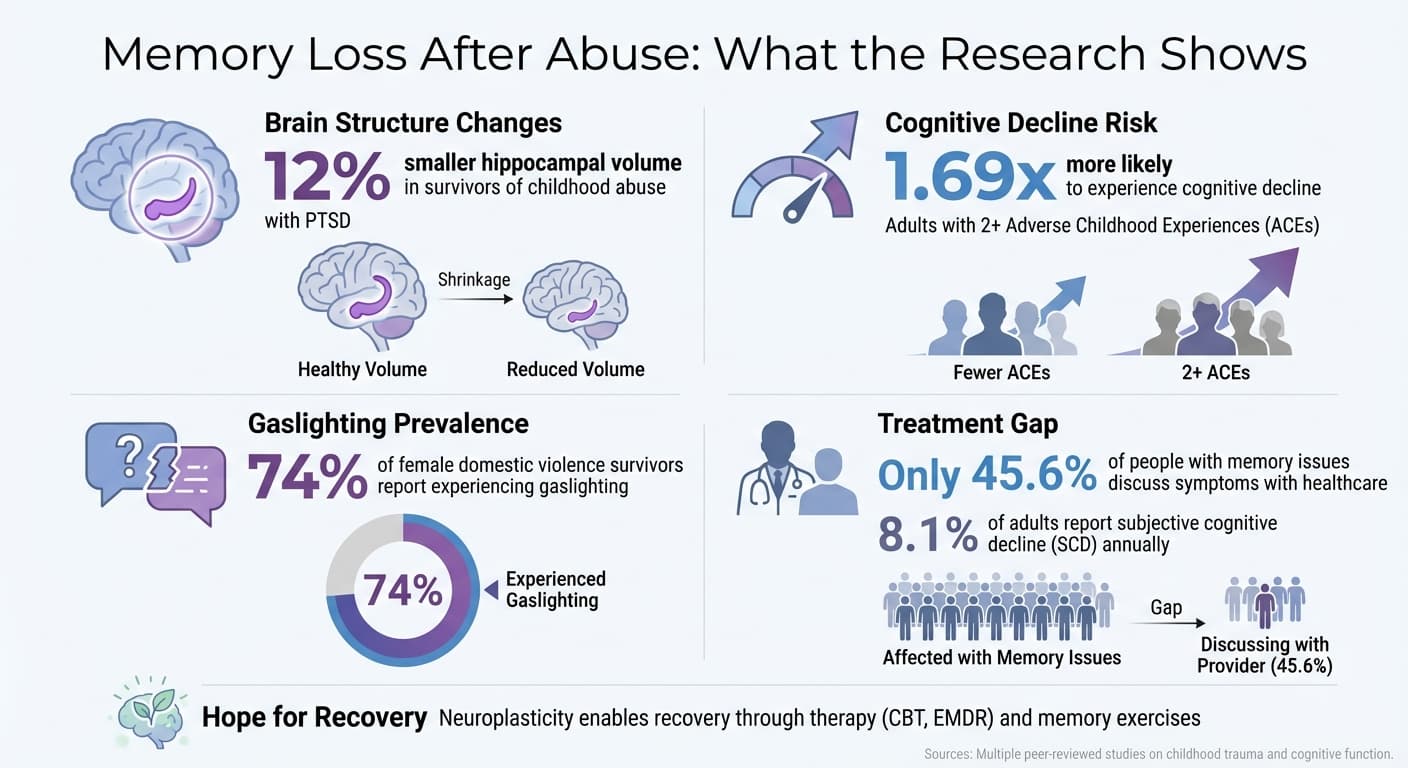
- Survivors of childhood abuse may have up to 12% smaller hippocampal volume, with memory deficits linked to the severity of trauma.
- Adults with two or more adverse childhood experiences (ACEs) are 1.69 times more likely to report cognitive decline later in life.
Therapies like CBT and EMDR, combined with tools like Gaslighting Check, can help survivors rebuild memory and mental health. While fewer than half of those with memory issues seek help, the brain's ability to recover offers hope for healing.
::: @figure
What Research Shows About Emotional Abuse and Memory Loss
Childhood Emotional Abuse and Memory Problems
Research has shown a strong connection between childhood emotional abuse and long-term memory challenges. Studies differentiate between two main types of adverse childhood experiences (ACEs): "threat-type" experiences, such as physical or sexual abuse, and "deprivation-type" experiences, like emotional neglect. Both types are linked to poorer cognitive performance in adulthood, though they tend to affect different aspects of memory [4].
Specifically, emotional abuse and neglect have been tied to problems with working memory, immediate verbal memory, and delayed verbal memory [4]. For example, a study focusing on middle-aged women (ages 49 to 69) found that those who endured severe childhood abuse had learning and working memory scores similar to women nearly five years older [5]. Interestingly, while verbal memory is often significantly affected, visual memory tends to remain intact in survivors of abuse [3]. Research consistently shows that these early impacts on memory can contribute to cognitive decline later in life.
Large-Scale Studies on Trauma and Memory
Large-scale studies reveal a clear link between childhood adversity and cognitive decline, showing a dose-response relationship. Adults who experienced two or more ACEs are 1.69 times more likely to report subjective cognitive decline (SCD) as they age [6].
One 2020 study analyzed data from 18 states and found that about 8.1% of adults reported experiencing SCD in the past year. However, only 45.6% of these individuals had discussed their symptoms with a healthcare provider [6]. This gap underscores how memory issues tied to past abuse are often overlooked or left untreated.
How Gaslighting Affects Memory
While childhood abuse lays the groundwork for cognitive difficulties, gaslighting introduces additional challenges that directly undermine memory. Gaslighting often involves two key tactics: "countering", where the victim’s accurate recollections are questioned, and "forgetting", where the perpetrator denies events ever occurred [2]. These strategies create confusion and erode the victim’s confidence in their own memory.
Gaslighting is particularly effective when there’s a power imbalance, as it increases the victim’s reliance on the perpetrator to define reality [8][9]. Over time, this dependence fosters deep self-doubt, which fragments memory and makes it harder to form clear recollections. Prolonged exposure to gaslighting can lead to anxiety, depression, and other psychological trauma, further impairing cognitive function [2][1].
Brain Changes Caused by Emotional Abuse
Damage to Memory and Decision-Making Brain Regions
Emotional abuse can lead to lasting changes in brain structure, particularly in areas tied to memory and decision-making.
One major impact is on the hippocampus, a critical region for learning and forming new memories. Due to its high concentration of glucocorticoid receptors, the hippocampus is especially vulnerable to chronic stress caused by emotional abuse. Over time, this stress can result in hippocampal shrinkage, reduced dendritic branching, loss of neurons in the CA3 region, and a decline in the creation of new neurons.[7][12]
The prefrontal cortex also suffers damage from maltreatment. Research shows that the anterior cingulate and ventromedial/dorsomedial cortices - areas essential for decision-making, mood regulation, and executive functioning - can shrink following abuse.[7][10] Furthermore, the connection between the prefrontal cortex and the amygdala weakens, which can disrupt emotional regulation. Studies have also linked parental verbal abuse to damage in white matter tracts and a smaller corpus callosum, impairing communication between the brain's hemispheres.[7][10]
These structural changes make it even harder for individuals to cope with the effects of chronic stress, particularly when it comes to memory.
How Chronic Stress Damages Memory
On top of these structural changes, chronic stress further undermines memory consolidation, with the stress hormone cortisol playing a central role. As researchers Matthew Sabia and Almut Hupbach explain:
"The hippocampus is particularly sensitive to stress effects because of its high density of mineral and glucocorticoid receptors. While moderate stress can enhance memory... intense stress can cause GRs to become oversaturated, compromising hippocampal processing."[11]
When cortisol levels are consistently high, the brain struggles to stabilize new memories. This often shifts memory processing from contextual (detailed) to habitual (vague), leaving survivors with only a fragmented sense of past events. For example, a Yale University study involving 16 healthy female participants found that elevated cortisol levels caused by stress were linked to poorer delayed recall of words and spatial memory 24 hours after a stress challenge, though immediate recall was unaffected.[13]
The cumulative effects of such stress are significant. Research highlights that individuals with four or more Adverse Childhood Experiences have a 2.5 times higher risk of panic reactions and are 3.6 times more likely to experience depressed mood.[7]
How to Address Memory Loss After Abuse
Identifying Manipulation Through Gaslighting
Healing from abuse often starts with recognizing and stopping manipulation. One common tactic used by abusers is gaslighting, which involves making victims question their own reality. For example, an abuser might deny events ever happened, leaving the victim doubting their memory. Research reveals that about 74% of women who have experienced domestic violence report being subjected to gaslighting by a partner or ex-partner [15].
A tool like Gaslighting Check can help document these manipulative behaviors. It offers features like real-time audio recording, text and voice analysis, and conversation tracking. All data is safeguarded with end-to-end encryption and automatic deletion policies. The platform creates detailed reports that highlight various gaslighting tactics, such as outright lying, coercion, scapegoating, trivializing, and reality questioning [15].
Catching manipulation early can significantly reduce stress, which is known to harm memory-related brain areas like the hippocampus. For those seeking deeper insights, the Premium Plan ($9.99/month) allows users to track patterns over time, helping to uncover recurring behaviors that might otherwise go unnoticed. By verifying your experiences, you can take the first step toward healing and pursuing therapies that support cognitive recovery.
Restoring Memory Through Therapy and Exercises
Once manipulation is identified, therapy can play a crucial role in rebuilding memory and mental health. Cognitive Behavioral Therapy (CBT) helps individuals challenge harmful thought patterns, while Eye Movement Desensitization and Reprocessing (EMDR) addresses traumatic memories to reduce their emotional weight [14][15]. For those dealing with complex trauma, Internal Family Systems (IFS) therapy can address deeply rooted beliefs, and Somatic Experiencing focuses on validating physical sensations to rebuild self-trust [16].
Memory exercises can also lead to noticeable improvements. Practices like mindfulness have been shown to increase gray matter in the hippocampus, while aerobic activities stimulate the production of Brain-Derived Neurotrophic Factor (BDNF), a protein that aids cognitive healing. Brain-training programs, such as BrainHQ, are designed to sharpen memory and problem-solving skills. Additionally, connecting with supportive peers can release oxytocin, a hormone that counteracts the effects of isolation and helps improve cognitive function [6].
Studies indicate that individuals who have experienced two or more Adverse Childhood Experiences are 1.69 times more likely to report cognitive decline later in life [6]. However, the brain's ability to adapt and rewire itself - known as neuroplasticity - offers hope. The same mechanism that allowed trauma to impact the brain can also enable recovery through consistent and intentional practices.
How Trauma and PTSD Change the Brain
Conclusion
Studies reveal that emotional abuse can have a lasting impact on memory and cognitive function. For example, adults who endured childhood abuse and developed PTSD show a 12% decrease in left hippocampal volume. Additionally, individuals with two or more Adverse Childhood Experiences are 1.69 times more likely to face cognitive decline later in life [3][6]. Gaslighting - a manipulative form of emotional abuse that distorts a victim's sense of reality - has been reported by 74% of female domestic violence survivors [15].
These findings highlight the importance of early detection and intervention. Recognizing cognitive and memory impairments is crucial for beginning the recovery process. As Harvard researcher Paige L. Sweet aptly noted, "Gaslighting could not exist without inequities in the distribution of social, political, and economic power" [15]. Identifying manipulation early can empower survivors to reclaim their autonomy and reduce the toll of chronic stress on their brains.
Thanks to the brain's neuroplasticity, recovery is possible through focused therapy and supportive tools. For instance, Gaslighting Check helps survivors by documenting manipulation patterns using real-time audio recording, text and voice analysis, and conversation history tracking. When paired with therapies like CBT (Cognitive Behavioral Therapy) and EMDR (Eye Movement Desensitization and Reprocessing), along with memory-strengthening exercises, survivors can work toward restoring their cognitive abilities.
Despite these options, fewer than half (45.6%) of individuals experiencing memory problems discuss their symptoms with a healthcare provider [6]. Breaking this silence - whether by seeking professional help, using documentation tools, or making lifestyle adjustments - can lead to meaningful improvements. The brain's remarkable ability to heal provides hope for survivors to regain control over their memory and cognitive health after enduring abuse.
FAQs
How does gaslighting affect memory and thinking?
Gaslighting is a manipulative tactic where someone twists or outright denies past events, making the other person doubt their own memories. For instance, statements like "I never said that" can sow seeds of uncertainty, making individuals second-guess their recollection. This constant questioning can chip away at their trust in their own memory, leaving them confused and unsure of what's real. Over time, this erosion of confidence can disrupt short-term and working memory, leaving survivors feeling lost and powerless.
Studies have found that prolonged exposure to emotional abuse, such as gaslighting, can lead to cognitive struggles later in life. The stress caused by ongoing manipulation raises cortisol levels, which, in turn, can harm the hippocampus - the brain's hub for creating new memories. This damage often manifests as trouble focusing, slower processing of information, and a lingering sense of mental cloudiness.
How does childhood emotional abuse affect the brain over time?
Childhood emotional abuse can leave a lasting imprint on the brain, especially in areas tied to memory, emotional control, and decision-making. Studies reveal that the prefrontal cortex and hippocampus - two critical brain regions - often show reduced size in individuals who experienced such abuse. These alterations are associated with memory struggles, heightened stress reactions, and difficulties in regulating emotions.
The effects don’t stop there. The amygdala, which processes emotional responses, and the corpus callosum, responsible for coordinating activity between the brain's hemispheres, can also be impacted. Brain imaging studies have shown that the white-matter pathways connecting these areas may suffer damage, disrupting the brain's internal communication network. These structural changes can linger for decades, potentially leading to anxiety, memory issues, and other cognitive challenges well into adulthood.
What are the best therapies for recovering memory after emotional abuse?
Recovering memory after emotional abuse often involves trauma-informed therapies designed to address how prolonged psychological stress impacts the brain. Techniques like Cognitive-Behavioral Therapy (CBT) and Eye Movement Desensitization and Reprocessing (EMDR) have been effective in helping individuals work through trauma, calm intrusive thoughts, and improve memory by stabilizing the brain's stress responses.
Beyond therapy, incorporating habits that promote brain health and reduce stress - such as mindfulness practices, deep breathing, and regular exercise - can play a key role in memory recovery. These activities support the rebuilding of neural pathways damaged by emotional stress, enhancing focus, recall, and overall mental clarity. When these strategies are combined with the expertise of a trauma-informed therapist, they create a supportive environment for healing and restoring memory.