Linguistic Patterns Gaslighters Use in Texts

Linguistic Patterns Gaslighters Use in Texts
Gaslighting through text messages is a subtle but harmful form of manipulation. Gaslighters use specific language patterns to distort reality, undermine confidence, and create emotional dependence. Here’s what to watch out for:
- Denial and Contradiction: Phrases like "That never happened" or "You're imagining things" aim to make you doubt your memory.
- Dismissive Language: Statements such as "You're overreacting" or "It was just a joke" trivialize your emotions.
- Blame-Shifting: Phrases like "If you acted differently, I wouldn’t treat you like this" deflect responsibility onto you.
- Non-Apologies: Statements like "I’m sorry you feel that way" avoid accountability while making you question your feelings.
- Stonewalling: Tactics like one-word replies ("Fine") or prolonged silence are used to punish and silence.
These tactics can erode self-confidence, increase emotional dependence, and lead to anxiety or depression. Recognizing these patterns is key to protecting your mental health. Tools like Gaslighting Check can help analyze text interactions for manipulative behaviors, offering clarity and validation.
To regain control, set boundaries, document interactions, and seek support. Protecting your sense of reality is essential to breaking free from a gaslighter's influence.
How to Spot a Toxic Person Through Their Text Messages | 7 Red Flags
Common Linguistic Patterns Gaslighters Use in Text Messages
::: @figure
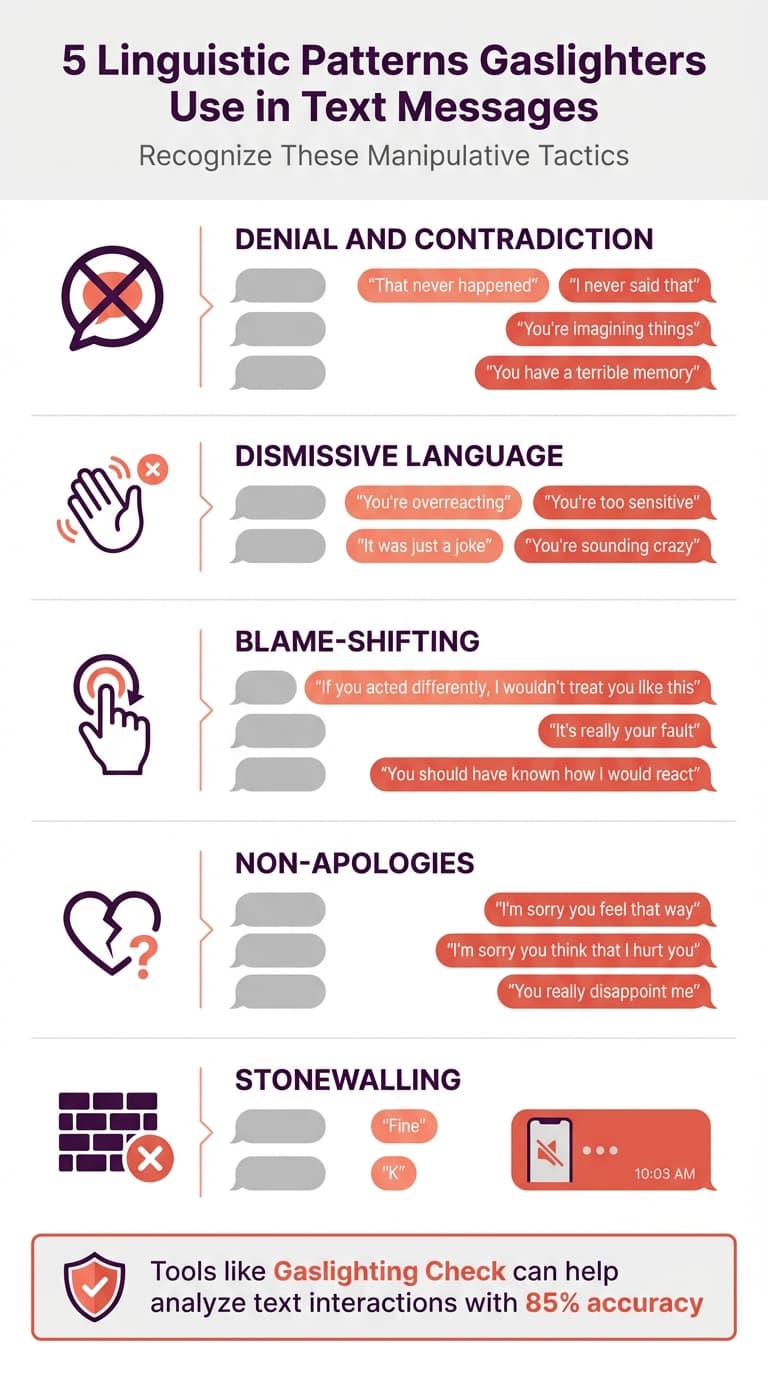
Gaslighters often rely on specific language tactics to manipulate and distort reality. Recognizing these patterns is a crucial step toward identifying and resisting their influence.
Denial and Contradiction
One of the most common tools in a gaslighter's arsenal is outright denial. They’ll say things like, "That never happened", "I never said that", or "You're imagining things." These statements are designed to make the victim doubt their memory, even when evidence exists to the contrary. Therapist Shannon Thomas sheds light on this behavior:
"People who cannot authentically argue their point of view or stand behind their words turn to gaslighting as a tool. They resort to confusion-creating tactics, and that is a sign of character weakness" [4].
Gaslighters often escalate their denial by attacking the victim’s memory directly, using phrases like "You have a terrible memory" or "You're remembering it wrong." This approach not only undermines the victim’s confidence in their recollection but also in their cognitive abilities. Even when confronted with text records, gaslighters persist in their denial, often pairing it with dismissive or manipulative tones to invalidate emotional responses.
Manipulative Tone and Word Choice
Gaslighters use language that minimizes and trivializes the victim's feelings. Dismissive remarks like "You're overreacting", "You're too sensitive", or "It was just a joke" aim to make victims feel as though their emotions are exaggerated or unwarranted. Clinical psychologist B. Nilaja Green explains:
"This can result in one partner distrusting their own judgment and their own reactions. They may really begin to believe that they are 'too sensitive,' or 'irrational'" [4].
In more aggressive cases, gaslighters question the victim’s mental stability with statements like "I'm worried about your mental health", "You're sounding crazy", or "You're being paranoid." These remarks frame legitimate concerns as irrational or a sign of instability. Gaslighters may also weaponize logic, presenting their dismissive behavior as "rational" while labeling the victim’s emotional responses as unintelligent or unreasonable. This manipulation often overlaps with blame-shifting tactics.
Blame-Shifting and Guilt-Tripping
When confronted, gaslighters avoid accountability by shifting blame onto their victims. Phrases such as "If you acted differently, I wouldn’t treat you like this", "It’s really your fault", or "You should have known how I would react" are commonly used to deflect responsibility [5]. Shannon Thomas explains the impact of this tactic:
"By telling the victim they should have known better, the gaslighter places the blame on the victim" [4].
Another tactic is the "non-apology", where the gaslighter avoids taking responsibility with phrases like "I’m sorry you feel that way" or "I’m sorry you think that I hurt you." These statements subtly shift the focus from the gaslighter’s actions to the victim’s supposed misinterpretation. Gaslighters also apply guilt-tripping language, using phrases like "You really disappoint me", "How can you make such a ridiculous mistake?" or "This is the third time you’ve messed this up" to create emotional pressure and make the victim feel inadequate [6].
Psychological Effects of Text-Based Gaslighting
Building upon the manipulative tactics previously discussed, text-based gaslighting takes a profound toll on mental health, affecting how individuals perceive themselves and their reality. The psychological damage it causes is far-reaching and deeply personal.
Loss of Self-Confidence
Gaslighting gradually chips away at a person’s ability to trust their own thoughts and memories. Dr. Amanda L. Chase Avera, Assistant Professor of Psychology at Middle Georgia State University, explains:
"A person who is subjected to repeated attempts of gaslighting can doubt their thoughts, memories, and behaviors which in turn can cause them to become dependent on the abuser and emotionally overwhelmed" [1].
This constant second-guessing leaves victims trapped in a cycle of self-doubt. Even when they have saved evidence to validate their perspective, gaslighters often dismiss it as a misunderstanding, further undermining their sense of reality. Over time, this mental tug-of-war can lead to cognitive dissonance, where victims accept the abuser's narrative just to alleviate the internal conflict [3].
In the most damaging cases, victims begin to internalize the gaslighting, invalidating their instincts before they even express them. This behavior, often described as "walking on eggshells", creates a heightened state of anxiety. Victims become hypervigilant, constantly worrying about triggering another manipulative response [8]. This relentless erosion of self-worth sets the stage for deeper emotional dependence.
Increased Emotional Dependence
As self-confidence diminishes, victims increasingly rely on the gaslighter to define their reality. Licensed Clinical Social Worker Lisa Ferentz explains:
"The victim starts questioning her instincts and relies more and more on the 'reality' that gets created and manipulated by the abuser. It also heightens a sense of dependency on the abuser" [4].
This reliance is not accidental - it's a deliberate strategy. By systematically undermining the victim’s trust in their own judgment, gaslighters ensure that even small decisions feel uncertain, requiring validation from them [4]. To solidify their control, gaslighters often isolate victims, claiming that "everyone else" supports their version of events. With external validation removed, victims may feel they have no choice but to turn back to the abuser [4].
The long-term mental health effects of this manipulation are severe. Victims frequently report heightened anxiety, depression, and emotional trauma. In extreme cases, prolonged exposure can lead to complex PTSD or even psychosis [7]. Many describe feeling "crazy" or paranoid, which further isolates them from potential support systems that could help validate their experiences [8]. Over time, this psychological manipulation strips away the victim’s sense of agency and identity, leaving them to adopt the distorted self-image imposed by the gaslighter [8].
How to Spot Gaslighting in Text Conversations
Recognizing gaslighting in text messages involves identifying specific manipulative patterns. Unlike face-to-face interactions, where tone and body language provide context, gaslighting in texts relies solely on words and the structure of the conversation to distort your sense of reality.
Warning Signs and Language Patterns
One of the clearest indicators of gaslighting is the consistent denial of facts you know to be true. Phrases like "I never said that", "You're imagining things", or "That never happened" are designed to make you question your memory and perception of events.
Another red flag is trivializing language, such as responses like "You're too sensitive", "You're overreacting", or "It was just a joke." These dismissive statements avoid addressing your concerns and instead undermine them. This differs from healthy disagreements where both sides acknowledge each other's feelings and perspectives.
Be cautious of blame-shifting tactics, especially what experts call the "Narcissistic Flip." Research by Neill Korobov highlights how manipulators deflect responsibility by making you feel at fault, using phrases like "You did that to yourself" or "If you hadn’t made me angry, I wouldn’t have said that." These statements, known as Object-Side (O-Side) assessments, frame the manipulator's opinions as undeniable truths, invalidating your experience [10].
Stonewalling is another common tactic, often seen in one-word replies like "K" or "Fine", or through prolonged silence. Studies show that this behavior predicts relationship breakdowns with over 90% accuracy [9]. It’s a way to punish and silence you, shutting down any effort to resolve issues.
When self-doubt creeps in, objective tools can help identify these patterns and provide clarity.
Using Detection Tools
Once you’ve noticed these manipulative patterns, digital tools can offer additional support. Gaslighting can cloud your judgment, but platforms like Gaslighting Check are designed to analyze text interactions and highlight these red flags. Using AI and sentiment analysis, the tool evaluates emotional shifts, assigns manipulation scores, and identifies tactics like denial, trivialization, and blame-shifting. It boasts an 85% accuracy rate in detecting gaslighting behavior [2].
The platform’s free plan includes a basic text analysis feature, which can be a helpful starting point if you suspect something is off. For $9.99/month, the premium plan offers more advanced features like voice analysis, detailed reports with actionable insights, and the ability to track conversation history to spot recurring patterns. Privacy is prioritized with end-to-end encryption, and all data is automatically deleted within 30-90 days.
Having an unbiased report can affirm your instincts and provide tangible evidence of manipulative behavior. It’s a way to ground yourself in reality when someone tries to make you question what you know to be true.
How to Respond to and Recover from Text-Based Gaslighting
Once you’ve identified manipulative patterns, the next step is protecting your sense of reality. This means setting clear boundaries and using tools that help you recognize manipulation, so you can rely on your own judgment.
Setting Boundaries and Seeking Support
Start by clearly communicating your limits. For instance, you might say, "If you call me 'crazy,' I will leave the room", or "We can discuss this, but if you shout, I will end the conversation" [13]. Stick to these boundaries consistently, even if the other person tries to guilt-trip you. Avoid over-explaining your decisions - doing so can give manipulators more opportunities to twist your words.
Calling out gaslighting behaviors as they happen is another way to reclaim control. Dr. Robin Stern, Co-founder of the Yale Center for Emotional Intelligence, emphasizes:
"As soon as you understand that it doesn't matter how right you are, the closer you will be to freedom" [12].
Dr. Chivonna Childs, a psychologist at Cleveland Clinic, adds:
"Calling out gaslighting behaviors helps set boundaries and change the power dynamic. It puts the other person on notice that you will no longer accept this type of treatment" [11].
You can also document interactions - whether through screenshots or a "he said, I said" log - to reinforce your perspective. If your boundaries are repeatedly ignored, it may be necessary to limit or completely cut off contact to protect your emotional well-being.
Combining firm boundaries with objective tools can further help you regain trust in your own perceptions.
Using Tools to Regain Confidence
Once your boundaries are in place, objective analysis can help you confirm your instincts when self-doubt creeps in. Platforms like Gaslighting Check provide AI-powered tools that scan your text conversations for signs of manipulative tactics, such as love bombing, stonewalling, or blame-shifting - behaviors that can often be disguised as care or concern [9]. These tools offer scalable features for text analysis, as previously discussed.
Having data-backed feedback can strengthen your confidence in your experiences. Gaslighting Check also prioritizes privacy, with end-to-end encryption and timely data deletion, ensuring your personal information remains secure.
After difficult interactions, grounding techniques and positive affirmations can aid in recovery [11]. Reconnecting with hobbies or activities you once loved can also help you reclaim parts of yourself that gaslighting may have tried to suppress.
Conclusion
Spotting gaslighting in texts often comes down to recognizing specific patterns in language. These include outright denials ("that never happened"), dismissals of emotions ("you're too sensitive"), and shifting blame - behaviors that AI tools can identify with an accuracy rate of 85% [2].
These manipulative tactics do more than just twist communication; they can leave lasting psychological harm. Text-based gaslighting chips away at self-confidence and self-trust. Philosopher Kate Abramson captures this impact perfectly:
"Gaslighting is a form of emotional manipulation in which the gaslighter tries (consciously or not) to induce in someone the sense that her reactions, perceptions, memories and/or beliefs are not just mistaken, but utterly without grounds" [14].
This is why keeping a record of events and relying on objective analysis is so crucial. Documentation provides clarity and helps counteract the confusion gaslighting creates.
Thankfully, practical tools can help. For example, Gaslighting Check offers text analysis to flag manipulative patterns. Their plans start at $0 for basic features, with advanced options like voice analysis and conversation history tracking available for $9.99/month. These tools prioritize your privacy with encryption and automatic data deletion, giving you peace of mind while addressing the issue.
FAQs
What are common signs of gaslighting in text messages?
Gaslighting through text messages often relies on specific phrases designed to twist your sense of reality. For example, dismissive comments like “You’re too sensitive” or outright denials such as “That never happened” are common tactics. Manipulators might also guilt-trip you with statements like “If you cared about me, you would...” to shift blame and make you feel responsible for their emotions.
Other warning signs include invalidating remarks like “You’re overreacting” or personal jabs such as “You’re always selfish.” Be alert for sudden changes in tone, conflicting messages, or attempts to make you question your memory or emotions. Spotting these behaviors is the first step in recognizing emotional manipulation and protecting your well-being.
What impact does gaslighting through text messages have on mental health?
Gaslighting through text messages can take a serious toll on mental health, chipping away at a person's confidence in their own reality and judgment. This manipulation often uses subtle tactics like denying facts, dismissing emotions, and creating confusion, which gradually foster self-doubt, anxiety, and emotional strain.
Over time, the impact can be profound. Victims may struggle with low self-esteem, find it hard to trust their own instincts, and feel increasingly powerless. Emotional exhaustion and depression often follow, along with difficulties in setting healthy boundaries. The nature of text-based communication - lacking tone and body language - makes these manipulative behaviors harder to spot, amplifying the psychological damage. Being able to identify these patterns is a crucial first step toward safeguarding mental health and seeking the support needed to heal.
How can I recognize and protect myself from gaslighting in text messages?
Recognizing gaslighting in digital communication starts with spotting the common tactics manipulators use. These often include denial, blame-shifting, or dismissing your feelings. Watch out for phrases like "That never happened" or "You're overreacting." These are designed to make you doubt your own perceptions and emotions.
To protect yourself, consider documenting conversations to create a record of interactions. Setting clear boundaries is another essential step. Additionally, tools that can analyze text for manipulative language may help you identify patterns or shifts in tone. Staying alert to these behaviors can help you trust your instincts and prioritize your emotional well-being. If things feel overwhelming, don't hesitate to reach out to trusted friends, family, or professionals for guidance and support.