
How Gaslighting Fuels Dependency Dynamics
Gaslighting is a psychological manipulation tactic that distorts your reality, erodes self-trust, and fosters dependence on the manipulator. It often begins with subtle actions, like denying events or dismissing emotions, and escalates into full control, leaving victims doubting their perceptions and relying on the abuser for validation.
Key points:
- Tactics: Denial, invalidation, isolation, and shifting blame.
- Impact: Leads to confusion, self-doubt, and emotional exhaustion.
- Stages: Starts with "love bombing", progresses through criticism, manipulation, and ends in emotional entrapment.
- Dependency: Gaslighters create control by making victims question their reality and rely on the abuser for decisions.
- Recovery: Requires setting boundaries, documenting interactions, and rebuilding self-trust through support networks and therapy.
Gaslighting thrives on undermining confidence and isolating victims. Recognizing these patterns is essential to breaking free and regaining independence.
Gaslighting Expert Reveals 10 Early Warning Signs You Shouldn’t Ignore | Dr. Daniel Fox
How Gaslighting Works
Gaslighting uses deliberate strategies to distort your sense of reality, shifting power from you to the manipulator. By recognizing these tactics, you can take steps to protect your independence and perception.
Common Gaslighting Tactics
Gaslighters employ specific methods to confuse and undermine their targets. One of the most frequent is denial and rewriting history. They may deny events or conversations ever happened, even when you provide evidence[6][9]. For instance, they might insist, "I never said that", despite clear proof.
Another common approach is trivializing and invalidation, which dismisses your emotions as exaggerated or unimportant. They might label your reactions as "overreacting" or "being too sensitive"[6][4][5]. Over time, this trains you to question your feelings and doubt whether your responses are reasonable.
Isolation is another powerful tool. Gaslighters often distance you from supportive friends or family, claiming others are lying or saying, "Everyone thinks you're crazy"[6][2][4]. In one case, isolation eliminated a victim's external support, leaving them entirely dependent on the manipulator[2].
Projective identification is when the manipulator projects their own negative traits - like dishonesty or instability - onto you[8]. For example, they might accuse you of being controlling while deflecting attention from their own behavior.
"They make you look to the left so you don't see what's going on to the right."
– Chivonna Childs, Ph.D., Psychologist[4]
Gaslighters may also use "logic" to undermine emotion. They frame their dismissiveness as rationality, creating a false hierarchy where their perspective is "logical" and yours is "emotional"[9]. This tactic erodes your confidence in your judgment, making you question your instincts.
How Gaslighting Affects the Victim's Mind
The effects of gaslighting go beyond momentary confusion - it alters how your brain processes reality. Prolonged manipulation triggers fear responses and impairs rational thinking[6][8]. This makes it increasingly difficult to challenge the gaslighter's narrative.
"Gaslighting is a way of replacing your subjective reality with someone else's."
– Jason Shimiaie, M.D., Assistant Clinical Professor, Mount Sinai Hospital[8]
The psychological impact unfolds in three stages. During the disbelief stage, you dismiss the manipulator's statements as mere misunderstandings. In the defense stage, you exhaust yourself trying to prove them wrong, seeking their approval. Finally, in the depression stage, you accept their version of reality and feel as though you've lost your sense of self[5]. At this point, the manipulator has achieved full control, and you rely on them entirely to define what's real.
Long-term exposure to gaslighting can lead to "reality monitoring deficits", where you struggle to distinguish between your thoughts and actual events[6]. Your brain may also trigger dissociation as a survival mechanism, leaving you emotionally numb or disconnected from the world[8]. These responses aren't signs of weakness - they're your mind's way of coping with relentless psychological pressure.
Why Gaslighters Create Dependency
While understanding the manipulator's motives doesn't excuse their actions, it does shed light on their persistence. Gaslighters often feel an overwhelming need to be "right" to protect their fragile self-image and maintain control[3]. When you challenge their version of events, they double down on manipulation rather than admit fault.
"Gaslighting is always a creation and interplay of two people: A gaslighter, who needs to be right to preserve their own sense of self and to keep a sense of power in the world; and a gaslightee, who is manipulated into allowing the gaslighter to define their sense of reality."
– Robin Stern, Ph.D., Yale Center for Emotional Intelligence[3]
Many gaslighters display narcissistic tendencies or use manipulation as a defense mechanism to avoid accountability for their actions[8][4]. For example, in one case, a boss accused of inappropriate behavior retaliated by submitting a 500-page document to contest an unemployment claim. He weaponized racial stereotypes to portray the employee as "aggressive" and "nefarious", undermining her credibility[2].
Creating dependency serves a clear purpose: control. When you doubt your own judgment, you turn to the gaslighter for guidance on everything - from minor daily decisions to major life choices. This creates a cycle where they are both the source of your distress and the person you rely on to navigate it. Breaking free from this dynamic can feel nearly impossible, as the manipulator ensures that their control deepens over time.
The Progression of Gaslighting and Dependency
::: @figure
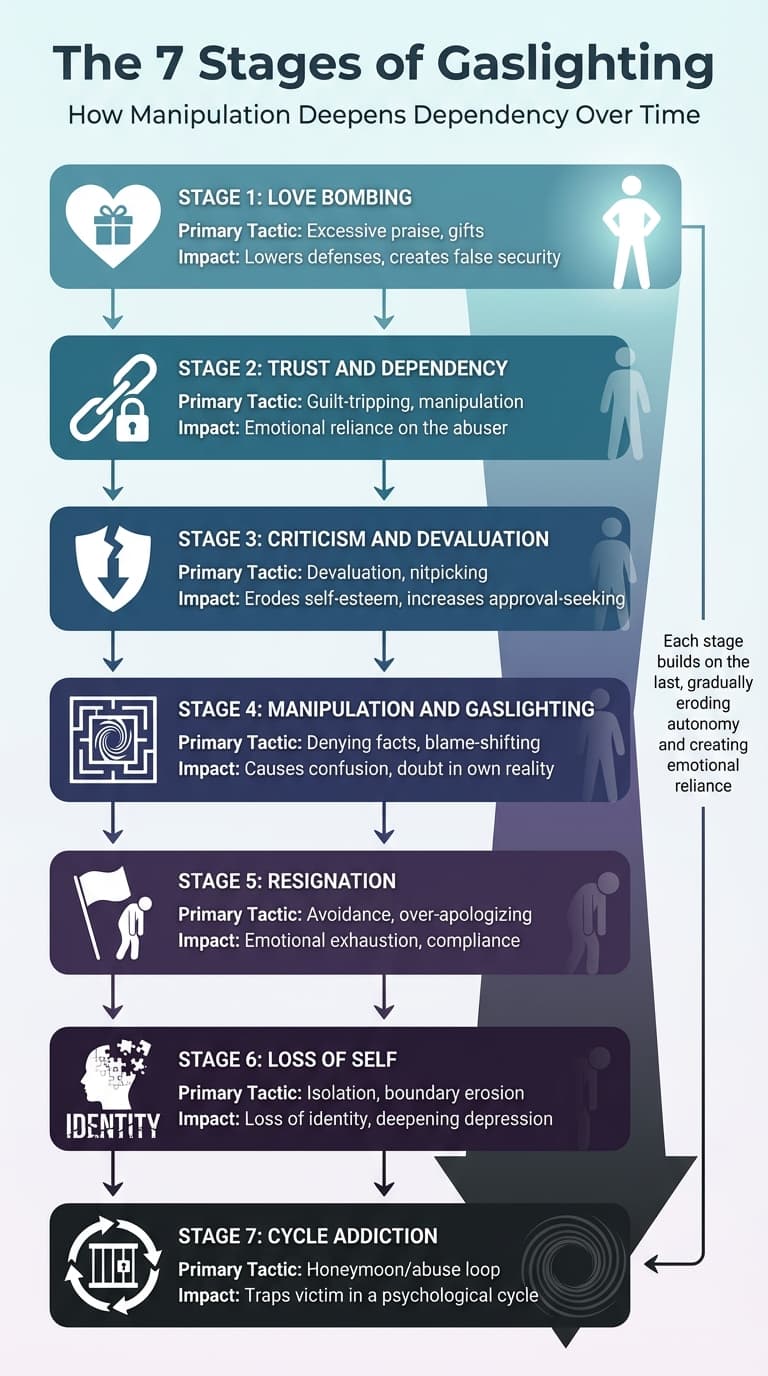
Gaslighting doesn’t happen all at once - it unfolds in a series of deliberate steps that deepen the victim's dependency on the manipulator. Each stage builds on the last, gradually eroding autonomy and creating emotional reliance. Recognizing these stages can help you identify where you might be in the cycle and understand what could happen next if the pattern continues.
The 7 Stages of Gaslighting
Gaslighting typically follows a clear progression, starting with charm and ending in emotional entrapment.
Stage 1: Love Bombing begins with overwhelming affection, compliments, and attention that create a false sense of security. This stage is designed to lower your defenses. As Susan Knapp, a marriage and family therapist, explains:
"The individual is establishing that strong connection by bombarding you with excessive compliments and praise. It exploits their deepest wants and fantasies about what a relationship is supposed to be" – Susan Knapp[10]
Stage 2: Trust and Dependency introduces guilt-tripping tactics, like saying, "After all I’ve done for you", to create emotional reliance on the abuser[10][11].
Stage 3: Criticism and Devaluation follows, where subtle or overt attacks chip away at self-esteem, leaving you desperate for the manipulator’s approval[12][13].
Stage 4: Manipulation and Gaslighting distorts reality. The abuser denies facts, shifts blame, and makes you question your memory. When you express frustration, they accuse you of being "unstable", a tactic known as reactive abuse[11][14].
Stage 5: Resignation marks the point where you begin to comply and over-apologize just to avoid further conflict[10][14].
Stage 6: Loss of Self occurs as isolation deepens and the gaslighter becomes your only point of reference. Your identity and boundaries start to disappear[10][13].
Finally, Stage 7: Cycle Addiction traps you in a loop of abuse followed by apologies and fleeting moments of affection. This intermittent reinforcement creates a psychological and biological addiction to the relationship itself[10][13].
| Stage | Primary Tactic | Impact on Victim |
|---|---|---|
| 1. Love Bombing | Excessive praise, gifts | Lowers defenses, creates false security |
| 2. Trust/Dependency | Guilt-tripping, manipulation | Emotional reliance on the abuser |
| 3. Criticism | Devaluation, nitpicking | Erodes self-esteem, increases approval-seeking |
| 4. Gaslighting | Denying facts, blame-shifting | Causes confusion, doubt in own reality |
| 5. Resignation | Avoidance, over-apologizing | Emotional exhaustion, compliance |
| 6. Loss of Self | Isolation, boundary erosion | Loss of identity, deepening depression |
| 7. Cycle Addiction | Honeymoon/abuse loop | Traps victim in a psychological cycle |
This progression creates a foundation for trauma bonding, where the manipulator becomes both the cause of your pain and the only perceived source of relief.
What Is Trauma Bonding?
Trauma bonding is a deeply unhealthy emotional attachment that forms when cycles of abuse are mixed with moments of affection. Unlike healthy relationships, which are built on consistent trust and mutual respect, trauma bonding thrives on unpredictability. The abuser alternates between cruelty and kindness, reinforcing the cycle of dependency[11][13].
As described by The Attachment Project:
"The target is now conditioned to endure abuse to regain positive reinforcement. They may even believe that they have a sense of control over their abuser's actions, as they know that apologizing and acting meek will gain their abuser's approval" – The Attachment Project[11]
This dynamic is further fueled by cognitive dissonance: on one hand, you recognize the mistreatment, but on the other, you believe the abuser’s claims that you’re "overreacting." Over time, the gaslighter becomes both the source of your suffering and the only person who can offer comfort.
Research shows this cycle can lead to physical changes in the brain, particularly in the limbic system, causing symptoms like brain fog and dissociation[14]. Breaking free means understanding that this bond isn’t love - it’s a survival response to manipulation.
Healthy Relationships vs. Gaslighting Relationships
Building on the gaslighting tactics discussed earlier, it becomes clearer how manipulation fosters dependency. Understanding the difference between healthy conflicts and gaslighting patterns is key to recognizing when normal disagreements cross the line into emotional abuse. While healthy conflicts aim to resolve issues and strengthen mutual understanding, gaslighting works to maintain control and erode your confidence.
Behavior Patterns in Gaslighting Relationships
Gaslighting relies on one partner asserting dominance by undermining the other's confidence and self-trust, effectively making them dependent on the gaslighter’s version of events. Unlike constructive disagreements where both parties seek resolution, gaslighting is rooted in control. Marriage and family therapist Aki Rosenberg explains:
"Gaslighting at its core is always about self-preservation and the maintenance of power/control - namely, the power/control to construct a narrative that keeps the gaslighter in the 'right' and their partner in the 'wrong.'" – Aki Rosenberg, LMFT [15]
This manipulation starkly contrasts with the balanced communication that defines healthy relationships.
Isolation plays a significant role in gaslighting. Gaslighters often discredit their victim’s experiences by portraying them as unstable to friends and family, ensuring that others won’t validate their perspective [2]. Many victims resort to recording conversations or keeping detailed notes just to confirm that their reality is, in fact, real [25, 6, 27].
To better understand these dynamics, let’s look at how the behavior patterns in gaslighting relationships differ from those in healthy ones.
Table: Comparing Healthy and Gaslighting Relationship Dynamics
| Feature | Healthy Relationship | Gaslighting Relationship |
|---|---|---|
| Conflict Goal | Resolution and mutual understanding | Dominance, control, and being "right" |
| Reality | Both partners' perceptions are valued | One partner's reality is denied or distorted |
| Accountability | Both partners take responsibility and apologize | Blame is shifted; the abuser never apologizes |
| Communication | Active listening and addressing concerns | Nonconstructive debate and avoidance |
| Emotional State | Feeling heard and valued even when upset | Feeling confused and doubting oneself |
| Support System | Encourages connections with friends and family | Isolates the victim to deepen dependency |
| Sense of Self | Fosters growth, agency, and independence | Erodes self-esteem and creates feelings of worthlessness |
Healthy relationships thrive on mutual respect and a shared effort to address both partners’ experiences, even during disagreements [7]. On the other hand, gaslighting relationships aim to erase the victim’s sense of reality, leaving only the abuser’s narrative as “truth.” This manipulation fosters dependency - when you can’t trust your own perceptions, you’re left relying on the person who’s distorting them.
Detect Manipulation in Conversations
Use AI-powered tools to analyze text and audio for gaslighting and manipulation patterns. Gain clarity, actionable insights, and support to navigate challenging relationships.
Start Analyzing NowUsing AI Tools to Detect and Escape Gaslighting
Gaslighting can make you doubt your own reality, eroding trust in your perceptions. In these situations, AI-powered tools can offer a fresh perspective by identifying manipulative tactics. These tools use machine learning to detect behaviors like blame-shifting, DARVO (Deny, Attack, Reverse Victim and Offender), emotional invalidation, and memory distortion during conversations.
Statistics show the long-term impact of gaslighting: 74% of victims experience lasting trauma, many stay in manipulative relationships for over two years, and 60% initially fail to recognize the abuse [16]. While these tools aren’t a replacement for therapy, they provide much-needed validation when your reality feels constantly undermined. By working alongside traditional recovery methods, they help rebuild self-trust.
Behavioral scientist Samantha Parnham, founder of Tether, highlights the potential of AI in this context:
"Emotional abuse has patterns. And AI is really good at patterns - if we teach it what to look for." [17]
With real-time analysis, these tools uncover abusive patterns, giving you the clarity and confidence to set boundaries.
How Gaslighting Check Works

Gaslighting Check uses advanced text and voice analysis to identify manipulation tactics like denial and blame-shifting. Whether you upload text exchanges or record phone calls, the AI reviews these interactions to flag subtle tactics that might otherwise go unnoticed.
The platform generates detailed reports with actionable insights. Dr. Stephanie A. Sarkis emphasizes the importance of this:
"Identifying gaslighting patterns is crucial for recovery. When you can recognize manipulation tactics in real-time, you regain your power and can begin to trust your own experiences again." [16]
For those using the Premium plan, the conversation history tracking feature is particularly helpful. It allows you to spot recurring patterns over time, rather than viewing each incident in isolation.
Privacy is a top priority. All data is encrypted end-to-end and automatically deleted, ensuring your confidentiality. Using the platform in Incognito mode or private browsing adds another layer of discretion, leaving no digital traces behind.
This combination of real-time insights and secure analysis empowers you to reclaim control over your experiences.
Plans and Features Comparison
Here’s a breakdown of the available plans and their key features:
| Plan | Monthly Cost | Key Features | Best For |
|---|---|---|---|
| Free | $0 | Basic text analysis, limited insights | Occasional checks or trying out the platform |
| Premium | $9.99 | Text & voice analysis, detailed reports, conversation history tracking | Comprehensive protection and tracking |
| Enterprise | Custom | All Premium features, custom integrations, enhanced security | Therapists, support groups, organizations |
The Free plan is a great way to explore the platform’s capabilities. For those dealing with frequent gaslighting, the Premium plan offers advanced features like voice analysis and conversation history tracking - especially useful when tone and inflection are used manipulatively. Meanwhile, the Enterprise plan caters to professionals, such as therapists or support groups, with added security and organizational tools.
With its privacy safeguards and tailored features, Gaslighting Check equips individuals and professionals alike with the tools needed to break free from manipulative dynamics.
Recovering from Gaslighting
Long-Term Effects of Gaslighting
Gaslighting can leave emotional wounds that linger long after the relationship ends. Studies show that victims often suffer from "testimonial injustice", a state where they begin questioning their own perceptions. This can lead to a fractured sense of identity, loss of personal interests, diminished self-worth, and even a struggle to set goals. These effects often manifest as anxiety, depression, and a disorienting sense of living in an alternate reality [2] [1].
Shockingly, about 30% of participants in one study identified their parents as their primary gaslighters, highlighting how these behaviors can take root in childhood [2]. As Sarah Swenson, MA, LMHC, explains:
"The greatest price she may pay for her partner's gaslighting is this: she now doubts her own judgment" [19]
Isolation only deepens these scars. Without access to supportive friends, family, or outside perspectives, victims often lack the validation needed to challenge the gaslighter’s narrative. Sociologist Paige L. Sweet describes this as a "breeding ground" for gaslighting [2]. Acknowledging the depth of these effects is the first step toward reclaiming your independence.
Steps to Regain Independence
Overcoming the damage caused by gaslighting requires deliberate action. One essential step is breaking free from the need for the gaslighter’s approval. Trauma-informed therapist Amelia Kelley, Ph.D., advises:
"Choosing not to go to the gaslighter for confirmation is the first step in reclaiming your self-esteem" [18]
Start by documenting interactions - write down conversations, save texts, and take screenshots. Having a clear record can help you separate reality from the gaslighter’s distortions. Robin Stern, Ph.D., co-founder of the Yale Center for Emotional Intelligence, emphasizes:
"As soon as you understand that it doesn't matter how right you are, the closer you will be to freedom" [3]
Building a support network is equally important. Confide in trusted friends, family, or a therapist, and practice self-compassion by speaking to yourself as kindly as you would to a loved one.
Setting firm boundaries is another key step. Learn to disengage from power struggles. Psychologist Chivonna Childs, Ph.D., offers this advice:
"A fire cannot burn if there's no fuel. They can't fight if there's no one to fight with" [4]
Use short, neutral phrases like "I see it differently" or "I'm not going to argue about this" to avoid being drawn into unproductive conflicts.
| Action | Purpose | Implementation |
|---|---|---|
| Truth Sorting | Clarify reality and challenge distortions | Record conversations verbatim as soon as they happen. |
| Boundary Setting | Regain control and stop manipulation | Use neutral phrases to end arguments and walk away. |
| Reality Testing | Combat self-doubt and isolation | Share your experiences with a trusted support group. |
| Self-Care | Heal emotionally and physically | Practice grounding techniques and affirmations daily. |
Rebuilding trust in your own judgment is a cornerstone of recovery [19]. Grounding techniques like deep breathing or meditation can help re-center your thoughts [4]. Working with a therapist who specializes in manipulative behaviors or narcissistic personality disorders can provide further support in addressing trauma and rebuilding your confidence. Additionally, practical resources - such as safe housing, financial assistance, and community services - can help reduce dependency on the abuser and create a path toward independence [2].
Conclusion
Gaslighting operates through a mix of denial, distortion, isolation, and attacks on credibility, leaving victims doubting their own thoughts and relying on the abuser to define reality. Research highlights the prevalence of this behavior: in a survey of 2,875 individuals facing intimate partner violence, 85.7% reported being called "crazy" by their partner, while 73.8% believed their partner intentionally made them feel as though they were losing their mind [6][2][20].
Recognizing these patterns is key to breaking free. Gaslighting thrives when the manipulator controls your sense of reality. By understanding this dynamic, you can begin to take steps toward regaining control and clarity.
Tools like Gaslighting Check can provide external validation to help distinguish manipulated perceptions from reality. With features such as text and voice analysis, detailed reports, and conversation history tracking, this platform enables users to document interactions and spot manipulation tactics in real time. It offers a practical way to counteract the distortions often imposed by gaslighters [6][7].
Recovery, however, takes intentional effort. Start by documenting interactions, setting clear boundaries, and seeking professional support. Rebuilding your support system with trusted friends and family is vital in countering the isolating effects of manipulation. The ultimate antidote to gaslighting lies in reclaiming your truth - your perceptions, your emotions, and your self-worth. Taking back this truth is a powerful step toward independence and healing [7].
FAQs
How can I tell if I’m being gaslighted?
Gaslighting often reveals itself through subtle emotional and psychological patterns. One key indicator is when you start doubting your own memories or decisions because someone repeatedly denies or twists your perception of reality. This can leave you feeling confused, anxious, or second-guessing your own judgment.
Other warning signs include behaviors like manipulation, shifting blame, guilt-tripping, or dismissing your emotions as invalid. Tools such as Gaslighting Check can be useful in identifying manipulative patterns in conversations, helping you gain clarity and spot these toxic behaviors. Recognizing these signs is a crucial step toward addressing and confronting gaslighting in your relationships.
What are the first steps to break free from gaslighting in a relationship?
Breaking free from gaslighting starts with acknowledging the manipulation and focusing on your well-being. A practical first step is to document specific instances of gaslighting. Writing down what happened, how it made you feel, and any patterns you notice can help validate your experiences and reduce feelings of confusion or self-doubt.
It's also important to lean on someone you trust - whether that's a close friend, a family member, or a mental health professional. These individuals can offer emotional support and help you navigate the situation with clarity. Additionally, creating a safety plan tailored to your needs can make a big difference. This might involve setting clear boundaries, preparing for emotional challenges, and identifying professional resources to turn to if necessary.
By taking these steps, you're equipping yourself with the tools to regain control and work toward a healthier, more confident future.
What are the long-term mental health effects of gaslighting?
Gaslighting can deeply affect mental health, often leaving people feeling disoriented, unsure of themselves, and questioning their grasp on reality. Over time, this form of emotional manipulation can chip away at self-confidence, foster persistent self-doubt, and even contribute to mental health struggles like anxiety and depression.
The effects don’t necessarily stop when the gaslighting ends. Many individuals continue to face difficulties trusting themselves and others, which can make building healthy relationships and maintaining emotional balance a real challenge. Spotting these signs early and seeking help - whether through therapy or tools aimed at identifying manipulation - can play a key role in the healing process.