Why Gaslighting Survivors Struggle With Self-Trust

Why Gaslighting Survivors Struggle With Self-Trust
Gaslighting undermines your ability to trust yourself by distorting your sense of reality. Survivors are left doubting their memories, emotions, and decisions, often internalizing the manipulation as self-blame. This form of psychological abuse disrupts brain processes, creating long-term emotional and cognitive challenges. Recovery involves rebuilding self-trust through validation, mindfulness, cognitive restructuring, and setting boundaries. Tools like Gaslighting Check can help identify manipulation and support healing. If you're facing abuse, reach out to trusted resources like the National Domestic Violence Hotline at 1-800-799-7233. Recognizing the effects of gaslighting is the first step toward reclaiming your confidence and clarity.
The Gaslight Effect: Gaslighting, Anxiety, & Self-Trust with Dr. Robin Stern | Dealing With Feeling
How Gaslighting Creates Self-Doubt
::: @figure
Reality Distortion and Cognitive Dissonance
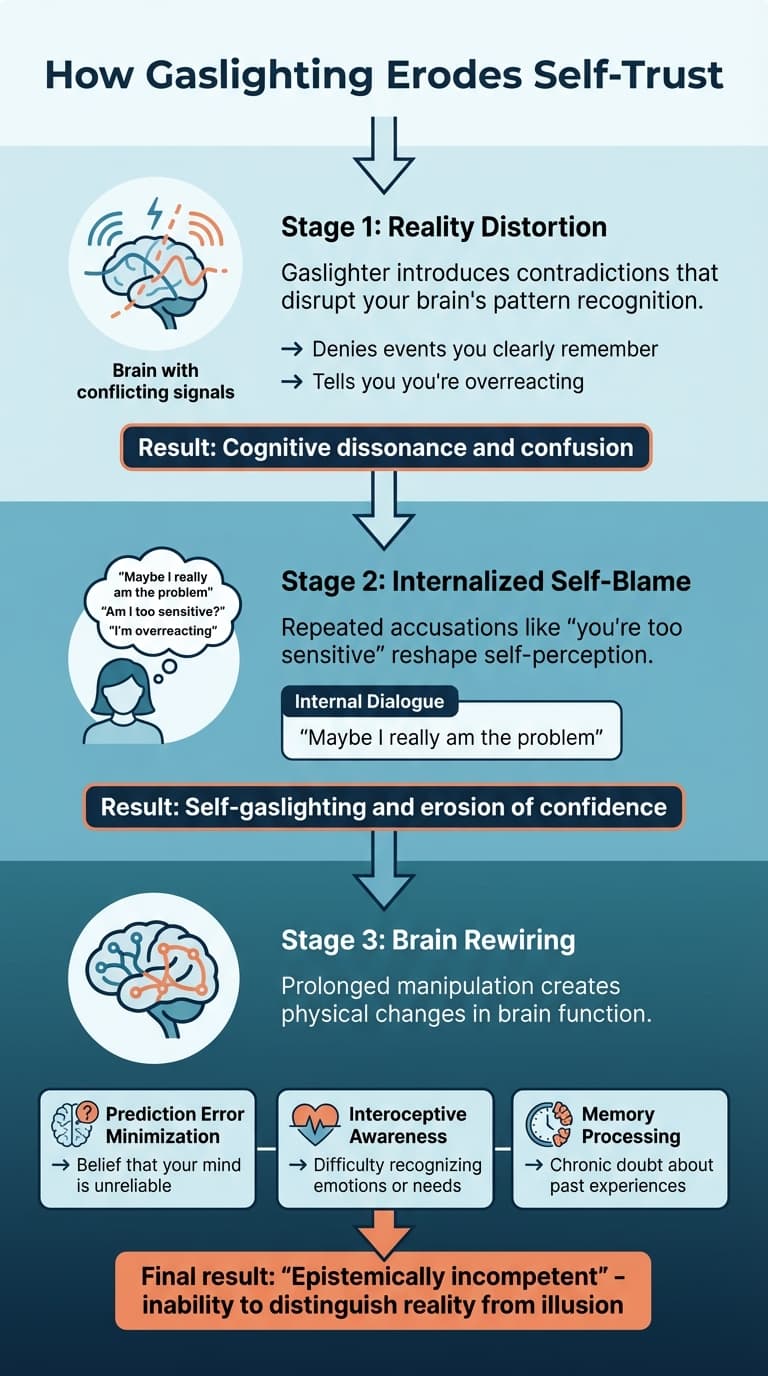
Our brains rely on patterns and expectations built from past experiences to make sense of the world. Gaslighters disrupt this process by introducing contradictions that throw us off balance. For example, imagine someone you trust denies an event you clearly remember or tells you you're overreacting to something hurtful. Your brain struggles to reconcile these contradictions, creating confusion. As Klein explains, this unexpected behavior forces victims into a state of uncertainty, reinforcing feelings of self-doubt [3].
This confusion leads to cognitive dissonance - a psychological discomfort caused by holding two conflicting beliefs. On one hand, you know what you experienced. On the other, someone you trust insists it didn’t happen that way. To ease this tension, many victims begin questioning their own perceptions, eventually believing their memories and feelings are unreliable. This mental conflict often spirals into self-blame, eroding self-trust and leaving deeper emotional scars.
Internalized Self-Blame
Once your reality feels shaky, self-blame often takes root. Repeated accusations like “you’re too sensitive” can reshape how you see yourself. Over time, survivors may internalize these criticisms, thinking, "Maybe I really am the problem. If I weren’t so emotional, things would improve." This shift in self-perception turns external manipulation into what researchers call "self-gaslighting" [2].
Oddly enough, blaming yourself can feel like a way to regain control. If you believe you're at fault, it might seem possible to "fix" the situation. But this mindset only deepens the cycle of manipulation. Dr. Chivonna Childs from Cleveland Clinic explains how this process undermines your confidence:
"question your self-worth, self-esteem and mental capacity" [5].
The gaslighter’s voice becomes an internal critic, constantly doubting your thoughts and decisions. This psychological toll is so profound that it even creates physical changes in the brain.
Brain Changes From Prolonged Manipulation
The persistent self-doubt caused by gaslighting doesn’t just affect your emotions - it actually rewires how your brain processes information. According to research based on the Prediction Error Minimization (PEM) model, gaslighting hijacks your brain’s natural learning mechanisms [3]. Normally, your brain uses “prediction errors” (moments when reality doesn’t match expectations) to update its understanding of the world. But when someone repeatedly creates these errors and blames you for the confusion, your brain starts to believe a damaging narrative: that you’re “epistemically incompetent” [3][1]. In other words, you might come to think you’re incapable of distinguishing reality from illusion.
This mental shift impacts key areas of brain function. Memory becomes unreliable, decision-making feels overwhelming, and even recognizing your own emotions becomes a struggle. Gaslighting disrupts interoceptive awareness - your ability to sense internal signals like heart rate, tension, or emotional states [4]. The result? Your brain learns to distrust itself, a pattern that can linger long after the gaslighting ends.
| Brain-Based Process | How Gaslighting Affects It | Result |
|---|---|---|
| Prediction Error Minimization | Exploits confusion to reshape learning | Belief that your mind is unreliable |
| Interoceptive Awareness | Breaks connection to internal signals | Difficulty recognizing emotions or needs |
| Memory Processing | Repeated denials of events | Chronic doubt about past experiences |
What Makes People Vulnerable to Gaslighting
Low Self-Esteem and Past Trauma
People with low self-esteem are more susceptible to gaslighting. Thoughts like "I'm not good enough" or "I must be wrong" create fertile ground for manipulation[6]. These internal doubts make it easier for gaslighters to plant seeds of uncertainty.
Past trauma adds another layer of vulnerability. Survivors often develop self-gaslighting habits as a way to cope, downplaying negative experiences and reinforcing their own self-doubt. For example, someone who grew up with a parent who was both loving and abusive might have learned to accept mixed signals. This early confusion - being praised one moment and criticized the next - can make them more accepting of the same tactics gaslighters use, like alternating between harsh criticism and excessive flattery. These ingrained patterns of doubt can make it harder to recognize or resist manipulation in relationships.
Dependency and Fear of Conflict
Personal insecurities aren’t the only factor. Relationship dynamics also play a big role. Avoiding conflict and suppressing personal needs can lead to dependency. This "walking on eggshells" behavior creates an environment where gaslighters can maintain control without much resistance[5]. Dr. Amelia Kelley, PhD, a trauma-informed therapist and author, describes this cycle:
"The persistent manipulation can create a cycle of self-doubt and dependency."[7]
Isolation from supportive friends or family makes things even worse. Without outside perspectives, individuals can feel trapped in the gaslighter’s version of reality. Attempts to assert independence are often met with punishment, further reinforcing the cycle[5]. Interestingly, research shows that those with strong family support are much less likely to fall victim to gaslighting[6]. Having a reliable support system can act as a buffer against manipulative tactics.
Detect Manipulation in Conversations
Use AI-powered tools to analyze text and audio for gaslighting and manipulation patterns. Gain clarity, actionable insights, and support to navigate challenging relationships.
Start Analyzing NowHow to Rebuild Self-Trust: Research-Backed Strategies
After recognizing how gaslighting can erode self-trust, these strategies, grounded in research, can help you rebuild confidence in your own perceptions and feelings.
Validating Your Experiences
Seeking external validation is often a crucial first step. Hearing others acknowledge your experiences helps you separate reality from the distorted version presented to you. Therapy provides a safe space where your emotions and experiences are validated, while support groups connect you with individuals who have faced similar manipulation. These connections can be incredibly grounding.
Once you've started to rebuild trust through external validation, mindfulness practices can help you reconnect with your inner truth.
Mindfulness and Cognitive Restructuring
Mindfulness techniques encourage you to observe your thoughts and feelings without judgment, helping you reestablish trust in your internal compass. Practices like paying attention to physical sensations or naming your emotions can counteract the self-doubt gaslighting creates.
Cognitive restructuring takes this a step further by helping you challenge the self-critical thoughts planted by manipulation. Dr. Chivonna Childs, a psychologist at Cleveland Clinic, explains:
"Gaslighting is a form of emotional manipulation to make you feel as if your feelings aren't valid, or that what you think is happening isn't really happening. Over time, you start to question your self-worth, self-esteem and mental capacity." [5]
Working with a therapist can help you identify these harmful thought patterns - like automatically assuming, "I must be wrong" - and replace them with more balanced perspectives.
Setting Boundaries and Reclaiming Autonomy
Learning to set boundaries is another key step in regaining self-trust. Assertiveness training can help you express your needs clearly and confidently without feeling the need to over-explain. Start with small steps, such as saying "no" to minor requests or using "I" statements like, "I feel overwhelmed when you call during work hours." Each boundary you establish reinforces your sense of autonomy and validates your needs.
How Technology Can Help: Tools Like Gaslighting Check

Technology can play a supportive role in rebuilding trust in your perceptions. Tools like Gaslighting Check provide objective analysis of conversations, helping you identify manipulation tactics such as blame-shifting, deflection, and DARVO (Deny, Attack, and Reverse Victim and Offender).
This tool allows you to record and encrypt conversations with timestamps, creating a reliable record you can review later to spot patterns of manipulation. Reports generated by the tool can serve as a reality check when someone accuses you of overreacting. These reports can even be exported (a feature planned for late 2025) to share with your therapist, offering concrete evidence to support your recovery.
Gaslighting Check offers a Free plan with basic text analysis, while the Premium plan, priced at $9.99/month, includes features like voice analysis and conversation history tracking. By using technology to document interactions and validate your instincts, tools like this can complement the personal strategies discussed earlier, helping you move away from the manipulator's narrative and toward trusting your own judgment.
Long-Term Effects of Gaslighting and Recovery
The aftermath of gaslighting lingers far beyond the immediate experience, leaving survivors to grapple with its effects during their recovery journey.
Chronic Emotional Consequences
The emotional scars of gaslighting often persist long after the abuse ends. Survivors frequently deal with heightened hypervigilance, especially in new relationships. This constant state of alertness can make trusting others feel like a daunting, almost impossible task. On top of that, many survivors find themselves struggling to make even the simplest decisions - an echo of having their judgment repeatedly questioned and dismissed.
Gaslighting’s impact isn’t just emotional; it can also leave a physical mark on the brain. Chronic stress caused by the abuse can alter brain structures like the prefrontal cortex, hippocampus, and temporal lobe, further fueling doubt in one’s memory and perception.
Post-Traumatic Growth and Self-Rediscovery
Despite these challenges, recovery can lead to profound personal growth. Many survivors find themselves rediscovering a stronger, clearer sense of self. In fact, research involving 65 survivors revealed that those who embraced recovery often reclaimed their identity with greater clarity and resilience[4].
Healing practices like yoga, meditation, and sports play a key role in this transformation. These activities help rebuild interoceptive awareness - the ability to tune into and trust your body’s internal signals. Additionally, taking small, independent steps without seeking external validation can gradually restore self-trust and reinforce autonomy.
Understanding these long-term effects is essential for navigating the healing process and reclaiming a sense of self and trust.
Conclusion: Reclaiming Self-Trust After Gaslighting
Gaslighting preys on your brain’s natural response to unexpected situations, planting seeds of doubt that can distort your confidence in your own perceptions[2]. Over time, this manipulation can deeply undermine trust in yourself.
Healing begins by addressing these distortions head-on. Reconnect with your inner voice through mindfulness, grounding exercises, and seeking validation from trusted sources[4][9]. Studies show that gaslighting can affect anyone, as our brains often depend on close relationships to shape our understanding of reality[3]. With patience, support, and the right tools, you can rebuild your inner clarity and resilience.
Technology can also play a role in recovery. For example, platforms like Gaslighting Check offer secure and detailed analyses of your conversations, helping you identify patterns of manipulation while ensuring your privacy through encryption. These tools provide an additional layer of support as you work toward clarity.
That said, no tool can replace human connection. Reclaiming self-trust requires both personal effort and external support. If you’re facing abuse, reach out to the National Domestic Violence Hotline at 1-800-799-7233[8][5]. As Dr. Chivonna Childs explains:
"Calling out gaslighting behaviors helps set boundaries and change the power dynamic. It puts the other person on notice that you will no longer accept this type of treatment"[5].
Through small, steady steps, survivors can rebuild their self-trust. Many find that they emerge from the experience with a stronger, clearer sense of self.
FAQs
How can I tell if I'm being gaslighted in a relationship?
Gaslighting can be tricky to spot because it often creeps in subtly. It typically involves behaviors that make you doubt your own reality, memories, or feelings. For example, someone might repeatedly deny facts you know are true, brush off your emotions as unimportant, or accuse you of being "too sensitive" when you voice concerns. Over time, these actions can leave you feeling confused, second-guessing yourself, and unsure of your own judgment.
If you sense that your reality is being questioned or dismissed, trust your gut. Look for recurring patterns in the relationship that make you feel this way. It can also help to talk to trusted friends, family members, or a professional who can offer perspective and support as you work to rebuild your confidence and clarity.
How can I start trusting myself again after experiencing gaslighting?
Rebuilding self-trust after experiencing gaslighting is a journey that requires patience and deliberate action. Start by acknowledging what happened and giving yourself permission to feel your emotions. It's important to remind yourself that the manipulation you faced does not determine your value or define who you are.
Establishing firm boundaries is another key step. Protecting your emotional well-being and standing by your decisions can help restore your confidence. Alongside this, practice self-compassion by addressing negative self-talk and embracing the fact that healing takes time. Techniques like mindfulness, journaling, or other reflective activities can be powerful tools for managing emotional triggers and building inner strength.
Lastly, don’t shy away from reaching out for support. Whether it’s a trusted friend, family member, or therapist, having someone to validate your experience and offer guidance can make all the difference as you work toward trusting yourself again.
How does gaslighting impact mental health and self-trust over time?
Gaslighting can take a serious toll on mental health and self-trust by making people second-guess their own perceptions, memories, and decisions. This type of manipulation gradually chips away at confidence, often leaving individuals grappling with self-doubt, anxiety, depression, and a deep sense of isolation. Many survivors find it challenging to trust their own thoughts, which can disrupt their emotional balance and leave them feeling lost.
When gaslighting continues over time, it can also interfere with cognitive abilities like self-awareness and emotional regulation, making it even harder to rebuild trust in oneself. Recovering from such experiences often requires focused support and deliberate strategies to regain confidence and strengthen psychological resilience.