
Gaslighting and Mental Health: Anxiety and Trauma Links
Gaslighting is a psychological manipulation tactic designed to make you doubt your perceptions, feelings, and reality. It’s not just emotionally harmful - it can lead to long-term mental health issues, including anxiety, PTSD, and depression.
Key takeaways:
- Gaslighting tactics: Examples include denial ("I never said that"), trivializing feelings ("You're too sensitive"), and blame-shifting ("This is your fault").
- Mental health impact: Victims often experience chronic self-doubt, emotional instability, and symptoms resembling PTSD.
- Trauma link: Gaslighting erodes self-trust, leading to anxiety, stress, and long-term emotional damage.
- Research findings: Studies show a moderate correlation between gaslighting and PTSD (r = .32) and depression (r = .27).
- Tools for recovery: Documenting interactions, seeking therapy, and building supportive relationships are vital for healing.
Gaslighting undermines your sense of reality, but recognizing the tactics and their effects can help you regain control and begin the recovery process.
::: @figure
What Is Gaslighting?
Definition and Common Signs
Gaslighting is a form of psychological manipulation aimed at distorting your memory, perception, and even your sense of reality to gain control over you [10]. It’s not a one-time act but a subtle, repetitive process that gradually chips away at your ability to trust your instincts and judgments.
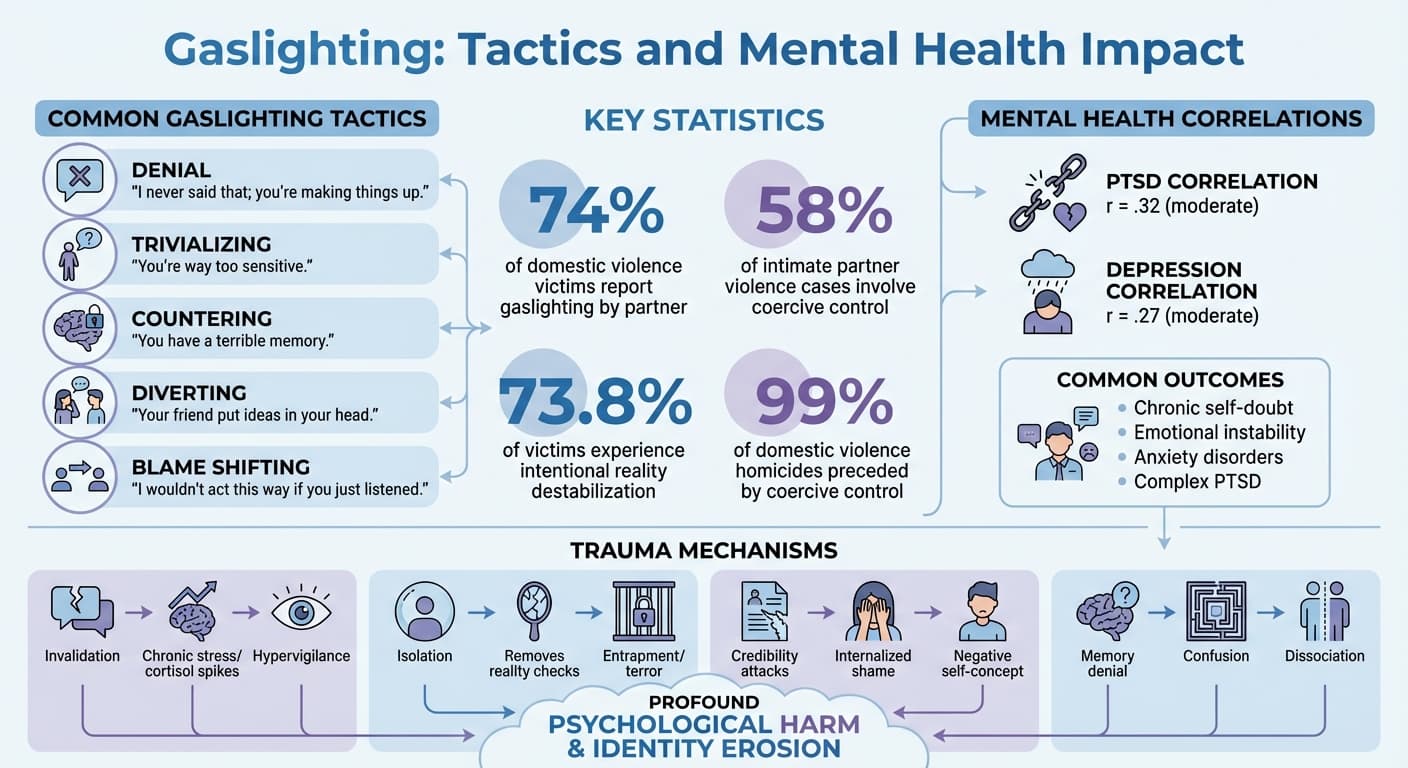
Here’s a breakdown of common gaslighting tactics:
| Gaslighting Technique | Description | Common Phrase Used |
|---|---|---|
| Denial | Rejects events or statements as if they never happened. | "I never said that; you're making things up." |
| Trivializing | Dismisses your feelings or concerns as insignificant. | "You're way too sensitive." |
| Countering | Questions your memory of specific events to sow doubt. | "You have a terrible memory." |
| Diverting | Changes the subject to avoid taking responsibility. | "You're only saying that because your friend put ideas in your head." |
| Blame Shifting | Makes you feel at fault for their behavior. | "I wouldn’t act this way if you just listened." |
Recognizing these tactics is crucial because they are designed to destabilize your mental health. Research reveals that 74% of women who have experienced domestic violence also report being subjected to gaslighting by their partner or former partner [11]. The term gained so much attention that Merriam-Webster named "gaslighting" the 2022 Word of the Year, reflecting its growing presence in public conversations [11].
These manipulations don’t just twist facts - they actively undermine your mental stability, as explained further below.
How Gaslighting Affects the Mind
The techniques listed above create a foundation for deeper psychological harm. Gaslighting works by breaking down your confidence in your own perceptions and sense of reality. This makes it a particularly damaging form of abuse, as it targets your understanding of truth itself [8][2]. Over time, the gaslighter’s distorted version of events can replace your own, leading you to question your thoughts and even adopt their perspective [3][5].
For instance, a study conducted with 251 young Italian women found that gaslighting significantly correlates with poorer mental health and overall well-being [2]. Victims often experience effects similar to PTSD [5], as the constant distortion of reality erodes their ability to trust their own experiences and emotions.
Some individuals may even develop "self-gaslighting", where they internalize the gaslighter’s voice, doubting their own needs and feelings long after the abuser is gone [10]. This internalized doubt becomes a breeding ground for anxiety, trauma, and a loss of self-trust, making recovery an uphill battle.
How Gaslighting Leads to Anxiety Disorders
Effects on Mental Well-being
When someone constantly makes you question your perception of reality, it can throw your mind into overdrive. This state of hypervigilance disrupts how you process and interpret everyday experiences. Gaslighting specifically targets your confidence as a "knower", making you doubt the very foundation you rely on to navigate life [8].
The effects of gaslighting are deeply personal and unsettling. You might find yourself second-guessing even the smallest choices, leading to a cascade of self-doubt. A 2024 study involving 251 women revealed that gaslighting significantly undermines both mental health and overall well-being [2].
Gaslighters often exploit your emotional responses, twisting them to support their claims that you’re unstable or irrational [3]. As domestic violence survivor Selah described:
"They live in an alternate reality. And they want you to live there with them" [3]
This manipulation fuels a cycle of shame and uncertainty, leaving you questioning your sense of self. Research shows that coercive control, which includes gaslighting, is present in up to 58% of intimate partner violence cases. It's also moderately linked to PTSD symptoms (r = .32) and depression (r = .27) [9].
The Cycle of Stress and Anxiety
Gaslighting creates a mental environment where stress and anxiety feed off each other. As your ability to trust your own judgment erodes, you’re left stuck in a fight-or-flight state. This constant state of alertness drains your mental energy and makes relaxation feel impossible [15].
Isolation only deepens the problem. Without outside perspectives to validate your experiences, you may begin to rely solely on the abuser’s distorted version of reality [3][1]. Over time, this can lead to internalizing their perspective, convincing yourself that your emotions are irrational or invalid [5]. This internalization often triggers a "fawn response", where you focus on appeasing the abuser to avoid conflict [15]. Even after the abuse ends, the emotional scars remain, leaving you feeling unstable and unsure.
Dr. Chivonna Childs, a psychologist at Cleveland Clinic, sheds light on the experience:
"The person who's doing the gaslighting may or may not realize they're doing it. But either way, when you're on the receiving end, it can feel confusing and be very damaging" [1]
That confusion isn’t a personal failing - it’s a natural response to prolonged psychological manipulation. Gaslighting undermines your sense of reality, leaving you trapped in a maze of doubt and emotional pain.
Gaslighting and Trauma: Links to PTSD
Damage to Self-Trust and Emotional Control
Gaslighting fundamentally disrupts your ability to trust yourself. It targets your confidence in your own perceptions and memories, which researchers call "testimonial injustice" - a state where you begin to doubt your own narrative entirely [3][8]. This manipulation doesn’t just shake your confidence; it rewires how you see and process reality.
When your sense of reality is constantly undermined, your autonomy and decision-making take a hit [2]. Survivors often describe their lives as trapped in a "surreality", a distorted environment where truth feels out of reach [9]. This chronic uncertainty leaves you unable to trust the mental tools you rely on every day.
The psychological toll of gaslighting is profound. It’s closely tied to Complex PTSD (CPTSD), a condition that goes beyond the typical symptoms of PTSD - like flashbacks and avoidance. CPTSD includes persistent emotional instability, a deeply negative self-image, and difficulty maintaining healthy relationships. These added layers of trauma make recovery even more challenging.
| Gaslighting Mechanism | Direct Impact | Trauma Response |
|---|---|---|
| Invalidation | Triggers chronic stress and spikes in cortisol | Leads to hypervigilance and constant alertness |
| Isolation | Removes external reality checks | Creates feelings of entrapment and terror |
| Credibility Attacks | Instills internalized shame and labels like "crazy" | Fuels a negative self-concept (a hallmark of CPTSD) |
| Memory Denial | Causes confusion and disorientation | Results in dissociation from reality |
These effects highlight how gaslighting creates a psychological environment ripe for trauma, setting the stage for long-term emotional damage.
Research Findings on Gaslighting and Trauma
The link between gaslighting and trauma isn’t just anecdotal - there’s solid research to back it up. A meta-analysis of 45 studies revealed a moderate connection between coercive control (a category that includes gaslighting) and PTSD, with a correlation of r = .32 [9]. The same analysis also found a similar link to depression (r = .27) [9].
Coercive control is alarmingly common, occurring in up to 58% of relationships involving intimate partner violence [9]. Even more alarming, a study of domestic violence homicides in New South Wales (2008–2016) found that 99% were preceded by coercive control [4].
These findings emphasize that gaslighting isn’t just emotionally damaging - it can escalate into life-threatening situations. The psychological harm it causes doesn’t fade quickly, often persisting long after the abuse ends. Addressing these deep wounds requires specialized, trauma-informed therapy to repair the damage done to one’s sense of reality [8].
Research Studies on Gaslighting and Mental Health
2024 Study on Gaslighting in Young Adults
In 2024, a study involving 177 Italian young adults (ages 19–26) revealed that gaslighting causes more than just typical social conflicts - it leads to intense emotional and psychological distress. Victims often experience severe confusion about reality, and in extreme cases, symptoms resembling psychosis [14].
The study also shed light on the personality traits of those most likely to engage in gaslighting. A 2025 study of 315 Australian participants identified primary psychopathy, Machiavellian tendencies, and sadism as the strongest predictors of gaslighting behavior [16]. These personality traits help explain why certain individuals deliberately manipulate others' sense of reality. As researcher Evita March explained:
"...ultimately prevents [victims] from seeking support and resources that could help them escape the abuse as they no longer trust their surroundings" [16].
This research underscores the deep mental and emotional toll gaslighting takes on its victims, often leaving them doubting their own perceptions and self-worth.
How Psychological Abuse Affects Self-esteem
Gaslighting has a direct and damaging effect on self-esteem. In fact, 73.8% of individuals in a study reported that their partners intentionally attempted to destabilize their sense of reality [17].
A 2025 cross-sectional study conducted in the UK, involving 544 participants, found a strong connection between gaslighting and depression [7]. Victims frequently internalize the manipulator's perspective, which leads to harmful self-talk and feelings of inadequacy, often believing they are "stupid" or irrational [11]. This internalized shame can isolate victims, cutting them off from supportive friends and family who might help them recognize the abuse.
Together, these findings show how gaslighting can lead to a progression from immediate emotional pain to long-term mental health struggles.
Long-Term Effects of Gaslighting
The harm caused by gaslighting doesn’t stop at short-term emotional distress; it often results in lasting mental health challenges. A 2025/2026 study of 251 young Italian women (average age 38.72) found that gaslighting is a strong predictor of poor psychological health and diminished eudaimonic well-being - the feeling of living a meaningful and fulfilling life [2]. The study also linked gaslighting to higher rates of depression, chronic anxiety, and paranoid thinking [7][5].
There is hope, though. The same research highlighted that self-compassion and strong social support from family or loved ones can help protect against some of these negative effects [2]. This suggests that building supportive relationships and practicing self-kindness are essential steps toward healing from the psychological damage caused by gaslighting.
Detect Manipulation in Conversations
Use AI-powered tools to analyze text and audio for gaslighting and manipulation patterns. Gain clarity, actionable insights, and support to navigate challenging relationships.
Start Analyzing NowMichigan Minds Podcast: 'Gaslighting' and its impact on mental health

How Gaslighting Check Helps Identify Manipulation

Gaslighting can leave you questioning your own reality, but having an objective way to document events can make a big difference. Gaslighting Check provides tools to help you separate your authentic perceptions from a manipulator's distortions. As psychologist Chivonna Childs puts it, "Document interactions... it may help you sort truth from fiction" [1].
Features of Gaslighting Check
This tool uses AI to analyze conversations for specific phrases often tied to manipulation, like "You're so sensitive" or "Stop acting crazy" [13][3]. These linguistic markers can uncover patterns of gaslighting that might otherwise go unnoticed.
Real-time audio recording allows you to capture interactions as they happen, making it easier to verify what was said later [18]. The tool also offers text and voice analysis to identify tactics like denial, blame-shifting, and invalidation [6]. Detailed reports provide a clear view of recurring behaviors, giving you evidence to understand and address the manipulation.
Supporting Mental Health and Recovery
Having concrete evidence can help rebuild self-trust and establish boundaries, shifting the power dynamic in your favor [8][6][3]. Features like end-to-end encryption and auto-deletion ensure your records remain private and secure [18]. By validating your experiences, Gaslighting Check helps restore a sense of control, which is essential for emotional recovery from gaslighting's effects [3].
Conclusion
Gaslighting undermines your ability to trust your own perception of reality. Research shows that 73.8% of domestic violence victims have endured deliberate manipulation designed to make them feel "crazy" [4]. Studies have also linked gaslighting to anxiety disorders and trauma, including PTSD, with moderate correlations between coercive control and both PTSD (r = .32) and depression (r = .27) [9].
It’s important to understand that the confusion you feel is a result of external manipulation, not a reflection of your own mental stability. Recognizing these tactics is a powerful first step toward rebuilding self-trust [8], and it provides a solid starting point for recovery.
Healing takes time. Steps like documenting interactions, practicing self-compassion, and leaning on trusted friends and family can offer crucial support during this process [2][12]. Tools like Gaslighting Check can also help you gather objective evidence to counteract distorted narratives.
Seeking trauma-informed therapy is a key part of addressing the long-term effects of gaslighting. Psychologist Chivonna Childs emphasizes the importance of confronting these behaviors:
"Calling out gaslighting behaviors sets boundaries and shifts the power dynamic, putting the other person on notice that you will no longer accept this treatment." [1]
FAQs
How can I tell if someone is gaslighting me?
Gaslighting can be tricky to spot, but certain patterns can help you identify it. For instance, you may find yourself questioning your own feelings or reactions because someone tells you that you're being too sensitive or unreasonable. Another warning sign is doubting your memory, especially if someone keeps insisting that your version of events is inaccurate. This repeated denial can make you start to question your grip on reality.
Over time, gaslighting can chip away at your self-esteem, leaving you feeling uncertain, invalidated, or reliant on the other person’s narrative. If these behaviors sound familiar, trust your gut and think about reaching out for support to navigate the situation.
What are the long-term effects of gaslighting on mental health?
Gaslighting can leave deep and enduring scars on mental health. Over time, it frequently leads to increased anxiety, emotional trauma, and a weakened ability to trust oneself. Those who experience it often wrestle with confusion, persistent self-doubt, and overwhelming feelings of shame - struggles that can linger even after the gaslighting has stopped.
These psychological effects can also erode emotional stability, making it challenging to trust others or feel confident in one’s own judgment. Identifying and confronting gaslighting is key to reducing its long-lasting effects and fostering recovery.
How can someone start recovering from the effects of gaslighting?
Recovering from gaslighting starts with acknowledging it as a form of emotional abuse and reaching out to people you trust who can affirm your experiences. Having others validate what you've been through is a vital step in rebuilding your confidence and reconnecting with your sense of reality.
Seeking help from a licensed therapist can also be incredibly helpful. Therapy offers a safe space to process the trauma, develop healthy coping mechanisms, and learn how to set boundaries to safeguard yourself from future harm.
On top of that, make self-care and self-compassion a priority. Recovery takes time, so focus on activities that nurture your mental and emotional health. Surround yourself with a supportive network and work on building self-awareness - both are essential in regaining your independence and emotional well-being.