Gaslighting in Friendships: How to Respond

Gaslighting in Friendships: How to Respond
Gaslighting in friendships happens when someone manipulates you into doubting your feelings, memories, or reality. It’s not just a disagreement - it’s a control tactic that can harm your mental health. Common behaviors include dismissing your concerns, denying past events, or making you feel overly sensitive. Over time, this can lead to self-doubt, anxiety, and even physical symptoms like fatigue or headaches.
Key Takeaways:
- Recognize the signs: Withholding, blame-shifting, and dismissing your feelings are red flags.
- Respond effectively: Stay calm, set clear boundaries, and avoid debating your reality.
- Document interactions: Keep records of conversations to track patterns and maintain clarity.
- Evaluate the friendship: If boundaries aren’t respected, consider reducing contact or ending the relationship.
Protecting your emotional well-being starts with trusting your instincts and taking steps to address manipulative behavior. If the friendship consistently leaves you feeling uneasy, it may be time to reassess its value.
::: @figure
What to Do When Your Friend is the Gaslighter
How to Recognize Gaslighting in Your Friendship
Understanding the signs of gaslighting is crucial for protecting your emotional health and regaining a sense of control.
Common Gaslighting Behaviors to Watch For
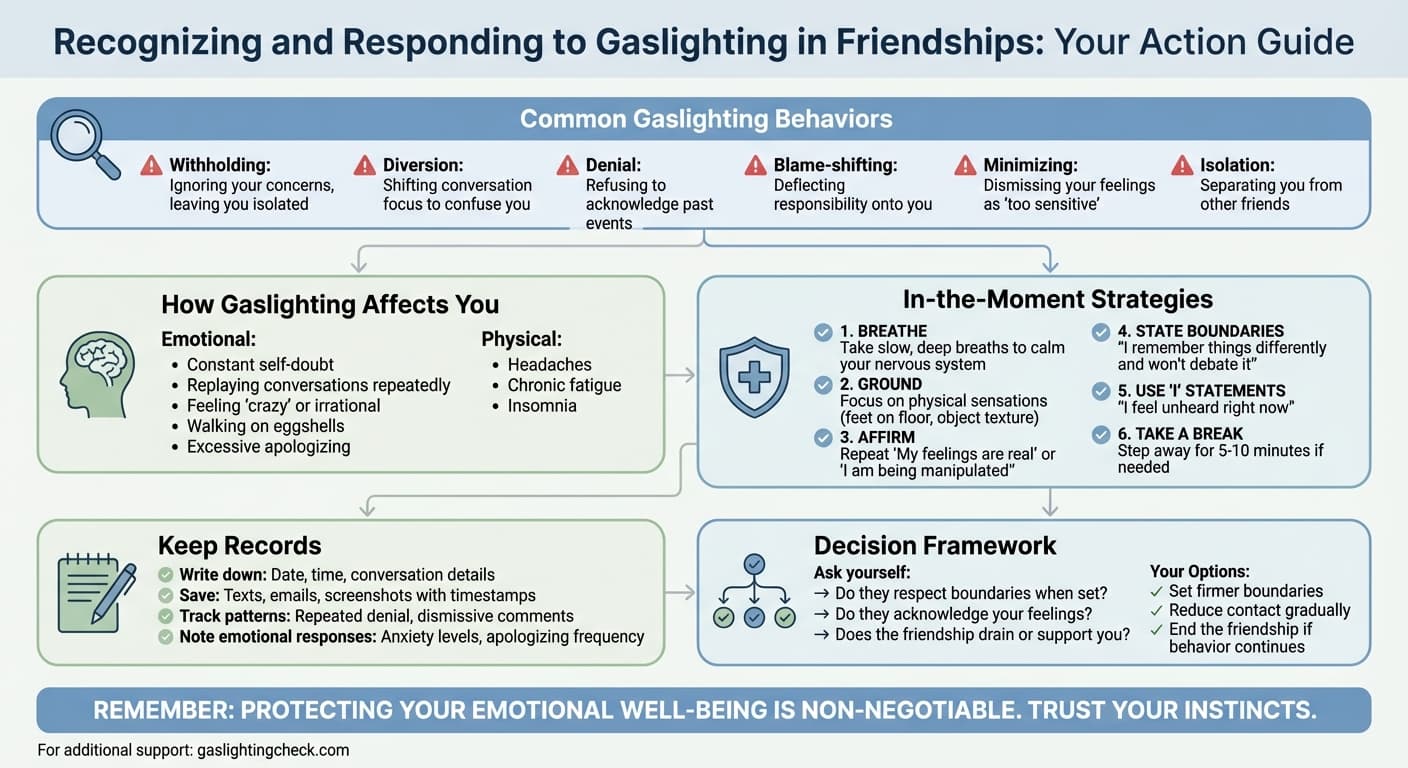
Gaslighting in friendships often involves subtle tactics that make you question yourself. One common method is withholding, where the person ignores your concerns, leaving you feeling isolated [7]. Another is diversion, which shifts the focus of the conversation, leaving you confused and unheard [8]. They might also deny past events or minimize your feelings, making you doubt your own experiences [7].
"In friendships, this can involve denying past events, downplaying emotional experiences, dismissing hurtful experiences and distorting facts to benefit themselves."
- Dr. Shaakira Haywood Stewart, Licensed Psychologist [7]
Another red flag is blame shifting, where they deflect responsibility and make you feel like you're at fault. They may even try to isolate you from other friends to maintain control. Social exclusion, a tactic often used to assert power, can trigger a response in your brain similar to physical pain [4]. These behaviors create a foundation for the emotional strain that gaslighting causes.
How Gaslighting Makes You Feel
Your emotions can serve as early warning signs of gaslighting. Constant self-doubt, replaying conversations in your head, and feeling like you're "crazy", overly sensitive, or irrational are key indicators. You might find yourself walking on eggshells around this friend, second-guessing everything you say or do [7][8][6][4].
"A person being gaslit may question their own beliefs, instincts and perceptions. It is often used to deflect responsibility in conflict and to uphold a possible power dynamic."
- Dr. Brittney Jones, Licensed Clinical Psychologist [7]
Gaslighting can also take a physical toll. Symptoms like headaches, chronic fatigue, or insomnia may show up before you consciously recognize the manipulation [8][1][6]. You might notice yourself apologizing excessively for things that aren’t your fault or withdrawing from supportive relationships [8][1][6]. Alarmingly, as your confidence erodes, you could become more reliant on the gaslighter to define what’s "true" [1].
How to Track Gaslighting Patterns
To address gaslighting, keeping a record of your interactions is a powerful tool. Writing down the date, time, and details of conversations soon after they happen helps cut through the confusion. Focus on the facts rather than just your feelings [9]. This can help reveal patterns, like repeated denial, blame shifting, or dismissive comments (e.g., "You're too sensitive").
"Writing it down, along with the date and time, can serve as a reminder that they did experience the incident."
- Julie Williamson, Licensed Professional Counselor [9]
Save all digital communications - text messages, emails, and screenshots with timestamps. These provide objective evidence that can’t be altered later. Tools like Gaslighting Check can even analyze your conversations to identify manipulation patterns, offering reports while keeping your data secure. Tracking your emotional responses - such as feeling constantly "on edge" or apologizing too often - can also signal ongoing gaslighting. This combination of documentation and self-awareness can help you regain clarity and confidence.
How to Respond to Gaslighting in the Moment
Once you've spotted the signs of gaslighting, knowing how to respond in real-time is essential. If a friend twists your words or denies your experiences, it's important to ground yourself quickly. This kind of confusion is intentional - it’s designed to make you question your reality.
Techniques to Stay Calm and Focused
Gaslighting can trigger a stress response, sending your body into fight-or-flight mode. To regain control, start with slow, deep breaths. This helps lower your heart rate and clears your mind. Another effective way to stay grounded is to focus on something tangible, like the texture of an object or the sensation of your feet on the ground.
Silently repeating a phrase like "I am being manipulated" or "My feelings are real" can help you break free from self-doubt [6]. If the conversation feels like it's going nowhere, take a step back. A short break - just 5 to 10 minutes - can interrupt the manipulation and give you time to regain emotional balance. Once you feel calm, you can focus on setting boundaries.
How to Set Verbal Boundaries
You don’t need to persuade someone to see things your way. Instead, state your perspective clearly and avoid getting drawn into endless debates. For example, you can say: "I remember things differently, and I’m not going to keep debating it" [6][10] or "I experienced that differently" [8]. If they accuse you of being "too sensitive", respond with: "My feelings are valid, and I deserve to be heard without being labeled."
"The key is to stand your ground and stop trying to prove your reality to someone who's actively denying it."
- Niro Feliciano, LCSW, Psychotherapist [10]
Using "I" statements can also help you express your feelings without escalating the situation. Instead of saying, "You always twist my words", try: "I feel unheard right now, and it’s important for me to feel understood" [11]. If they continue to dismiss your feelings, be firm: "I am not going to continue this discussion if you keep telling me how I should feel" [5]. Calling out the behavior directly can shift the dynamic and make it clear that you won’t tolerate manipulation [2].
Using Technology for Real-Time Support
Technology can be a powerful ally when dealing with gaslighting. Recording conversations as they happen provides an objective reference point, especially when someone tries to rewrite events later. Tools like Gaslighting Check offer live audio recording features, and its AI can analyze interactions to highlight manipulation patterns you might overlook in the moment. These detailed reports can be a helpful resource when you start to doubt your own perspective.
After a tough conversation, consider recording a quick voice memo to document what happened. Keeping a digital record ensures your account remains intact, even if someone questions your memory later [11][3]. And with encrypted data and automatic deletion policies, platforms like these prioritize your privacy while offering a sense of security.
How to Set and Maintain Boundaries
Setting boundaries isn't about controlling others - it’s about protecting your emotional well-being and defining how you wish to be treated. Think of boundaries as personal guidelines for acceptable behavior. Karen Salerno, a social worker at Cleveland Clinic, puts it this way: "Boundaries are the framework we set for ourselves on how we want to be treated by others and how we treat other people" [12]. The best part? You can establish or adjust boundaries at any time, even if you’ve noticed something feels off in a relationship. This clarity helps you set and enforce those limits with confidence.
What Healthy Boundaries Look Like
Healthy boundaries are built on honesty, respect, and acknowledgment of your experiences. They’re not about trying to change someone else but about making sure your needs are met so you feel safe and valued. Research even shows that social exclusion - a tactic often used by gaslighters - activates the same brain mechanisms as physical pain [4]. Protecting your emotional health is not just important; it’s essential.
Steps to Set Clear Boundaries
Start by identifying your non-negotiables - the values and principles that matter most to you. Once you’ve pinpointed these, communicate your limits clearly. For example, you could say, "If this behavior continues, I will end the conversation." This approach sets a clear consequence and minimizes opportunities for manipulation. If certain topics repeatedly trigger manipulative behavior, consider setting boundaries specific to those subjects. If you’re new to this process, practice in less intense situations first to build your confidence before tackling more challenging patterns [12][15]. Once your boundaries are in place, monitor any breaches to ensure they are respected.
How to Document Boundary Violations
Keeping a detailed record of interactions can help you stay rooted in reality, especially when dealing with someone who tries to distort events. Maintain a concise log that includes dates, times, and direct quotes from conversations. This can help you identify patterns where details are twisted or topics are shifted to avoid accountability [14]. Save texts, emails, and screenshots as well - these serve as tangible reminders when self-doubt creeps in [6][13]. Tools like Gaslighting Check’s conversation history tracker can make this process easier by securely organizing your records. With features like encrypted data and automatic deletion policies, you can document patterns without worrying about privacy. These records are for you, offering validation that your experiences and feelings are real.
Deciding What to Do About the Friendship
Once you've set boundaries and documented behaviors, the next step is to take a hard look at the friendship itself. Is this connection bringing value to your life, or is it causing more harm than good? The answer often hinges on whether your friend is genuinely willing to change. When you bring up their behavior, do they acknowledge your feelings and try to see things from your perspective? Or do they dismiss your concerns, accuse you of being "too sensitive", or even escalate their manipulative tactics? As the Calm Editorial Team notes, "If only one person is willing to make changes, it might not be possible to salvage the friendship" [16].
How to Evaluate the Friendship
One way to gauge your friend's respect for your boundaries is to set a clear limit and observe their response. For example, you could say, "If you call me too sensitive, I will end this conversation." Their reaction can reveal a lot. A friend who values your well-being will respect your boundaries, even if it's uncomfortable for them. On the other hand, if they dismiss, mock, or outright ignore your limits, it’s a sign they may not prioritize your feelings.
Also, listen to your body. If you often feel anxious, drained, or diminished in their presence, it’s a red flag. Healthy friendships should leave you feeling supported, not small. Take note of whether they consistently honor your feelings and boundaries. If the effort to maintain the relationship feels one-sided, it’s worth questioning whether this friendship is truly balanced. Therapist Brooke Sprowl highlights the emotional toll of such dynamics: "It really takes a toll on your self-trust, because you're being told that if you set boundaries, you're being selfish, or if you're not giving in to all of their needs, you're letting them down" [17].
Your Options for Moving Forward
For a friendship to last, both people need to respect each other's boundaries. If your friend continues to disregard yours, you have several options. You could try restructuring the friendship by setting firmer boundaries, gradually reducing contact, or, if the behavior doesn’t improve, ending the friendship entirely. Psychiatrist Dr. Sarah Quaratella suggests a direct yet respectful approach: "I'm not comfortable with the way this friendship is going right now, so I'm going to stop our communication here" [17]. It’s also helpful to remember Dr. Chivonna Childs’ advice: "A fire cannot burn if there's no fuel. They can't fight if there's no one to fight with" [2].
Seek Outside Support
Deciding whether to continue or end a friendship can feel overwhelming, especially if emotions are running high. Talking to a trusted friend or therapist can provide much-needed clarity. Use your records to map out patterns and confirm your experiences when seeking outside input. Having these objective details can help you feel more confident in your decisions, especially if self-doubt starts to creep in.
Conclusion: Taking Back Your Emotional Wellbeing
When dealing with manipulation, grounding yourself in reality is crucial. Use records - whether written notes, voice memos, or other documentation - to solidify your truth. These aren't tools for winning arguments; they're safeguards to help you stay rooted in your own reality when someone tries to make you question it. This approach reinforces the foundation of truth you’ve established through earlier steps.
If gaslighting occurs, it’s important to set firm boundaries. Use straightforward statements like, "I remember it differently and I trust my memory" or "My feelings are real." If the behavior continues, don’t hesitate to end the conversation and remove yourself from the situation. As trauma-informed therapist Amelia Kelley, Ph.D., explains, "The most effective way to stop gaslighting is with a clear and decisive response to it" [13].
Avoid isolation, as gaslighting often thrives when you're cut off from outside perspectives. Reach out to trusted friends, family, or a therapist who can help validate your experiences and provide a reality check. Prolonged exposure to gaslighting can lead to serious mental health challenges, including depression and trauma [11]. Keeping a record of events not only validates your experiences but also equips you with tools to take the next steps.
Take control by prioritizing your mental health and making empowered decisions about the relationship. If someone consistently refuses to respect your boundaries, you’re under no obligation to stay. Reclaiming your emotional wellbeing is non-negotiable. As psychologist Patrice Le Goy, Ph.D., MBA, LMFT, puts it, "Responding to gaslighting can be empowering because you are refusing to accept the false narrative that the other person is trying to make you believe. Responding to it is a way of reclaiming your self-respect and confidence" [5].
For additional support, platforms like Gaslighting Check (https://gaslightingcheck.com) can provide objective insights. Their tools include real-time audio recording and text analysis to identify emotional manipulation tactics. With detailed reports and encrypted data, this resource offers clarity when self-doubt arises. Reclaiming your emotional wellbeing starts with informed, decisive choices that put your mental health first.
FAQs
How can I tell the difference between a normal disagreement and gaslighting in a friendship?
Normal disagreements are a natural and healthy aspect of friendships. They’re built on open communication, mutual respect, and a genuine effort to understand each other’s viewpoints. In these situations, both individuals recognize the conflict, take accountability when necessary, and work together to resolve the issue without invalidating each other’s emotions.
Gaslighting, however, is a completely different dynamic. It’s a form of emotional manipulation where someone tries to make you question your memory, feelings, or even reality. This can show up in ways like denying facts, twisting past events, or brushing off your emotions with remarks like “You’re overreacting” or “Calm down.” If you often walk away from conversations feeling unsure of yourself, doubting your perceptions, or emotionally dismissed, you might be experiencing gaslighting.
To distinguish between the two, consider this: Is your friend willing to hear your perspective, or do they habitually rewrite events and invalidate your feelings? Tools like Gaslighting Check can help you spot these manipulation tactics, empowering you to address the issue directly or establish clear boundaries.
How can I set boundaries with a friend who gaslights me?
Setting boundaries with a gaslighting friend begins by clearly identifying the behaviors that are causing harm - like denying your experiences or brushing off your emotions. Once you've recognized these patterns, determine what your limits are. For instance, you might decide that comments dismissing your feelings won't be tolerated.
When it’s time to communicate your boundaries, stay calm but firm. Use "I" statements to make your needs clear. For example: "I need you to stop dismissing my feelings when I share something important. If it happens again, I’ll have to step back from our conversations." Consistency is key - if your boundaries are crossed, follow through on the actions you outlined. This reinforces that your limits matter.
If the problematic behavior continues, don’t hesitate to seek support. Talk to a trusted friend, consult a therapist, or use tools like Gaslighting Check to help you better understand and validate your experiences. If your boundaries are repeatedly ignored, it may be time to reconsider the friendship to safeguard your well-being.
How do you know when it’s time to end a friendship affected by gaslighting?
Deciding to end a friendship is never easy, but sometimes it’s the healthiest choice - especially when gaslighting becomes a recurring issue. If your friend regularly denies obvious facts, shifts blame onto you, downplays your emotions, or accuses you of being "too sensitive", and refuses to change even after calm discussions, it’s a strong indicator that the relationship has become harmful.
Take note of how this friendship impacts you emotionally. If you find yourself constantly feeling anxious, doubting your own memories, or questioning what’s real, it’s possible that the relationship is taking a toll on your mental well-being. Gaslighting, a form of emotional abuse, can erode trust and leave you feeling emotionally drained.
If attempts to set boundaries are met with manipulation or hostility, it might be time to step back. Tools like Gaslighting Check can be useful for documenting instances of manipulation, helping you gain clarity and confidence in your decision. Remember, prioritizing your mental health isn’t selfish - it’s an essential form of self-care.