Gaslighting at Work: 3 Real-Life Scenarios

Gaslighting at Work: 3 Real-Life Scenarios
Gaslighting at work is a subtle but harmful form of manipulation designed to make you question your reality. It often shows up as:
- Denial of Submitted Work: Managers or coworkers claim they never received your work, even when you have proof.
- False Blame: You're accused of mistakes you didn’t make, sometimes to cover others’ errors.
- Inconsistent Rules: Policies or expectations shift unpredictably, leaving you unsure of what’s acceptable.
These behaviors can damage your confidence and mental health over time. To protect yourself, document everything - emails, timestamps, and follow-ups. Tools like Gaslighting Check can help track patterns and validate your experiences, with plans starting at $9.99/month or a free basic option.
Gaslighting disproportionately affects women, minorities, and LGBTQ+ individuals, making it crucial to recognize and address these tactics. If the situation doesn’t improve, it may be time to consider other options.
::: @figure
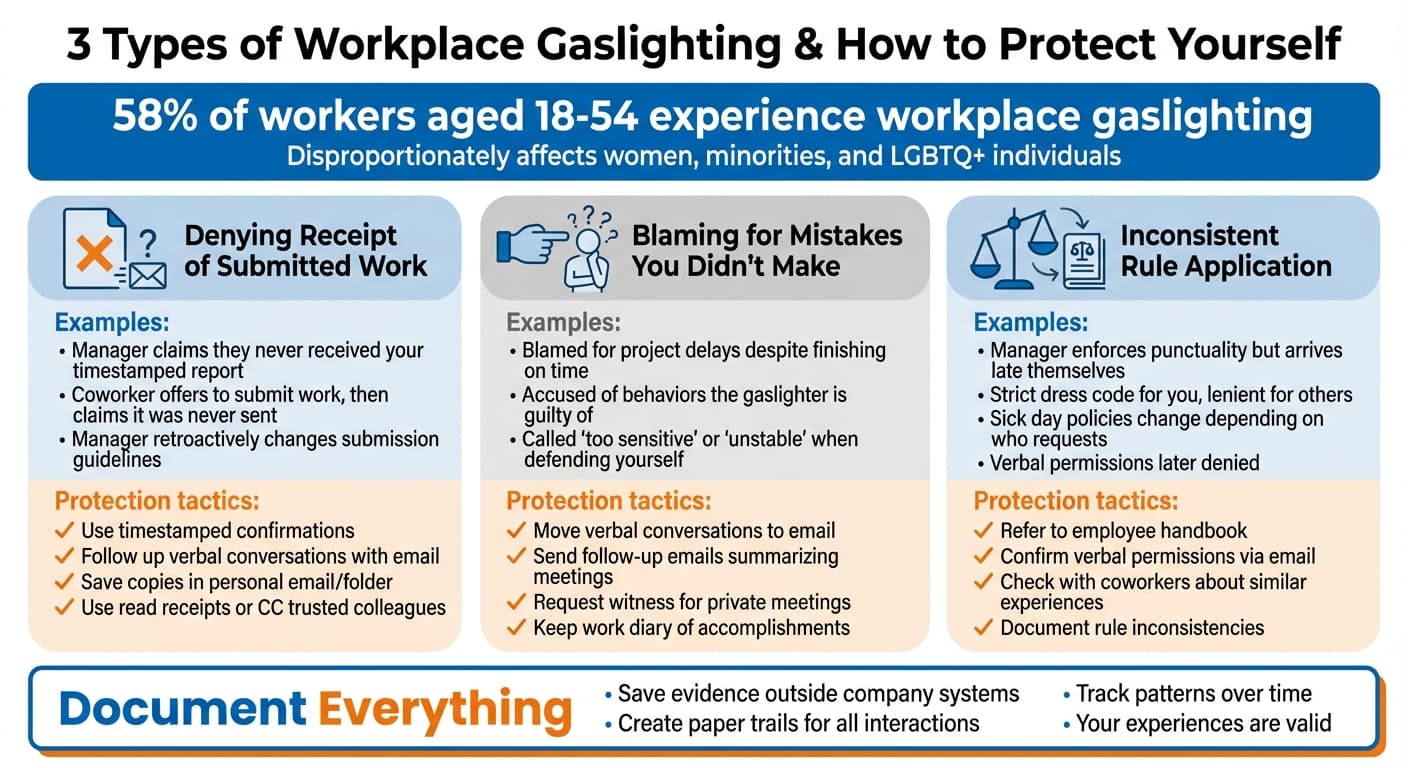
6 Types of Workplace Gaslighting to Be Aware Of
1. Denying Receipt of Submitted Work
Imagine sending a detailed, timestamped report to your manager, only to hear later that they never received it. They might even blame some vague technical glitch that doesn’t seem to exist. Unfortunately, this is a classic example of how some managers manipulate situations to distort reality.
"A bad boss is someone who takes credit for your work while a manipulative gaslighter is someone who says you didn't submit the work when you know for sure you did." - Vicki Salemi, Career Expert and Coach for Monster.com [2]
This tactic isn’t limited to managers. A coworker might offer to submit work on your behalf, only to later claim it was never sent. Or, a manager might retroactively change submission guidelines, using this as an excuse to lower your performance ratings. In some cases, they may even omit key records during reviews to deny you raises or promotions.
These behaviors can chip away at your self-assurance, leaving you second-guessing yourself. Over time, the constant denials can make you feel like you need to be on high alert all the time.
To protect yourself, it’s crucial to document everything. Use tools that offer timestamped confirmations for submissions and follow up verbal conversations with a short, confirming email. Save copies of submission receipts in a personal email account or a physical folder - somewhere outside your workplace systems. If the issue persists, consider using read receipts or looping in a trusted colleague on submission emails to serve as a witness to your actions. A solid paper trail can be your best defense against these manipulative tactics.
2. Blaming Employees for Mistakes They Didn't Make
Picture this: a project deadline comes and goes, and suddenly your manager blames you for the delay - even though you finished your part on time. Or maybe a coworker offers to submit your work, doesn’t follow through, and then tells your supervisor you dropped the ball. This kind of false blame is a classic example of workplace gaslighting.
One of the most harmful tactics gaslighters use is twisting facts to shift responsibility. They might accuse you of behaviors they’re guilty of themselves, like claiming you’re “trying to get others in trouble” while they’re quietly sabotaging your efforts behind the scenes.
"The person bolsters their own sense of self-confidence and self-esteem by undermining yours." - Craig Malkin, PhD, Clinical Psychologist and Lecturer, Harvard Medical School [1]
When you try to defend yourself, gaslighters often turn the tables, calling you “too sensitive” or “unstable.” This creates cognitive dissonance - a mental tug-of-war that erodes your confidence and leaves you doubting yourself.
To safeguard your mental well-being and your reputation, take proactive steps. Move verbal conversations to email whenever you can. After meetings, send a follow-up email summarizing what was discussed or decided. If you’re invited to a private meeting with someone prone to false accusations, ask for a trusted colleague or supervisor to join as a witness. Keep a work diary where you log your accomplishments and any positive feedback. These records can serve as crucial evidence if you need to defend yourself later.
3. Applying Rules Inconsistently
Picture this: your manager insists on punctuality but regularly strolls in late. Or maybe they enforce a strict dress code for you while letting others slide. This kind of selective rule enforcement is a classic gaslighting tactic, leaving you unsure of what’s actually acceptable.
Rules seem to shift depending on your manager’s mood. One week, taking a sick day might require a doctor’s note. The next, a coworker takes a day off without any documentation and faces no pushback. But when you request the same leniency, you’re told you’re "not following protocol." It’s a setup that leaves you feeling like you can never get it right [2].
"The gaslighter changes company policies to suit their own objectives... which makes it difficult to know what the rules are and how you can avoid breaking them." - PureWow [2]
Another common tactic is the "permission trap." Your manager verbally approves something, only to later deny it, leaving you questioning what was actually agreed upon [2].
To safeguard yourself, refer to your employee handbook whenever a manager tries to introduce unwritten changes. Follow up verbal permissions with a quick confirmation email to create a paper trail. It’s also helpful to check in with trusted coworkers to see if they’ve experienced similar inconsistencies. If it feels like the rules only change for you, that’s a major warning sign [2]. Keeping a record of these irregularities is essential for recognizing and addressing gaslighting as it happens.
How to Detect and Document Gaslighting
Understanding how to identify and document gaslighting is crucial, especially when dealing with a manipulative environment. Spotting gaslighting in the moment can be tricky. In fact, 58% of workers aged 18 to 54 report experiencing workplace gaslighting [1]. This makes having a reliable method to track and address these situations essential. Experts note that gaslighters often operate subtly, undermining your confidence and sense of reality in ways that are hard to pinpoint. That’s where tools like automated tracking systems can be a game-changer.
Gaslighting Check steps in with tools designed to counter workplace manipulation. This platform uses AI to analyze both written and spoken communication. Through real-time audio recordings and text analysis of emails and chat messages, it identifies patterns like denial, shifting blame, and inconsistent rule enforcement as they occur.
To protect yourself, it's essential to document every interaction. For verbal conversations, send a follow-up email summarizing the discussion right away [5]. Keep all evidence - screenshots, emails, chat logs - stored securely outside of company systems [6][4]. Remember, if you're let go, you could lose access to anything saved on work devices or company cloud accounts. Gaslighting Check ensures privacy by encrypting your data and automatically deleting records after a set period.
The platform also provides detailed reports, logging incidents by date, time, participants, and actions. This structured documentation helps you identify patterns over time. When you start doubting your memory or questioning if you're overreacting, having timestamped evidence can validate your experiences and help restore your sense of reality.
Gaslighting Check offers two plans. The Premium plan, starting at $9.99/month, includes text and voice analysis, detailed reports, and conversation tracking. If you're just starting to document manipulative behaviors, the Free plan offers basic text analysis to get you started. Both options equip you with tools to recognize manipulation, set boundaries, and regain control through thorough documentation.
Conclusion
Gaslighting in the workplace is a damaging form of manipulation, affecting 58% of workers between the ages of 18 and 54 [1]. It can show up in various ways - like denying they received your work, blaming you for errors you didn’t make, or enforcing rules unfairly. Over time, these behaviors can chip away at your confidence and make you question your own judgment.
This issue disproportionately impacts minorities, women, and members of the LGBTQ+ community, who often have less institutional power [1][3]. Mita Mallick, Head of Inclusion, Equity, and Impact at Carta, highlights the importance of addressing this:
"If you want to keep your great talent, you will absolutely put an end to any gaslighting that's happening in your organization" [3].
The first step in protecting yourself is recognizing these patterns. If you suspect gaslighting, start documenting each incident and consider confiding in trusted colleagues or professionals. You don’t have to face this alone - your mental health should always come first. If the situation doesn’t improve, it might be worth exploring a transfer or a fresh start elsewhere.
Tools like Gaslighting Check can also help you regain control. By objectively documenting interactions, it validates your experiences and gives you clarity. With plans starting at $9.99/month for detailed analysis - or a free option for basic reviews - it’s an accessible way to support yourself in navigating these challenges. Remember, your experiences are valid, and you deserve a workplace that respects and supports you.
FAQs
What’s the best way to document gaslighting at work?
To document gaslighting at work effectively, start by maintaining a thorough log of each incident. Include the date, time, location, exact words or actions, and any witnesses. If there’s written evidence - like emails, texts, or chat messages - save those as well, ensuring timestamps are visible for context. Where it's legally permitted, you might also consider recording verbal exchanges or using tools to identify patterns of manipulation.
Keep all this information organized in one secure spot, such as a password-protected folder. If colleagues witnessed the behavior, ask if they’re willing to provide brief written statements. These should include their name, role, and the date of the incident. Over time, identify recurring patterns and note how they’ve affected your work or well-being. This detailed and factual record can be a valuable resource if you decide to report the issue to HR or consult an external professional for advice.
What can I do if gaslighting at work doesn’t stop after addressing it?
If gaslighting persists despite your best efforts to address it, start by keeping a thorough record of every incident. Write down exactly what happened, including dates, times, people involved, and the specific details of the interactions. Whenever possible, move conversations to email or follow up verbal exchanges with written summaries. This creates a clear, timestamped trail that makes it much harder for the gaslighter to twist the narrative and provides concrete evidence if you need to escalate the issue.
Once you've gathered enough documentation, take it to someone you trust in your workplace, such as a supervisor, an HR representative, or someone from an employee assistance program. Request a confidential investigation and, if possible, involve colleagues who may have witnessed the behavior to strengthen your case. If the response from your workplace feels insufficient or if you continue to feel unsafe, reaching out to a therapist or a workplace attorney can provide additional guidance and support.
For extra help, consider using tools like Gaslighting Check, which can analyze conversations and highlight patterns of manipulation. This can be especially useful if you decide to file a formal complaint, request a transfer, or take other steps to safeguard yourself from a toxic work environment.
Why are certain groups more vulnerable to gaslighting at work?
Gaslighting tends to flourish in workplaces where power imbalances exist, leaving individuals in lower-status or historically marginalized roles more exposed. Women, people of color, LGBTQ+ employees, and junior staff often find themselves at greater risk, as their concerns are more likely to be dismissed with phrases like "you're overreacting" or "you're being too sensitive." This kind of dismissal can erode their credibility, with their voices being overshadowed by blame, denial of their contributions, or even a rewriting of events.
Adding to the challenge, these employees often face systemic biases that discourage them from speaking out, enabling gaslighting to persist unchecked. The consequences can be deeply damaging, leading to emotional withdrawal, a breakdown in trust, and diminished job performance. Tools such as Gaslighting Check, which offer real-time analysis and detailed conversation insights, can play a critical role in helping employees recognize manipulation and safeguard their professional reputation.