27 Examples of Parental Gaslighting

27 Examples of Parental Gaslighting
Gaslighting by parents can distort your reality, undermine your mental health, and leave lasting emotional scars. It often involves denying your experiences, invalidating your feelings, shifting blame, or controlling your decisions. These tactics can lead to anxiety, depression, PTSD, and self-doubt.
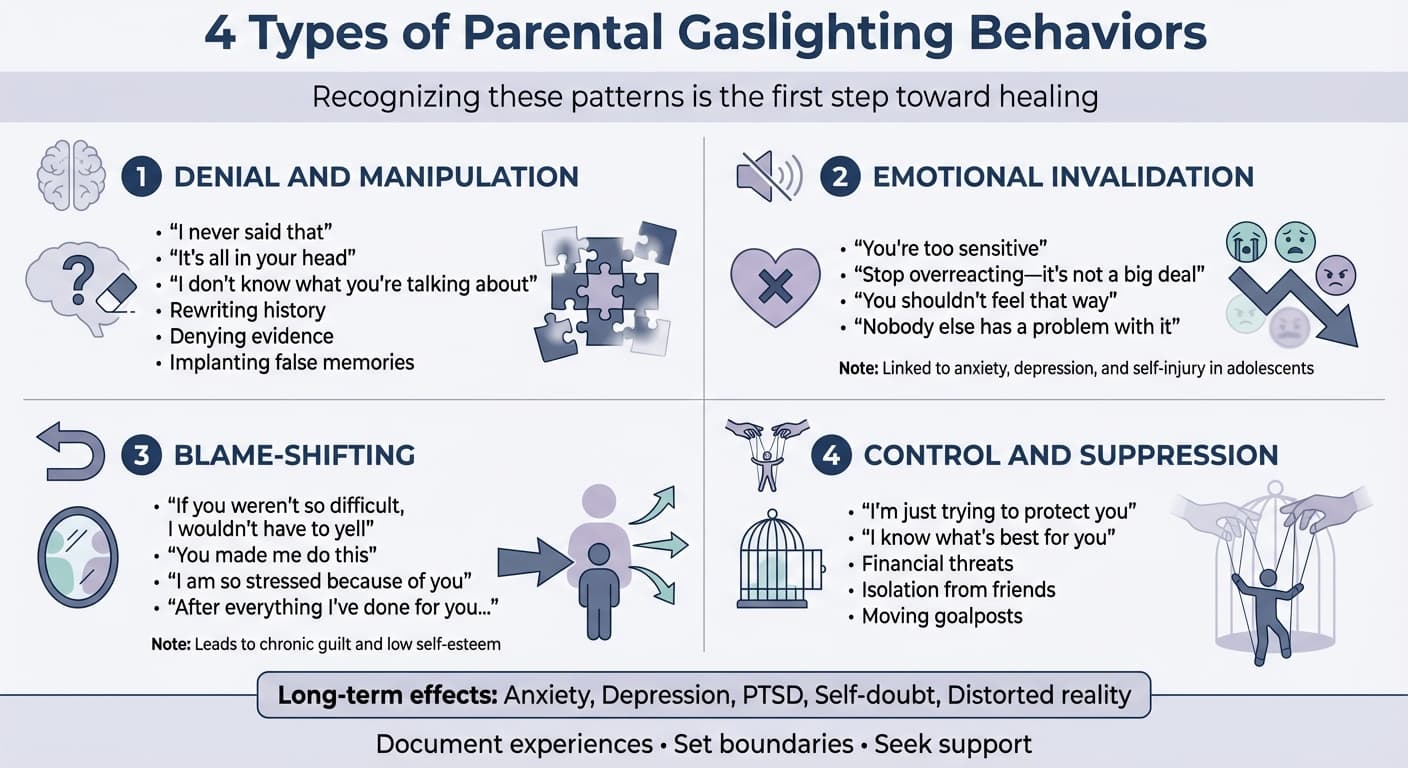
Here’s a quick breakdown of common parental gaslighting behaviors:
- Denial and Manipulation: Parents may deny past actions, rewrite history, or dismiss evidence, making you question your memory.
- Emotional Invalidation: They might label you as "too sensitive" or dismiss your feelings entirely, eroding your emotional trust.
- Blame-Shifting: Parents often place responsibility for their harmful actions on you, leading to guilt and low self-esteem.
- Control and Suppression: Through financial control, isolation, or constant criticism, they suppress your independence.
Recognizing these patterns is the first step toward healing. Document your experiences, set boundaries, and seek support to rebuild trust in yourself. Tools like Gaslighting Check can help validate your reality and identify manipulation.
::: @figure
7 Signs Your PARENTS Are GASLIGHTING You
1. Denial and Manipulation
Gaslighting parents often go to great lengths to erase evidence of their actions, all in an effort to avoid taking responsibility. This behavior deeply affects a child's ability to trust their own memory and perception, becoming a hallmark of gaslighting within family dynamics.
"I Never Said That" – One common tactic is outright denial: "I never said that." This statement forces the child to question their recollection of events, planting seeds of self-doubt[3][4].
Rewriting History – Some parents twist past events to fit their own narrative. For instance, if a child recalls being yelled at during dinner, the parent might insist, "That's not how it happened; you're making things up." Over time, this erodes the child's confidence in their own memories[3][5].
"I Don't Know What You're Talking About" – Feigning confusion is another strategy. By saying, "I don't know what you're talking about", parents derail conversations and leave the child feeling confused or irrational[7].
"It's All in Your Head" – Dismissing concerns with phrases like, "It's all in your head", invalidates the child's feelings and experiences, further distorting their sense of reality[4][7].
The Memory Hole – Gaslighting parents often “forget” their own harmful actions while sharply remembering the child's mistakes. For example, a parent might claim, "I don't recall saying anything mean, but I definitely remember you screaming at me"[4].
Denying Evidence – Even when presented with undeniable proof - like text messages or recordings - these parents may argue that the evidence is fake or misinterpreted, leaving the child feeling powerless[3].
Implanting False Memories – Repetition is a powerful tool. By repeatedly insisting on a fabricated version of events, parents can overwrite the child's real memories with false ones, creating a distorted view of the past[3].
"Gaslighting is a tactic in which a person or entity, in order to gain more power, makes a victim question their reality." – Sarkis, Psychology Today[8]
2. Invalidation of Emotions
When parents habitually dismiss or belittle their child's emotions, they engage in a form of emotional gaslighting. This behavior can make children question their own feelings and perceptions over time [9]. Repeatedly undermining a child's emotions chips away at their ability to trust their inner experiences. Much like denial, emotional invalidation skews a child's sense of reality.
"You're Too Sensitive" – Labeling a child as "too sensitive" or "dramatic" sends the message that their emotional responses are wrong. This teaches children to suppress their feelings rather than process them [10][11].
"You're Not Hungry, You're Just Tired" – Parents sometimes extend this invalidation to physical sensations. For example, telling a child they aren't hungry but merely tired undermines their ability to trust their own bodily signals [1][4].
"Stop Overreacting - It's Not a Big Deal" – Dismissing a child's concerns with comments like this trivializes their emotional pain and suggests their feelings are unimportant [13][14].
"You Shouldn't Feel That Way" – By dictating how a child should feel, parents invalidate their child's personal experience. Clinical psychologist Craig Malkin notes that "our feelings are very close to our sense of self", making this type of dismissal particularly damaging [5].
"You're the One Hurting Me" – In a troubling twist, some parents shift the focus from their child's distress to their own feelings by claiming, "You're abusing me by being upset." This dynamic creates an unhealthy emotional dependency [9].
"Nobody Else Has a Problem With It" – Comparisons like this imply that the child's emotional reaction is inherently flawed if others aren't upset. This approach can make the child feel isolated and misunderstood [3].
Shielding from "Negative" Emotions – When parents insist "it's not that bad", they distort the child's understanding of natural emotions like sadness and disappointment. This not only invalidates their feelings but also hinders the development of healthy coping skills [9][12].
"A gaslighting parent systematically manipulates their child into doubting their own reality, perceptions, and memory to maintain control and avoid accountability." – Simply Psychology [9]
The long-term effects of emotional invalidation are serious. Research shows that parental invalidation is linked to higher rates of self-injury among adolescents [14]. Children raised in emotionally abusive environments are also more likely to experience anxiety, depression, and substance misuse as they grow up, largely because they have been taught to distrust their own feelings [3][13][14].
3. Blame-Shifting
Blame-shifting is one of the more damaging tactics in the realm of gaslighting. It goes beyond denial and emotional invalidation by placing the burden of a parent's mistakes squarely on the child’s shoulders. This tactic forces children to question their own judgment and even believe they are responsible for their parent’s harmful behavior [16][3]. For the parent, it’s a way to dodge accountability, protect their self-image, and maintain control over the child [3][8].
For children, the consequences can be deeply ingrained. They often internalize this blame, leading to chronic feelings of inadequacy and self-doubt. Over time, this can evolve into what experts call "internalized gaslighting", where the child believes they are fundamentally flawed [3][4]. Studies reveal that children subjected to blame-shifting in psychologically abusive households face higher risks of delinquency, aggression, and post-traumatic stress disorder [3].
Here are some common examples of blame-shifting:
-
"If you weren't so difficult, I wouldn't have to yell."
This statement shifts responsibility for the parent’s outburst onto the child. Andrea Papin, RTC, and Jess Jackson, LMT, note that gaslighting is often used to "gain an upper hand and avoid accountability" [6]. -
"The problem isn't that I hit you. The problem is that you made me hit you." [15]
Such phrases excuse physical discipline by placing the blame entirely on the child. -
"You made me late to work with all your crying as a baby." [15]
Even normal childhood behavior may be twisted into a reason for the parent’s setbacks, creating an unfair sense of guilt. -
"It's your fault our relationship is so messed up. You're the one who can't let go of the past." [15]
When confronted with past harm, some parents deflect by accusing the child of being unable to move on. -
"I only yelled at you because of your bad attitude." [15]
This reframes the parent's anger as a justified reaction to the child’s behavior, teaching the child to blame themselves. -
"I am so stressed because of you." [3][2]
Here, the parent projects their stress onto the child, creating a sense of undue responsibility. -
"After everything I've done for you, this is how you repay me?" [4]
This guilt trip turns normal parental duties into a debt the child is unfairly expected to repay.
"The parent will distort reality and shift blame onto the child to avoid facing consequences, feeling guilty, or taking accountability." – Simply Psychology [3]
To counteract blame-shifting, clarity is key. Keep a record of interactions and use neutral phrases like "I experienced that differently" to assert boundaries. Avoid defending or justifying your perspective, as this can feed into the manipulative dynamic [4][2][3].
4. Control and Suppression
Control and suppression tactics strip children of their independence, allowing gaslighting parents to maintain dominance and emotional reliance. As Simply Psychology notes, "Gaslighting typically stems from parents' need to gain control over their child's thoughts, emotions, and behavior" [9].
These behaviors can range from subtle manipulations to blatant overreach, all aimed at reinforcing the child's dependence on the parent.
"I'm just trying to protect you."
Parents often mask their controlling tendencies as concern, prying into every aspect of their child's life or discouraging independent decision-making under the pretense of ensuring safety [17].
"If you don't do what I say, I'll stop paying for your car/groceries/rent."
Financial control is another common tactic, with parents threatening to withdraw support unless the child complies with their demands [17].
"Are you sure you can handle that?"
By constantly questioning a child's abilities, parents sow seeds of self-doubt [17].
"I know what's best for you."
This dismissive statement invalidates the child's opinions and undermines their autonomy [10].
"Your friends are a bad influence. You shouldn't see them anymore."
Isolating children from their peers cuts off access to outside perspectives that might challenge the parent's control [16].
Moving the goalposts.
Parents may continually change expectations to ensure the child never feels successful. Narcissistic abuse recovery coach Kim Saeed explains:
"Gaslighters always move the goalpost because their goal is for you to supply them with constant attention as you seek their approval" [18].
To counteract such manipulation, Dr. Karmen Smith, LCSW, DD, suggests the "gray rock" method - keeping responses brief, neutral, and setting firm boundaries [17]. These control tactics, layered on top of earlier gaslighting behaviors, further chip away at a child's sense of self and independence.
Conclusion
Understanding and identifying parental gaslighting is a crucial step in protecting your mental health and reclaiming your sense of reality. This form of manipulation can leave lasting scars, often leading to years of self-doubt and second-guessing your own experiences [2][3]. As Robin Stern, PhD, Co-founder of the Yale Center for Emotional Intelligence, points out:
"If you don't question gaslighting, you might grow up thinking there must be something wrong with you" [2].
The impact of chronic parental gaslighting is profound - it can heighten anxiety, depression, PTSD, and chip away at your self-worth [3][4]. Among various forms of psychological abuse, gaslighting is considered one of the most harmful during a child's formative years [3].
If these patterns resonate with your family dynamics, consider documenting your experiences. Keeping a journal or recording voice memos can serve as a concrete record, helping you counter any future denials [4][19]. Setting boundaries is another vital step. Phrases like, "I appreciate your opinion, but I'm not prepared to change my mind", or, "That was my experience; yours might be different", can help assert your reality and protect your mental space [2][3].
You can also turn to tools designed to provide clarity. For example, Gaslighting Check uses AI to analyze text and voice interactions, offering detailed reports and tracking conversation history. These insights can help you identify manipulative patterns and validate your experiences.
Healing from parental gaslighting is not an overnight process, but rebuilding self-trust is absolutely achievable. Surround yourself with people who affirm your reality, seek professional counseling to develop healthy coping strategies, and practice self-compassion. As Robin Stern wisely advises:
"Treat yourself with the same compassion you'd show any of your friends or loved ones" [2].
You have the right to trust yourself again.
FAQs
How can I tell if my parents are gaslighting me?
Parental gaslighting often involves twisting your sense of reality in ways that make you question yourself. This might look like your parents denying events you clearly recall, brushing off your emotions as "too sensitive" or "overreacting", or even holding you responsible for how you feel. They might also rewrite your childhood story, insisting "everything was fine" despite clear evidence that it wasn’t.
You might notice patterns such as shifting blame, denying facts, or projecting their own shortcomings onto you. Over time, these behaviors can leave you feeling unsure of your memories, confused, and doubting your own judgment. When these actions are consistent, it’s a strong sign of gaslighting.
To track and better understand these behaviors, tools like Gaslighting Check can help by analyzing conversations to identify manipulative tactics. Recognizing these patterns is an important step toward protecting your mental health and establishing firm boundaries.
What are the long-term mental health effects of being gaslighted by a parent?
Parental gaslighting can leave deep scars on a child's mental well-being. When kids are made to doubt their own memories, feelings, or perceptions, they often struggle with chronic anxiety, depression, and low self-esteem as they grow. This constant self-doubt can make it hard for them to trust their instincts or build healthy, stable relationships.
The emotional damage doesn’t just stay in the mind - it can show up in the body too. Some people develop intense stress responses or physical symptoms tied to trauma, like somatic complaints. Identifying these patterns early and finding the right support can be a crucial step toward breaking the cycle and starting the healing process.
How can I recognize and recover from parental gaslighting?
Recognizing parental gaslighting often starts with spotting manipulation tactics like dismissing your feelings, twisting past events, or labeling you as "too sensitive." These actions are designed to make you question your memory and judgment. To safeguard yourself, consider documenting conversations through notes or journaling. Setting firm boundaries, such as stepping away when your experiences are invalidated, can also be crucial. Tools like Gaslighting Check can assist in analyzing conversations, highlighting manipulative language, and helping you trust your own perspective.
Healing from the effects of gaslighting requires support and self-care. Therapy, particularly cognitive-behavioral therapy (CBT), can be a powerful way to rebuild confidence and combat self-doubt. Surrounding yourself with people who validate your experiences is equally important. Practices like mindfulness and journaling can nurture self-compassion and help you reconnect with your inner voice. Over time, these efforts can restore your sense of trust in yourself and pave the way for healthier relationships.