Empathy vs. Manipulation: Key Differences

Empathy vs. Manipulation: Key Differences
Empathy and manipulation may seem similar on the surface, but their intent and impact set them worlds apart. Empathy fosters mutual understanding and support, while manipulation exploits emotions for control and personal gain. Here's what you need to know:
- Empathy involves understanding and sharing emotions, offering genuine care, and respecting boundaries. It empowers others and strengthens trust.
- Manipulative empathy uses emotional awareness to exploit vulnerabilities. It’s conditional, self-serving, and often undermines confidence and independence.
Quick Overview:
- Empathy Types: Cognitive (understanding), Emotional (feeling), Compassionate (helping).
- Manipulation Tactics: Gaslighting, guilt-tripping, blame-shifting, and emotional withdrawal.
- Signs of Genuine Empathy: Respect for boundaries, consistent kindness, and encouraging independence.
- Signs of Manipulation: Conditional care, creating dependency, and eroding self-trust.
Key takeaway: Genuine empathy builds trust and autonomy, while manipulative empathy creates confusion and control. Recognizing these patterns is crucial to protecting your emotional well-being.
Covert Narcissists: Fake Empathy, Real Manipulation | Dr. Daniel Fox
What Genuine Empathy Looks Like
Genuine empathy brings together all forms of empathy to establish trust and emotional safety without manipulation. It’s about truly understanding someone’s perspective, connecting with their emotions, and offering support - all while respecting personal boundaries. This kind of empathy isn’t about control or obligation; it’s about standing by someone without expecting anything in return.
Core Traits of Genuine Empathy
Genuine empathy weaves together understanding, emotional connection, and supportive action. Unlike superficial gestures, it involves cognitive insight, emotional resonance, and compassionate behavior. And here’s the key: genuinely empathetic people don’t act out of self-interest. They give without strings attached.
"The foundation of empathy has to be a willingness to listen to other peoples' experiences and to believe they're valid." - Raymond Mar, PhD, Professor of Psychology, York University [6]
What sets this apart is other-oriented perspective-taking. Instead of imagining themselves in your shoes, empathetic individuals focus on your unique perspective. This approach helps them understand you without projecting their own feelings onto your situation. They’ll ask open-ended questions, show genuine curiosity, and respect your autonomy, celebrating your independence rather than fostering dependence.
Signs of Healthy Empathy
Empathy reveals itself in actions that consistently respect boundaries. A truly empathetic person won’t guilt or pressure you when you say "no." They take responsibility for their mistakes instead of deflecting blame. And their kindness doesn’t waver - it’s not conditional or tied to what they might gain.
Research highlights empathy as a strong predictor of prosocial behaviors like forgiveness, volunteering, and helping others [6]. In professional settings, empathy has measurable benefits. For instance, in healthcare, it strengthens patient-provider relationships, leading to better diagnoses and treatment outcomes [2]. Teachers who show empathy reduce the need for harsh discipline, while empathetic parole officers help reduce reoffending rates [6].
These qualities clearly distinguish genuine empathy from manipulative imitations.
How Genuine Empathy Affects Relationships
Genuine empathy is the glue that holds relationships together, creating an environment where people feel safe to be vulnerable without fear of judgment or exploitation [6]. In healthy connections, empathy flows both ways, fostering balanced and supportive interactions [4].
This mutual exchange builds respect and deepens bonds. When someone listens, validates your feelings, and supports your independence, it empowers you. Over time, your confidence grows because you know they’re not trying to control you - they’re encouraging your growth and self-reliance.
How Manipulative Empathy Works
Genuine empathy is about building trust and connection, but manipulative empathy takes a darker turn. Instead of showing care for your well-being, manipulators use their understanding of emotions to control or exploit you. This distinction is key to understanding how these tactics operate.
What is Manipulative Empathy?
Manipulative empathy involves an uncanny ability to read people. Unlike genuine empathy, which promotes mutual respect, this type of empathy is weaponized for control. Individuals who use manipulative empathy - sometimes referred to as "dark empaths" - combine high emotional intelligence with traits from the Dark Triad: Machiavellianism (manipulation for power), narcissism (craving admiration), and psychopathy (a lack of remorse)[7]. They don’t just understand your emotions - they use that understanding to serve their own interests.
Research links the ability to read emotions with a tendency to manipulate, a behavior known as narcissistic exploitativeness[1]. While personality traits are partially inherited (30% to 60%), environmental factors like upbringing also play a significant role in shaping these tendencies[7]. Unlike typical narcissists, dark empaths are often aware of the harm they cause but choose to continue for personal gain[7].
Common Manipulation Tactics
Manipulators have a toolbox of tactics designed to keep you off balance. They may alternate between praise and neglect, using intermittent reinforcement to keep you hooked. Gaslighting is another common strategy, where they distort reality to make you question your perceptions. This tactic often makes you feel dependent and unsure of yourself. As Meaghan Rice, PsyD., Licensed Professional Counselor, explains:
"Gaslighting, historically, is used to establish dominance. This is a key feature of someone who struggles with narcissistic personality disorder because the security of their lens depends on the other party being wrong"[8].
Guilt-tripping is another favorite tool, making you feel responsible for their emotions. Trivializing your feelings - dismissing them as "too sensitive" - is another way manipulators undermine your confidence. Alarmingly, 74% of female domestic violence victims report experiencing gaslighting from their partner or ex-partner[9]. Over time, these tactics reveal themselves in predictable patterns of behavior.
Warning Signs to Watch For
Manipulative empathy often follows a pattern. Acts of kindness are conditional, appearing only when the manipulator wants something or needs to smooth over a situation. If you set boundaries, they may respond with emotional withdrawal, guilt trips, or even aggressive counter-attacks. Their empathy is fleeting and disappears when it no longer serves their agenda.
Blame-shifting is another hallmark. Manipulators rarely take responsibility for mistakes, instead projecting their negative emotions onto you. Their communication often feels deceptive and passive-aggressive rather than straightforward. Over time, you may notice your self-confidence eroding and self-doubt creeping in - leaving you feeling the opposite of what genuine empathy should inspire. If someone’s "support" leaves you feeling confused, overly dependent, or questioning your own judgment, it’s a warning sign that shouldn’t be ignored.
Genuine Empathy vs. Manipulative Empathy: Side-by-Side Comparison
::: @figure
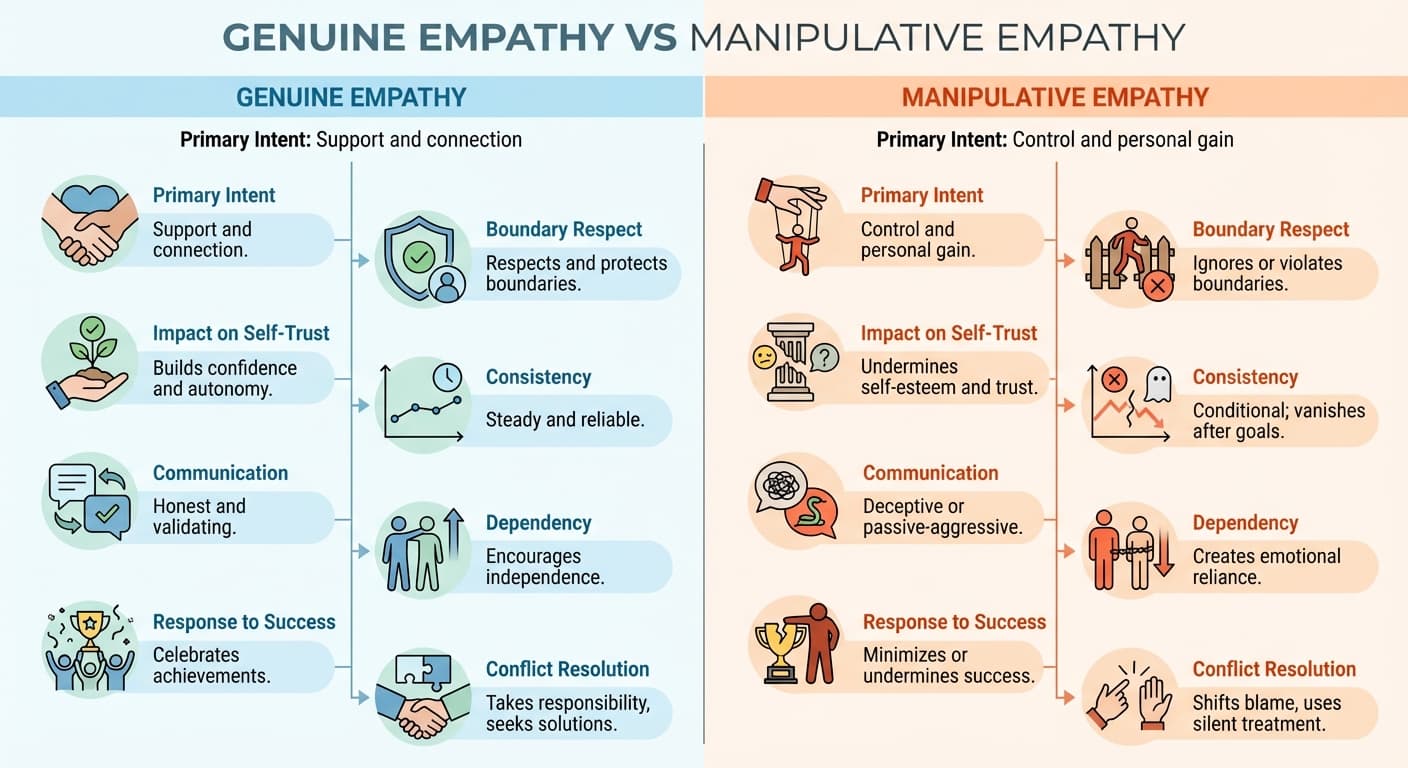
Let’s take a closer look at how genuine empathy and manipulative empathy differ. While they might seem similar on the surface, their underlying intent, behavior, and impact reveal two very different approaches.
Intent and Consistency
At its core, genuine empathy comes from an honest desire to help and support others. It’s steady and reliable, showing care without expecting anything in return. This type of empathy builds trust and fosters meaningful connections.
In contrast, manipulative empathy is self-centered and conditional. While manipulators might display high levels of cognitive empathy - appearing to understand emotions - they lack genuine concern. Instead, they exploit vulnerabilities to serve their own goals. Their care is often a facade, disappearing as soon as they’ve achieved their desired outcome.
Impact on Independence and Self-Trust
Genuine empathy empowers. It helps you better understand yourself, boosts your confidence, and encourages independence. Even when disagreements arise, it leaves you feeling capable and respected.
Manipulative empathy does the opposite. It creates dependency. Instead of offering comfort, manipulators use emotional insight as a tool to control. They treat your feelings as information to exploit later. Studies on psychopathic behavior reveal that, when witnessing distress, these individuals activate brain regions related to language and cognition rather than empathy. This allows them to manipulate without emotional interference[10]. Over time, this behavior can lead to confusion, self-doubt, and a reliance on the manipulator for emotional validation.
Comparison Table: Healthy Support vs. Emotional Control
| Aspect | Genuine Empathy | Manipulative Empathy |
|---|---|---|
| Primary Intent | Support and connection | Control and personal gain |
| Boundary Respect | Respects and protects boundaries | Ignores or violates boundaries |
| Impact on Self-Trust | Builds confidence and autonomy | Undermines self-esteem and trust |
| Consistency | Steady and reliable | Conditional; vanishes after goals |
| Communication | Honest and validating | Deceptive or passive-aggressive |
| Dependency | Encourages independence | Creates emotional reliance |
| Response to Success | Celebrates achievements | Minimizes or undermines success |
| Conflict Resolution | Takes responsibility, seeks solutions | Shifts blame, uses silent treatment |
When faced with rejection or a simple "no", genuine empathy respects your decision and autonomy. Manipulators, however, often resort to guilt-tripping or withdrawing affection to regain control.
How to Recognize and Protect Yourself from Emotional Manipulation
Understanding the difference between genuine empathy and manipulative behavior is only the first step. To truly protect yourself, you need to learn how to identify and resist emotional manipulation. A good starting point? Pay close attention to your feelings. If you often leave conversations feeling drained, confused, or burdened with guilt, it might be a sign you're dealing with manipulation. Therapist and abuse specialist Sharie Stines explains it well:
"Manipulation is an emotionally unhealthy psychological strategy used by people who are incapable of asking for what they want and need in a direct way." [13]
One common tactic manipulators use is the FOG pattern - Fear, Obligation, and Guilt. These emotions are powerful tools for keeping you off balance and influencing your behavior. Recognizing these patterns is key to regaining control of your emotional well-being [13].
Questions to Ask Yourself
After interacting with someone, take a moment to reflect. Do you feel uplifted or emotionally drained? Are you apologizing for things you didn’t do? Do you find yourself prioritizing their emotions over your own reality? Psychiatrist Dr. Harold Hong offers this reminder:
"You are not responsible for their happiness or well-being, only your own. They can easily manipulate you if you believe you are responsible for their feelings." [5]
To protect yourself, try the "Observe, Don’t Absorb" technique. If you feel pressured, use the 20-minute rule - step away and take time to process your thoughts before responding [13]. Avoid making important decisions in the midst of emotional turmoil. Giving yourself time, even just a night to sleep on it, can help you see things more clearly [5][13].
Once you’ve started assessing your feelings, the next step is to test boundaries.
Testing Boundaries to Reveal True Intent
Setting boundaries is one of the quickest ways to uncover someone’s intentions. Try saying "no" to a small request and see how they respond. Someone with genuine empathy will respect your decision, while a manipulator may react with anger, guilt-tripping, or dismissive behavior [12][3]. You can also have a direct conversation about how their actions affect you. Authentic individuals will listen and try to make amends, but manipulators often deny, blame, or distort the situation [12].
Another helpful approach is to practice neutral responses - shrugging, avoiding eye contact, or replying with short, unemotional answers. This can help you observe how they react without giving them more emotional material to work with [11][3]. Additionally, be cautious about sharing too much personal information early on. Avoid disclosing your fears or insecurities in new relationships, as manipulators may use this information against you later [5][12].
If self-reflection and boundary testing don’t provide enough clarity, there are tools available to help identify manipulation patterns.
Using Tools to Detect Manipulation Patterns
Platforms like Gaslighting Check (https://gaslightingcheck.com) can analyze your conversations to uncover subtle manipulation tactics. This tool offers both text and voice analysis, providing detailed reports on patterns you might not notice on your own. It works with real-time audio recordings or uploaded text conversations. For those facing ongoing manipulation, the Premium plan ($9.99/month) includes features like conversation history tracking, which helps you identify recurring behaviors over time. Privacy is a top priority, with end-to-end encryption and automatic data deletion. If you’re just starting out, the Free plan offers basic text analysis to help you get a sense of what’s happening.
These strategies and tools can empower you to recognize manipulation and take steps to protect your emotional well-being.
Conclusion
The difference between genuine empathy and manipulative behavior boils down to intent, consistency, and impact. True empathy asks, "How can I support you?", while manipulation questions, "How can I turn this to my advantage?" One nurtures trust and independence, while the other fosters confusion and dependence. Recognizing this distinction is key to building relationships rooted in respect and emotional safety.
Think about how these dynamics play out in everyday life. Identifying manipulation isn't about a single kind gesture or a harsh comment - it’s about observing the patterns over time. Ask yourself: Does this person respect your boundaries, acknowledge their mistakes, and encourage your confidence? Or do they shift blame, erode your self-trust, and leave you doubting yourself?
Protecting your emotional boundaries is non-negotiable. When you set clear limits, pay attention to how the other person reacts. A healthy individual will respect your needs, while a manipulator might push back, guilt-trip you, or make you feel selfish for asserting yourself.
If you're unsure about someone's behavior, tools like Gaslighting Check can help analyze conversations to uncover subtle manipulative tactics.
Above all, trust your instincts. If something feels off, it likely is. You deserve relationships grounded in mutual respect, honesty, and care - not control masked as concern.
FAQs
How can I tell if someone is using empathy to manipulate me?
Manipulative empathy can be tricky to recognize because it often looks like genuine care on the surface. The real difference lies in the intent behind the actions and the impact they have on you. Genuine empathy honors your boundaries, acknowledges your feelings, and encourages your independence. Manipulative empathy, on the other hand, uses tactics like love-bombing (showering you with excessive affection to gain influence), guilt-tripping (making you feel responsible for their emotions), or mirroring (imitating your behavior to create a false sense of connection).
Some warning signs to watch for include feeling confused, overly guilty, or second-guessing yourself after spending time with someone. If they consistently disregard your boundaries, make you feel like you owe them, or subtly shift blame onto you, they may be using empathy as a way to control you. Observe whether their actions align with their words and whether their behavior leaves you feeling genuinely supported - or manipulated.
How can you tell if someone is genuinely empathetic in a relationship?
Genuine empathy in a relationship shows itself through consistent actions that focus on care and respect, free of hidden agendas. You’ll notice it in active listening - when someone gives you their undivided attention, asks meaningful questions, and avoids cutting you off mid-sentence. It’s also evident when they validate your emotions, acknowledging and respecting how you feel, even if they may not entirely agree with your perspective.
Another clear sign is when they respect your boundaries. They won’t push you to step beyond your comfort zone or share more than you’re willing to. Alongside this, they encourage your independence by supporting your goals and decisions instead of fostering any sense of dependency. Lastly, they provide non-judgmental support - offering help without criticism or any hidden motives.
When these behaviors are consistent and sincere, it’s a strong reflection of true empathy, not manipulation.
How can I recognize and protect myself from emotional manipulation?
Protecting yourself from emotional manipulation begins with recognizing the tactics manipulators often use. These can include guilt-tripping, love-bombing, or even mirroring your emotions to foster dependency while ignoring your personal boundaries. If you often feel drained, confused, or pressured in a relationship, it’s worth taking a moment to assess the situation and its dynamics.
One of the best ways to shield yourself is to set firm boundaries - and stick to them. This can significantly reduce a manipulator's ability to control or influence you. Equally important is to trust your gut; if something feels off, don’t ignore it. Take a step back, and consider reaching out to a trusted friend, family member, or professional for perspective.
For additional support, tools like Gaslighting Check can help you identify subtle manipulation patterns in conversations while maintaining your privacy. Strengthening your support network and exploring therapy can also be incredibly helpful. Both can provide guidance, boost your self-confidence, and help you navigate these challenging situations with greater clarity.