Top 7 Emotional Cues Gaslighters Use

Top 7 Emotional Cues Gaslighters Use
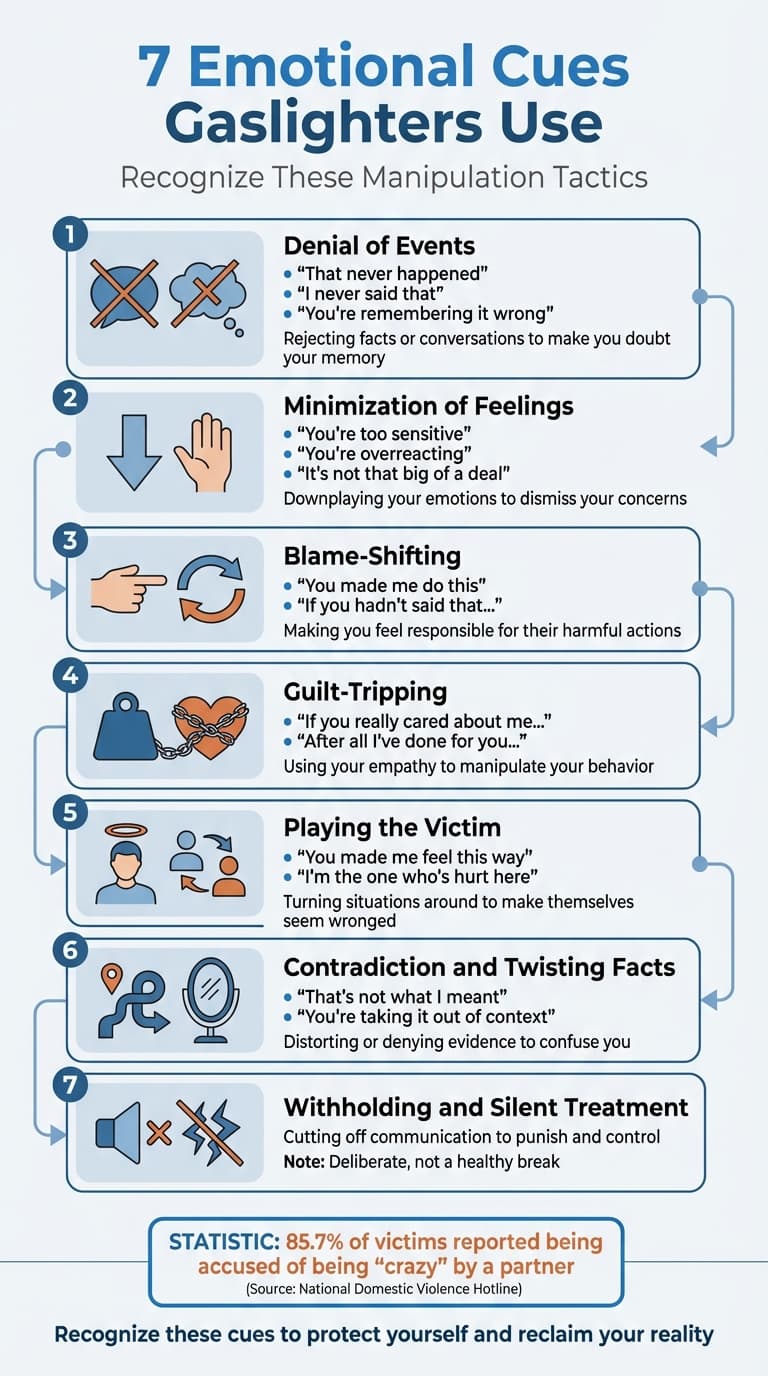
Gaslighting is a manipulation tactic that distorts reality to make you question your own thoughts, feelings, and memories. This article breaks down seven common emotional cues gaslighters use to control and confuse their victims:
- Denial of Events: Rejecting facts or conversations to make you doubt your memory.
- Minimization of Feelings: Downplaying your emotions with phrases like "You're overreacting."
- Blame-Shifting: Making you feel responsible for their harmful actions.
- Guilt-Tripping: Using your empathy to manipulate your behavior.
- Playing the Victim: Turning situations around to make themselves seem wronged.
- Contradiction and Twisting Facts: Distorting or denying evidence to confuse you.
- Withholding and Silent Treatment: Cutting off communication to punish and control.
Each tactic can erode your confidence and create dependency on the manipulator. Tools like Gaslighting Check use AI to detect these behaviors in real time by analyzing text and voice patterns. Recognizing these cues is the first step toward protecting yourself and reclaiming your sense of reality.
::: @figure
1. Denial of Events
Emotional Manipulation Tactic Explained
Denial of events happens when a gaslighter flat-out rejects that something occurred. They might claim conversations never happened, promises were never made, or hurtful actions didn’t take place. Phrases like, “That never happened,” “I never said that,” or “You’re remembering it wrong” are their common tools. This tactic works to make you doubt your memory and perception.
"Gaslighting is when someone 'tries to get another person or a group of people to question or doubt their own beliefs or their own reality.' It's a manipulation tactic." – Danielle Hairston, M.D., Assistant Professor of Psychiatry [4]
Sometimes, this manipulation escalates into a strategy called DARVO - Deny, Attack, and Reverse Victim and Offender. Here, the gaslighter denies the events, attacks your credibility, and then flips the roles to make it seem like you’re the one causing the confusion [7]. These tactics are often so subtle that they can unfold in real time without being immediately obvious.
AI Detection Capability (Text and Voice)
Gaslighting Check’s AI is designed to spot these denial tactics by analyzing both written text and voice patterns. It examines tone, pitch, and pace for signs of condescension or mismatches between what’s being said and how it’s delivered. The platform also tracks conversation histories over time, identifying recurring patterns of denial that might go unnoticed in single interactions. Real-time audio recordings provide timestamped evidence, offering a clear record of these manipulative behaviors.
Impact on Victim's Perception or Emotions
Repeated denial of your reality can take a serious toll on your mental health. Over time, it chips away at your confidence, leaving you unsure of your own memories and self-worth.
"Gaslighting is a form of emotional manipulation to make you feel as if your feelings aren't valid, or that what you think is happening isn't really happening. Over time, you start to question your self-worth, self-esteem and mental capacity." – Chivonna Childs, PhD, Psychologist, Cleveland Clinic [5]
This isn’t accidental - it’s an intentional and harmful form of emotional abuse. By isolating you from your own sense of reality, the gaslighter makes you more dependent on their version of events. This cycle traps you, forcing you to accept their narrative as the only safe truth. Recognizing these behaviors is a critical first step in breaking free from gaslighting.
2. Minimization of Feelings
Emotional Manipulation Tactic Explained
Minimization happens when someone downplays your feelings, making them seem exaggerated, unreasonable, or unimportant. Gaslighters often rely on phrases like, "You're too sensitive", "You're overreacting", "It’s not that big of a deal", or "I was just joking." These statements are designed to shift attention away from their harmful actions and place the spotlight on your emotional reaction. By doing this, they compel you to defend your feelings instead of addressing their behavior.
"By accusing you of being dramatic, the gaslighter is attempting to dismiss your concerns as irrational and unfounded." – Dr. Cortney S. Warren, PhD, Harvard-trained psychologist [6]
This tactic not only erodes your confidence but also leaves behind subtle clues - especially in digital interactions - that AI tools can pick up on.
AI Detection Capability (Text and Voice)
Like denial tactics, minimization leaves behind detectable patterns. Gaslighting Check identifies dismissive language such as "overreacting" or "too sensitive" by analyzing specific phrases in text. In voice, it can detect condescending tones and shifts in pitch. Sentiment analysis further helps track emotional changes, offering additional insights into the manipulative behavior.
Impact on Victim's Perception and Emotions
When minimization happens repeatedly, it can lead to self-invalidation. Over time, you might start questioning your own instincts and memories, even when the gaslighter isn’t around. This creates a dependency on the manipulator to define what’s real. As your self-esteem weakens, you become more vulnerable to anxiety or depression. Many victims report suppressing their emotions and doubting their own judgment, which can lead to a profound sense of disconnection from their inner self. The longer this cycle continues, the harder it becomes to trust your own experiences and feelings [8]. Recognizing these patterns is a critical step toward breaking free and reclaiming your sense of self.
3. Blame-Shifting
Emotional Manipulation Tactic Explained
Blame-shifting happens when a gaslighter turns the tables and makes you feel like the guilty party. They might say things like, "You made me do this," or "If you hadn’t said that, I wouldn’t have reacted this way." Sometimes, they’ll accuse you of behaviors they’re actually guilty of - like cheating - hoping to deflect attention from their own actions. This tactic relies heavily on projection, where their accusations mirror their own misconduct [11].
"Gaslighting is a form of manipulation that moves beyond deception. It often starts with a lie, but it takes it one step further. It flips the narrative to put you on the defense." – Dr. Alison Cook, Psychotherapist [10]
Studies show that people with narcissistic or sadistic tendencies are more likely to use blame-shifting as a manipulation tool [9].
AI Detection Capability (Text and Voice)
To combat this tactic, AI tools are being developed to detect these manipulative behaviors in real time. For example, Gaslighting Check uses Natural Language Processing (NLP) to scan for phrases that redirect blame and assigns scores based on how manipulative the language appears. It doesn’t stop at text - voice analysis can pick up on tone, pitch, and pacing to catch subtle mismatches between what’s said and how it’s delivered. For instance, calm words spoken in a condescending or hostile tone might raise red flags. Sentiment analysis also tracks shifts in emotional tone, helping to identify when someone abruptly moves from supportive to accusatory in an effort to maintain control.
Impact on Victim's Perception and Emotions
Recognizing these patterns is essential because blame-shifting can take a serious toll on a victim’s emotional well-being. Over time, this tactic fosters hypervigilance, guilt, and indecision. Victims may feel trapped, constantly second-guessing their actions to avoid provoking further accusations. In a survey conducted by the National Domestic Violence Hotline, 85.7% of respondents reported being accused of being "crazy" by a partner or ex-partner [9]. This constant barrage can lead to a cycle where you find yourself apologizing for things that aren’t your fault and walking on eggshells, all while the gaslighter’s behavior goes unchallenged.
4. Guilt-Tripping
Emotional Manipulation Tactic Explained
Guilt-tripping is a form of manipulation where someone uses your sense of responsibility or morality to steer your actions. Gaslighters often make you feel selfish or ungrateful for asserting your needs or setting boundaries. For example, they might say, "If you go out with your friends tonight, I'll feel so lonely and sad" [1][2]. Or, "If you really cared about me, this wouldn’t even cross your mind" [3]. These kinds of statements play on your empathy, making you feel accountable for their emotions and leading you to prioritize their desires over your own.
AI Detection Capability (Text and Voice)
Gaslighting Check is designed to pick up on guilt-tripping through advanced detection methods. Using Natural Language Processing (NLP), it scans text for conditional phrases that link your actions to emotional harm. For instance, it can detect statements like "If you loved me, you’d…" or language that frames your boundaries as selfish. On the voice side, the tool analyzes tone and pitch changes, such as a sudden shift to a plaintive or whining tone, extended pauses, higher-pitched speech indicating exaggerated hurt, or even audible sighs and heavy breathing [1][12]. By combining both text and voice analysis, it identifies the subtle cues of guilt-tripping.
Impact on Victim's Perception and Emotions
The emotional toll of guilt-tripping can be severe. Over time, this tactic chips away at your confidence, leaving you with self-doubt, anxiety, and a diminished sense of self-worth [1][2]. You might start feeling like you’re constantly "walking on eggshells", adjusting your behavior to avoid triggering guilt-laden reactions. This pattern not only undermines your independence but also makes you question whether you even have the right to set boundaries or express your feelings. Recognizing these signs is essential, and tools like Gaslighting Check can help you identify and counter these manipulative behaviors effectively. Guilt-tripping often works alongside other emotional manipulation tactics, creating a layered and damaging dynamic.
5. Playing the Victim
Emotional Manipulation Tactic Explained
Expanding on methods like guilt-tripping, gaslighters often use victim-playing as a way to divert attention from their own actions.
This tactic involves the gaslighter portraying themselves as the wronged party when confronted about harmful behavior. They might say things like, "After all I've done for you" or "You made me feel this way," turning the tables to make you feel like the aggressor. It’s a calculated move to avoid accountability and shift the blame onto you.
AI Detection Capability (Text and Voice)
Gaslighting Check uses advanced tools to uncover signs of victim-playing. Its natural language processing (NLP) algorithms identify phrases that signal self-victimization or blame-shifting. On the voice side, it picks up on tone inconsistencies - like frustrated delivery of supposedly supportive words - and detects sudden changes in emotional intensity or exaggerated displays of distress.
Impact on Victim's Perception and Emotions
This manipulation can leave you feeling confused, doubtful, and emotionally drained. You might start questioning whether you even have the right to express your own needs, as you’re forced to juggle your emotions along with the gaslighter’s fabricated grievances. Over time, this can erode your boundaries and lead to a profound loss of personal autonomy.
Detect Manipulation in Conversations
Use AI-powered tools to analyze text and audio for gaslighting and manipulation patterns. Gain clarity, actionable insights, and support to navigate challenging relationships.
Start Analyzing Now6. Contradiction and Twisting Facts
Emotional Manipulation Tactic Explained
Gaslighters often use contradictions to distort reality, twisting facts and denying events to fit their narrative. They might say things like "That never happened" or "You're taking it out of context" even when you have undeniable proof - emails, texts, or recordings - showing otherwise. This isn’t just a disagreement; it’s a calculated strategy to make you doubt your own memory and perception.
Another common approach is paltering, where they share partial truths but leave out critical details, creating a misleading impression. They may also engage in reality denial, dismissing concrete evidence with statements like "That email doesn’t mean anything" or claiming a recording is deceptive. Over time, these tactics force you into a constant cycle of defending your version of events. The goal? To chip away at your confidence in your own understanding of reality.
AI Detection Capability (Text and Voice)
Expanding on its ability to detect denial and minimization, Gaslighting Check also identifies contradictions. In text, it analyzes absolute statements and subtle shifts that distort facts across a conversation. For voice analysis, it picks up on mismatches between tone and language - like when someone uses comforting words but delivers them in a condescending or frustrated tone. These discrepancies help flag manipulative behavior that might otherwise go unnoticed, especially when emotions cloud your judgment.
Impact on Victim's Perception and Emotions
Repeated contradictions can take a serious toll on how you see yourself and the world around you. Over time, this creates what experts call "sentiment whiplash" - a state of mental exhaustion where you feel off-balance and unsure of your own judgment. The constant effort to reconcile the facts you know with the manipulator’s denials drains your mental energy and erodes your self-trust. Eventually, you might start relying on the gaslighter to define reality for you, which is exactly the power dynamic they aim to establish. As John Kenny, an Interpersonal Relationship Coach and Psychologist, puts it:
"Gaslighting is a form of emotional or mental abuse and happens when someone is trying to make you question your own thoughts, actions and emotions in order to gain control over you and your relationship." [13]
7. Withholding and Silent Treatment
Emotional Manipulation Tactic Explained
Withholding and silent treatment are subtle yet powerful tools of emotional manipulation. Unlike taking a healthy break after a disagreement, this tactic is deliberate and designed to undermine your confidence. Gaslighters use these methods to cut off communication, not for resolution or space, but to punish and assert control. By doing so, they create an environment where you feel compelled to seek their approval, making you increasingly dependent on their unpredictable behavior.
The gaslighter dictates when and how communication resumes, keeping you on edge. This unpredictability isn't accidental - it's a calculated move to maintain power and destabilize the relationship dynamic.
AI Detection Capability (Text and Voice)
The Gaslighting Check tool can identify withholding patterns by examining communication gaps in text messages. It flags sudden silences, especially when they occur after discussions that involve accountability or sensitive topics. Additionally, it highlights dismissive language or abrupt conversation endings that shut down valid concerns. This analysis ties into the broader strategies gaslighters use, reinforcing the patterns discussed earlier.
Impact on Victim's Perception and Emotions
The silent treatment can leave you feeling anxious and full of self-doubt. You might find yourself replaying conversations, searching for clues about what went wrong. This emotional isolation often pushes you to take the blame, just to reconnect with the gaslighter. Over time, this manipulation subtly trains you to avoid certain topics or behaviors, giving the gaslighter control over what is acceptable to discuss in the relationship.
Recognising Gaslighting Tactics, Phrases and Stages
How Gaslighting Check Identifies Emotional Cues

Gaslighting Check leverages AI to analyze both text and voice interactions, pinpointing seven key manipulation techniques commonly used by gaslighters. By focusing on these emotional and verbal cues, the tool helps you spot gaslighting behaviors, even when your emotions might make it harder to see clearly.
The system scans conversations for manipulative language, such as denial or minimization, and evaluates vocal patterns, including rising inflections or monotone delivery, to identify potential red flags. This combination of text and voice analysis provides a comprehensive way to detect manipulation as it happens.
Gaslighting Check offers three subscription plans:
- Free Plan ($0/month): A great starting point for trying out the platform, this tier includes basic keyword detection but provides limited insights.
- Premium Plan ($9.99/month): Unlocks advanced features like natural language processing (NLP) for text analysis, full voice analysis, detailed breakdowns with percentages, and the ability to track conversation history for up to 90 days.
- Enterprise Plan (custom pricing): Ideal for organizations, this plan includes all Premium features along with additional customization options like AI-driven biometric scoring and personalized analytics dashboards.
| Feature | Free Plan | Premium Plan | Enterprise Plan |
|---|---|---|---|
| Monthly Cost | $0 | $9.99 | Custom |
| Text Analysis | Basic keyword detection | NLP with sentiment analysis | NLP with 95% accuracy |
| Voice Analysis | Not included | Tone, pitch, and stress pattern analysis | AI-driven biometric scoring (98% precision) |
| Report Details | Summary of top 3 cues per session | Detailed breakdowns with percentages | Customizable PDF reports with analytics |
| Conversation History | 7-day history with basic search | 90-day history with tagging and export | Unlimited storage with multi-device sync |
| Best For | Testing the platform | Individual protection | Organizations and professionals |
All plans prioritize user privacy with encryption and automatic data deletion. Reports for Premium and Enterprise users are typically erased after 30 days to ensure sensitive information isn't stored longer than necessary. By identifying these subtle cues, Gaslighting Check equips you with the tools to regain clarity and confidence in your interactions.
Conclusion
Understanding the seven emotional cues - denial, minimization, blame-shifting, guilt-tripping, playing the victim, contradiction, and withholding - is essential for protecting yourself from manipulative behavior. These patterns can erode your confidence and leave you questioning your reality.
If interactions consistently leave you feeling anxious, confused, or uneasy, trust those instincts. Your emotions are valid, and recognizing these signs is the first step toward reclaiming clarity. This is where having an objective perspective becomes invaluable.
Gaslighting Check provides real-time text and voice analysis to identify manipulative tactics and validate your experiences. Its detailed reports break down the psychological strategies being used and offer actionable steps for setting boundaries and responding effectively.
To safeguard yourself, document key details - dates, specific phrases, and interaction summaries. This not only helps counter attempts to rewrite history but also strengthens your ability to establish clear boundaries. Reach out to trusted friends or family for perspective, and consider using tools that provide objective insights to navigate emotionally charged situations.
Rebuilding trust in your perceptions takes time, but you don’t have to do it alone. Start with the Free Plan or access advanced features with the Premium Plan for $9.99/month. These tools, combined with consistent documentation and firm boundaries, can help you regain confidence and protect yourself from manipulation. Stay empowered, and take control of your narrative.
FAQs
How can I tell if someone is gaslighting me?
Gaslighting is a form of emotional manipulation that aims to make you question your own reality. It often shows up in subtle ways, like dismissing your emotions with phrases such as "You're overreacting", or outright denying events you know happened with statements like "That never happened." Gaslighters might also rely on tactics like guilt-tripping, shaming, or shifting blame to erode your confidence and warp your sense of reality.
Watch for patterns in behavior, such as constant invalidation, abrupt tone shifts, or condescending comments. These actions can gradually lead to confusion and self-doubt. Trust your gut when something feels off, keep a record of troubling interactions, and explore tools that can help you assess conversations for manipulative tendencies. Spotting these red flags early can go a long way in safeguarding your emotional health.
What are the long-term effects of gaslighting?
Gaslighting can deeply affect a person’s mental and emotional health over time. One of the most noticeable impacts is on self-esteem, as it often leads individuals to question their own feelings and perceptions. This constant second-guessing can create a cycle of chronic self-doubt and confusion, making it difficult to trust their own judgment.
The long-term effects don’t stop there. Many who endure gaslighting for extended periods may develop anxiety, depression, and even feel disconnected from reality. Emotional weariness becomes a common struggle, often accompanied by feelings of guilt and helplessness. These challenges can take a significant toll on overall mental health. Spotting these signs early can make a huge difference in protecting your well-being and rebuilding trust in your own instincts.
How does Gaslighting Check detect emotional manipulation in real-time?
Gaslighting Check leverages cutting-edge AI to spot emotional manipulation in real time. By utilizing natural language processing (NLP) and voice pattern analysis, it examines both text and voice communications to identify subtle signs of manipulation, such as gaslighting, blame-shifting, and emotional invalidation.
The tool analyzes conversational elements like language, tone, and shifts in emotional dynamics, sending real-time alerts to help users detect manipulative behavior as it unfolds. It also provides features like detailed reports and conversation history tracking, offering insights into recurring abusive patterns. These tools aim to support users in safeguarding their mental health and maintaining emotional clarity.