10 Early Signs of Gaslighting in Conversations

10 Early Signs of Gaslighting in Conversations
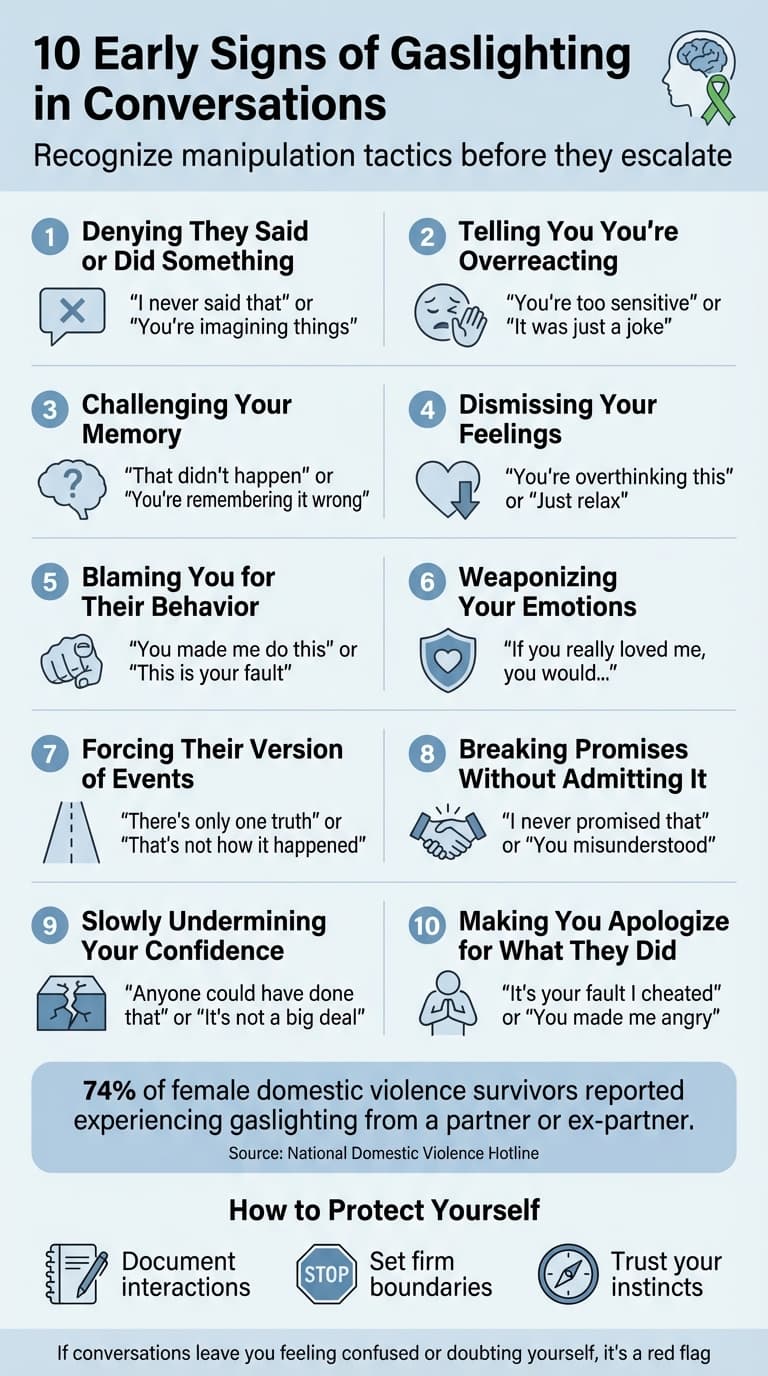
Gaslighting is a subtle yet harmful manipulation tactic that makes you question your reality, memory, or feelings. Recognizing its early signs can help protect your mental health and confidence. The article outlines ten common gaslighting behaviors, including denying past actions, dismissing emotions, shifting blame, and twisting events. These tactics aim to erode trust in yourself while increasing dependence on the manipulator. Key takeaways:
- Denial of past actions: "I never said that" or "You're imagining things."
- Dismissing emotions: Labeling you as "overreacting" or "too sensitive."
- Blame-shifting: Making you responsible for their behavior.
- Twisting your memory: Insisting their version of events is correct.
- Breaking promises: Denying commitments they made.
To counteract gaslighting, document interactions, set boundaries, and trust your instincts. If you often feel confused or doubting yourself after conversations, it’s a red flag. Tools like Gaslighting Check can analyze patterns in communication to help you identify manipulation early. By staying aware and seeking support, you can protect your mental well-being.
::: @figure
Gaslighting Expert Reveals 10 Early Warning Signs You Shouldn’t Ignore | Dr. Daniel Fox
1. Denying They Said or Did Something
When someone outright denies a conversation or event that clearly happened, it’s a textbook gaslighting move. They might say things like, "I never said that" or "You're imagining things", even when there’s solid proof to the contrary.
This tactic chips away at your confidence in your own memory and judgment, leaving you more open to their manipulation. Dr. Brittany McGeehan, a licensed psychologist, sheds light on the impact:
"Gaslighters consistently deny their actions, words or promises, even in the face of clear evidence. This is harmful because observable evidence is dismissed. It teaches you that you cannot trust your senses, which makes it easier to manipulate you later down the line." [1]
In personal relationships, denial might look like refusing to acknowledge an agreement to be exclusive. At work, it could be a manager claiming they never assigned a task or gave specific instructions, leaving you second-guessing yourself. Over time, this erodes trust and distorts your sense of reality.
To protect yourself, try documenting interactions. Use a journal, jot down notes immediately after conversations, or rely on email for communication - it creates a verifiable record. Voice memos can also be a helpful tool for capturing details right after they happen. When confronted with denial, a grounding response like, "I remember it differently, and I’m not going to argue about it", can help you disengage. Avoid lengthy debates, as gaslighters rarely admit to their behavior, no matter the evidence.
Research shows that 74% of female domestic violence survivors reported experiencing gaslighting from a partner or ex-partner [8]. Over time, this constant denial can lead to "memory distrust syndrome", where victims lose faith in their own recollection and start relying on the gaslighter’s version of events. This tactic not only undermines your sense of self but also lays the groundwork for other manipulative behaviors, which will be explored in the following sections.
2. Telling You You're Overreacting
Hearing someone say you're "overreacting" or "too sensitive" is a textbook gaslighting move. Instead of owning up to their behavior, they shift the spotlight to your emotional reaction. This tactic, much like denial, undermines your confidence - not in your memory this time, but in your feelings. Dr. Robin Stern, Co-founder of the Yale Center for Emotional Intelligence, explains:
"The idea is to turn the attention away from their bad behavior by making it about you doing something wrong." [5]
You might hear phrases like, "It was just a joke", "You're being dramatic", or "Don't be so sensitive." These remarks aren't harmless - they're calculated attempts to make you question whether your concerns are justified. As Dr. Stephanie Sarkis, psychotherapist, notes, this tactic is designed to "silence you and make you doubt the validity of your emotions" [4].
The goal here isn’t just to dismiss your feelings in the moment. It’s about creating a dynamic where they define what’s “reasonable” in the relationship. Over time, this can lead you to second-guess your instincts and trust their narrative over your own.
To push back against this, remind yourself: My feelings are valid, and I have every right to express them. If the gaslighter keeps dismissing your emotions, set a firm boundary, like: If you continue to minimize my experience, I’ll step away from this conversation [1]. Keep it short; engaging in lengthy arguments rarely leads anywhere productive with a gaslighter.
The difference between healthy disagreement and manipulation is clear. Someone who values you will respect your feelings, even if they don’t share the same perspective. A gaslighter, on the other hand, will consistently dismiss, belittle, or shame your emotions to keep control.
3. Challenging Your Memory
One of the most unsettling tactics of gaslighting is when someone outright denies something they said or did - even when you're certain it happened. You might hear phrases like, "I never said that", "That didn’t happen", or "You’re remembering it wrong." This goes beyond simple denial; it’s a deliberate effort to distort your memory of past events.
The aim isn’t just to win a disagreement - it’s to create a pattern where you begin doubting your own memory and start depending on the gaslighter's version of reality.
To make things even more confusing, gaslighters often use what’s called retroactive reframing. They’ll recount the same event differently at different times, leaving you feeling a sense of "whiplash" that makes it harder to trust your recollection. Over time, this can lead to what some psychologists refer to as Memory Distrust Syndrome [4].
To protect yourself, try documenting important conversations. Note dates, specific quotes, and key details. If your memory is questioned, respond with clear statements like, "That’s not how I remember it", or "I’m confident about what happened." These steps can help you stay grounded and resist manipulation.
If you frequently leave conversations feeling confused or second-guessing yourself, pay attention to that gut feeling. In healthy relationships, different memories are discussed and respected. A gaslighter, however, will insist their version is the only truth - an unmistakable warning sign.
4. Dismissing Your Feelings
When someone brushes off your emotions with phrases like "You're too sensitive" or "It's not a big deal", they’re doing more than just disagreeing with you - they’re minimizing your experiences and casting doubt on your emotional responses. This kind of dismissal can chip away at your self-esteem and make you question your perception of reality. Over time, this tactic, like other forms of gaslighting, undermines your ability to trust yourself and opens the door for further manipulation [3].
"Trivializing your emotions allows the person who is gaslighting you to gain power over you." - Sherri Gordon, CLC [3]
Gaslighters often use this strategy to deflect attention from their own behavior. Instead of addressing the issue at hand, they shift the focus to your reaction, framing it as exaggerated or unreasonable. You might hear comments like, "You're overthinking this", "Just relax", or "No one else gets upset about this - why do you?" The intent is clear: to make you doubt whether your feelings are valid.
"Gaslighters often dismiss emotions…which invalidates the victim's genuine feelings and undermines their emotional responses." - Dr. Joel Frank, Psy.D., Licensed Psychologist [1]
This pattern of invalidation usually unfolds in stages. At first, you might feel confused or defensive, trying to explain why your feelings matter. Over time, constant dismissal can wear you down, leaving you feeling drained or even questioning your own reality. Eventually, you might find yourself relying on the gaslighter’s perspective instead of trusting your instincts, simply to avoid further conflict [7].
To break this cycle, it’s essential to stand firm. Respond with statements like, "I feel deeply, and my feelings are valid." Set clear boundaries, and if a conversation consistently leaves you doubting yourself, take a step back. Trust your intuition - your emotions are real and meaningful, no matter how someone else tries to frame them. Recognizing and addressing this pattern of emotional invalidation is a key step toward reclaiming your confidence and independence [1][4].
5. Blaming You for Their Behavior
One clear warning sign of manipulation is when someone shifts the blame for their actions onto you. Phrases like "You made me do this" are designed to deflect responsibility and make you feel at fault for their poor decisions, outbursts, or even infidelity. But let’s be clear: everyone is accountable for their own behavior, no matter the circumstances [5].
"The truth is that no one can 'make' you feel anything. That is a choice they are making." - Stephanie Sarkis, PhD, Psychotherapist and Author [5]
Gaslighters use this tactic to avoid accountability and keep you on the defensive. When you're busy justifying yourself, you're less likely to question their narrative. Statements like "If you really loved me, you wouldn’t have made me feel like I had to cheat" or "You’re the reason I’m so stressed" are crafted to make you feel guilty for things you didn’t cause. This blame-shifting not only undermines your confidence but also strengthens their control over you. It’s another way gaslighting manipulates your sense of reality [1][11].
"This shift in blame makes it easy for you to stay in a one-down position and, therefore, default to whatever the other person says is true." - Dr. Brittany McGeehan, Ph.D., Licensed Psychologist [1]
The effects of this tactic are far-reaching. Research shows that 74% of female victims of domestic violence reported experiencing gaslighting from their partner or ex-partner, with blame-shifting being a frequent element [8][13]. When you start accepting blame for things you didn’t do, it chips away at your confidence and clouds your judgment.
Setting boundaries is key to breaking this cycle. You can say something like, "I’m willing to take responsibility for my role in this, but I won’t take responsibility for yours." It’s also important to remind yourself that while you might influence a situation, you’re not responsible for how someone else chooses to react. If the blame-shifting continues, it’s often better to disengage rather than defend yourself [1][11].
6. Weaponizing Your Emotions
Using your emotions against you is another way manipulators chip away at your self-trust. When someone exploits your feelings, vulnerabilities, or affection to gain control, they turn your insecurities into tools to manipulate you during arguments. This tactic often leaves you feeling defensive and distracted from the real issues at hand [6][10].
For instance, hearing phrases like, "If you really loved me, you would…" is a red flag. This isn’t about finding compromise - it’s about using your love as leverage to override your boundaries. Dr. Robin Stern, Co-founder of the Yale Center for Emotional Intelligence, puts it plainly: "You're supposed to love me unconditionally, no matter what" [5]. This approach pressures you into compliance and often shifts the blame onto you, as experts have observed.
"Gaslighters will also blame you for their emotions, making you responsible for upsetting them and for keeping them happy, even when it is something you have no control over." - Dr. Stephanie Sarkis, Psychotherapist [5]
Another telltale sign is when your emotional honesty is twisted into an attack on your character. If someone dismisses you as "too sensitive", "crazy", or "dramatic", or makes hurtful jokes about your insecurities only to accuse you of lacking humor when you react, they’re likely using these tactics to undermine your confidence.
The ultimate aim of such behavior is to make you doubt your self-worth, fostering a dependency where you seek validation solely from the abuser. It’s crucial to set clear boundaries when your feelings are dismissed or you’re subjected to insults. If conversations repeatedly leave you feeling confused, unjustly guilty, or ashamed, consider these as serious warning signs [6][10].
7. Forcing Their Version of Events
Gaslighters often refuse to acknowledge alternative perspectives, insisting that their version of events is the only valid one. Even when you present concrete evidence - like text messages or emails - they remain unyielding, dismissing anything that challenges their narrative. This strategy isn't just about control; it’s about causing you to doubt your own recollection and isolating you from your sense of reality.
"If a person insists that there is one version of any truth, it's a warning sign that they may be setting you up for gaslighting" - Dr. Brittany McGeehan[1]
A common tactic they use is "countering", where they question your memory and even insert fabricated details into the story[9]. To make matters worse, manipulators might employ strategic omission or distortion - leaving out key facts or altering the story slightly each time they retell it. This inconsistency is designed to make you second-guess yourself[1]. Sometimes, they’ll overwhelm you with conflicting details, wearing you down mentally until you’re too exhausted to argue back[14].
To protect yourself, document interactions as soon as possible, noting dates, quotes, and key details[1]. If someone insists on forcing their version of events, a simple response like, "It seems we remember things differently, so let's move on", can help break the cycle. Avoid getting drawn into lengthy debates to prove your side, as these arguments often serve as a tool for further manipulation and confusion[1].
8. Breaking Promises Without Admitting It
When someone repeatedly breaks promises yet denies ever making them, you're dealing with a classic gaslighting tactic. This isn't just forgetfulness - it's a deliberate way to erode your boundaries. Couples and relationship therapist Boris Herzberg explains:
"Gaslighters often break agreements to test personal boundaries and assert control. By doing so, they gauge the individual's reactions and seek to consolidate their power." [12]
The manipulation becomes clear when they use phrases like, "I never said that," "You're remembering it wrong," or "I don't know what you're talking about." While holding you accountable for every minor misstep, they conveniently dismiss their own broken promises. They might even use seemingly kind words, such as "I would never hurt you on purpose," to deflect responsibility - yet the cycle of broken promises continues. This behavior doesn't just damage trust; it creates fertile ground for deeper psychological manipulation.
Over time, this denial can lead to memory distrust syndrome, where you begin to doubt your own recollections. Dr. Brittany McGeehan highlights the harm caused by this tactic:
"Gaslighters consistently deny their actions, words or promises, even in the face of clear evidence. This is incredibly harmful because... it teaches you that you cannot trust your senses, which makes it easier to manipulate you later down the line." [1]
To protect yourself, it’s essential to recognize these patterns early. Document agreements with specific dates and exact wording. In professional settings, follow up verbal commitments with emails to create a clear paper trail. Most importantly, focus on actions rather than words - a consistent gap between someone's behavior and their promises is a major warning sign. If they try to reframe past conversations to fit their narrative, take note.
If you frequently feel like you're "wrong" about agreements you know were made, trust your instincts. Early awareness can help you safeguard your emotional well-being before deeper harm occurs.
9. Slowly Undermining Your Confidence
Gaslighting doesn’t always come as obvious insults; instead, it chips away at your confidence bit by bit until you’re left doubting yourself constantly. Psychotherapist Stephanie Moulton Sarkis likens this to the "frog in the frying pan" effect - changes happen so gradually that you don’t notice until the damage feels irreversible [15]. What might begin as small, seemingly harmless comments can snowball into a pattern that leaves you feeling incapable and unworthy.
These tactics are often cloaked in concern or disguised as humor. Gaslighters might use something like negging - those backhanded compliments such as, "You're pretty smart for someone who doesn't read much" - to plant seeds of insecurity while pretending they mean no harm [16]. They may also downplay your achievements with remarks like, "Anyone could have done that" or "It’s not a big deal", making it hard for you to feel proud of your successes [1]. Dr. Joel Frank sheds light on this behavior:
"The gaslighter might undermine accomplishments by saying things like 'Anyone could have done that' or 'It's not a big deal.' This tactic serves to erode the victim's self-esteem and make them feel incompetent or undeserving, fostering dependency on the abuser for validation." [1]
This erosion of confidence often follows a predictable pattern - Disbelief, Defense, and eventually Depression. As this cycle deepens, you might start apologizing for things you didn’t do wrong or second-guessing decisions you once made with certainty [5][2]. You may even find yourself walking on eggshells, trying to avoid setting off a negative reaction. Robin Stern highlights the long-term effects:
"The more the gaslighter can keep you feeling insecure and questioning your reality, the more you'll believe their explanations. Over time, you'll eventually reach a point where your self-confidence is destroyed and you no longer trust yourself." [5]
To counteract this, lean on trusted friends or family who knew you before the gaslighting began - they can offer a clearer perspective when you start doubting yourself. Keeping a record of specific interactions, complete with dates and direct quotes, can help you stay grounded in reality rather than falling into the gaslighter’s version of events. Above all, trust your instincts: if someone’s words consistently leave you feeling small, it’s a sign to reevaluate the relationship. Healthy connections should empower you, not tear you down piece by piece.
Next, we’ll look at how gaslighters push you into apologizing for their behavior.
10. Making You Apologize for What They Did
Gaslighters have a way of turning the tables so convincingly that you end up apologizing for their bad behavior. Whether they cheat, lie, or lash out, they twist accountability to make you feel like you're the one at fault. Statements like "It's your fault I cheated" or "You made me furious" are designed to manipulate you into believing their actions are somehow your responsibility [5][1]. This tactic lays the groundwork for deeper manipulation.
Dr. Robin Stern, co-founder of the Yale Center for Emotional Intelligence, sheds light on this behavior:
"A gaslighter will often make you beg for their forgiveness and apologize profusely for any 'wrong' you committed, even if it's something they did." [5]
Gaslighters also amplify this manipulation by projecting their actions onto you. They paint themselves as the victim, dodging accountability and pushing you into a position of submission [1][17][4].
A key warning sign is when you find yourself constantly apologizing for things you didn’t do. As Dr. Cortney S. Warren puts it, "I'm willing to take responsibility for my role in this, but I'm not taking responsibility for yours" [11]. To protect yourself, document interactions to keep a clear perspective and avoid getting caught in their web of distortion.
How AI Tools Help Identify Patterns
Gaslighting often starts small - sporadic lies, subtle jabs, or dismissive comments - and grows into something much more damaging over time. These evolving patterns can be hard to spot, which is where AI steps in.
Gaslighting Check uses AI to uncover these manipulation patterns before they spiral out of control. By analyzing documented conversations - whether text or voice - the platform identifies signs of manipulation. It assesses text for manipulative language and detects shifts in tone during spoken interactions. If you find yourself doubting your memory or apologizing excessively, this tool tracks interactions over time, helping you notice recurring behaviors you might otherwise overlook.
The platform doesn’t stop there. It creates detailed, evidence-based reports that highlight manipulation patterns clearly. These reports can be invaluable when discussing your concerns with a therapist, counselor, or even a trusted friend. Your privacy is a top priority, with all data protected through end-to-end encryption and automatic deletion. By providing objective documentation, the tool equips you with the clarity and confidence to confront gaslighting.
| Plan | Price | Key Features | Best For |
|---|---|---|---|
| Free | $0 | Text analysis, limited insights | Testing basic conversation patterns |
| Premium | $9.99/month | Text and voice analysis, detailed reports, conversation history tracking | Comprehensive manipulation detection |
| Enterprise | Custom pricing | All premium features plus customization options | Organizations and support groups |
With searches for "gaslighting" skyrocketing by 1,740% in 2022 [18], it’s clear more people are becoming aware of these harmful tactics. Using an objective tool like this can help you trust your instincts when someone tries to distort your reality.
Conclusion
Gaslighting often begins with subtle, seemingly harmless remarks - denying past statements, dismissing your emotions, or questioning your memory. These early behaviors can be easy to miss, but they lay the groundwork for deeper emotional harm. Spotting these patterns early is essential to protecting your mental health. Awareness is your first layer of defense.
Trust what your instincts tell you. If something feels off, pay attention. Gaslighting thrives on making you second-guess your perceptions, so acknowledging that uneasy feeling is a critical first step. Consider keeping a record of key interactions to help counter any attempts to twist or distort your recollections.
You’re not alone in this. Staying connected with supportive friends, family, or a therapist can provide valuable outside perspectives and validation. If you’re having trouble identifying patterns, tools like Gaslighting Check can analyze text and voice conversations for signs of manipulation. Detailed reports from such tools can help you see tactics you might have missed, giving you the clarity to act confidently.
Set firm boundaries, and don’t hesitate to step away from interactions that leave you feeling confused or belittled. As Dr. Brittany McGeehan explains:
"Gaslighters often rely on making you doubt yourself, so recognizing and acknowledging your feelings is the first step in protecting yourself" [1].
Your experiences and perceptions are valid - stand by them.
FAQs
How can I tell the difference between a normal disagreement and gaslighting?
Normal disagreements are a natural part of relationships. They typically involve differing opinions or misunderstandings, where both parties aim to resolve the issue while respecting each other’s viewpoints. For instance, a couple might discuss how to divide household expenses, acknowledging each other's feelings and goals in the process.
Gaslighting, on the other hand, is something entirely different. It’s a manipulative tactic intended to make someone question their perception of reality. This behavior often includes denying facts, dismissing emotions, or even twisting past events to create confusion and self-doubt.
Here are some common signs of gaslighting to watch out for:
- Denying events: Statements like, “That never happened,” even when you clearly remember it did.
- Shifting blame: Phrases such as, “You’re too sensitive” or “You’re imagining things,” used to invalidate your concerns.
- Distorting reality: Rewriting past events in a way that makes you question your own memory.
If these behaviors show up repeatedly, it’s likely more than just a disagreement. Tools like Gaslighting Check can analyze conversations and help identify patterns of manipulation, offering clearer insight into such interactions.
What can I do if I think someone is gaslighting me?
If you think you're being gaslighted, the first step is to trust your own perceptions and experiences. Start keeping a detailed record of specific incidents - note dates, exact phrases, and any supporting evidence like text messages or emails. This documentation can help you stay anchored in reality when someone tries to distort the truth.
From there, establish firm boundaries and address the behavior directly but calmly. For instance, if something feels off, ask for clarification and explain how their actions or words affect you. If the person persists in dismissing or twisting your words, it might be necessary to limit your interactions - or even consider cutting ties altogether.
Lastly, lean on your support system. Talk to trusted friends, family, or a mental health professional who can offer perspective and guidance. You can also explore tools like Gaslighting Check, which helps identify manipulation tactics in conversations while ensuring your data remains private. And if you ever feel unsafe, don’t hesitate to contact local domestic violence hotlines or law enforcement for help.
Why is it helpful to keep a record of conversations when dealing with gaslighting?
Documenting your interactions can be an incredibly effective way to address gaslighting. By keeping a record of conversations - whether through written notes, legally permissible recordings, or detailed summaries - you create a way to track patterns of manipulation and spot inconsistencies as they emerge. This process can help bring clarity to situations that may otherwise leave you doubting your own experiences.
Having these records can also be invaluable when seeking support from others, such as a trusted friend, therapist, or even a legal expert. Concrete examples make it easier to explain your concerns, ensuring you’re better equipped to communicate what’s happening and get the assistance you need.