Dominance vs. Submission: Behavioral Patterns Explained

Dominance vs. Submission: Behavioral Patterns Explained
Understanding dominance and submission is key to deciphering human interactions. These behaviors shape how individuals assert control or yield in social situations, often driven by biological and psychological systems. Dominance is about taking charge, using assertiveness or authority to influence others, while submission involves stepping back to avoid conflict or risks. Both are rooted in evolutionary patterns and manifest through specific body language, emotions, and verbal cues.
Key Points:
- Dominance: Assertive, confident behavior aimed at controlling resources or status. Often involves bold posture, direct eye contact, and commanding language.
- Submission: Yielding behavior to de-escalate conflict, marked by slouched posture, avoiding eye contact, and compliance.
- Motivations: Dominance stems from a desire for power and control; submission arises from fear of conflict or harm.
- Impact: Rigid dominance can lead to aggression or manipulation, while chronic submission may cause anxiety, shame, or depression.
- Evolutionary Roots: These behaviors help maintain social order, minimizing conflict over resources.
Balancing these dynamics is crucial for healthy relationships and effective communication. Recognizing and addressing power imbalances can prevent harmful patterns and improve interactions.
What Dominance Behaviors Look Like
Dominance shows up in the ways people assert control, claim authority, and position themselves above others in social settings. It’s about using control over rewards and consequences to demand respect or compliance [2]. This can range from subtle actions, like interrupting someone in a meeting, to outright intimidation or threats.
Common traits of dominance include assertiveness, forcefulness, and being outspoken, often paired with body language that signals authority - think broad postures, taking up more space, or facial expressions that exude superiority [2][7]. Dominant individuals may rely on aggression, threats, or intimidation to maintain their position [2][7].
Studies show that power can lead to disinhibition, making people take bigger risks, act overconfidently, and develop an "illusion of control" over outcomes [6]. This shift often comes with a lower tendency to seek advice and a drop in empathy, leading to behaviors that objectify or dehumanize others [6].
Tian Chen Zeng from Harvard University’s Department of Human Evolutionary Biology explains:
"Dominance captures behavioural patterns found in social hierarchies that arise from agonistic interactions in which some individuals coercively exploit their control over costs and benefits to extract deference from others, often through aggression, threats and/or intimidation" [2].
Interestingly, not all dominance looks the same. Some individuals use "bistrategic tactics" - a mix of coercion and cooperative strategies - to expand their influence. By combining authority with competence, they balance fear-based control with respect-driven leadership. This approach sheds light on the deeper psychological motivations behind dominance.
Why People Display Dominance
The need to dominate is deeply rooted in the desire for power - the ability to control resources, reward or punish others, and secure advantages [1]. This drive is tied to a psychological system that helps individuals gain control over essential resources for survival and reproduction.
Several factors fuel dominant behavior. Dominance motivation makes people highly attuned to changes in their status. When their power is threatened, anger often kicks in, leading to assertive or aggressive responses [1]. This reaction is tied to a neurobiological mechanism called "approach system activation", which heightens confidence and encourages reward-seeking behavior when power is achieved.
Life experiences also play a role. People develop mental templates, or internal models, based on past successes or failures, which guide their strategies for gaining dominance. For example, someone who learned early on that aggression works might lean on that tactic in high-pressure situations.
Dominance behaviors emerge early in life. A 2022 study of over 350 MBA students working in small teams for a month found that initial dominance levels predicted who would eventually hold the most influence [2]. Even infants as young as 6 to 10 months can recognize dominance and use physical size to predict which individual will prevail in a conflict [2][5]. These early tendencies reflect the evolutionary roots of dominance.
Origins of Dominance in Evolution and Society
Dominance behaviors trace back to our evolutionary history, shared with primates like chimpanzees and bonobos. In these species, hierarchical rank determines access to resources like food and mating opportunities [2]. From an evolutionary perspective, dominance hierarchies evolved to minimize constant, costly conflicts over resources. Instead of fighting every time a resource is contested, hierarchies establish order, saving energy and reducing injury risk [1][2].
This concept is explained through the "hawk-dove" game model, where natural selection favored individuals who could signal dominance based on traits like size, age, or past victories, avoiding unnecessary confrontation [2]. Once hierarchies are established, they function as efficient systems for resource allocation, with individuals naturally adhering to ranks [1][8].
Dominance is such a key part of primate social structure that it’s the first personality trait identified through factor analysis in all great apes except orangutans [7]. In one study, rhesus macaques even traded rewards just to view images of high-status macaques, highlighting how attuned non-human primates are to power dynamics [1].
Humans also recognize dominance early. Physical aggression and dominance-seeking behaviors - like kicking, biting, or breaking objects - peak between 2 and 3 years old across different cultures [2]. By 15 months, children can assess dominance based on prior interactions [5].
On a larger scale, hierarchies help groups function more efficiently under a central authority, especially in dangerous situations where coordination is crucial for survival [5]. While dominance can offer individual benefits, these structures also help communities manage threats and distribute resources effectively.
However, unchecked dominance doesn’t go unchallenged. In some egalitarian societies, "reverse dominance hierarchies" emerge, where groups use tactics like ridicule, ostracism, or even execution to curb overly dominant individuals [2][7]. This shows that while dominance is deeply ingrained, human societies have developed ways to regulate it collectively.
What Submission Behaviors Look Like
Submission often involves giving up power to avoid conflict, and it’s typically expressed through nonverbal cues. These might include a slouched posture, lowered head, avoiding eye contact, or what’s called the "shame display", where the body appears crouched or withdrawn [10]. In tense situations, these behaviors act as signals of appeasement, helping to de-escalate aggression before it turns violent [10][12].
Kayleigh-Ann Clegg from McGill University puts it this way:
"Submissiveness refers to both an interpersonal trait and a set of social defensive strategies that indicate the person is relinquishing power, status, autonomy, or control." [10]
This behavior doesn’t just show deference - it can also set off a cycle of heightened vigilance, which can affect emotional well-being. Submissive actions often appear as compliance, conflict avoidance, or yielding to those perceived as more powerful. For instance, someone might give up resources or status markers to steer clear of confrontation [12]. Research even shows that in experiments, participants who encountered a dominant partner with an expansive posture instinctively reduced their own stance, signaling a submissive response [3].
One particularly intense form of submission is stonewalling, which is essentially a freeze reaction to perceived threats. Laura Silverstein, LCSW, a Certified Gottman Couples Therapist, explains:
"Stonewalling is the freeze reaction to perceived danger. Heart-rates are well over one hundred beats per minute, accompanied by difficulty breathing, muscle tension and internal panic." [11]
Although stonewalling might look like indifference, it’s actually a sign of extreme physiological stress.
What Causes Submission Responses
Submission often stems from a fear of what researchers call "cost-infliction" - essentially, the threat of physical or social harm from someone more dominant [12]. When people believe someone else has a higher capacity to control resources or assert power, they may adopt submissive behaviors to avoid losses [1][12].
This response ties into the Behavioral Inhibition System (BIS), which kicks in when someone feels powerless. The BIS heightens sensitivity to social threats and potential punishment [1]. Sheri L. Johnson, a psychology professor at the University of California, Berkeley, explains:
"Powerlessness is proposed to activate the behavioral inhibition system, which increases reactivity to cues of threat." [1]
Social norms also play a big role. In many societies, people are discouraged from displaying overt dominance, which can lead to more submissive behaviors to avoid social backlash like ridicule or exclusion [12][9]. In one-on-one interactions, a phenomenon called complementarity might occur, where dominant nonverbal cues from one person naturally prompt submissive responses from the other, creating a sense of interpersonal ease [3].
Submissive individuals are also more likely to overestimate social risks, such as rejection, which reinforces these patterns. However, submission isn’t a one-size-fits-all response. For example, someone might act submissively at work but take on a more assertive role in their local community [1]. These dynamics help explain how chronic submission can take a toll on mental health.
How Submission Affects Mental Health
Repeated or rigid submissive behaviors can have a serious impact on mental health. When these patterns become inflexible or contextually inappropriate, they’re often linked to anxiety, depression, and chronic shame [1]. A particularly harmful state is known as "involuntary subordination", where individuals feel stuck in subordinate roles, leading to long-term emotional damage.
Shame is a key emotion tied to submission, often arising when someone feels they lack social value or appeal [1][12]. Unlike guilt, which focuses on specific actions, shame attacks a person’s core sense of self-worth, making its effects more deeply ingrained.
The physical consequences are just as striking. During freeze responses like stonewalling, individuals might appear calm on the outside but experience internal panic, difficulty breathing, and muscle tension [11]. This disconnect between outward composure and inner distress can lead to a sense of isolation.
Additionally, the heightened activity of the Behavioral Inhibition System makes submissive individuals more alert to potential rejection or disapproval, keeping them in a constant state of stress [1]. Tools like the 16-item Submissive Behavior Scale (SBS), which has shown strong reliability (alpha = .89), can help clinicians identify when submissive tendencies become harmful [1].
Understanding these behaviors provides deeper insight into how power dynamics shape human interactions, complementing the earlier discussion of dominance.
Dominance vs. Submission: Side-by-Side Comparison
::: @figure
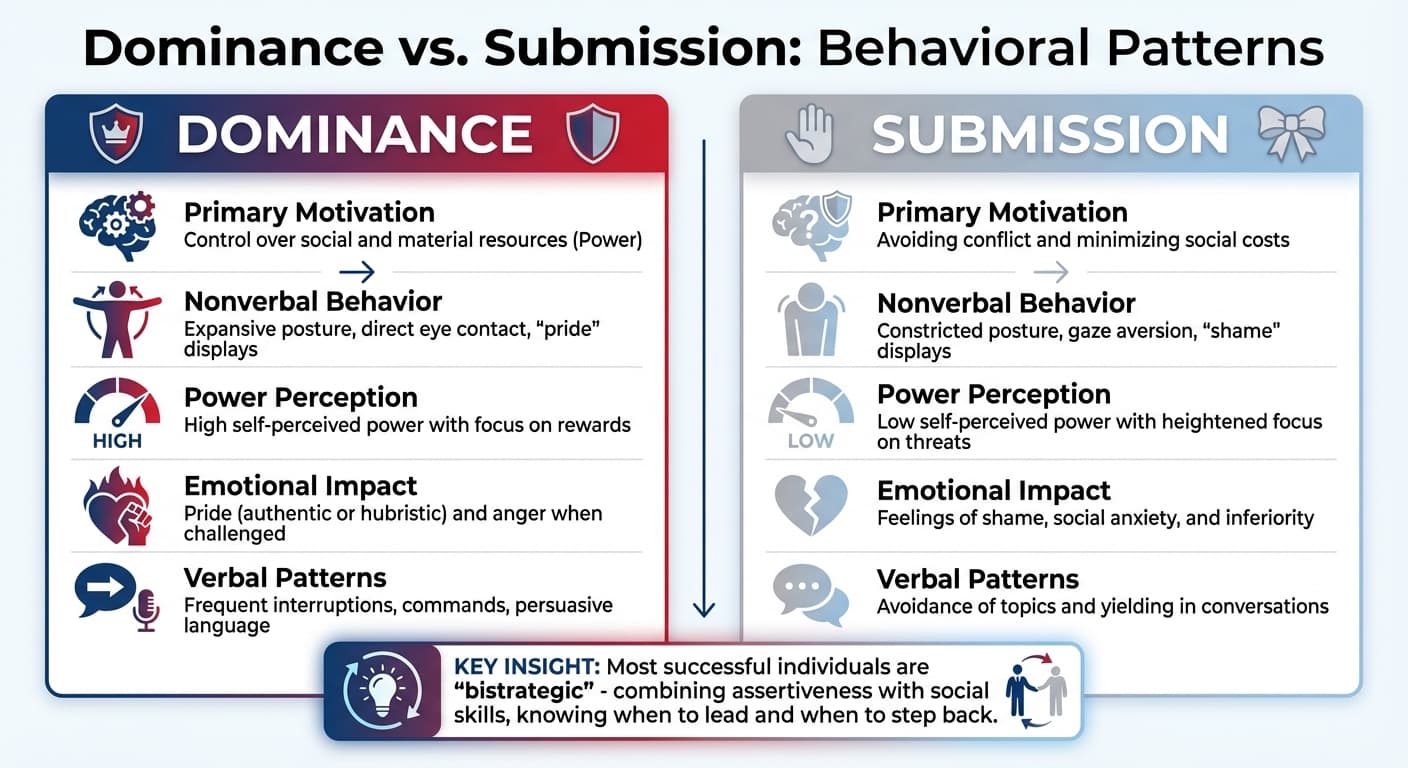
Comparison Table: Key Behavioral Traits
Dominance and submission exhibit distinct patterns in posture, speech, and how individuals respond to stress.
| Trait | Dominance | Submission |
|---|---|---|
| Primary Motivation | Control over social and material resources (Power) [1] | Avoiding conflict and minimizing social costs [1][12] |
| Nonverbal Behavior | Expansive posture, direct eye contact, "pride" displays [3][12] | Constricted posture, gaze aversion, "shame" displays [3][12] |
| Power Perception | High self-perceived power with a focus on rewards [1] | Low self-perceived power with heightened focus on threats [1] |
| Emotional Impact | Experiences of pride (authentic or hubristic) and anger when challenged [1] | Feelings of shame, social anxiety, and inferiority [1] |
| Verbal Patterns | Frequent interruptions, commands, and persuasive language [4][12] | Avoidance of topics and yielding in conversations [13] |
These contrasting traits help explain how dominance and submission influence interpersonal interactions. Dominance often activates the brain's approach system, boosting confidence and assertiveness. On the other hand, submission triggers the inhibition system, increasing sensitivity to potential threats [1].
It’s important to note that dominance isn’t always aggressive. For example, "prosocial dominance" focuses on leadership, building alliances, and persuading others, while "aggressive dominance" relies on intimidation and manipulation [1][12].
Patricia Hawley, a researcher in this field, highlights the effectiveness of "bistrategic controllers" - individuals who blend assertiveness with social skills:
"Bistrategic controllers... are the most successful at resource control. Part of their success is due to the fact that they are high in aggression yet mitigate the costs of aggression by employing prosociality." [12]
How These Patterns Affect Relationships
The dynamics of dominance and submission extend beyond individual behavior, playing a key role in shaping relationships. Complementarity is often at the heart of these dynamics - when one partner's dominance aligns with the other's submission, interactions tend to flow more smoothly [3].
A 2005 study of 97 couples (58 married, 39 cohabiting) by Norah E. Dunbar and Judee K. Burgoon revealed that a person’s internal sense of power directly influences their dominant communication style during problem-solving tasks [4]. However, when power imbalances become too rigid or extreme, relationships can suffer. In such cases, lower-power partners are at a higher risk of experiencing psychological aggression [13].
Tian Chen Zeng from Harvard University sheds light on the darker side of dominance:
"Dominance captures behavioural patterns found in social hierarchies... in which some individuals coercively exploit their control over costs and benefits to extract deference from others." [12]
In high-pressure situations, dominant behaviors can escalate into emotional manipulation. Tools like Gaslighting Check (https://gaslightingcheck.com) help identify when dominance crosses the line. By analyzing conversation patterns through real-time audio recording and text analysis, this platform uncovers subtle forms of emotional control that might otherwise go unnoticed.
One troubling outcome of unchecked dominance is the "chilling effect." This occurs when the submissive partner suppresses their own needs and concerns to avoid conflict [15]. Over time, this dynamic not only strains the relationship but can also cause lasting psychological harm to the individual in the subordinate role.
Why Flexibility Matters in Behavioral Patterns
As discussed earlier, power dynamics show up in various ways, and their ability to adapt plays a big role in fostering healthy interactions. The capacity to shift between dominance and submission is crucial for navigating social situations effectively. When these patterns become rigid, they can strain both personal and professional relationships [14].
Most people naturally adjust their behavior depending on the context. For example, someone might take a deferential approach during a work performance review but adopt a more assertive role when leading a local community project. However, when individuals struggle to make these shifts, it can harm their relationships and even lead to psychological challenges [1].
The most socially adept individuals are often referred to as "bistrategic." They combine assertiveness with strong social skills, knowing when to take charge and when to step back. As researcher Hawley explains, these individuals "are high in aggression yet mitigate the costs of aggression by employing prosociality" [12]. They understand that pure coercion can push people away, while excessive submission can leave them vulnerable. This balance highlights why rigidity in either direction can negatively impact mental health.
When Rigid Patterns Become Psychological Problems
When dominance or submission becomes too fixed, it can lead to mental health issues. Inflexible dominance is often linked to traits like narcissism and externalizing behaviors, while chronic submission is associated with anxiety, depression, and feelings of shame [16][17]. A constant need for control often stems from deep-seated insecurity.
Sheri L. Johnson from the University of California, Berkeley, explains:
"Powerlessness is proposed to activate the behavioral inhibition system, which increases reactivity to cues of threat. Powerless persons may over-estimate social threats, such as being disliked or rejected" [17].
In the workplace, rigid dominance can result in "toxic leadership." A 2020 study published in PNAS used cichlid fish to explore social influence. The researchers observed that dominant males, while socially central and aggressive, were less effective at fostering group consensus compared to their more passive counterparts. The aggressive behavior created "noise", disrupting the group’s ability to learn and cooperate. The study concluded:
"Processes of hierarchical ascension in which the most aggressive, competitive, or coercive individuals rise to positions of dominance may be counterproductive in contexts where group performance is prioritized" [18].
On the flip side, when someone struggles to transition from a subordinate role at work to a leadership position in their community, they may face ongoing social and psychological challenges [17]. Failing to assert themselves when necessary can lead to depression, social anxiety, and a sense of disappointment, all of which can interfere with their professional and personal lives [19].
Tools for Spotting and Fixing Power Imbalances
Understanding the risks of power imbalances allows for targeted interventions to address them. Identifying these imbalances involves paying close attention to signals like interruptions, changes in tone, and body language [3][4]. The AEO Framework - Acknowledge, Explain, Offer - provides a practical way to address these issues. For instance, one might say:
"When you text me constantly while I'm out with my friends, I feel like you don't trust me... That really makes me feel like the underdog in this relationship, and like you have more power - and I don't like feeling powerless." (Holly Richmond, Somatic Psychologist) [16]
Setting clear and consistent boundaries is also key when dealing with chronically dominant individuals. Licensed Marriage and Family Therapist Aki Rosenberg emphasizes that rigid control often stems from:
"self-preservation and the maintenance of power/control - namely, the power/control to construct a narrative that keeps the gaslighter in the 'right' and their partner in the 'wrong'" [16].
Technology tools like Gaslighting Check (https://gaslightingcheck.com) offer support by analyzing audio and text in real time to detect manipulative dominance. With encrypted, auto-deleting data, the platform protects user privacy while providing detailed reports and conversation tracking to monitor whether power dynamics are improving or worsening.
In professional environments, subordinates can counteract rigid hierarchies by using "leverage" - withholding cooperation or services to challenge oppressive dominance. This natural strategy can help prevent power structures from becoming abusive [12].
Conclusion
Dominance and submission play a crucial role in shaping high-stakes interactions, as illustrated by the behavioral models discussed earlier. Sheri L. Johnson, a Professor of Psychology at the University of California, Berkeley, explains that these behaviors "serve to regulate aggression and conflict while ensuring that dominant individuals generally have first access to the resources that garner the greatest reproductive success" [17]. By understanding this system, we can better identify when power dynamics work in our favor and when they might create challenges.
Effective individuals know how to adjust their approach to dominance or submission depending on the situation. Johnson highlights that "one important developmental goal in humans is to learn socially competent ways to achieve dominance flexibly, using prosocial strategies" [17]. This adaptability is essential for navigating complex social environments.
Awareness is a critical first step toward achieving balance. Recognizing power dynamics in daily interactions can help prevent minor manipulations from escalating into harmful patterns. Tools like Gaslighting Check (https://gaslightingcheck.com) provide support by monitoring conversations in real time through encrypted audio recording, detailed reports, and conversation tracking, starting at $9.99/month. Such technology offers an additional layer of protection against emotional manipulation.
Reciprocal interactions, where assertiveness is met with appropriate deference, encourage effective communication [20][3]. This doesn't mean tolerating abusive behavior but rather understanding how power flows within conversations. By doing so, you can maintain control of the narrative and keep a clear perspective. Whether you're navigating workplace dynamics or personal relationships, recognizing these patterns fosters healthier and more balanced interactions.
FAQs
How can understanding dominance and submission behaviors improve my relationships?
Recognizing dominance and submission behaviors in relationships can play a key role in improving communication and creating healthier interactions. When you identify these patterns, it becomes easier to understand the emotions and motivations driving certain actions, which can help avoid unnecessary misunderstandings or conflicts.
For example, dominant behaviors - like controlling speech or assertive body language - might reveal potential power imbalances in the relationship. On the other hand, submissive behaviors - such as avoidance or excessive compliance - could point to feelings of being undervalued or overlooked. Being aware of these dynamics gives you the chance to address concerns early, build empathy, and work toward a more balanced relationship.
This understanding also helps in setting clearer boundaries and reducing the chances of emotional manipulation, including tactics like gaslighting. By fostering mutual respect and encouraging open, honest communication, you can create relationships that feel more supportive and genuinely fulfilling.
How does chronic submission affect mental health?
Chronic submission can have a profound impact on mental health. When someone consistently engages in submissive behavior over an extended period, it can heighten the risk of anxiety, depression, and feelings of helplessness. Living in a state where you often feel powerless or subordinate doesn’t just affect your emotions - it can also trigger physical stress responses, compounding the strain on your mental well-being.
What makes this even more challenging is the tendency to internalize these submissive roles. Over time, this can chip away at self-esteem, creating a cycle where dependency and emotional suppression become the norm. Breaking out of this cycle can feel nearly impossible, as the loss of control and autonomy deepens. Tackling these patterns early is crucial to rebuilding a sense of self and developing emotional strength for the future.
How does dominance behavior vary across different social situations?
Dominance can manifest in various ways depending on the social context and the nature of the interaction. In professional or hierarchical settings like workplaces, it often comes across as assertive communication, confidently steering discussions, or using body language that exudes authority - think standing tall or maintaining steady eye contact. These signals are all about projecting influence and control.
In personal relationships, dominance tends to be more understated. It might show through a particular tone of voice, frequent interruptions, or gestures that subtly assert control. In collaborative environments, dominance often shifts toward prestige-based behavior, where individuals gain respect by showcasing expertise or knowledge rather than relying on forceful methods. Meanwhile, in competitive or high-pressure situations, dominance becomes more overt, with commanding speech and broad, expansive postures taking center stage. Ultimately, the way dominance is displayed hinges on the setting, societal expectations, and the unique dynamics between the people involved.