Cultural Context in Emotional Language Detection

Cultural Context in Emotional Language Detection
AI struggles to understand emotions without accounting for cultural differences. Emotional expressions vary widely across languages, norms, and social behaviors. For example, the same phrase or facial cue can convey entirely different emotions depending on one’s background. This gap in understanding can lead to misinterpretations, especially in areas like mental health, communication, or detecting manipulation.
Key takeaways:
- Language models often misread emotions due to biases in training data, which is usually Western-centric.
- Cultural norms shape emotional intensity, tone, and non-verbal cues, like facial expressions or vocal sounds.
- AI tools must integrate diverse linguistic and cultural data to improve accuracy and avoid harmful misjudgments.
Understanding Emotional Language Detection
What is Emotional Language Detection?
Emotional language detection, often referred to as AER, uses AI to go beyond basic sentiment analysis. It identifies a range of emotions like joy, anger, and fear in both text and speech [6][7]. In today’s culturally varied world, AER systems face the challenge of recognizing how emotions are expressed differently across cultures.
The process begins with text preparation - steps like tokenization, lemmatization, and removing stop words. Then, AI assigns sentiment scores to specific keywords using rule-based, machine learning, or hybrid approaches [7]. More advanced language models take this further by explaining their interpretations and analyzing additional cues such as emojis, tone, and cultural context [5].
"Different people express the same emotion differently; the same text may convey different emotions to different people." - Saif M. Mohammad, Senior Research Scientist [6]
For example, in August 2025, researchers from Microsoft Research, Lancaster University, and the University of Washington examined how well large language models (LLMs) could interpret emotions in informal WhatsApp messages from Nairobi youth health groups. They analyzed 6,121 messages that had unanimous human annotations. Both GPT-4-32k and Mistral-7B achieved an impressive F1 accuracy score of 0.90, showing that these models can effectively interpret emotions even in complex, low-resource, code-mixed environments like Swahili-English-Sheng [5].
These findings highlight the importance of considering cultural factors when designing systems for emotional analysis.
Why Accuracy Matters in Emotional Analysis
Getting emotional analysis right is crucial, especially for personal relationships and mental health. Misreading emotional signals can lead to misunderstandings, broken trust, or missed chances to offer support. When AI systems are tasked with identifying harmful patterns - like manipulation or gaslighting - accuracy becomes even more critical to safeguard individuals' well-being.
However, detecting emotions isn’t straightforward. Human emotions are complex, and AI often struggles with subtleties like sarcasm, double negatives, or sentences that convey multiple, conflicting emotions [7]. Research indicates that the six basic emotions account for less than 33.3% of the variance in human emotional responses [3]. This complexity has driven the creation of more detailed categorization systems that recognize up to 27 distinct emotions, including nuanced states like gratitude, pride, and amusement [6].
For applications like Gaslighting Check, precision is key. These systems must differentiate between healthy disagreements and subtle forms of manipulation, requiring a deep understanding of both language and cultural context.
Emotion Recognition Technology: Present and Future
How Culture Shapes Emotional Language
::: @figure
How Culture Influences Emotional Expression
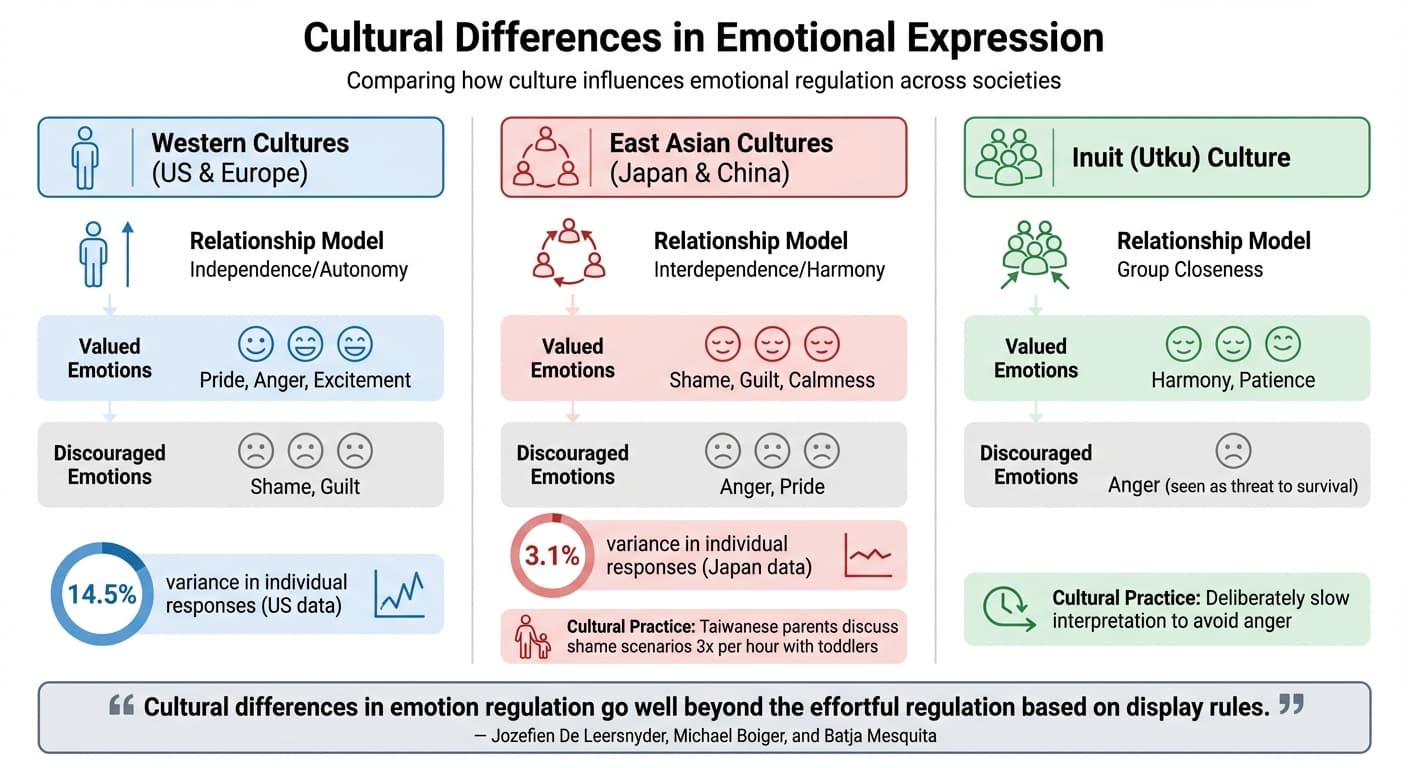
Understanding how culture shapes emotional expression is key for AI systems aiming to interpret emotions accurately. Culture influences not only what emotions are expressed but also how they're conveyed. For instance, in Western cultures like the United States and Europe, people tend to value emotions that assert individuality, such as pride, anger, and excitement [8]. On the other hand, East Asian cultures, including Japan and China, prioritize social harmony. This emphasis on interdependence makes "socially engaging" emotions like shame, guilt, and calmness more prominent because they help maintain group cohesion [8]. A striking example comes from a study of Taiwanese parents, who were observed discussing shame-related scenarios with their 2.5-year-old children about three times an hour as a way to teach proper social behavior [8].
"Cultural differences in emotion regulation go well beyond the effortful regulation based on display rules."
- Jozefien De Leersnyder, Michael Boiger, and Batja Mesquita [8]
Even when people from different cultures experience the same emotions, the intensity of expression can vary significantly. Research shows that individual expressive responses account for 14.5% of variance in the United States but only 3.1% in Japan, reflecting considerable differences in facial and vocal expressions between these cultures [10]. Some groups, like the Utku Inuit, take a unique approach by deliberately slowing their interpretation of behavior to avoid anger, which is seen as a threat to group survival [8].
| Cultural Context | Valued Relationship Model | Functional Emotions | Discouraged Emotions |
|---|---|---|---|
| Western (e.g., United States, Europe) | Independence/Autonomy | Pride, Anger, Excitement | Shame, Guilt |
| East Asian (e.g., Japan, China) | Interdependence/Harmony | Shame, Guilt, Calmness | Anger, Pride |
| Inuit (Utku) | Group Closeness | Harmony, Patience | Anger |
Challenges in Accounting for Different Cultures
AI systems encounter major obstacles when trying to account for cultural differences in emotional expression. For one, some languages lack direct translations for specific emotions. For example, Tahitian has no word for "sadness", while Amharic lacks a term for "surprise" [4]. Models trained predominantly on English data often fail to capture these subtle but important emotional nuances.
Cultural context can also shape how people react emotionally to the same event. For example, tipping - a common practice in North America - might be seen as offensive in Japan or simply unusual in China [4].
"A single event can evoke distinct emotional reactions depending on cultural background and language."
- Tadesse Destaw Belay, Researcher [4]
Another challenge lies in the bias of AI benchmarks, which often lean heavily on Western data. Underrepresented regions like the UAE, Ethiopia, and India see significantly lower accuracy in detecting emotional subtleties [4][9]. In cross-cultural studies, agreement on emotion labels can be as low as 29% - such as between Germany and India - highlighting the potential for misinterpretation when models are built primarily on Western datasets [4].
These challenges emphasize the importance of developing AI systems that incorporate a broader range of linguistic and cultural data, setting the stage for the discussion in the next section.
Building AI Systems That Understand Different Cultures
Using Multilingual and Multicultural Data
Training AI systems on diverse datasets is absolutely essential. Many multilingual models tend to reflect Western norms, which can lead to significant gaps when applied to non-Western contexts [12][14]. Simply translating data from one language to another often misses the mark, as it fails to account for the subtle cultural nuances that shape human emotions. For instance, directly translating English-annotated emotion data often results in evaluations that are less reliable and culturally disconnected [1][11].
"Existing emotion benchmarks suffer from two major shortcomings: they largely rely on keyword-based emotion recognition, overlooking crucial cultural dimensions... and many are created by translating English-annotated data into other languages, leading to potentially unreliable evaluation."
- Tadesse Destaw Belay et al., Researchers [1]
The CuLEmo (Cultural Lenses on Emotion) benchmark offers a more thoughtful approach. Designed to evaluate culture-aware emotion prediction, it includes 400 carefully designed questions per language across six languages: Amharic, Arabic, English, German, Hindi, and Spanish [1][11]. Instead of relying on simple keyword recognition, these questions assess whether AI can navigate and reason through cultural contexts. Interestingly, research suggests that prompting large language models in English while providing explicit cultural context (e.g., "This person is from Japan") can sometimes yield better results than delivering prompts in the target language [1][11].
To build systems that genuinely understand cultural diversity, developers need to move beyond static, one-size-fits-all evaluation methods. AI systems should be tested for the cultural assumptions embedded in their logic. A participatory approach - actively involving cultural communities in the design process - can help ensure that AI reflects the dynamic and pluralistic nature of cultural expression rather than perpetuating stereotypes [13]. This kind of culturally aware design forms a strong foundation for expanding into other data types, like voice and visuals.
Combining Text, Voice, and Visual Data
Relying solely on text-based datasets can leave gaps in understanding cultural emotions. Incorporating vocal and visual data adds another layer of depth. For instance, vocal signals - such as sighs or chuckles - often carry emotional meaning that transcends cultural boundaries, while still retaining unique cultural elements [2]. These subtle vocal bursts can provide clues that text alone might miss.
Facial expressions, too, play a crucial role. Research using deep learning on large-scale video datasets has identified at least 12 dimensions of emotional experience that facial movements can reliably predict across cultures [3]. However, developers need to account for variations in display intensity. For example, people in Japan may express the same emotion with less intense facial movements compared to those in the United States, even when the underlying emotional experience is identical [3].
The CultureCare dataset highlights the value of combining different data types with explicit cultural annotations. Created by researchers at UKP Lab and Bar-Ilan University, this dataset includes 1,729 distress messages and 1,523 cultural signals spanning Arabic, Chinese, German, and Jewish cultures [15]. By integrating culture-informed role-playing, detailed cross-cultural counseling guidelines, and explicit annotations of cultural signals, the project consistently achieved better results than simpler, text-only approaches. This shows that to truly grasp emotions across cultures, AI requires multiple layers of context - not just multilingual text but also vocal and visual cues [15].
Where This Technology Matters Most
Improving Personal Relationships and Communication
Understanding emotions through a culturally aware lens can transform how people connect, especially across different backgrounds. Research highlights the existence of 21–24 emotional dimensions, showing that the way emotions are expressed varies significantly between cultures. For instance, in Japan, subtle facial cues might convey the same intensity of emotion as more pronounced expressions in North America [3][2]. These dimensions include complex feelings like awe, interest, and triumph, which, while universal, are expressed differently depending on cultural norms.
Take relationships as an example - someone from a collectivist culture might show affection or concern in a more reserved manner, while a person from an individualistic background could be more direct. Without understanding these patterns, subtle expressions might be misinterpreted as indifference, leading to unnecessary misunderstandings.
Technology that recognizes these cultural variations can help friends, families, and partners better understand each other. When systems are equipped to identify that subtle expressions in one culture carry the same emotional weight as overt displays in another, they can offer more accurate insights into what someone is truly feeling [3]. This reduces the risk of assuming someone is less engaged or invested simply because their way of expressing emotions is different.
By bridging these cultural gaps, such tools not only strengthen personal relationships but also create a foundation for better mental health support.
Supporting Mental and Emotional Health
Cultural context is especially critical in mental health, where misreading emotional cues can have serious consequences. Research shows that individual expressive responses explain 14.5% of emotional variance in the U.S. but only 3.1% in Japan, highlighting how much cultural norms shape emotional expression [3]. A therapist or support system trained predominantly on Western data might completely misjudge the emotional state of someone from a different cultural background.
This becomes particularly important in moments of distress. In cultures where mental health is heavily stigmatized, blunt advice like "seek therapy" can worsen feelings of shame rather than offering relief [15]. Similarly, recommendations that prioritize individual happiness - such as suggesting someone "cut ties with family" - can clash with the values of collectivist cultures, where familial duty is deeply ingrained [15].
"Even well-intentioned responses can cause harm or alienation without cultural grounding and sensitivity, rather than providing the support users seek."
- Chen Cecilia Liu et al., Researchers [15]
Datasets like CultureCare emphasize the importance of culturally specific approaches to emotional support [15]. For instance, themes like family control and mental health invalidation are more prevalent in Arabic and Chinese contexts, while financial stress is more commonly reported in German scenarios. Emotional support tools that account for these patterns can provide tailored, culturally appropriate responses, avoiding generic advice that overlooks the realities of different cultural experiences.
Detecting Gaslighting Across Different Backgrounds
Cultural awareness also plays a key role in identifying manipulative behaviors, such as gaslighting. By building on the improvements seen in personal communication and mental health support, culturally informed systems like Gaslighting Check can better distinguish between cultural norms and genuine manipulation.
Recognizing emotional manipulation is especially challenging when cultural communication styles differ. For instance, Gaslighting Check must carefully analyze these nuances to avoid flagging culturally appropriate behaviors as manipulative. While 79% of emotional meanings in vocal bursts like sighs and chuckles are consistent across cultures, the remaining 21% varies in ways that require thoughtful interpretation [2].
The platform uses a combination of text and voice analysis, paired with cultural sensitivity, to differentiate between manipulation and typical cultural behaviors. For example, indirect communication, which is common in many Asian cultures, should not trigger gaslighting alerts. Similarly, emotional restraint that aligns with cultural norms is distinct from the calculated withholding seen in manipulative tactics.
The Future of Emotional Language Detection
The next wave of emotional language detection technology is moving beyond simple keyword matching. Future systems are being designed to account for the fact that identical situations can evoke very different emotional responses depending on someone's background [1][4]. Rather than treating emotions as static labels, these advanced AI systems will interpret them as context-specific expressions shaped by local norms, values, and social expectations [5]. This new approach aims to incorporate culturally nuanced signals tailored to specific tasks.
For this evolution to succeed, cultural signals must be deeply embedded into the technology itself. Research highlights that simply instructing an AI to "act like someone from Culture X" isn’t enough - effective systems require structured guidance rooted in established cross-cultural frameworks [15]. For example, when AI models are provided with clear cultural context, accuracy can improve by up to 21% in languages like Hindi [4]. The best-performing methods combine cultural role-playing with explicit guidelines and signal annotations, consistently delivering better results across diverse cultural settings. Researchers point out that task-specific guidance and clearly defined signals within a given context are far more effective than relying on generic cultural role-playing [15].
A practical example of this approach is Gaslighting Check, a platform that merges precision with cultural sensitivity while prioritizing user privacy. It uses end-to-end encryption and automatic data deletion to protect personal conversations, analyzing both text and voice patterns [15]. The system can pick up on subtle emotional cues - like signs of withdrawal or suppressed frustration - that traditional tools often overlook. This capability allows it to identify manipulation tactics within a variety of cultural communication styles [5].
FAQs
How does cultural context affect AI's ability to detect emotions in language?
Cultural context significantly influences how AI interprets emotions in language. Emotions are expressed and understood differently across cultures, which can create hurdles for AI systems primarily trained on Western norms. For example, idioms, phrases, or emotional cues that are familiar in one culture might not make sense - or could even be misunderstood - in another.
To tackle these differences, technologies like natural language processing (NLP) and context-aware models are being designed to better reflect cultural variations. Still, challenges remain. Training data often carries biases, and AI systems can struggle to grasp the deeper subtleties of diverse cultural expressions. By factoring in cultural context, AI can improve its ability to interpret emotional language more accurately and equitably for people from a wide range of backgrounds.
What challenges do AI systems face in understanding emotions across cultures?
AI systems face a tough time when it comes to understanding emotions across different cultures. Why? Because how people express and interpret emotions varies widely depending on cultural norms, idioms, and social expectations. Most AI models are trained on datasets that lean heavily toward Western perspectives, which means they often struggle to grasp non-Western emotional cues. Things like sarcasm, indirect language, or culturally specific expressions can easily trip them up.
Another big hurdle is the lack of representation for certain languages and cultural contexts in training data. This gap can lead to AI making incorrect assumptions or oversimplifying emotional subtleties. To tackle this, we need to focus on creating more inclusive datasets and designing AI systems that can better adapt to the rich diversity of emotional expression found across the globe.
Why is including cultural diversity important in AI emotional language detection?
Incorporating cultural diversity into AI emotional language detection is crucial because emotions aren’t universally expressed or interpreted the same way. Ignoring these differences can lead to misreading emotional cues, inaccurate evaluations, and even the unintentional reinforcement of stereotypes.
Cultural norms play a big role in shaping how emotions are communicated - whether through tone, word choice, or nonverbal signals. For example, an emotional reaction that feels appropriate in one culture might be misinterpreted in another. By including a variety of cultural data, AI tools like Gaslighting Check can deliver more precise and respectful emotional insights. This allows users to navigate sensitive conversations more effectively, with cultural nuances in mind.