How Context-Aware Models Analyze Manipulative Behavior

How Context-Aware Models Analyze Manipulative Behavior
Context-aware models help detect manipulation in conversations by analyzing patterns, intent, and emotional shifts over time. Unlike traditional tools that focus on specific words, these models evaluate entire interactions to identify tactics like gaslighting or blame-shifting. They use advanced techniques to assess linguistic features, emotional cues, and relational dynamics, offering deeper insights into manipulative behavior.
Key Takeaways:
- What They Do: Track intent, semantic changes, and patterns across conversations to detect subtle manipulation.
- How They Work: Use data like word choice, emotional shifts, timing, and relationship context to flag harmful behavior.
- Why It Matters: Manipulation can harm mental health and workplace morale, making early identification crucial.
- Gaslighting Detection: Tools like Gaslighting Check analyze text and voice for real-time insights, with 82% accuracy.
- Privacy: Strong security measures like encryption and data deletion ensure user data stays protected.
These models aim to help individuals recognize harmful communication patterns, whether in personal relationships or professional environments, and take informed action.
AI Detects Covert Manipulation (You Won't Believe)
How Context-Aware Models Detect Manipulation
::: @figure
Data Points That Models Analyze
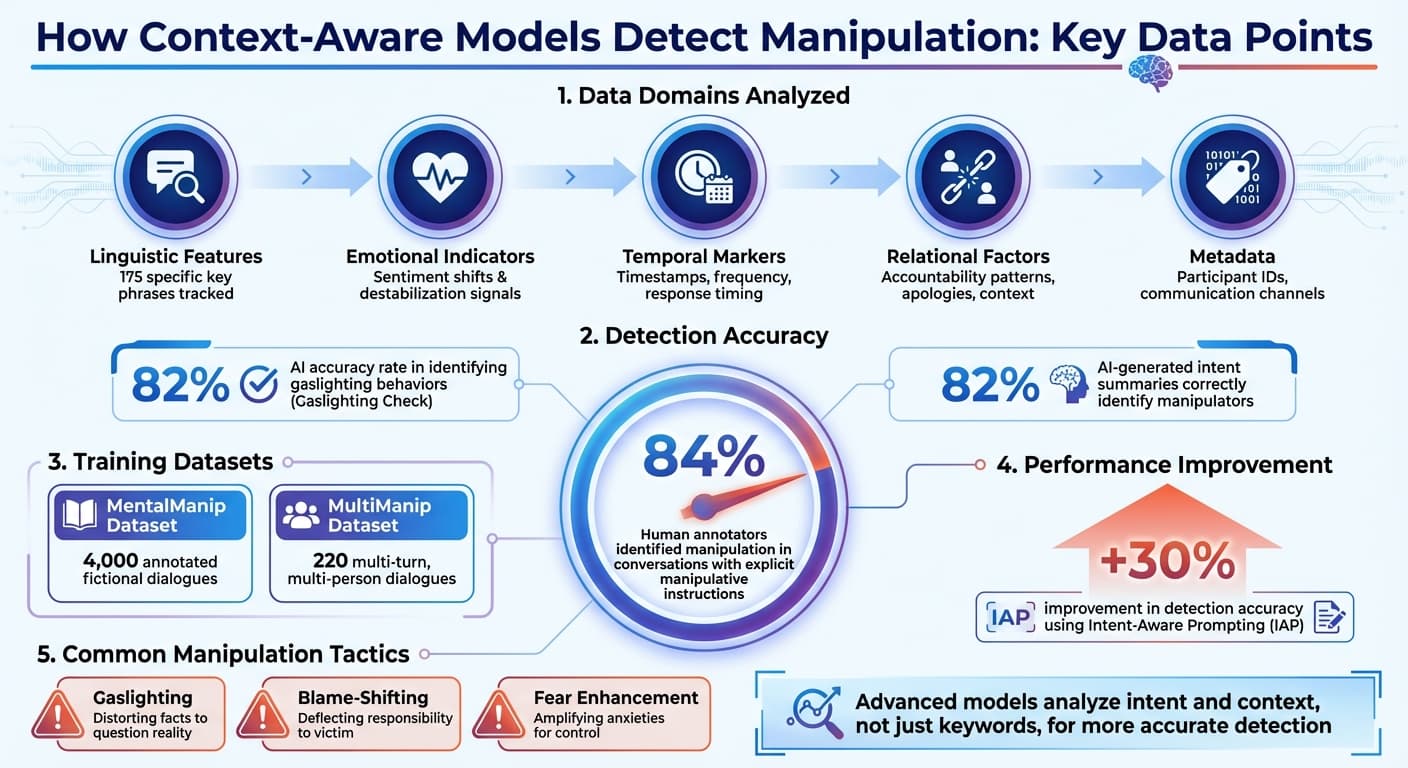
Context-aware models rely on five key data domains to detect manipulation: linguistic features, emotional indicators, temporal markers, relational factors, and metadata. Linguistic features include elements like word choice, sentence structure, and 175 specific key phrases [7]. Emotional indicators assess shifts in sentiment, especially those that signal destabilization. Temporal markers, such as timestamps, message frequency, and response timing, give insight into conversational patterns. Relational factors examine behaviors like accountability avoidance, frequent apologies, and the context of relationships. Metadata focuses on participant IDs and communication channels. Advanced frameworks go a step further, analyzing message intent and targeting vulnerabilities [3][1]. By quantifying these cues and patterns, these models can effectively differentiate between genuine interactions and manipulative tactics.
Common Emotional Manipulation Tactics
These models are adept at identifying common manipulation tactics, including gaslighting, blame-shifting, and fear enhancement. Gaslighting involves distorting facts to make someone question their reality, while blame-shifting deflects responsibility by turning accountability back onto the victim. Fear enhancement works by amplifying anxieties to maintain control. In controlled tests, human annotators identified manipulation in 84% of conversations involving explicit manipulative instructions. Even in less overt "persuasive" settings, these tactics often emerged [6].
"Recognizing manipulative intent, especially when it is implicit, requires a level of social intelligence that current AI systems lack." - Soroush Vosoughi, Assistant Professor of Computer Science, Dartmouth [7]
How AI and Machine Learning Enable Behavioral Analysis
Machine learning models have revolutionized manipulation detection by training on specialized datasets. For instance, the MentalManip dataset, which includes 4,000 annotated fictional dialogues, equips models to detect subtle manipulation techniques [3]. Meanwhile, the MultiManip dataset, featuring 220 multi-turn, multi-person dialogues, enables systems to grasp complex group dynamics [2].
Detection methods have grown more sophisticated, moving beyond simple phrase-matching to intent analysis. Techniques like Intent-Aware Prompting (IAP) allow models to interpret the "why" behind a message instead of just the "what" [1][4]. Another approach, the SELF-PERCEPT framework, uses introspection inspired by Self-Perception Theory to evaluate reasoning in group conversations [2][4]. Interestingly, research shows that smaller, fine-tuned open-source models can perform on par with larger proprietary models [6].
"With private conversations moving to messaging apps and social media, there are increasing instances of people enduring mental and emotional manipulation online." - Yuxin Wang, PhD Student, Dartmouth [7]
These advancements are setting the stage for practical tools designed to protect individuals from manipulation in their everyday interactions.
Gaslighting Detection and Why It Matters
What Gaslighting Is
Gaslighting is a manipulative tactic where someone deliberately causes another person to question their perception of reality [11]. It often relies on subtle distortions that build up over time [10]. The manipulator may deny facts, twist conversations, or challenge the victim's memory, leaving them unsure of what actually happened. The psychological toll can be profound, leading to confusion, self-doubt, anxiety, and even long-term emotional trauma [12]. Gaslighting tends to occur in close relationships or workplaces where power imbalances exist, making victims more susceptible to ongoing harm. Because of its insidious nature, tools like Gaslighting Check are crucial for identifying and addressing these patterns early.
How Gaslighting Check Analyzes Conversations

Gaslighting Check uses a combination of text and voice analysis to identify manipulative behavior in real time. By examining linguistic markers and vocal cues, the tool flags signs of emotional manipulation. For example, audio analysis looks at tone and rhythm, detecting shifts that might indicate stress or manipulation [9]. It also tracks how conversations develop over time, identifying recurring patterns that might not be obvious in isolated interactions. Detailed reports consolidate these insights, offering a clear view of potential manipulation. Impressively, this approach has an 82% accuracy rate in identifying gaslighting behaviors in research datasets [11]. Unlike traditional systems that rely on keyword matching, Gaslighting Check focuses on intent, significantly reducing false negatives. While accuracy is critical, the tool also prioritizes user privacy and data security.
Privacy and Data Security in Gaslighting Check
Gaslighting Check is designed with multiple layers of security to protect user data. End-to-end encryption ensures that all text and audio data remain secure during transmission and storage, making it unreadable in case of interception. The platform also employs automatic deletion policies, erasing records after 30 to 90 days to reduce the risk of prolonged exposure. Personal information is anonymized by replacing identifiers with generic tokens, allowing the system to focus solely on behavioral patterns while safeguarding user identities. Users have full control over their data through selective storage options, deciding what to keep for evidence and what to delete. Additionally, role-based access control ensures that only authorized individuals can access the data, and strict policies prevent sharing information with third parties or using it for purposes beyond the service [9]. These robust measures ensure that Gaslighting Check not only detects manipulation effectively but also protects users' privacy.
Detect Manipulation in Conversations
Use AI-powered tools to analyze text and audio for gaslighting and manipulation patterns. Gain clarity, actionable insights, and support to navigate challenging relationships.
Start Analyzing NowReal-World Uses of Context-Aware Models
Detecting Emotional Abuse in Personal Relationships
Context-aware models are proving to be powerful tools in identifying emotional abuse that might otherwise go unnoticed in personal relationships. These systems analyze both text and voice data to uncover patterns of manipulation, such as blame-shifting, memory distortion, and emotional invalidation. For example, text analysis can identify phrases that twist reality or deflect responsibility, while voice analysis detects shifts in tone or emotional pressure that indicate coercion. By tracking these patterns over time, the models highlight systematic abuse that might be dismissed as normal relationship friction. Alarmingly, research reveals that 34% of adolescents have reported experiencing online gaslighting [8], underlining how common these tactics are in digital communication. By providing objective insights, these tools empower individuals to recognize harmful behaviors that might otherwise be obscured by emotional complexities.
Identifying Toxic Behavior in the Workplace
Manipulation isn’t limited to personal relationships - it’s also prevalent in workplaces, where power dynamics and hierarchies can make toxic behavior harder to spot. Context-aware models address this challenge by analyzing entire interaction histories rather than isolated incidents. This broader approach uncovers deceptive trends that might otherwise go unnoticed. As Marwa Abdulhai and her team at UC Berkeley explain:
"Deception in dialogue is a behavior that develops over an interaction history, its effective evaluation and mitigation necessitates moving beyond single-utterance analyses." [5]
The demand for Emotional AI in workplace settings is growing rapidly. The market is expected to hit $13.8 billion by 2032 [13], driven in part by regulations like the European Union's AI Act, which classifies emotion recognition systems as "high-risk" in professional environments [20,22]. These advancements highlight the increasing role of AI in promoting healthier workplace dynamics.
How Tools Like Gaslighting Check Help People Take Control
Practical tools like Gaslighting Check are making these capabilities accessible to everyday users. Gaslighting Check analyzes text and voice data in real-time, detecting manipulative cues and identifying recurring patterns. Its advanced features, such as Intent-Aware Prompting, improve detection accuracy by over 30% [14]. Users can choose from a free basic text analysis option, a premium plan at $9.99 per month with advanced features, or enterprise solutions tailored for organizations. Human evaluations demonstrate that AI-generated intent summaries correctly identify manipulators in 82% of cases [14].
Conclusion
Context-aware models are transforming how we detect manipulative behavior by examining entire conversations rather than focusing on isolated statements. These advanced techniques capture subtle semantic shifts and hidden intentions, making it possible to uncover covert manipulation patterns. This progress not only improves detection but also opens the door to meaningful intervention.
Yuxin Wang, a PhD student at Dartmouth, highlights the potential of these models:
"LLM models trained to reliably recognize manipulation could be a valuable tool for early intervention, warning victims that the other party is trying to manipulate them" [7]
This kind of early warning is essential, especially when considering that 45.6% of young adults report experiencing gaslighting in various types of relationships [8].
Gaslighting Check takes this a step further by offering real-time analysis with robust privacy safeguards. With features like end-to-end encryption and automatic data deletion, it ensures user privacy while delivering actionable insights. This is crucial, as over 80% of practitioners hesitate to act on unexplained AI alerts [15]. By prioritizing privacy, Gaslighting Check fosters user trust, empowering individuals to address harmful interactions confidently.
As Khanna et al. (ACL 2025) emphasize:
"mental manipulation is a subtle yet pervasive form of abuse... making its detection critical for safeguarding potential victims" [4]
FAQs
How do context-aware models identify manipulative behavior in conversations?
Context-aware models excel at spotting manipulative behavior by looking at the tone, language patterns, emotional cues, and timing within conversations. Rather than focusing on isolated remarks, these models assess the broader context to identify tactics like blame-shifting, emotional invalidation, or twisting the truth. For example, they can pick up on repeated phrases that question someone's memory or redirect responsibility.
Using tools like natural language processing (NLP) and sentiment analysis, these models decipher the emotional and contextual layers of communication. They can even evaluate vocal elements - such as tone and pitch - to flag manipulation as it happens. However, while these systems are powerful, they can sometimes misread subtle emotions or misunderstand differences in communication styles, emphasizing the need for human oversight to ensure accuracy.
What emotional cues do context-aware models analyze to detect manipulative behavior?
Context-aware models are designed to spot manipulative behavior by examining emotional cues across language, tone, and facial expressions. These cues might include changes in vocal pitch, nuanced speech patterns, or expressions that convey emotions like happiness, sadness, fear, anger, or contempt. By picking up on shifts in emotional intensity or spotting inconsistencies, these models can flag tactics such as gaslighting or guilt-tripping.
To enhance this capability, tools like sentiment analysis interpret the emotional undertone of words and phrases, while voice analysis detects subtle tonal changes that might hint at emotional invalidation or blame-shifting. When combined, these technologies offer a powerful way to uncover emotional manipulation during real-time conversations.
How does Gaslighting Check protect my privacy while analyzing conversations?
Gaslighting Check puts your privacy first by employing encryption to protect your data throughout the analysis process. On top of that, the platform follows automatic deletion policies, ensuring your conversation details are erased as soon as they're no longer needed.
These steps are in place to help you feel secure while using Gaslighting Check’s tools to identify emotional manipulation, all without compromising your personal information.