How to Calm Your Nervous System After Emotional Abuse

How to Calm Your Nervous System After Emotional Abuse
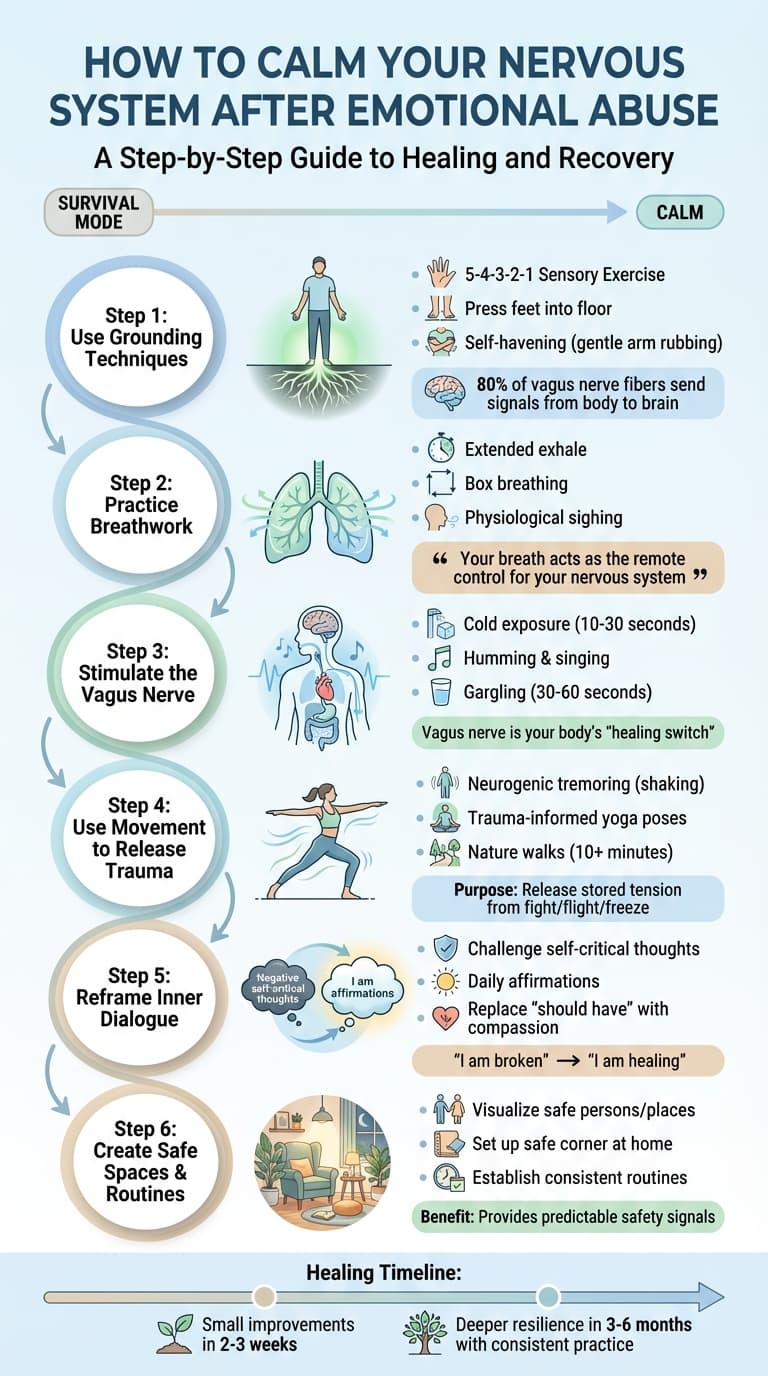
Emotional abuse can leave your nervous system stuck in survival mode, causing anxiety, hypervigilance, or numbness. Healing starts with teaching your body it's safe again. This guide outlines practical steps to calm your nervous system and regain balance.
Key strategies include:
- Grounding techniques like the 5-4-3-2-1 sensory exercise, pressing your feet into the floor, or gentle self-havening.
- Breathwork methods such as extended exhale breathing, box breathing, and physiological sighing to activate calm responses.
- Vagus nerve stimulation through cold exposure, humming, or gargling to shift from stress to relaxation.
- Movement practices like shaking, trauma-informed yoga, or nature walks to release stored tension.
- Self-compassion exercises to reframe negative inner dialogue and rebuild emotional safety.
- Safe spaces and routines to create predictability and reduce triggers.
These steps help reset your body's stress response and promote long-term resilience. While progress takes time, consistent effort can restore a sense of safety and calm.
::: @figure
Restoring your Internal Sense of Safety after Trauma w/ CPTSD Expert Dr. Arielle Schwartz
Step 1: Use Grounding Techniques for Immediate Stress Relief
When your nervous system goes into survival mode, grounding techniques help anchor you to the present moment, creating distance from past trauma [10][11]. These methods assist your brain in distinguishing between "then" - the traumatic event - and "now", where safety exists, shifting focus from the emotional brain to the logical, observing mind [8][10].
"Grounding invites you to sense your body, notice your tension patterns, and surrender the weight of your physical body into gravity to feel the support of the earth. As a resource for trauma recovery, grounding can help you reclaim a sense of safety, feel rooted in the present moment, and strengthen your resilience." – Dr. Arielle Schwartz, Clinical Psychologist [9]
Interestingly, 80% of vagus nerve fibers are afferent, meaning they send signals from your body to your brain. This allows physical sensations to communicate safety directly to your mind [12]. Studies indicate that grounding can reduce inflammation, alleviate pain, lower stress hormones, and calm the fight-or-flight response [9][10][11]. Here are three grounding techniques to help you regain focus and calm.
The 5-4-3-2-1 Sensory Exercise
This exercise interrupts racing thoughts by grounding your attention in your immediate surroundings. Here’s how it works:
- Identify 5 things you can see. Describe their color, texture, and shape - like a red coffee mug or a patterned rug.
- Notice 4 things you can touch, such as the soft fabric of a sweater or the cool, hard surface of a table.
- Listen for 3 distinct sounds, like the hum of traffic, a ticking clock, or your own breathing.
- Identify 2 scents. If none are obvious, notice the scent of your skin or clothing.
- Focus on 1 thing you can taste, such as the lingering flavor of coffee or simply the sensation of your tongue in your mouth [8][10].
Practicing this during calm moments, like sipping your morning coffee, helps build the habit so it’s easier to use during stressful situations. Take slow, deep breaths between each step for added relaxation.
Press Your Feet into the Floor
Physical actions can also help ground you. Sit or stand and press your feet firmly into the ground, paying attention to the sensation beneath them [10][2]. Imagine the earth absorbing your tension, drawing it downward and away from your body [9]. This simple act engages your proprioceptive sense - your body’s awareness of its position in space - which can help stabilize emotions during challenging moments.
Self-Havening: Gentle Arm Rubbing
Self-havening is a soothing technique that uses gentle touch to reduce the emotional weight of traumatic memories [4]. Cross your arms and slowly rub your upper arms, moving from your shoulders down to your elbows [2][4]. Alternatively, you can stroke your palms or cheeks. This gentle touch stimulates the vagus nerve, sending calming signals to your brain and encouraging the release of oxytocin [2][4]. For added comfort, hum a tune or repeat reassuring affirmations like "I am safe now" as you stroke [4].
These grounding techniques create a solid foundation for managing stress and preparing for further emotional regulation strategies.
Step 2: Practice Breathwork to Activate Calm Responses
Following grounding techniques, breathwork takes your relaxation efforts a step further. Emotional abuse often leaves the body stuck in "survival mode", but intentional breathing can help reverse this. By sending calming signals to your brain, breathwork activates the parasympathetic nervous system, which is responsible for rest and recovery [13]. This happens because breathing exercises stimulate the vagus nerve, a key connection between your brain and internal organs.
Deep breathing also restores oxygen to your prefrontal cortex - the area of your brain responsible for decision-making and rational thought. High-stress states often deprive this part of oxygen. Survivors of trauma, who frequently develop shallow breathing habits due to chronic hypervigilance, can use these exercises to retrain their bodies to feel safe [3]. Below are specific techniques to help signal calm and regulate your nervous system.
"Your breath acts as the remote control for your nervous system - and it's always accessible."
– Dr. Leslie Hemedes, Psychologist [15]
Extended Exhale Breathing
This method helps calm your nervous system by lengthening your exhale. To practice, inhale through your nose for 4 seconds, then exhale slowly through your mouth for 8 seconds [2]. The longer exhale tells your brain you’re safe and helps reduce hyperarousal. Aim for a slow, steady rhythm and practice for 2–3 minutes, especially during stressful moments or before sleep.
Box Breathing
Box breathing is a structured technique that can quiet racing thoughts. It's a favorite among military personnel, healthcare workers, and athletes for staying composed under pressure [15]. The steps are simple: inhale through your nose for 4 seconds, hold your breath for 4 seconds, exhale through your mouth for 4 seconds, and pause for 4 seconds before repeating [15]. Complete four to five rounds for a calming effect.
Physiological Sighing
This natural reflex for stress relief can also be used intentionally. Start by taking a deep inhale through your nose, then add a quick second inhale to fully expand your lungs. Exhale completely through your mouth [14]. The double inhale reinflates collapsed air sacs, while the extended exhale activates the vagus nerve. Research has shown this technique to be more effective at improving mood and slowing breathing than box breathing or mindfulness meditation [14]. Use it two or three times for quick relief without needing to stop what you’re doing.
"The extended exhalations of sighing activate the parasympathetic nervous system by increasing vagal tone."
– Andrew Huberman, PhD, Neuroscientist [14]
Step 3: Stimulate the Vagus Nerve for Emotional Regulation
The vagus nerve, the longest cranial nerve in the body, plays a key role in calming your system after stress by activating the parasympathetic nervous system. Essentially, it acts as a "healing switch" that helps shift your body from a state of hyperarousal or dissociation back to a sense of safety and balance [2][4][16][17][19].
Having a higher vagal tone - essentially the strength of your vagus nerve - can speed up your recovery from stress [17][18]. The great news? You can improve your vagal tone with simple techniques. Building upon grounding exercises and breathwork, these methods specifically target the vagus nerve to help regulate your emotions more effectively.
"The vagus nerve is your body's built-in healing switch. Activating it helps shift you out of survival mode."
– reneeminx, Somatic EMDR Holistic Therapist [2]
Cold Exposure Techniques
Cold exposure is a quick and effective way to stimulate the vagus nerve. Splashing ice-cold water on your face, especially around your eyes and cheeks, for 10–30 seconds activates the diving reflex. This natural response slows your heart rate, reduces sympathetic activity, and boosts parasympathetic activity, helping reset your nervous system [4]. If a full face splash feels too intense, try holding an ice cube or a cool compress against your neck [20].
Another option is to end your shower with 30 seconds of cold water on your face, neck, or chest. Even stepping outside in chilly weather for a brief moment can have a similar effect. These simple techniques can quickly interrupt negative thought loops or help you recover from a freeze state [4].
Important: If you have heart conditions, a history of fainting, or respiratory issues, consult with a healthcare provider before trying cold exposure [19].
Humming, Singing, and Gargling
Because the vagus nerve runs through your throat, vocal vibrations can help stimulate it. Gargling forcefully for 30–60 seconds after brushing your teeth is an easy way to activate the nerve [16].
Humming is another effective technique. Try the "Bhramari" or humming bee breath: take a deep inhale through your nose, then exhale slowly while making a low, resonant hum. Keep your jaw relaxed and focus on feeling the vibration in your mouth. Practice for about 10 rounds, or simply hum during everyday activities like driving or showering [18]. Singing along to your favorite songs or chanting sounds like "om" also encourages deeper breathing and rhythmic muscle movement in your throat, which can help regulate your heart rate, breathing, and mood [16][18].
"By developing an understanding of the workings of your vagus nerve, you may find it possible to work with your nervous system rather than feel trapped when it works against you."
– Dr. Arielle Schwartz, Clinical Psychologist [17]
Step 4: Use Movement to Release Stored Trauma
Emotional abuse often leaves physical tension trapped in your body, locking you in a state of fight, flight, or freeze [2][4]. Intentional movement can help release this tension, shifting your body from chronic stress toward a sense of calm and balance. This process sends a clear message to your nervous system: you're safe now [3][5][7]. Below are three movement techniques designed to help release stored trauma.
Neurogenic Tremoring (Shaking Limbs)
Your body has a natural way of letting go of stress - shaking and trembling. If you’ve ever felt your hands or legs shake after a stressful event, that’s your body’s way of releasing pent-up "freeze" energy [2][4]. To intentionally tap into this process, start by shaking your hands, then your legs, and eventually your entire body. Allow the shaking to happen freely, as it helps your system discharge built-up tension [2][4].
Trauma-Informed Yoga Poses
Gentle yoga poses can help your body feel grounded and stable again. Movements like Child's Pose, Legs-Up-the-Wall, Happy Baby, or Cat-Cow are particularly effective [2][21]. These poses promote a sense of safety by encouraging slow, rhythmic movement and physical connection to the floor. As you flow through each pose, focus on the sensations in your muscles and the grounding feeling of your body touching the earth [8]. Pairing these movements with deep, steady breaths enhances their calming effects. The goal here isn’t about perfecting the poses - it’s about mindfully reconnecting with your body.
"Movements that involve gentle rocking or swaying like Cat-Cow or Happy Baby poses let your body know it's safe."
– Dr. Melissa Marek, Physical Therapist, Hinge Health [21]
Yoga offers structured movement that gently guides your body toward a sense of safety and relaxation.
Nature Walks for Healing
Spending time outdoors can work wonders for calming your nervous system. Even a 10-minute walk in nature can help regulate your body and mind [2]. Whether you’re wandering through a park, taking a stroll in your neighborhood, or simply enjoying your backyard, nature has a way of interrupting anxious thought patterns [2][8]. To deepen the grounding effect, try a sensory awareness exercise: notice five things you see, four things you hear, and three things you can touch [3][8]. If possible, go barefoot on grass or dirt - this practice, known as "earthing", can further enhance the calming experience [6]. Walking with a trusted friend or a pet can also reinforce feelings of safety [4][6].
"Dancing, stretching, walking, yoga, and healthy exercise ground you into your current-day body."
– Robyn E. Brickel, M.A., LMFT [3]
Step 5: Reframe Your Inner Dialogue with Self-Compassion
Emotional abuse can leave behind a relentless inner critic, one that keeps you on edge even when you're in a safe environment [2]. By questioning self-blame, you can send a powerful message to your nervous system: peace and safety are within reach. This mental work complements physical practices, helping restore a sense of calm.
Reframe Self-Critical Thoughts
The first step is to notice the patterns in your self-critical thinking. Common traps like catastrophizing or black-and-white thinking often fuel cycles of self-blame [23]. If you catch yourself saying, "I should have known better", take a moment to pause and ask, "Is there actual evidence to support this thought?" This small but powerful question can help you see when you're being unnecessarily hard on yourself [23].
Try replacing harsh "should have" statements with gentler alternatives. For instance, instead of thinking, "I should have known better than to trust them", shift to, "I made the best decision I could with the information I had at the time" [2]. Another helpful trick is flipping negative "what if" scenarios into positive ones. If your mind spirals with, "What if they don't like me?" try countering it with, "What if they do like me?" This subtle shift can break the cycle of negativity and open the door to more hopeful possibilities [23].
| Self-Critical Thought | Compassionate Reframe |
|---|---|
| "I am a failure because I didn't finish my to-do list." | "I wish I had done more, but it's okay to give myself time to finish later." [23] |
| "I am broken because of what happened." | "I am not broken; I am in the process of healing." [2] |
"Providing yourself with self-compassion is going to be the most healing thing you can do for yourself. Primarily, it will help you be less critical and impatient with yourself."
– Beverly Engel, LMFT [22]
Daily Affirmations for Emotional Recovery
In addition to reframing negative thoughts, daily affirmations can help rebuild your sense of safety. These affirmations work by gradually retraining your brain's fear response, teaching your body that it’s safe [2]. If affirmations feel unnatural at first, try softening them with phrases like, "I am open to the idea that..." or "My body is learning that..." [25]. For example, instead of saying "I am safe", you might say, "My body is learning that it is safe" [2]. This approach acknowledges your current state while gently moving you toward healing.
Make affirmations a daily habit with phrases like "I am allowed to rest and heal" or "My needs matter" [2][4][25]. To deepen their impact, pair them with Self-Havening - a soothing technique where you gently stroke your arms from shoulders to elbows while repeating the affirmation. This physical action can help calm your nervous system and reinforce the message of safety [2][4].
Step 6: Create Safe Spaces and Routines
After practicing grounding and breathwork, the next step is to create consistent safe spaces and routines. Emotional abuse can leave your brain wired to anticipate chaos, so developing these habits helps retrain your nervous system. Just like grounding and breathwork brought balance, safe spaces and routines provide daily reassurance, acting as a steady anchor during overwhelming moments. They send consistent signals to your body that you are protected.
Visualize Safe Persons or Places
When a trigger arises, visualization can help calm your emotions. Unlike physical grounding, this technique taps into your inner resources to foster a sense of security. Close your eyes and picture a "safe person" - someone who makes you feel completely at ease. This could be a trusted friend, a mentor, a fictional character, or even a cherished pet. As you visualize, repeat a grounding phrase to yourself, such as, "I am safe, right here, right now." These mental exercises can help your mind regulate itself during stressful moments.
Set Up a Safe Corner at Home
Designate a specific area in your home as a space for relaxation and recovery. This physical sanctuary complements the mental work of visualization. Equip it with soft lighting, a weighted blanket, calming scents, and a few comforting items. Studies suggest that weighted blankets can activate the parasympathetic nervous system, naturally helping your body relax [6]. You might also include images that inspire peace or awe - spend about 15 seconds looking at them a few times a day to help shift your nervous system out of a stress-focused state. This corner becomes a refuge when life feels overwhelming.
Pause to Assess Your Needs During Triggers
When you feel a trigger coming on, try the "Trigger Pause" method. Before reacting, stop and ask yourself: "What do I need right now?" and "Am I safe?" [3]. If you are safe in the moment, take a moment to notice your surroundings - perhaps the familiar comfort of your home, the sound of birds outside, or the softness of your chair. This pause can prevent automatic survival responses and guide you toward addressing your actual needs, whether that’s a glass of water, some fresh air, or a few deep breaths.
"Routine provides safety cues for your nervous system."
– Melissa Marek, PT, DPT, Physical Therapist, Hinge Health [21]
Establishing daily routines, like consistent wake and sleep times, can provide your brain with predictable safety signals. Research shows that adequate sleep not only improves resilience but also strengthens the immune system, which is often weakened by chronic stress [21]. These routines help you reclaim a sense of safety and lay the foundation for long-term emotional stability. By soothing immediate triggers and reinforcing a sense of control, these practices contribute to lasting resilience.
Build Long-Term Resilience
Building resilience over time goes beyond quick fixes like grounding or breathwork - it’s about integrating daily habits that reset your body’s sense of calm [21]. When stress becomes chronic, your body can lose touch with what a relaxed state feels like, leaving you stuck in hypervigilance [21]. Regular practices help reestablish this baseline and bring balance back.
"Your nervous system is like the vehicle you drive every day. Learning to understand and befriend it gives you a sense of empowerment - you can actually change how you respond to stress."
– Melissa Marek, PT, DPT, Physical Therapist, Hinge Health [21]
Progressive Muscle Relaxation and Body Scanning
Progressive Muscle Relaxation (PMR) is a technique that trains your body to distinguish between tension and genuine relaxation. Begin by tensing your toes for 5–10 seconds, then release the tension completely [26][7]. Gradually work your way up through your body - calves, thighs, stomach, shoulders - tensing and releasing each area. This practice builds awareness of the contrast between tension and relaxation, helping to reduce hyperarousal.
Body scanning, on the other hand, focuses on observing sensations in each part of your body without judgment. Starting at your head and moving down to your toes, simply notice what you feel in each area [26][7]. Both methods help release built-up tension and encourage mindfulness, making them perfect for winding down before bed or during a midday break.
Daily Mindfulness Practices
Incorporating mindfulness into your daily routine helps regulate your nervous system. Practices like Yoga Nidra (a form of yogic sleep), Loving-kindness meditation, or guided visualizations can lower stress hormones and strengthen your brain’s resilience over time [26]. Even brief "movement snacks", such as 30-second stretches, swaying, or cat-cow poses, can interrupt stress patterns during the day [21]. These small actions not only ease pain and anxiety but can also improve sleep and promote a sense of calm. While minor improvements might show up in just a few weeks, building deeper resilience typically requires three to six months of consistent practice [2].
"Any moment of pause is beneficial, and repetition compounds the benefit."
– Dr. Melissa Marek, Physical Therapist, Hinge Health [21]
With regular mindfulness, these small moments of calm can snowball into a long-term shield against stress.
Set Boundaries for Emotional Protection
Setting clear emotional boundaries is just as vital as creating physical safety. Healthy boundaries protect your emotional well-being and prevent your fight-or-flight response from being constantly triggered [21]. This might mean limiting exposure to stressors like negative news, draining social media interactions, or toxic relationships. Protect your emotional energy by avoiding engagement with harmful individuals [1].
To further support your nervous system, aim for 7–9 hours of sleep each night and establish a bedtime routine. Turn off screens at least an hour before bed and steer clear of consuming negative media to ensure better rest and resilience the next day [26][21]. Remember, boundaries aren’t selfish - they’re essential for giving your mind and body the time they need to recover and rebuild.
Conclusion
Healing isn’t something you can rush - it’s a steady, daily effort that helps your mind and body find balance again. Practices like grounding, breathwork, vagus nerve stimulation, and movement can help shift you out of survival mode and into recovery. While you might see small changes, such as improved sleep, within a few weeks, building deeper resilience usually takes three to six months of consistent practice [2].
At the heart of it all is self-compassion. After experiencing emotional abuse, it’s common for your inner voice to echo the harsh criticisms of your abuser. This can make it hard to trust yourself or believe you’re worthy of peace [24][27]. To counter this, remind yourself: “I did the best I could with the information I had.” This simple shift from self-blame to kindness isn’t just about feeling better - it actively helps calm your nervous system by signaling safety [3][27]. Writing down your experiences can also strengthen your sense of self-worth and help you stay grounded in your reality.
Gaslighting, on the other hand, can make you question your own perception and erode your trust in yourself. Tools like Gaslighting Check offer a way to document and counter manipulation. With features like text and voice analysis, detailed reporting, and conversation tracking (starting at $9.99/month), these tools provide objective validation [28][29]. This external support works alongside somatic practices by reactivating your prefrontal cortex - the part of your brain responsible for rational thought, which often shuts down during trauma [3].
"Now, it's time to notice you deserve self-compassion, self-care, and reparative relationships, to help regulate your nervous system and give you the gift of calm and peaceful times."
– Robyn E. Brickel, M.A., LMFT [3]
FAQs
How does stimulating the vagus nerve help calm the nervous system?
Stimulating the vagus nerve can help your body transition from the high-alert "fight-or-flight" state to the more relaxed "rest-and-digest" mode. When the vagus nerve is activated, it sends signals that slow your heart rate, lower blood pressure, and decrease stress hormones like cortisol. This shift not only calms your body but also reduces inflammation, helping your nervous system move away from chronic stress and toward balance.
Emotional abuse often traps the nervous system in survival mode, leaving you feeling unsafe and on edge. Simple techniques like deep breathing, humming, immersing your face in cold water, or gentle neck stretches can activate the vagus nerve, signaling safety to your brain and restoring a sense of calm. Once your nervous system feels more regulated, tools such as Gaslighting Check can help you recognize manipulation tactics, empowering you to regain a sense of security and control.
What are some simple techniques to quickly calm your mind and body?
If you're feeling stressed or overwhelmed, grounding techniques can help you reconnect with the present moment and ease your mind. Here are a few simple methods you can try:
-
5-4-3-2-1 Technique: Take a moment to identify 5 things you can see, 4 things you can touch, 3 things you can hear, 2 things you can smell, and 1 thing you can taste. This exercise gently shifts your attention to your surroundings, pulling you away from anxious or distressing thoughts.
-
Deep Breathing: Breathe in slowly through your nose for a count of 4, hold your breath briefly, then exhale softly through your mouth for a count of 6. Repeat this cycle for a few minutes to help soothe your nervous system and promote relaxation.
-
Physical Grounding: Plant your feet firmly on the ground, feel the texture of an object in your hands, or notice the weight of your body resting in your chair. These physical sensations can help you stay connected to the here and now.
These techniques are quick, easy to practice anywhere, and can offer relief when emotions feel too heavy to manage.
How can self-compassion help in recovering emotionally after abuse?
Practicing self-compassion can be a game-changer in the journey of emotional recovery after abuse. Simple exercises like silently repeating kind phrases to yourself - “I’m doing the best I can” - or placing a comforting hand over your heart can gently shift your inner dialogue from harsh self-criticism to understanding and care. Writing a supportive letter to yourself is another powerful tool, helping to validate your feelings and encourage self-acceptance. Emotional abuse often leaves behind lingering shame or self-doubt, but self-compassion can help you reconnect with a sense of worth and understanding.
When you treat yourself with the same kindness you'd show a loved one, it does more than just feel good - it activates your parasympathetic nervous system. This is the part of your brain that promotes calm and reduces the fight-or-flight response often triggered by abuse. The result? Better sleep, less anxiety, and a greater sense of safety. Small daily habits, like taking a three-minute mindfulness pause, keeping a gratitude journal, or repeating a self-kindness mantra, can gradually rebuild your emotional resilience and help you feel stronger and more in control of your recovery.