Boundaries and Healing After Emotional Abuse

Boundaries and Healing After Emotional Abuse
Healing from emotional abuse starts with setting boundaries to protect yourself and regain control. Emotional abuse can leave deep psychological scars, often causing anxiety, depression, and self-doubt. Boundaries help you rebuild your sense of self, establish emotional safety, and break free from manipulation. Here’s what you need to know:
- Recognize emotional abuse: Tactics include gaslighting, isolation, invalidation, and verbal attacks.
- Set boundaries: Identify your limits, communicate them clearly, and enforce them consistently.
- Practice self-care: Use journaling, grounding techniques, physical activity, and affirmations to rebuild self-worth.
- Seek support: Rely on trusted friends, family, or professional help to navigate recovery.
- Handle challenges: Address self-doubt with documentation and disengage from ongoing manipulation.
Recovery is a step-by-step process. By prioritizing your well-being and trusting your instincts, you can move forward and create a healthier future.
How To Use Boundaries To Protect Against Abuse
How to Set Boundaries After Emotional Abuse
::: @figure
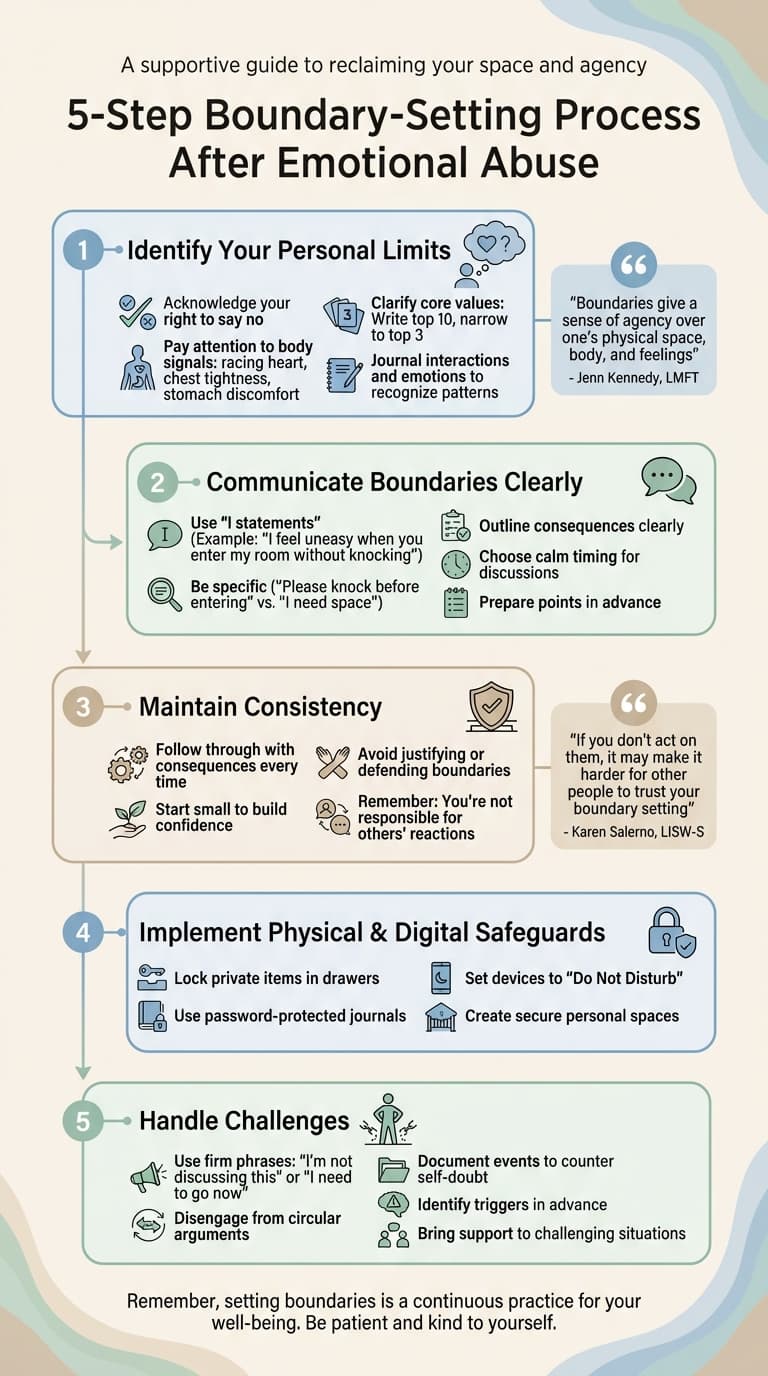
Setting boundaries after emotional abuse is a crucial step toward reclaiming your sense of self and ensuring your emotional well-being. It involves understanding your needs, communicating them clearly, and consistently upholding them. Each boundary you establish is a declaration of self-respect and a reinforcement of your right to safety and autonomy. Here’s how you can take these steps effectively.
Identify Your Personal Limits
Before you can set boundaries with others, it’s essential to determine where your own limits lie. Start by acknowledging your right to say no, to be treated with respect, and to prioritize your own needs. Reflecting on past experiences can help you redefine what you’re willing to accept moving forward.
Pay attention to your body’s signals - they often provide clues when a boundary is being crossed. Physical reactions like a racing heart, tightness in your chest, or a sinking feeling in your stomach can indicate discomfort. As Jenn Kennedy, a Licensed Marriage and Family Therapist, explains:
"Boundaries give a sense of agency over one's physical space, body, and feelings. We all have limits, and boundaries mark that limit." [4]
Another way to identify your boundaries is by clarifying your core values. Write down your top 10 values, then narrow them to the three that are most important to you. Notice how often these values are compromised in your daily life - this can reveal where your boundaries might need reinforcement. Keeping a journal of your interactions and emotions can also help you recognize patterns and trust your instincts, especially if your experiences have been invalidated in the past.
Communicate Your Boundaries Clearly
Once you’ve identified your limits, the next step is to express them in a clear and assertive manner. Using "I statements" can help you communicate your feelings and needs without assigning blame. For instance, instead of saying, "You never respect my privacy", you could say, "I feel uneasy when you enter my room without knocking because I need a space where I feel secure. I need you to knock and wait for my response before coming in."
Be specific when communicating your boundaries. Instead of saying, "I need space", try something more concrete like, "Please knock before entering my room", or "I need 30 minutes to myself after work before discussing household matters." It’s also important to outline the consequences of violating a boundary. For example, you might say, "If you continue to raise your voice, I will leave the room, and we can talk later when things are calmer."
Timing matters. Discuss your boundaries when both you and the other person are calm. Preparing your points in advance can help you stay focused and ensure your message is clear.
Maintain Your Boundaries When Challenged
Setting boundaries is one thing - enforcing them is another. Consistency is key. Follow through with the consequences you’ve outlined every time a boundary is crossed. If you don’t, others may begin to see your boundaries as flexible. Karen Salerno, MSSA, LISW-S at Cleveland Clinic, emphasizes:
"If you don't act on them, it may make it harder for other people to trust your boundary setting." [3]
For instance, if you’ve stated that you will leave the room when someone raises their voice, make sure to do so every time it happens. This consistency reinforces the idea that your boundaries are non-negotiable.
Avoid justifying or defending your boundaries - this can open the door to manipulation. Remember, you are not responsible for managing someone else’s emotional reactions. Start small if you need to; making minor boundary changes can help you build confidence for addressing larger issues later on.
You can also implement physical and digital safeguards to protect your space. Lock private items in a drawer, use password-protected journals, or set your devices to "Do Not Disturb" to create a sense of security.
How to Heal Emotionally and Rebuild Self-Worth
Healing from emotional wounds takes time, but it starts with one crucial step: acknowledging your trauma without blaming yourself. It's important to remind yourself that the abuse was never about your worth - it was about the abuser's need for control. Reclaiming your voice begins with rediscovering what brings you joy, whether that's indulging in hobbies or making simple, independent choices. Abuse often silences your true self, but recovery is about gradually taking back that autonomy. Start small - like choosing your favorite dessert at a restaurant - and work your way up to bigger decisions as your confidence grows. Alongside this, practical self-care can help rebuild emotional strength.
Self-Care Activities for Emotional Recovery
Self-care is a way to rebuild trust in yourself and your body. Physical activity can be particularly effective for releasing pent-up emotions. Whether it's kickboxing to channel anger, yoga to reconnect with your body, or running to clear your mind, movement can help process feelings that words sometimes can't.
Grounding techniques are another helpful tool, especially during moments of anxiety or flashbacks. The 5-4-3-2-1 method, for instance, encourages you to focus on your senses: name five things you see, four you can touch, three you hear, two you smell, and one you taste. Journaling is also a powerful practice - it not only helps you work through emotions but also serves as a factual record to counteract gaslighting when someone denies past events.
Practicing self-compassion is key. Challenge your inner critic with daily affirmations like "I am capable", "I am worthy", or "I love myself." Writing letters of encouragement to yourself can also nurture a kinder inner voice. Creative outlets, whether it's painting, music, or writing, offer a safe space to express emotions. And don't overlook the basics: prioritizing at least seven hours of sleep each night supports emotional healing. While self-care lays the groundwork, leaning on trusted people can further anchor your recovery.
Get Support from People You Trust
You don’t have to go through this alone. Abusers often isolate their victims, so reconnecting with supportive friends and family is a vital step. Be clear about what you need - whether it’s someone to simply listen or help with practical tasks like creating a safety plan.
Professional help can also be transformative. Therapists with expertise in emotional abuse and trauma can provide tools to untangle harmful patterns and foster healing. Techniques like Cognitive Behavioral Therapy (CBT) or Eye Movement Desensitization and Reprocessing (EMDR) can help reframe negative thoughts and reduce the emotional weight of traumatic memories. As Ashley Ertel, LCSW, BCD at Talkspace, explains:
"Recovery from emotional abuse frequently has many ups and downs. It can be painful to dig through past traumas, but the reward for coming out on the other side as a healthier individual is worth it!"
If therapy feels overwhelming or isn't an immediate option, the National Domestic Violence Hotline (1-800-799-SAFE) offers confidential, 24/7 support via phone, text, or chat. Advocates can assist with safety planning and connect you to local resources like shelters or legal services. For added privacy, consider clearing your browser history or using a secure device when researching support.
Use Gaslighting Check to Recognize Manipulation

Repeated gaslighting can make trusting your own perceptions feel nearly impossible. Gaslighting Check is a tool designed to help identify patterns of manipulation, such as denying events, minimizing emotions, or shifting blame. Using text and voice analysis, it provides detailed reports to clarify these behaviors.
Keeping a secure record of interactions can also validate your experiences. When someone claims, "That never happened", having documentation can reaffirm your memories. As Jillian Williams puts it:
"Confirming that your memories match with that record will help you trust yourself more."
Gaslighting Check also distinguishes healthy communication from manipulation by highlighting differences in phrasing. For example, it contrasts dismissive statements like "You're too sensitive" with empathetic ones like "I can see this really matters to you. Help me understand why." The platform offers a free plan for basic text analysis, while the Premium plan ($9.99/month) includes voice analysis, detailed reports, and secure data storage with end-to-end encryption and automatic deletion. Rebuilding trust in your own perceptions is a powerful step toward regaining the control that gaslighting once took from you.
Detect Manipulation in Conversations
Use AI-powered tools to analyze text and audio for gaslighting and manipulation patterns. Gain clarity, actionable insights, and support to navigate challenging relationships.
Start Analyzing NowCommon Challenges During Recovery
Recovery is rarely a straight path - it comes with setbacks that can test your progress. As you work on rebuilding your self-worth through clear boundaries and self-care, it’s important to anticipate and navigate these challenges. Two of the toughest hurdles to overcome are self-doubt and ongoing manipulation, both of which can stall your healing if left unchecked.
Handle Self-Doubt and Guilt
After enduring months or even years of being told you’re “too sensitive” or that things “never happened,” trusting your own instincts can feel impossible. Gaslighting chips away at your confidence, leaving behind a nagging voice that blames you for the abuse or convinces you that you’re overreacting.
The first step in tackling this is rejecting the blame. As Jillian Williams, LISW-S, puts it:
"It's not about you. It's about the abuser's need to control you. Remind yourself - over and over, if necessary - that it isn't your fault."
It’s crucial to separate their actions from your worth. When guilt surfaces, remind yourself that you were the target of their behavior, not the cause of it.
To combat self-doubt, document events as they happen. Keep a journal where you jot down conversations, dates, and even direct quotes. This “I said, they said” method can help you see patterns of distortion or manipulation more clearly. Over time, your journal becomes a powerful tool to counter self-doubt with hard evidence.
Another helpful practice is learning to distinguish between past trauma and present situations. For instance, if a coworker’s blunt comment stirs up feelings of shame, pause and ask yourself, “Am I reacting to what they said, or is this an old wound resurfacing?” This kind of self-awareness can stop you from internalizing the abuser’s false narratives about your worth. Grounding techniques, like the 5-4-3-2-1 method, can also help you stay anchored in the present.
While building resilience against inner doubts is essential, staying vigilant against ongoing manipulation is equally important for your recovery.
Protect Yourself from Ongoing Manipulation
If you’re still in contact with your abuser - whether due to co-parenting, work, or family ties - protecting the progress you’ve made becomes a priority. Manipulators often test your boundaries, provoke emotional reactions, or try to pull you back into old patterns, even as you work to heal.
One key tactic is recognizing when a conversation is a power struggle rather than a genuine dialogue. Healthy communication involves mutual listening and addressing concerns, but in manipulation, the abuser escalates anger to assert control while you may find yourself scrambling to appease them. As Chivonna Childs, PhD, explains:
"A fire cannot burn if there's no fuel. They can't fight if there's no one to fight with."
The best response? Don’t engage. Avoid arguing, explaining, or apologizing - this denies the abuser the reaction they’re looking for.
Instead, focus on how the interaction makes you feel. If it leaves you feeling attacked or unsettled, take it as a sign to disengage immediately. Remember, you can’t control how someone else perceives you, even if you’re right. Walking away from circular arguments is a powerful way to protect your emotional well-being.
Prepare simple, firm phrases like “I’m not discussing this” or “I need to go now.” When setting boundaries, be clear about consequences - such as, “If you raise your voice, I will leave the room” - and stick to them. Consistency is key; it reinforces that their tactics no longer work on you.
It’s also helpful to identify specific triggers that might pull you back into old dynamics. Whether it’s certain topics like money or family, or particular phrases or behaviors, knowing these in advance allows you to prepare emotionally or avoid those situations altogether. For example, if you need to attend a family event where the abuser will be present, consider bringing along a trusted friend or family member as an “emotional buffer” to support you or step in if needed.
These strategies help you maintain the healthy boundaries you’ve worked so hard to establish, keeping your recovery on track.
Conclusion: Move Forward with Your Recovery
Healing happens on your own terms. As Gregory L. Jantz, Ph.D., wisely puts it:
"Healing isn't a task you have to be perfect at, nor a race that only has one finish line" [5].
The boundaries and self-care strategies you've explored in this guide are more than just steps - they’re tools you can rely on throughout your recovery. These practices lay the groundwork for every step forward.
Standing firm in your boundaries - whether it’s walking away when voices are raised or refusing to engage with provocative comments - shows that you’re prioritizing your well-being [2]. Revisit your journal to remind yourself of your growth, and stay attuned to your body’s signals when your limits are being tested [7].
Recovery is a process, and as you build on your boundaries and self-care routines, you’ll keep moving through its phases. The final stage, often called "Maintenance", requires ongoing dedication [8]. This means carving out time for yourself, celebrating small victories, and viewing setbacks as opportunities to learn [1][6][9]. At the heart of it all is the relationship you cultivate with yourself - it’s the one that matters most.
Reclaiming your voice, trusting your instincts, and safeguarding your peace are powerful ways to rebuild your foundation. Stay connected to your support system, use the resources available to you, and remember that walking away from toxic behavior is a choice that strengthens your recovery [1]. You’re not just surviving - you’re actively shaping a healthier, more fulfilling future.
FAQs
How can I clearly communicate my boundaries after experiencing emotional abuse?
To communicate your boundaries effectively after experiencing emotional abuse, begin by determining what makes you feel safe and supported. This could involve steering clear of certain conversation topics, carving out personal space, or setting clear expectations in your relationships.
Once you've identified your needs, approach the conversation with honesty and respect. Clearly articulate your boundaries in a calm yet assertive tone so that others understand what you require. For instance, you might say, "I need to avoid discussions about [specific topic] because it impacts my well-being."
Focus on one boundary at a time and rehearse how you'll express it. Staying consistent is crucial - reiterating your boundaries not only helps others respect them but also plays a vital role in your healing journey.
What are some effective self-care practices for emotional healing after abuse?
Recovering from emotional abuse starts with prioritizing self-care that helps rebuild your confidence, supports healing, and restores a sense of safety. Activities like setting clear boundaries, journaling to work through your emotions, and practicing mindfulness techniques can help reduce stress while boosting self-awareness.
Spending time on hobbies or activities that bring you happiness and a sense of achievement can also play a key role in rediscovering your identity. Leaning on trusted friends, family, or professionals for support is equally important during this process. Healing doesn’t happen overnight - give yourself grace, be patient, and treat yourself with kindness as you navigate this journey.
How can I protect myself from emotional manipulation and start healing?
Protecting yourself from emotional manipulation starts with establishing clear boundaries to prioritize your mental and emotional health. Pinpoint specific behaviors that you find unacceptable, and communicate your limits firmly and consistently. This not only helps you feel more secure but also minimizes opportunities for manipulation to take hold.
It's also important to recognize common manipulation tactics like gaslighting, guilt-tripping, or the silent treatment. Staying aware and grounded in your own reality can make it easier to resist these behaviors. Practices such as mindfulness or keeping a journal can be excellent tools to strengthen your sense of self and maintain clarity.
If you're feeling overwhelmed, reaching out to a therapist or a support organization can provide valuable assistance. Professional guidance can help you build stronger boundaries, process your emotions, and navigate the path toward healing in a safe and understanding environment.