AI Sentiment Analysis for Hate Speech Prevention

AI Sentiment Analysis for Hate Speech Prevention
Hate speech is a growing problem online, with 80% of young people in Europe encountering it and 40% feeling personally attacked. Its effects can be devastating, from psychological harm to real-world violence. AI is stepping in to address this issue by using advanced tools to detect and mitigate harmful content.
Key insights:
- AI systems analyze text, images, and audio to detect hate speech with up to 98.53% accuracy.
- Techniques include Natural Language Processing (NLP), machine learning models, and multimodal frameworks.
- Challenges include sarcasm, language ambiguity, and evasion tactics like misspellings or memes.
- New tools integrate emotional analysis in real time, transparency, and real-time moderation for better results.
AI isn't perfect yet, but ongoing improvements are helping create safer online spaces while balancing free expression.
How generative AI could detect online hate | Nishant Vishwamitra | TEDxSanAntonioSalon
How AI Sentiment Analysis Detects Hate Speech
::: @figure
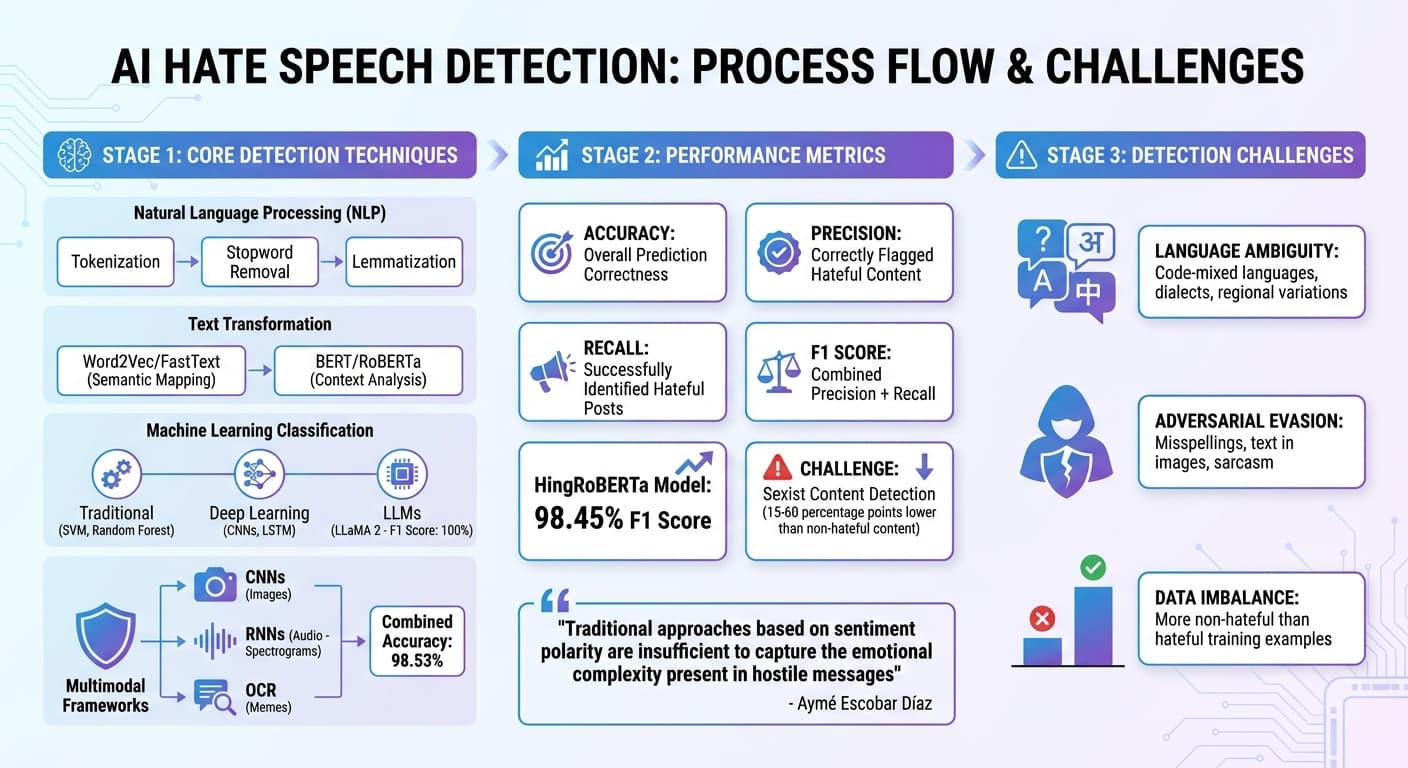
AI systems use a mix of advanced techniques to identify hate speech. By examining these methods, we can better understand both the capabilities of modern detection systems and the hurdles they still face. Here's a closer look at the core techniques, performance metrics, and challenges.
Core Detection Techniques
The process begins with Natural Language Processing (NLP), which prepares raw text for analysis. This involves steps like tokenization (breaking text into smaller units), removing stopwords (common words like "the" or "and"), and lemmatization (reducing words to their base forms) [4][5]. Once the text is cleaned, AI transforms words into numerical representations. Tools like Word2Vec and FastText map semantic relationships, while more advanced embeddings like BERT and RoBERTa analyze context, which is critical for understanding subtle nuances [4][1].
For classification, machine learning models take the lead. Traditional models such as Support Vector Machines (SVM) and Random Forest are often used [4][5]. However, to detect more intricate patterns, deep learning architectures are employed. For example, Convolutional Neural Networks (CNNs) identify local text patterns, while Long Short-Term Memory (LSTM) networks handle dependencies in longer posts [1][4]. Large Language Models (LLMs), like LLaMA 2, have even achieved an F1 score of 100% in detecting emotional tones in hate speech [4].
Modern detection systems don't stop at text. Multimodal frameworks integrate various data types. For instance, CNNs analyze images, RNNs process audio by converting recordings into spectrograms to detect hostile tones, and Optical Character Recognition (OCR) extracts text from memes. These combined approaches have pushed detection accuracies as high as 98.53% [1]. Together, these techniques allow AI to address hate speech across diverse formats.
Measuring Detection Performance
To gauge how well these systems work, specific metrics are used. Accuracy measures the overall correctness of predictions, while precision focuses on how many flagged items are genuinely hateful. Recall evaluates how many hateful posts the system successfully identifies, and the F1 score combines precision and recall into a single metric. For instance, the HingRoBERTa model achieved an impressive F1 score of 98.45% when detecting emotional tones in hate speech [4]. However, results can vary: identifying sexist comments often leads to F1 scores that are 15 to 60 percentage points lower than those for detecting non-hateful content [3].
Common Detection Challenges
Despite these advancements, AI systems face notable challenges. One major issue is language ambiguity. As researcher Aymé Escobar Díaz explains:
Traditional approaches based on sentiment polarity are insufficient to capture the emotional complexity present in hostile messages [4].
AI struggles with code-mixed languages (e.g., posts combining Hindi and English), minority dialects, and regional variations in offensive terms [4][1].
Another challenge is adversarial evasion. Hate speech creators often find ways to bypass filters by misspelling words, embedding text in images, or using sarcasm [1]. Additionally, data imbalance - where training datasets contain far more non-hateful examples than hateful ones - makes it harder for AI to accurately detect certain types of hate speech [4][3].
These challenges highlight the ongoing need for refinement in AI systems to better address the ever-evolving landscape of online hate speech.
Recent Progress in AI Hate Speech Detection
AI systems have made strides in detecting nuanced emotions, incorporating diverse data types, and offering clearer explanations for their decisions. These advancements pave the way for more refined methods that can pick up on subtle emotional cues.
Sentiment-Based Detection Methods
Modern AI tools now focus on analyzing specific emotions - like anger, fear, disgust, and sadness - rather than just labeling content as positive or negative. This detailed approach is critical for identifying implicit hate speech, where hostility may be hidden or ambiguous. By combining sentiment polarity with emotional analysis, these systems are better equipped to detect hate speech across different datasets [3].
Fine-tuned transformer models have been particularly successful, achieving near-perfect scores. These models are trained on datasets that merge sentiment analysis with hate speech labels, allowing them to use detailed emotional data to identify hostile intent more effectively than single-task models [3]. Impressively, this approach has also been applied to low-resource languages. For example, fine-tuned XLM-RoBERTa models set a new benchmark for Albanian with an F1 score of 86% [7].
Combined Text, Audio, and Visual Analysis
Detection accuracy improves significantly when AI systems integrate text, audio, and visual data. The Multi-modal Hate Speech Detection Framework (MHSDF) reached 98.53% accuracy by combining cues from text, images, and audio [8]. These hybrid architectures use convolutional neural networks (CNNs) to capture spatial features in images and text, while long short-term memory (LSTM) networks process temporal patterns in audio and video sequences [1].
In September 2024, researchers at Northeastern University introduced "Safe Guard" for VRChat. This system combines OpenAI’s Whisper for speech-to-text conversion, GPT-3.5 for analyzing text, and a CNN classifier to examine audio tone and pitch. Operating in real time, Safe Guard works in both conversational mode for individual users and observational mode for groups, detecting verbal hate speech as it happens [9]. Similarly, Roblox implemented a safety system that pairs a proprietary text filter with a CNN model trained on audio features, achieving 94.48% precision in categorizing verbal hate speech into types like racism or bullying [9]. Research also highlights that a speaker's emotional state plays a key role in how hate speech is identified [9].
Transparent AI Models
As detection systems evolve, transparency has become a priority. New frameworks like TARGE use Large Language Models to generate clear "rationales" explaining why specific content was flagged [10]. After applying refinement techniques, TARGE achieved a 94.85% overlap between AI-generated rationales and human-annotated explanations [10]. The MHSDF model also reported an interpretability ratio of 97.71% [1].
These transparent systems often use attention mechanisms to pinpoint the exact triggers for detection - whether it's a word in a meme or a tone in a video [1]. As highlighted in PeerJ Computer Science [10]:
Algorithmic transparency is not merely beneficial but essential... classification errors can paradoxically reinforce discriminatory patterns against the very demographics these systems aim to protect.
This push toward explainable AI ensures that human moderators can quickly understand decisions, reducing review times and improving accountability in automated content moderation systems.
Other Uses for AI Sentiment Analysis
AI sentiment analysis has applications far beyond detecting hate speech. These tools also address other harmful communication patterns, from emotional manipulation to creating safer online spaces. By analyzing emotional cues, AI not only identifies problematic behavior but also supports healthier digital interactions.
Identifying Emotional Manipulation
AI-powered sentiment analysis can uncover manipulation tactics by recognizing emotional manipulation in chats. Researchers have identified "prime vulnerability moments" - short periods when individuals are more susceptible to manipulation - and AI systems are adept at spotting these moments. By combining data from facial expressions, voice tones, and text (a method called multi-modal fusion), these systems achieve an impressive 94% accuracy in detecting emotions [13][15].
One example is Gaslighting Check, a service that uses real-time text and voice analysis to flag manipulative behaviors. For $9.99/month, users receive detailed reports highlighting emotional patterns across conversations. A free basic text analysis plan is also available. This tool provides users with tangible insights, helping them recognize and address manipulation in their interactions.
In customer service settings, AI tools like Balto analyze voice and text in real time to detect rising frustration or aggression. These systems offer empathy-based prompts to agents, helping de-escalate tense situations and prevent conflicts [11][12]. On a broader scale, tracking emotional trends over time can help individuals identify moments when their autonomy is being challenged [13][14]. This dual capability - exposing manipulation and supporting emotional awareness - empowers both individuals and organizations to foster healthier communication dynamics.
Building Safer Online Spaces
AI sentiment analysis plays a key role in creating safer online environments by going beyond simple content filtering. Instead of relying on binary classifications like "good" or "bad", modern systems use continuous scales to measure emotional intensity across six distinct intervals. This nuanced approach allows platforms to differentiate between genuine threats and harmless interactions [6].
For example, research published by MDPI highlights how emotion analysis can detect implicit hostility by focusing on specific emotions like anger, fear, or sadness, rather than just categorizing content as positive or negative [4]. This deeper emotional understanding enables platforms to identify indirect hostility that traditional filters might overlook. It’s especially beneficial for protecting speakers of minority languages and dialects, who are often underserved by basic moderation systems.
The Path Forward for AI in Hate Speech Prevention
AI sentiment analysis has made strides in identifying hate speech and emotional manipulation, but there’s still room for improvement - especially when it comes to analyzing text, images, audio, and video together. Right now, many systems struggle to catch hate speech embedded in memes or sarcastic videos, which often require a combination of visual and audio cues to understand fully [1][16].
One of the toughest challenges? Context. As Neurocomputing points out:
Deciding if a portion of text contains hate speech is not simple, even for human beings [5].
Future AI models need to go beyond surface-level keyword detection. They must learn to distinguish between slurs used in harmful attacks versus educational discussions. Additionally, detecting subtleties like irony, sarcasm, and implied biases will require more sophisticated reasoning capabilities [2][5].
Another promising shift is moving away from simple yes/no classifications of hate speech to using nuanced scales. For instance, advanced models like GPT-4 have shown better alignment with human judgment by using six-point intensity scales [6]. While these technical advancements are encouraging, they also highlight the growing need for ethical oversight.
Ethical considerations must evolve alongside detection technologies to ensure trust and accountability. One way to achieve this is through Explainable AI (XAI), which makes AI decisions more transparent. Researcher Aymé Escobar Díaz emphasizes this point:
XAI gained relevance by providing transparency in the models' decisions and strengthening their reliability in sensitive contexts [4].
Regular audits that examine potential demographic biases are another critical step to ensure fairness and accuracy [2].
These advancements don’t just stop at hate speech. They’re also being applied to combat emotional manipulation. For example, tools like Gaslighting Check use real-time text and voice analysis to identify manipulative patterns in personal conversations, offering detailed reports for $9.99/month. As AI continues to develop, improvements in detection accuracy, transparency, and ethical use can help create safer online environments, all while balancing free expression and protecting vulnerable communities.
FAQs
How does AI detect sarcasm and ambiguity in hate speech?
AI has made strides in understanding sarcasm and ambiguity in hate speech by focusing on context rather than just scanning for specific keywords. Models like BERT, which are based on transformer technology, are particularly skilled at spotting patterns such as irony, sentiment shifts, and subtle humor that might disguise hateful intent. By analyzing the broader conversational context, these models can interpret meaning more effectively.
One exciting development is the rise of multimodal AI systems. These systems combine text analysis with visual or auditory elements - like emojis or tone of voice - to make more precise judgments. They’re able to differentiate between sarcastic or ambiguous phrasing and actual hate speech by interpreting conflicting signals. While these advancements are promising, researchers are still working to refine detection methods for more complex and nuanced scenarios.
How does emotional analysis help in detecting hate speech?
Detecting hate speech often hinges on understanding the emotions behind online interactions. By analyzing negative emotions such as anger, fear, or sadness, detection models can pick up on subtle or ambiguous cases of harmful content that might slip through traditional filters.
This focus on emotional cues improves the accuracy and responsiveness of these models, making them better equipped to identify harmful content and contribute to creating safer spaces online.
How does AI ensure ethical and transparent hate speech detection?
AI enhances the ethical and transparent detection of hate speech through the use of models that are designed to be explainable, mindful of biases, and subject to regular audits. These systems work to reduce errors - such as flagging innocent remarks or missing subtle forms of hate - by aligning closely with human judgment and offering nuanced, context-aware evaluations instead of oversimplified binary decisions.
To ensure fairness and accountability, several safeguards are in place. These include openly sharing model details, using transparent training data sources, and involving human reviewers for cases that fall into gray areas. Regular audits, comprehensive documentation, and tools like model cards further reinforce these efforts. Additionally, input from diverse groups helps ensure that detection methods balance the protection of free speech with sensitivity to cultural differences. These combined measures foster trust and transparency in AI-powered moderation systems.