
AI for Gaslighting Recovery: Key Features
Gaslighting is a subtle but harmful form of manipulation that can leave victims doubting their reality. AI tools like Gaslighting Check are stepping in to help by analyzing conversations, identifying manipulation patterns, and offering real-time alerts. These tools process texts, emails, and even voice recordings to flag tactics like blame-shifting and emotional invalidation. With privacy measures like end-to-end encryption and local data processing, they ensure user security while providing actionable insights for recovery.
Key Features:
- Real-Time Detection: Flags manipulative phrases and patterns during live interactions.
- Voice & Text Analysis: Evaluates tone, pitch, and speech patterns for subtle manipulation.
- Privacy-Focused: End-to-end encryption, local processing, and data deletion options.
- Affordable Plans: Free basic features; $9.99/month for advanced tools.
- Therapy Support: Generates reports to share with therapists for validation and recovery planning.
AI tools like Gaslighting Check are not replacements for therapy but act as a support system to help users recognize manipulation and regain confidence.
You Can Use AI To Help Clear The Gaslighting
1. Gaslighting Check

Gaslighting Check provides practical tools for identifying and addressing emotional manipulation through precise conversation analysis and a secure, user-first approach.
Conversation Analysis Features
Gaslighting Check uses AI to analyze both text and voice, identifying tactics like blame-shifting, reality distortion, and emotional invalidation. It can evaluate text messages and audio recordings, flagging manipulative phrases as they occur. For Premium users, the platform takes it a step further with voice analysis, examining tone, pitch, and speech patterns to uncover subtler forms of manipulation. By tracking conversation history, the tool highlights patterns over time, showing users how manipulation can escalate or repeat in their interactions. These detection tools are complemented by strong privacy and accessibility measures.
Privacy and Security
Protecting user data is a top priority for Gaslighting Check. The platform uses end-to-end encryption to safeguard conversations during analysis and storage. Data processing happens locally on your device, reducing exposure risks. Sensitive information is automatically deleted after analysis unless you choose to save it, and any stored data is anonymized to prevent it from being traced back to you. Users retain full control over their records, with options to view, edit, or delete them at any time. Additionally, Gaslighting Check follows a strict no-commercialization policy, ensuring that your data is never sold or shared with third parties.
Affordability and Accessibility
Gaslighting Check strikes a balance between privacy and affordability, making it accessible to a wide range of users.
The free plan includes basic text analysis, offering immediate support. For $9.99/month, the Premium plan unlocks advanced features like voice analysis, conversation tracking, and detailed reports. The platform is accessible via a responsive web interface that works across devices without requiring downloads or technical expertise. A dedicated mobile app is also set to launch in Q4 2025, further expanding usability.
Effectiveness in Recovery Support
Beyond detection, Gaslighting Check is designed to support users in their recovery journey by offering evidence-based insights and practical tools.
Dr. Stephanie A. Sarkis highlights the importance of this approach:
"Identifying gaslighting patterns is crucial for recovery. When you can recognize manipulation tactics in real-time, you regain your power and can begin to trust your own experiences again." [1]
The platform's detailed reports provide objective documentation that users can share with therapists or counselors, helping validate their experiences. It also offers guidance on drafting neutral, factual responses - commonly known as the "Grey Rock" method - to reduce emotional engagement with manipulators. For additional support, users can join a moderated Discord community with 24/7 peer support groups, creating a space for connection and shared understanding.
2. Other AI Gaslighting Recovery Tools
Several AI platforms contribute to mental health recovery, though they aren’t specifically designed to detect gaslighting. While these tools can help with emotional support and conversation analysis, they lack the precision of specialized tools tailored to identify gaslighting behaviors.
General AI platforms, like ChatGPT, provide broad emotional support and text-based conversation analysis. However, a 2025 study by Fang et al. raised concerns about these tools' overly agreeable conversational models. Such models may unintentionally mirror user views, potentially deepening self-doubt for vulnerable individuals. Experts suggest that survivors of gaslighting benefit more from specialized tools, as general platforms lack features like real-time alerts for manipulation.
Mental health-focused platforms like Ellipsis Health and Woebot take different approaches. Ellipsis Health uses vocal biomarkers alongside text to assess mental health conditions like depression and anxiety, integrating these insights into clinical evaluations. Woebot, on the other hand, offers 24/7 emotional support through empathetic chatbot interactions. Despite their benefits, neither platform is equipped to detect gaslighting vs manipulation tactics or provide the real-time alerts necessary to identify gaslighting patterns.
Privacy strategies also differ across platforms. Some apps prioritize encrypted cloud processing, while others focus on secure local storage or even use disguised interfaces to protect users. Certain platforms emphasize secure evidence storage but may not directly assist with recovery from manipulation.
The need for specialized tools becomes even clearer when considering data: 74% of gaslighting victims experience long-term emotional trauma [1]. This statistic highlights the importance of tools designed specifically to detect manipulation patterns in real time. Unlike general mental health platforms, these tools can address subtle tactics like blame-shifting, reality distortion, and emotional invalidation, offering survivors a more targeted and effective form of support.
Detect Manipulation in Conversations
Use AI-powered tools to analyze text and audio for gaslighting and manipulation patterns. Gain clarity, actionable insights, and support to navigate challenging relationships.
Start Analyzing NowPros and Cons
::: @figure
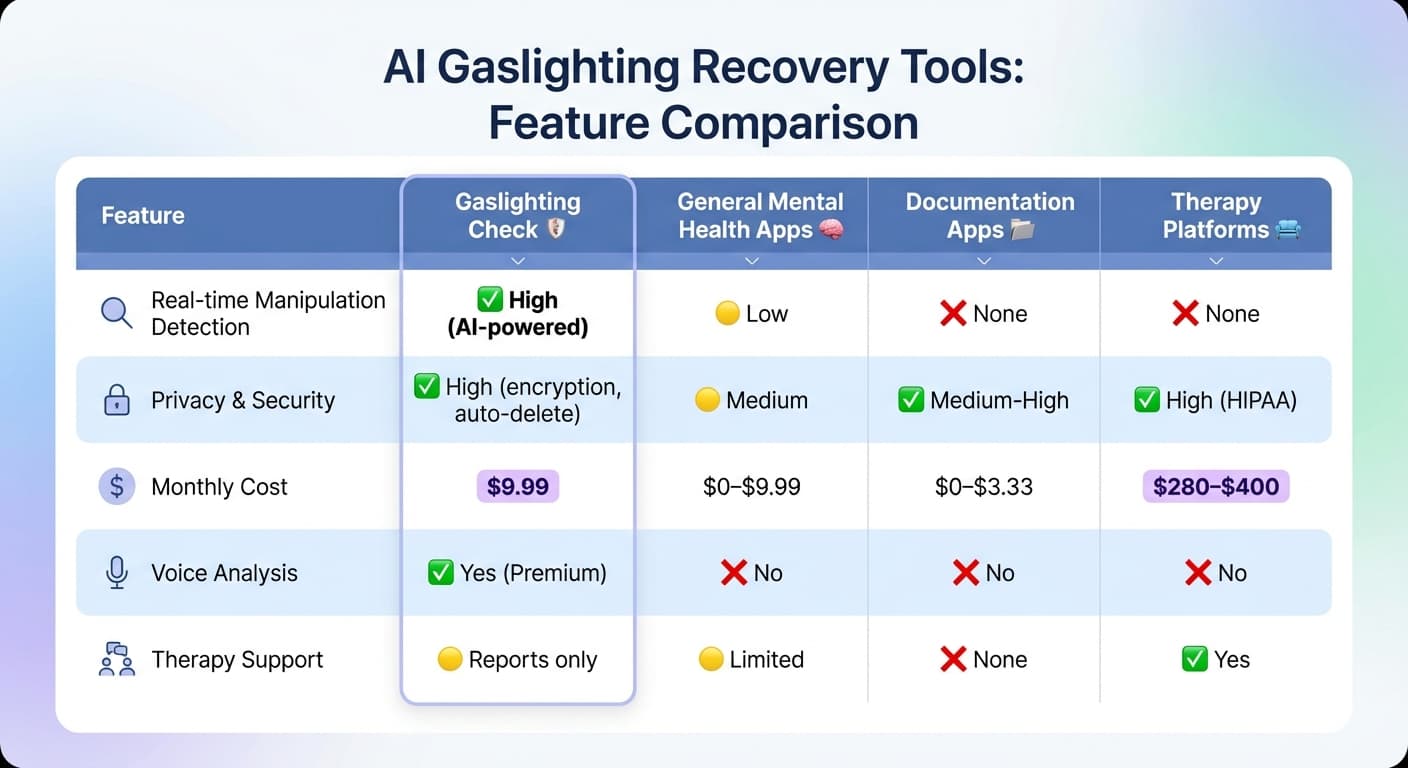
Let’s break down the strengths and weaknesses of these AI tools, building on the earlier feature analysis.
Specialized tools like Gaslighting Check shine when it comes to real-time detection. This app uses AI to analyze text and voice interactions, focusing specifically on identifying manipulation tactics. On top of that, it prioritizes user privacy with end-to-end encryption and automatic data deletion. It's a focused tool for immediate detection while keeping your information secure.
However, while AI tools can provide instant emotional validation, they’re no replacement for professional therapy. General platforms, such as ChatGPT, often rely on conversational designs that may feel overly agreeable. This can sometimes amplify self-doubt when the AI mirrors your words without offering deeper insights or perspectives [2].
| Feature | Gaslighting Check | General Mental Health Apps | Documentation Apps | Therapy Platforms |
|---|---|---|---|---|
| Real-time Manipulation Detection | High (AI-powered) | Low | None | None |
| Privacy & Security | High (encryption, auto-delete) | Medium | Medium-High | High (HIPAA) |
| Monthly Cost | $9.99 | $0–$9.99 | $0–$3.33 | $280–$400 |
| Voice Analysis | Yes (Premium) | No | No | No |
| Therapy Support | Reports only | Limited | None | Yes |
Other tools, like documentation apps (e.g., DocuSAFE), excel at securely storing evidence for legal purposes but don’t analyze conversations or detect manipulation patterns. Therapy platforms, such as BetterHelp, provide access to professional therapists, typically costing $70–$100 per week. However, these platforms lack the ability to deliver real-time analysis during conversations, which can be crucial for immediate validation.
One major drawback of AI tools is their narrow focus. For example, while Gaslighting Check is excellent at identifying manipulation, it doesn’t address broader mental health challenges like depression or anxiety. This limitation highlights the importance of using these tools as part of a larger support system rather than relying on them exclusively.
Conclusion
AI tools bring distinct advantages to support systems, and platforms like Gaslighting Check stand out for their ability to detect manipulation patterns in real time.
That said, it's crucial to recognize the boundaries of what AI can do in the context of gaslighting recovery. These tools aren't meant to replace human expertise. As the Talkspace Editorial Board points out, "These tools aren't designed to replace qualified therapists, but to enhance their ability to keep delivering high-quality care" [5]. Therapists bring a level of empathy and understanding through elaboration and self-disclosure that AI simply can't replicate. This is especially important given that 74% of gaslighting victims report experiencing long-term emotional trauma [1]. The human element remains essential for addressing the deep emotional impact of gaslighting.
Privacy is another key consideration when using AI tools. Gaslighting Check addresses this with features like end-to-end encryption and automatic data deletion. However, users should always confirm the security measures in place before sharing any sensitive information.
Ultimately, AI tools are most effective when paired with professional therapy. While they can offer objective insights and immediate validation, they aren't equipped to handle urgent mental health crises or suicidal thoughts [3][4]. Their strength lies in supporting professional care, not replacing it.
FAQs
How does Gaslighting Check protect my privacy and keep my data secure?
Gaslighting Check prioritizes your privacy and the security of your information. To protect your data from unauthorized access, all details are encrypted. The platform also enforces strict automatic deletion policies, ensuring your data is removed after a predetermined period. This approach keeps your sensitive conversations private and secure at all times.
What types of manipulation can Gaslighting Check identify in conversations?
Gaslighting Check is built to spot some of the most common manipulation tactics that can crop up in conversations. These include:
- Reality distortion: Twisting or outright denying facts to confuse or mislead.
- Blame shifting: Pushing responsibility onto someone else unfairly.
- Emotional invalidation: Dismissing or undermining someone’s feelings or experiences.
- Truth denial: Rejecting or contradicting clear evidence.
By highlighting these behaviors, Gaslighting Check empowers users to recognize and navigate emotional manipulation more effectively in their interactions.
How does Gaslighting Check support therapy and recovery from gaslighting?
Gaslighting Check plays a crucial role in therapy and recovery by delivering in-depth, objective reports that break down conversations to uncover emotional manipulation tactics like denial, blame-shifting, and invalidation. These reports provide clarity, helping individuals recognize harmful patterns and validate their feelings - something that can be incredibly challenging to do on their own.
Beyond identifying manipulation, the reports also pinpoint recurring behaviors and emotional triggers. This added clarity can help individuals rebuild their self-trust and confidence. For therapists, this data offers valuable insights into relationship dynamics, enabling them to design personalized interventions and monitor progress more effectively. This makes the recovery journey not only more targeted but also empowering for those affected.